
Last updated Jun 12, 2025
Getting Found in the Age of AI Search
AI-powered search is new and exciting, but also full of challenges for traditional SEO-focused marketers.
Driving organic visibility in AI search engines is the new imperative, requiring fresh thinking, approaches, and sometimes more AI-centric tools in key areas.
This post introduces AI search visibility concepts, insights, tips, and tools for success in this brave new world.
Let’s plow forward…

This post contains a few referral links to select vendor partners. We may receive compensation for purchases made via these links, at no additional cost to buyers.
AI Search Visibility — Introduction
SEO and the Shift to AI Visibility
As website owners and digital marketers, the ground is shifting beneath our feet. For decades, Search Engine Optimization (SEO) has been a cornerstone of digital marketing. A predictable, if sometimes arcane, discipline focused on climbing the ranks of Google’s search results.
We tracked keywords, built backlinks, and optimized title tags, all in pursuit of that coveted #1 spot on Google and other search engines. But the game has changed. The SEO era of the organic ‘ten blue links’ is fading fast, replaced by a dynamic, conversational, and AI-powered search landscape.
Welcome to the new imperative in the evolution of SEO: AI Search Visibility.
This isn’t about just another routine Google algorithm update. This is a fundamental reimagining of how users find information online. Google’s AI Overviews, conversational search engines like Perplexity, and the increasing prevalence of zero-click searches are forcing us to rethink everything we thought we knew about SEO.
Traditional rank tracking is becoming a relic of a bygone era, and a new set of rules is emerging for how to stay visible in this new world.
This post will be your guide to navigating this new terrain, understanding the forces at play, and equipping you with the strategies and tools you need to not just survive, but thrive in the age of AI search.
AI Search & The Crumbling SEO Castle
Why Traditional SEO Metrics Are Faltering
For years, rank tracking has been the go-to metric for measuring SEO success. We’ve obsessed over daily fluctuations in our keyword rankings, celebrating every upward tick and panicking at every downward slide.
But the castle we’ve built our SEO strategies on is crumbling, and the very idea of a static, universal search engine results page (SERP) is becoming a fantasy.

The Illusion of the Static SERP
For any given keyword/keyphrase (user query) entered into a search engine today, the SERP you see today is not the same SERP your potential customer sees.
AI-powered search can be hyper-personalized, taking into account a user’s location, search history, device, and a myriad of other signals to deliver a customized set of results.
This makes traditional rank tracking, which typically uses a generic, non-personalized search query to determine a website’s position, an increasingly unreliable measure of true search visibility. A #3 ranking in a vacuum means little if you’re not also appearing in the personalized, AI-generated answers served to your actual target audience.
The Rise of Zero-Click Searches
Even more profound is the rise of ‘zero-click’ search sessions. AI Overviews, featured snippets, knowledge panels, and other SERP features are designed to answer a user’s query directly on the results page, eliminating the need to click through to a website.
While this is great for the search user, it’s a potential nightmare for businesses that rely on organic traffic. Recent studies have shown that over half of all Google searches now result in zero clicks, and that number is only expected to grow as AI becomes more integrated into the search experience.
Your content can be wildly successful in terms of visibility — powering a direct answer in an AI Overview, for example — without ever registering a single click to your source website or blog.
The Black Box of AI
Adding another layer of complexity is the ‘black box’ nature of the AI itself. While we have a general understanding of the factors that influence AI-powered search, the inner workings of these complex algorithms are largely opaque.
This makes it impossible to ‘game the system’ in the same way we could with traditional SEO. The focus must shift from chasing algorithm updates to creating genuinely valuable and authoritative content that the AI will recognize as a trusted source.
The Evolution of SEO Measurement — Beyond Rank Tracking
This doesn’t mean SEO measurement is dead; it means it’s evolving. The smartest SEO tool providers understand this and are rapidly shifting their focus from simple rank tracking to more sophisticated ‘AI Visibility’ metrics.
While your position in the blue links still holds some value, the new frontier of measurement includes AI Overview tracking, Share of Voice (SOV) in AI conversations, prompt-level performance tracking, and deep citation analysis.
- AI Overview Tracking — Are you being cited in Google’s AI Overviews? Tools are emerging that specifically monitor when your domain is included as a source in these summaries. (See more on these tools below.)
- Share of Voice (SOV) — This metric moves beyond a single ranking to measure your brand’s overall presence within a set of relevant search queries or AI-driven conversations, comparing your visibility to that of your competitors.
- Prompt-Level Performance — Specialized tools now allow you to track how your brand performs for specific conversational prompts across different AI models (like ChatGPT, Gemini, and Perplexity), revealing not just if you appear, but how you are being portrayed.
- Citation Analysis — Understanding which of your URLs are being referenced by AI gives you invaluable insight into what content formats and structures the models prefer.
A Look at the Evolving SEO Toolkit
The marketplace for these new metrics is divided between established players adapting their platforms and new specialists built specifically for this challenge.
Legacy platforms like Semrush, Mangools, and SE Ranking are adding these features, while a new breed of specialized tools like Profound, Otterly, and Peec AI are being built from the ground up to tackle the unique challenges of Generative Engine Optimization (GEO).
See the ‘tools’ section below for more details.
Related: See my AI SEO Glossary for dozens of terms relevant to this emerging area of SEO.
The New Gatekeepers of AI-Powered Search Visibility
Understanding AI-Powered Search
If traditional SEO was about speaking the language of search engines, AI Search Optimization is about having a conversation with them.
The new gatekeepers of online visibility are the AI models that power modern search, and understanding what they’re looking for is the key to success in this new era.
From Keywords to Conversations
The shift from keywords to conversations is perhaps the most significant change in the search landscape. Users are increasingly interacting with search engines in a more natural, conversational way, asking complex questions and expecting nuanced answers.
This means that our content needs to be structured not just around individual keywords, but around broader topics and user intents.
The AI’s Diet — What Generative Engines Crave
So, what kind of content do these new AI gatekeepers prefer? They crave information that is:
- Structured and Clear — AI models love well-structured content with clear headings, subheadings, lists, and tables. This makes it easier for them to parse and understand the information.
- Concise and to the Point — In a world of information overload, clarity and conciseness are key. AI is more likely to surface content that gets straight to the point and answers the user’s query directly.
- Authoritative and Trustworthy — AI models are trained on vast amounts of data, and they are constantly learning to identify authoritative and trustworthy sources. This is where the concept of E-E-A-T comes in.

E-E-A-T on Steroids — The New Gold Standard
E-E-A-T (Experience, Expertise, Authoritativeness, and Trustworthiness) has long been a factor in SEO, but in the age of AI, it’s more important than ever. With the proliferation of AI-generated content, search engines are placing an even greater emphasis on content that is created by real people with real expertise.
This means that demonstrating your experience, showcasing your expertise, building your authority, and earning the trust of your audience are no longer just ‘nice-to-haves’ — they are essential for AI search visibility.
The AI Search Visibility Playbook
Tips for Staying Ahead in AI SEO
The old SEO playbook is outdated. It’s time for a new one that’s designed for the age of AI. Welcome to the world of Generative Engine Optimization (GEO).
Generative Engine Optimization (GEO) — The New SEO
GEO is an emerging discipline that focuses on optimizing content for AI-powered search engines. It’s not about tricking the AI, but about making your content as easy as possible for it to find, understand, and trust.
Here are the key pillars of a successful GEO strategy:
Content Strategy for the AI Era
Create ‘Better Than AI’ Content — In a world awash with AI-generated content, the key to standing out is to create content that only a human can. This includes:
- Unique perspectives and original research — Go beyond simply regurgitating what’s already out there. Conduct your own research, share your own unique insights, and offer a fresh perspective on well-worn topics.
- In-depth analysis and case studies — Provide real-world examples and in-depth analysis that demonstrate your expertise and provide genuine value to your audience.
- Personal stories and anecdotes — Connect with your audience on a human level by sharing your own experiences and stories.
- ‘Snippet-Worthy’ Formatting — Make your content easy for both humans and AI to digest by:
- Using clear and descriptive headings (H1, H2, H3): This helps to break up your content and make it more scannable.
- Employing lists and bullet points: This is a great way to present information in a clear and concise way.
- Creating FAQ sections: Answering common questions directly can make your content more likely to be featured in AI Overviews and other SERP features.
Leverage the Power of Multimedia — Don’t forget the power of images, videos, and other multimedia content. Not only do they make your content more engaging for humans, but they also provide another opportunity to be discovered by AI.
Technical SEO for AI
- Schema Markup on Everything — Schema markup is a type of code that you can add to your website to help search engines understand the context of your content. In the age of AI, it’s more important than ever to use schema markup to provide as much context as possible to the AI crawlers.
- Site Speed and Mobile-First — A fast and mobile-friendly website is no longer a luxury, it’s a necessity. AI-powered search engines prioritize websites that provide a good user experience, and that starts with a fast and responsive design.
Building Brand Authority
- The Currency of Trust — In a world of misinformation, trust is the new currency. Build trust with your audience by being transparent, honest, and authentic. Remember that the core of Google’s E-E-A-T is Trust.
- Harnessing User-Generated Content — User-generated content, such as reviews, testimonials, and social media mentions, is a powerful signal of trust and authority. Encourage your customers to share their experiences and make it easy for them to do so.
The Rebirth of the Backlink — From ‘Link Juice’ to Verifiable Trust
For those wondering if backlinks are dead, the answer is a resounding no. In fact, they may be more important than ever, but their role has fundamentally changed.
In an age where anyone can generate 10,000 words of ‘expert’ AI content in minutes, hard-to-fake signals of external trust are paramount. A backlink is no longer just ‘link juice’ to be gained and hoarded; it’s a verifiable, third-party endorsement that your content is authoritative and trustworthy.
High-quality links from relevant, reputable sources are one of the clearest signals to an AI model that your content isn’t just another piece of the AI-generated noise, but a resource that real humans trust.
The focus must shift entirely from quantity to quality. One editorially-given link from a respected industry publication is now worth more than a hundred low-quality directory links.
Related: Learn more about backlinks vs internal links, plus more on ranking without backlinks (yes, it’s possible!).
AI Search Visibility — Supporting Tools
A Look at the Evolving SEO > GEO Toolkit
The marketplace for new metrics, analysis, and reporting of AI search visibility is divided between established players adapting their traditional SEO platforms and new ‘GEO-native’ specialists built specifically for this challenge.
Here are several examples, starting with the popular free webmaster toolkits from Google and Microsoft (Bing).
Google Search Console (GSC) — Adapting for AI Search

Google Search Console’s evolution will be crucial as AI Overviews become more dominant. We can expect to see a new section in the search console ‘Performance’ report, likely called ‘AI Overviews‘ or something similar, with a new set of metrics.
Here are some likely AI-related moves for GSC:
- Impressions vs. Citations — ‘Impressions’ will be redefined. Instead of just meaning your website/blog page appeared in organic search results, it will mean your content was cited or used to generate an AI Overview. This is a critical distinction.
- Clicks on Citations — The report will likely still track clicks, but specifically for links that appear within the AI-generated answer.
- Citation Rate (instead of CTR) — A new key metric could emerge, showing the percentage of times your content was cited when it appeared in the underlying search results used by the AI.
- Query/Prompt Analysis — The ‘Queries’ tab would be enhanced to show the conversational prompts and questions that trigger citations for your content, moving beyond traditional keywords and keyphrases.
- Content-Specific Insights — You’ll be able to see exactly which of your pages are being used as sources most often, helping you identify your most ‘AI-friendly’ content.
The evolution of GSC to provide robust AI search-related performance and visibility metrics will likely take some time. It’s not there yet as of June 2025, at least.
Bing Webmaster Tools (BWT) — Steady AI Advancements

Bing has been a trailblazer with its integration of Copilot (formerly Bing Chat), so they have a head start. Their tools will likely get even more granular.
- Expanded ‘Copilot’ Reporting —They will probably build out their existing reporting to provide more direct insights into how content performs within its AI chat features.
- Attribution & Sentiment — Expect to see metrics not just on if you were mentioned, but how. This could include sentiment analysis (was the mention positive, neutral, or negative?) and tracking of direct traffic from links within Copilot answers.
- Content Submission for AI — Bing has already been more open with indexing tools like IndexNow. It’s plausible they could create a more direct pipeline for webmasters to submit ‘trusted content’ for the AI to learn from, with performance tracked directly in BWT.
In essence, both Google Search Console and Bing Webmaster Tools will have to shift their focus from measuring clicks and position to measuring influence and attribution. The core value of these tools will be to give creators direct insight into how their content is being seen, interpreted, and used by the AI models that are becoming the new front door to the internet.
A main advantage of GSC and BWT is that they will each have the deepest possible datasets for their respective AI-powered search environments. GSC knows all about Google search (but only Google). BWT knows all about Bing-related search (but only Bing).
A disadvantage is that they only report on their own data for websites that you own and manage (e.g., verified ownership with GSC and/or BWT). GSC will only provide Google AI search insights for your website(s), and not for any specific SEO/GEO competitors.
Similarly, BWT will (most likely) only report on Bing/Copilot AI search data for your connected site(s), and not for competitors.
Pro Tip: BWT currently does, however, let you compare your backlink profile against a small number of competitive domains. That’s a nice advantage over GSC.
Mangools — Popular SEO Toolkit With AI Search Grader

Known for its user-friendly interface and affordable pricing, Mangools has introduced a free ‘AI Search Grader’. This tool provides a quick analysis of a brand’s visibility and average ranking across multiple AI models (like ChatGPT, Gemini, and Claude), offering a proprietary ‘AI Search Score’ as a simple benchmark.
SE Ranking — Adding AI Overview Tracking

A popular all-in-one SEO platform, SE Ranking has rolled out a dedicated ‘AI Overviews Tracker’. It monitors your presence in Google’s AI-generated snippets, analyzes which sources are being featured, and helps you understand the search intent behind the queries that trigger these AI answers.
Semrush — Multiple Tools for AI Search Visibility

A long-time SEO/SEM industry leader, Semrush has integrated ‘ChatGPT Search Position Tracking’ into its core toolkit. Available in the mid-level paid plan and above, this allows users to track their domain’s visibility and position within ChatGPT’s answers for specific keywords, providing a ‘Visibility Score’ to gauge overall presence in the AI model.
This new position-tracking feature from Semrush does have its limitations but is a good start for monitoring AI search visibility in ChatGPT. Learn more in this Semrush Knowledge Base article.
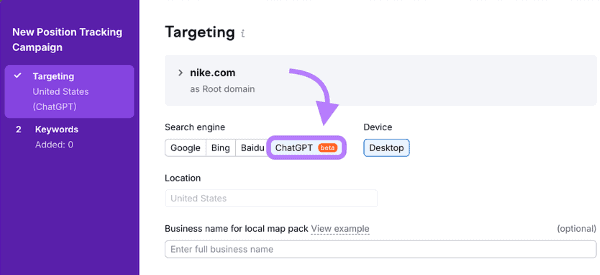
Additionally, the Semrush ‘AI Optimization (AIO) platform’ is their enterprise-grade solution, which is much more comprehensive than the ChatGPT Search tracking feature.

Semrush ChatGPT Search Tracking vs Enterprise AIO — Main Differences
ChatGPT Search Position Tracking (Standard Toolkit) — This is essentially an evolution of traditional rank tracking. It’s a tactical tool that lets you monitor your domain’s visibility for a specific set of keywords within a single AI model (ChatGPT). It is still very keyword-driven, much like traditional rank tracking.
AI Optimization or AIO (Enterprise Platform) — This is a strategic brand intelligence platform. It’s designed to give large businesses a holistic view of their brand’s presence, perception, and reputation across the broader AI ecosystem (ChatGPT, Perplexity, Gemini, etc.).
The AIO platform goes much deeper, helping Semrush enterprise clients to:
- Gain Visibility at Scale — Track and benchmark brand mentions across all major AI models, not just one.
- Maintain Brand Control — Monitor AI responses for inaccuracies, inconsistencies, or negative sentiment, allowing them to proactively shape the brand narrative.
- Turn Insights into Growth — Use deep analytics to understand what questions customers are asking AI, identify competitive gaps, and refine their overall digital strategy based on how they are being portrayed.
In short, the standard Semrush tool tells you if you’re visible, while the enterprise AIO platform tells you how you’re visible and helps you manage that perception strategically. It’s a great example of the market maturing to offer both tactical tracking and high-level brand management solutions for this new AI-driven world.
Profound — GEO-Native Platform for Answer Engine Insights

Built for enterprise-level needs, Profound focuses on providing ‘Answer Engine Insights’. It tracks brand mention frequency, analyzes the context and sentiment of those mentions in AI responses, and identifies which source URLs are being cited, giving a deep view into how a brand is perceived by AI.
Otterly AI — Tracking Brand & Website Visibility in AI Search

Even otters love SEO and AI search (apparently)!
Available through the Semrush App Center, Otterly is a specialized tool that monitors brand visibility, sentiment, and link citations across Google AI Overviews, ChatGPT, and Perplexity. It automates the tracking of brand mentions and prompt performance, providing weekly reports on AI presence.
Peec AI — AI Search Analytics with Competitive Insights

Peec AI provides a robust analytics suite for tracking performance across multiple LLMs. It delivers metrics on brand visibility, position scoring, and sentiment analysis, while also providing powerful competitor benchmarking to see who is winning the conversation on specific topics within AI search.
Like this post? Quickly share it with your social networks here.
AI Search Visibility & SEO Evolution — Closing Thoughts
The Future is Fluid — What to Expect and How to Prepare
The only constant in the world of search is change. The AI revolution is still in its early days, and we can expect to see even more significant changes in the years to come.
The future of search is likely to be even more personalized, more conversational, and more integrated into our daily lives.
The End of SEO? Or a New Beginning?
So, is this the end of SEO? Far from it. This is a new beginning. SEO is evolving from a technical discipline focused on gaming algorithms to a more holistic, user-centric discipline focused on creating genuinely valuable and authoritative content.
The Human Element
In a world increasingly shaped by AI, it’s easy to forget the importance of the human element. But the truth is, human creativity, empathy, and strategic thinking are more valuable than ever. The businesses that will succeed in the age of AI are the ones that can combine the power of technology with the irreplaceable value of human ingenuity.
What’s your next move? The time to act is now. Audit your current SEO strategy, start implementing the new rules of AI search visibility, and embrace the future of search. The road ahead may be uncertain, but for those who are willing to adapt and innovate, the opportunities are endless.
Questions or Comments?
I hope this discussion of SEO and the AI-powered ‘GEO’ evolution has been helpful! I’ll wrap up with a few related questions for you:
- How much is artificial intelligence impacting your SEO and other digital marketing efforts today? Where do you see the biggest impacts?
- Are you using any AI search visibility tools today? What is (or is not) working well for you so far?
- Are your existing SEO tools evolving fast enough to meet your AI needs or expectations? Why or why not?
Feel free to add more in the comments below with any thoughts, feedback, or related questions. Thanks also for any social shares on this post!
