
Last updated Jan 23, 2025
Website Visitor ID and GDPR Compliance
Are B2B website visitor tracking software tools GDPR compliant?
This is a common question and concern for B2B firms interested in using these tools for website-based lead generation in Europe.
Learn more below about software vendors and GDPR compliance for B2B website visitor identification and tracking tools.

This post contains a few referral links to select vendor partners. We may receive compensation for purchases made via these links, at no additional cost to potential buyers.
GDPR-Compliant Website Visitor Identification
What Is Anonymous Website Visitor Identification?
In the context of your B2B (business-to-business) website, anonymous website visitor identification is the process of discovering which companies and organizations are visiting your site.
It is commonly based on mapping IP addresses of your website visitors to specific end-user organizations, when possible. Vendors may also employ other proprietary methods when doing this IP-to-company mapping.
For one example, see how the Leadfeeder Tracker works, and also how Leadfeeder can help identify corporate visitors working remotely (e.g., work-from-home or ‘WFH’ company employees who visit your website).
Good to Know: The terms ‘website visitor identification’ and ‘website visitor tracking’ are often used somewhat interchangeably in the context of this topic. Learn more in this post about website visitor tracking vs identification for B2B and B2C marketers.
Once a visiting organization is discovered, it is then possible to identify potential prospect contacts at that organization. This is often done with the help of specialized B2B lead generation software tools and databases.
The goal is to generate timely, high-quality leads for B2B sales and marketing teams, based on incoming website traffic. These solutions can also enable B2B data enrichment for Google Analytics and other martech tools.
Website visitor tracking tools are also important in account-based marketing (ABM) operations. Learn more here about ABM and B2B website visitor tracking.
What Is GDPR?
GDPR stands for General Data Protection Regulation. It is a set of rules that went into initial effect in May 2018, impacting how organizations worldwide need to manage and use personal information (e.g., contact details) about citizens of European countries.
See the Wikipedia definition of GDPR here.
GDPR is relevant to anonymous website visitor identification because B2B sales and marketing teams need to be sure their tools and processes are compliant with GDPR for marketing to EU-based citizens.
EU regulators can and do levy substantial fines against companies that violate GDPR.
GDPR-Compliant Lead Generation
B2B firms selling to European customer prospects need to be GDPR-compliant in their sales and marketing campaigns. GDPR compliance is essential for B2B lead generation in Europe.
Outside of B2B, GDPR is also especially relevant for marketers interested in B2C website visitor identification and tracking — where the focus is on EU-based consumers, not businesses.
In this post, I take a look at how GDPR impacts B2B software tools for identifying website visitors, with a few specific examples of vendor GDPR compliance communications.
Related: Learn more about global data privacy regulations and marketing implications.
B2B Firms and Website Visitor Identification
Turning Company Websites into B2B Lead Generators
Tracking anonymous B2B website visitors is very useful for B2B firms that want to fully leverage their corporate websites for lead generation purposes.
As we all know from our personal experiences as online researchers and buyers, website visitors typically come and go without ever leaving contact details — such as making inquiries, registering for newsletters, or filling out website forms for premium content.
That’s just life in the real world of B2B marketing.
And that’s where these B2B website lead generation tools come into play. They help turn websites into more proactive and productive lead-generating machines.
Role of B2B Website Lead Generation Tools
Recognizing this need in the overall B2B marketplace, software vendors have built tools that help identify anonymous website visitors. Their purpose is to help B2B companies generate more sales leads directly from the stream of companies and people visiting corporate websites.
Core Software Features
These software products perform lead generation functions that are designed with proactive sales teams in mind.
Features typically include:
- Mapping your website visitor IP addresses to organizations and geographic locations.
- Providing company firmographic data (industry sectors, annual revenues, main social profiles, etc.)
- ISP suppression to ensure a high percentage of ‘valid’ buying organizations get identified for sales consideration, not just various internet service providers who provide the visitors’ IP connections.
- Providing company contact lookups to help identify potential people for targeted sales outreach (emails, phone calls, etc.)
- Lead scoring, account filtering, real-time alerts, and other features important for timely and accurate sales follow-up
- B2B ‘sales intelligence’ capabilities, including insights based on B2B buyer intent signals and first-party intent data
- Platform integrations with CRMs, marketing automation platforms, etc.
- ABM support, including (in some cases) supporting account-based advertising via IP-targeted ads, etc.
- Augmenting and enriching Google Analytics data with company-level visitor data
- Other proprietary value-added features
I’ve covered this category of lead generation software in much more detail in this post about B2B website visitor tracking software tools.
Also, in these posts about B2B IP tracking with Google Analytics and other vendor solutions, and identifying website visitors in Google Analytics.
Several vendors provide these tools today, and virtually all of them offer a free software trial period ranging from one week to a month. The most common trial duration advertised is two weeks.
Want to stay updated on my website visitor tracking content? Add your email details below for periodic updates straight from me (David).
Your email info is safe here. We don’t sell, rent, or share your details with outside parties. You can easily unsubscribe at any time.
Website Visitor ID Vendors & GDPR Compliance
Promoting GDPR Compliance
B2B software vendors with target audiences in Europe have worked hard to comply with GDPR. This applies to their marketing efforts as well as the capabilities provided by their products and services.
B2B lead generation software vendors do not want GDPR issues to be a barrier to user adoption of their tools. They need to address these possible concerns and objections in a clear and straightforward way.
They also want to avoid the possibility of heavy fines, of course. Not to mention the negative PR and media attention that may stem from being shamed as a GDPR violator.
GDPR and Anonymous Website Visitor Tracking Tools
The good news is that all of the mainstream products in this software segment are GDPR-compliant.
For the most part, these solutions have a strong argument in favor of GDPR support.
Identifying Companies, Not People
Most of these tools do not identify individual website visitors at a personal level. Instead, they typically use IP address and location information, and sometimes proprietary methods and databases, to identify companies that have visited your website.
They then use a variety of contact databases and other resources (LinkedIn, etc.) to associate specific people who may be good targets for B2B sales outreach based on the website visitor session data.
This is how you know ‘who is visiting your website’ — as typically advertised for these software tools.
Pro Tip: Some vendors may charge extra for contact-level (people) details, once the visiting company is positively identified. These contacts may or may not be the actual persons who visited your site, but they are a starting point for further prospecting and outreach.
So, at the company level of visitor identification, these software vendors comply with GDPR. B2B companies can feel confident that they will also be GDPR-compliant while using these products.
Important Note: Some vendors in the website visitor tracking software segment are now claiming the ability to track website visitors at an individual level — not just at the company level. Be aware of this distinction when looking for strictly GDPR-compliant B2B website lead generation tools.
Related: Learn more here about website visitor tracking tools and identifying companies vs individuals. Also, see Visual Visitor as a US-based vendor providing options for both layers of website visitor ID.
GDPR Compliance and Prospect Outreach
GDPR adherence seems a little trickier on the outbound prospecting side of website visitor discovery and follow-up.
These tools provide potential good contacts and prospects based on information known about the visiting company and location.
Personalized 1:1 sales outreach via introductory phone calls and emails is fine, of course.
However, simply adding company contact email addresses to outbound marketing campaigns without explicit user permission (opt-in) would be a GDPR violation unless a convincing ‘legitimate interest’ claim can be made.
If in doubt in this area, elevate the issue to your executive team and legal counsel for guidance. At a bare minimum, you may need to update your website’s privacy policy regarding GDPR and data privacy issues.
B2B Web Visitor ID & GDPR Compliance — Vendor Examples
European B2B Software Vendors Lead the Way
I have collected a few examples below of how leading companies in this software segment are communicating the GDPR aspects of their website visitor tracking products.
Since GDPR is about data privacy for European citizens, it makes sense that the software vendors based in the EU have led the way in terms of proactive GDPR compliance.
I found this to be true when doing my initial research for this post. The website visitor tracking vendors based in Europe and the UK tended to have the most visible statements about complying with GDPR rules.
US-based and other non-EU software vendors also want to market their solutions within Europe, of course. So, they also offer reassurances about their GDPR status concerning anonymous website visitors.
GDPR Compliance Examples
See the examples below for how various companies in this software segment are communicating their GDPR efforts and compliance.
Leadfeeder
Based in Helsinki, Finland, Leadfeeder does a great job with its GDPR statement.
Good to Know: Leadfeeder has merged with Germany-based Echobot to produce a new B2B sales intelligence platform called Dealfront. It is very EU-focused and has strong GDPR-compliance as a major value proposition. See the Dealfront highlights box below.


Dealfront: EU-Native B2B Go-To-Market Platform
Dealfront is a ‘revenue engine’ for B2B sales and marketing teams, especially those with European / EU account targets.
Dealfront combines the strengths of Echobot and Leadfeeder into a full-cycle, AI-assisted platform for B2B revenue growth.
Pros:
Boosts revenue and sales/marketing efficiency
Integrates multiple sales intelligence tools and data for B2B revenue teams
Supports affordable Account-Based Marketing (ABM) programs
Provides strong GDPR/regulatory compliance for EU markets
Cons:
May be pricey for smaller B2B’s with limited account targets
Lacks some features of enterprise-scale ABM platforms
Learn more here about Leadfeeder and Dealfront’s data sources and regulatory compliance.
Lead Forensics
Based in the UK, Lead Forensics is one of the world’s leaders in the area of website visitor identification solutions.
Lead Forensics’ GDPR compliance was announced in an early 2018 blog post, well in advance of the actual GDPR deadline in May of that year.
Learn about Lead Forensics GDPR compliance here.
See the Lead Forensics Data Compliance page here.

Visitor Queue
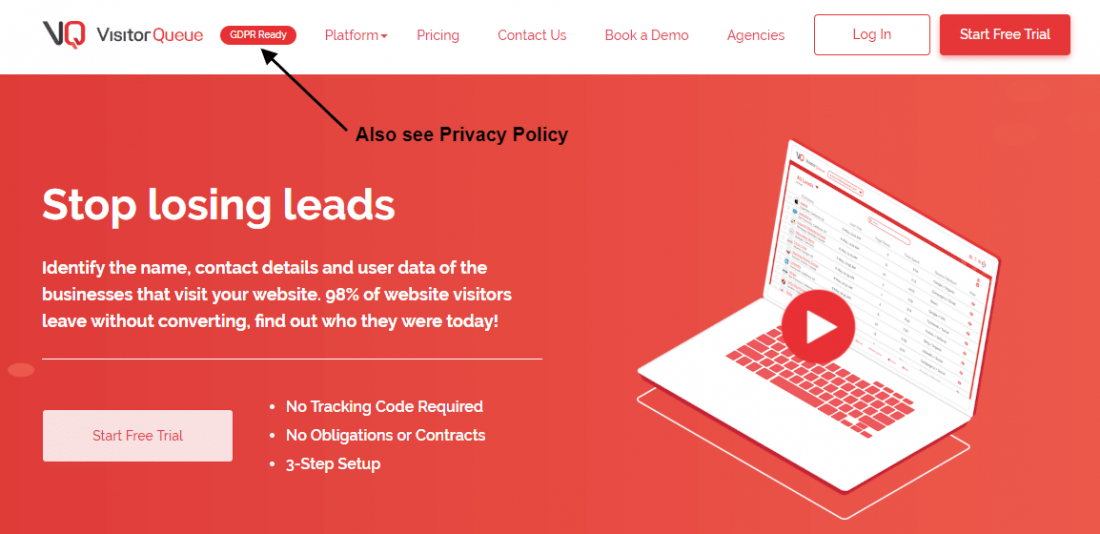
A Canadian firm based in Ontario, Visitor Queue initially posted a ‘GDPR Ready’ graphic on their website header, next to their logo.
Other B2B Website Visitor Tracking Vendors
There are over 40 vendors globally providing tools to help identify anonymous B2B website visitors. Those included above are just a small sampling to show how vendors in this space are helping B2B companies with GDPR-compliant lead generation.
Related: For more vendor options, see these posts on B2B website visitor ID and tracking tools, including anonymous website visitor tracking tools based in North America and several website visitor tracking solutions based in the UK and Europe.
Like this post? Quickly share it with your social networks here.
Anonymous Website Visitors & GDPR — Closing Thoughts
B2B Website Visitor Identification is Usually GDPR Compliant
Fortunately, GDPR is not a major concern for users of most website visitor tracking tools since these solutions focus primarily on company-level identification.
The follow-on marketing to the companies identified can be a bit trickier since GDPR rules demand that EU-targeted marketing campaigns be based on opt-in email addresses.
Software vendors in this space need to continue educating and reassuring their customers and prospects about GDPR. Most do this via GDPR-specific content on their websites.
On the flip side, vendors of website visitor tracking tools that identify actual people (not just companies) need to be clear about how and where their solutions comply with various data privacy regulations. Some of these may be US-only solutions for specific use cases.
Clear and Prominent GDPR Statements Work Best
Product FAQs, dedicated pages and blog posts, support documents, company privacy policies, and even website home page GDPR notifications are some of the primary methods used by vendors to indicate their GDPR compliance.
It’s best to research and reach out directly to any vendor you may be interested in regarding their GDPR status and how you can ensure your B2B company’s GDPR compliance when using these tools.
Questions or Comments?
I hope this brief introduction to GDPR and website visitor tracking has been helpful. I’ll wrap up with a few closing questions for you:
- Have you used or evaluated B2B website visitor tracking solutions specifically for EU-based audiences? How did GDPR compliance factor into your solution choices?
- How has your direct outreach to sales prospects in the EU region changed since GDPR took effect?
- Are you satisfied with the level of GDPR compliance in your complete martech stack for European marketing and sales efforts?
Feel free to add more in the comments below with any thoughts, feedback, or related questions. Thanks also for any social shares on this post via the buttons below!
