
Last updated Feb 13, 2026
Account-Based Marketing & Regional Insights
Account-Based Marketing (ABM) is a popular B2B growth strategy with important regional distinctions.
ABM tactics that work well in one region of the world may be very ineffective in others.
This post looks closer at B2B ABM around the world, including insights, tips, and tools for specific regions.
Let’s dive deeper below!
This post contains a few referral links to select vendor partners. We may receive compensation for purchases made via these links, at no additional cost to buyers.
Introduction — ABM & Global Trends
The Global Shift to Precision in Account-Based Marketing
In the early 2020s, Account-Based Marketing (ABM) was often viewed as a “North American specialty” – a high-tech experiment reserved for Silicon Valley SaaS giants with massive budgets and complex tech stacks.
Fast forward to 2026, and the landscape has fundamentally shifted. ABM is no longer a regional trend; it is a global mandate.
Recent data from Grand View Research (2025) indicates that the global ABM market is projected to reach $3.8 billion by 2030, growing at a steady compound annual growth rate (CAGR) of 17.9%.
This expansion isn’t just happening in traditional tech hubs. According to Huble Digital, 76% of B2B companies globally now report having an active ABM program, signaling a universal move away from “spray and pray” lead generation toward the surgical precision of account-based strategies.
The thesis for this global shift is clear: while the core principles of quality over quantity are universal, the execution is deeply dictated by regional nuances.
Whether it is the rigid privacy frameworks of the European Union or the relationship-heavy business cultures of Latin America and the Middle East, winning in 2026 requires a “Think Global, Execute Local” mindset.
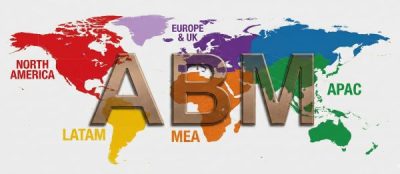
ABM Regional Highlights
Regional ABM: Comparison Snapshot
Understanding where your region stands on the ABM maturity curve is the first step in optimizing your strategy. The adoption “heatmap” reveals a world moving at different speeds, driven by varying degrees of digital literacy and regulatory pressure.
| Region | ABM Maturity Level | Primary ABM Style | Key Growth Driver | Major Roadblock |
|---|---|---|---|---|
| North America | Mature | Programmatic (1:Many) | AI/Automation Efficiency | Buyer Saturation |
| Europe | Scaling | Strategic (1:1) | Privacy-First Data | GDPR Compliance |
| APAC | High Growth | Hybrid (1:Few) | Tech Sector Expansion | Data Fragmentation |
| LATAM & MEA | Emerging | Relationship-Based | Social Selling (WhatsApp) | Martech Literacy |
As shown above, North America remains the global leader in maturity, largely due to its early adoption of programmatic ABM and predictive analytics. However, this maturity has led to significant “buyer saturation,” where prospects are increasingly weary of automated outreach, forcing a pivot toward hyper-personalization.
Conversely, Europe has carved out a unique path defined by the “Privacy Wall.” Marketers here have turned the constraints of GDPR into a competitive advantage, focusing on deep, 1:1 strategic ABM fueled by first-party intent data rather than third-party scraping.
In the APAC region, ABM growth is explosive – surpassing a 14% CAGR – but is often hampered by the sheer fragmentation of data across dozens of localized platforms and languages.
Understanding these differences isn’t just an academic exercise; it’s the difference between a campaign that resonates and one that is immediately filtered into the spam folder.
Related: Learn key B2B terms in my glossary of ABM terminology. Also, see this Account-Based Marketing FAQ for other ABM insights.
ABM & Regional Maturity Levels
The ABM Adoption Heatmap: Leaders & Laggards
When we examine the global adoption of ABM, we see a clear “maturity gap” that is rapidly closing as regions learn from one another.
North America: The Mature Incumbent
North America continues to hold the largest market share, with over 32% of global ABM revenue generated here. Because the ecosystem is so mature, the focus has shifted from “How do we do ABM?” to “How do we scale it?”
This has led to a heavy reliance on Programmatic ABM, where AI-driven predictive analytics (like those from 6sense or Demandbase) identify high-fit accounts at scale.
However, this high volume has created a “laggard” effect in terms of response rates; buyers are more skeptical of automation than ever before.
Europe: The Strategic Challenger
Europe, led by the UK and followed closely by the DACH (Germany, Austria, Switzerland) and Nordic regions, is currently in a high-scaling phase. Unlike their North American counterparts, European marketers often prioritize Strategic 1:1 ABM.
According to recent benchmarks, 82% of European B2B marketers report measurable success from ABM, but they achieve this through depth rather than breadth. They are leaders in “Privacy-First” marketing, having perfected the art of engagement without over-stepping regulatory lines.
APAC: The High-Velocity Engine
According to Mordor Intelligence, the APAC region is witnessing the fastest growth globally, with a projected CAGR of 14%. Countries like India, Australia, and Singapore are leading the charge, but China is the true wild card, seeing triple-digit growth in local account-targeting platforms.
APAC marketers are often “hybrid” practitioners, using 1:Few ABM models to bridge the gap between massive market opportunities and limited localized data.
LATAM & MEA: The Emerging Frontiers
These regions are currently the “laggards” in terms of pure martech adoption, but they are leaders in Relationship-Based ABM. In Brazil and the Middle East, business is deeply personal.
Here, ABM doesn’t happen through display ads as much as it happens through “Social Selling” – leveraging platforms like WhatsApp and LinkedIn to build long-term executive trust before a formal pitch is ever made.
ABM & Regional Industry Segments
ABM Industry Leaders by Region
ABM adoption isn’t just about where you are; it’s about what you sell. Certain industries have natural “account-based” DNA due to high contract values and complex buying committees.
- North America: High-Tech & SaaS. This is the cradle of ABM. SaaS firms lead with 25%+ of all ABM investment. Following closely are Fintech and Healthcare, where security and compliance require targeted, high-trust messaging.
- Europe: Manufacturing (Industry 4.0). Europe’s industrial backbone has embraced ABM to sell complex, multi-million Euro machinery and IoT solutions. Professional Services (consulting and legal) also lead here, using ABM to penetrate global 2000 accounts.
- APAC: IT Services & Logistics. As the “office of the world,” APAC’s massive IT services sector uses ABM to retain and expand global contracts. Smart Manufacturing in China and Southeast Asia is also a rapidly emerging leader.
- LATAM: Fintech & Telecom. The rapid digitalization of South American economies has made Fintech a prime candidate for ABM, specifically targeting large retail and government entities for infrastructure projects.
ABM & Regional Cultural Issues
Regional “ABM Nuances” & Cultural Variations
If you treat a German procurement officer like a California startup founder, your ABM program will fail. Understanding the “vibe” of a region is as important as the tech stack.
Europe: The Privacy Wall
In the EU, GDPR isn’t a hurdle; it’s the foundation. The nuance here is transparency. European buyers expect to know why they are being targeted. Furthermore, language is a massive differentiator.
Data suggests that in France and Germany, engagement rates are 40% higher when the entire ABM funnel – from the first ad to the final whitepaper – is localized into the native language. “English-only” is often perceived as a lack of commitment to the market.

APAC: The Fragmented Giant
The cultural concept of “Saving Face” is critical in APAC. Content must be educational and consensus-building rather than aggressive or disruptive. The platform nuance is also extreme; while LinkedIn dominates Australia and India, you cannot win in China without a WeChat strategy, or in Japan without considering LINE.
North America: The Efficiency Trap
The nuance in North America is too much noise. Because of the “Efficiency Trap,” where marketers over-rely on automated sequences, the “82% Rule” has emerged: according to studies by the RAIN Group, 82% of buyers will accept meetings with sellers who proactively reach out with relevant, brand-aligned insights.
In NA, the nuance is speed-to-value; if you aren’t providing value in the first 5 seconds of an interaction, you are invisible.
ABM Adoption Hurdles
Primary Regional ABM Adoption Roadblocks
Global expansion doesn’t come without friction. While the tools have become more accessible, the human and regulatory hurdles remain significant.
Global: The Alignment Gap
Across every region, 43% of practitioners still cite B2B Sales and Marketing alignment as their #1 roadblock. Without a shared definition of a “target account” and a unified hand-off process, even the most expensive ABM tech stack becomes a “siloed expense.”
Europe: The ROI & Compliance Duel
In Europe, 47% of marketers struggle to prove ABM ROI. This is compounded by data compliance; person-level targeting is restricted in several jurisdictions, making it difficult to track a single individual’s journey through the funnel.
APAC/LATAM: Data & Talent Scarcity
These regions suffer from a lack of high-quality, localized intent data. Many US-based data providers have thin coverage in Southeast Asia or South America. Additionally, there is a global shortage of ABM-specific talent – professionals who understand both the art of creative strategy and the science of data orchestration.
The Universal Scale Problem
For 40% of organizations, the primary challenge is scaling content. It is relatively easy to create a bespoke experience for 5 accounts; doing it for 500 requires a level of automation and modular content design that most teams haven’t yet mastered.
SMB ABM & Enterprise ABM
The Segment Divide: SMB vs. Enterprise ABM
One of the most common mistakes in global ABM is applying an Enterprise playbook to an SMB market (or vice-versa). In 2026, the distinction between these two segments has never been sharper.
SMB ABM is characterized by high velocity. The goal is to move a “buying pair” (usually 1-2 people) from awareness to closed-won in under 90 days.
The strategy relies on Dynamic Personalization – for example, using AI to swap out case studies and headlines based on the visitor’s industry or current pain points.
Enterprise ABM is a long-game of orchestration. You aren’t selling to a person; you are selling to a “buying committee” of 6-10 stakeholders. The cycle is 6-18 months, and the focus is on Account-Based Experience (ABX) – ensuring every touchpoint, from an executive dinner to a technical whitepaper, feels like a single, cohesive narrative.
ABM Segment Strategy Comparison Table
| Feature | SMB ABM | Enterprise ABM |
|---|---|---|
| Core Goal | Speed & High Velocity | Trust & Strategic Partnership |
| Sales Cycle | 30–90 Days | 6–18 Months |
| Personalization | Scalable (Dynamic Content) | Deep (Custom/Hand-crafted) |
| Main Channel | Social Selling & Email | Executive Events & Multi-channel |
| CAC Target | $1k–$5k | $50k–$100k |
ABM Tactics & Toolkits: Segment Breakdown
To succeed in either segment, your toolkit must match your tactics.
SMB ABM Tactics & Tools
- High-Volume Tiering: Grouping accounts by “clusters” (e.g., “Fintechs in Singapore using AWS”) and delivering semi-custom content.
- Product-Led Growth (PLG) Signals: Using product usage data (e.g., “Company X just hit their seat limit”) as the primary trigger for ABM outreach.
- The Toolkit: HubSpot for all-in-one orchestration, Leadfeeder for identifying anonymous website visitors, and Cognism for lean, accurate contact data.
Enterprise ABM Tactics & Tools
- Buying Committee Orchestration: Using contact-level advertising to “surround” the C-suite with specific value propositions before the first sales call.
- The “Lumpy Mail” Strategy: Sending high-value physical gifts (integrated via Reachdesk) to key stakeholders to secure the “Initial Meeting.”
- The Toolkit: 6sense or Demandbase for predictive AI and intent signals, Influ2 for person-based advertising, and Reachdesk for physical gifting at scale.
Related: Learn more in this post about the costs of ABM platforms and tools.
ABM & Regional Platforms/Tools
The ABM Tech Stack: More Preferred Tools & Platforms
In 2026, the “Global ABM Tech Stack” has standardized to some degree, but regional favorites persist due to data sovereignty and compliance.
The Global Standard: 6sense and Demandbase
These ABM leaders remain the heavyweights for predictive AI and intent data. Salesforce and HubSpot also serve as core CRMs for over 80% of global ABM programs.
The European Specialist: Dealfront
Dealfront – which also incorporates Leadfeeder – has become the gold standard for DACH (Germany, Austria, Switzerland) and wider EMEA. Its native compliance with GDPR and its deep “local” firmographic data often outperform global providers in these specific markets.
The Data Pure-Play: Cognism
Cognism is widely preferred across Europe and APAC for its “Diamond-verified” mobile numbers and compliance-first contact data.
The Gifting Layer: Reachdesk and Sendoso
These two are primary choices for physical orchestration. Reachdesk, in particular, has seen massive growth in the UK and Australia due to its localized warehouse and “marketplace” model that bypasses expensive cross-border shipping.

Dealfront: EU-Native B2B Go-To-Market Platform
Dealfront is a ‘revenue engine’ for B2B sales and marketing teams, especially those with European / EU account targets.
Dealfront combines the strengths of Echobot and Leadfeeder into a full-cycle, AI-assisted platform for B2B revenue growth.
Pros:
Boosts revenue and sales/marketing efficiency
Integrates multiple sales intelligence tools and data for B2B revenue teams
Offers new AI-powered capabilities
Supports affordable Account-Based Marketing programs
Provides strong GDPR/regulatory compliance for EU markets
Cons:
May be pricey for smaller B2B’s with limited account targets
Lacks some features of enterprise-scale ABM platforms
Leveraging AI in ABM
The 2026 Edge: AI Agents in ABM
The single biggest shift in 2026 is the transition from “AI Tools” to “AI Agents.” These autonomous entities are solving the “Universal Scale Problem” identified above.
- Autonomous Research: Agents like Salesforce’s Agentforce or HubSpot’s Breeze now perform deep account research in seconds, identifying a 10-K filing or a recent C-suite LinkedIn post and suggesting a specific personalization “hook” for the sales development rep (SDR).
- Real-Time Localization: AI agents now handle real-time “cultural translation.” This goes beyond just language; it adjusts the tone of an email from “Aggressive US” to “Polite DACH” automatically based on the account’s headquarters.
- Solving the Scale Problem: By automating the “first 80%” of personalization, AI agents allow a single marketer to run high-quality 1:1 campaigns for 500 accounts – a feat that was humanly impossible before.
Related: Learn more here about AI and ABM platforms, plus more on B2B sales intelligence platforms.
Want to stay updated on my B2B account-based marketing (ABM) content? Add your email details below for periodic updates straight from me (David).
Your email info is safe here. We don’t sell, rent, or share your details with outside parties. You can easily unsubscribe at any time.
Like this post? Quickly share it with your social networks here.
Global ABM Highlights — Closing Thoughts
ABM is a Worldwide Trend with Regional Demands
The message for 2026 is clear: ABM is no longer a monolithic strategy. It is a diverse, regional, and segment-specific framework that requires both technological prowess and cultural empathy.
To win globally, you must Think Global (centralized strategy and tech stack) and Execute Local (localized content, native data, and cultural nuances).
Whether you are scaling an SMB high-velocity machine or orchestrating an Enterprise ABX masterpiece, the surgical precision of ABM is your path to cutting through the global noise.
Your Global ABM Checklist:
- Audit Data Sovereignty: Does your tech stack comply with regional laws (GDPR/LGPD)?
- Verify Local Coverage: Does your intent provider have “thick” data in your growth regions?
- Localize Tone, Not Just Language: Is your messaging culturally resonant?
- Deploy AI Agents: Are you using AI-powered autonomy to help meet the ABM personalization scale challenge?
Questions or Comments?
I hope these highlights about “ABM around the world” have been helpful! Let’s wrap up with a few related questions for you:
- Are you currently using ABM strategies and tactics in your B2B business? If so, for which distinct global regions?
- For non-US campaigns, how does your ABM strategy adapt to regional needs and customer expectations?
- Which ABM platforms and tools have helped you the most for more regionalized ABM efforts?
Feel free to add more in the comments below with any thoughts, feedback, or related questions. Thanks also for any social shares on this post!
