
Last updated Sep 15, 2025
B2B ABM Solutions for All Business Sizes
As a marketing strategy for B2B companies, Account-Based Marketing (ABM) is now mainstream across a wide range of business segments and verticals.
However, the tactics and tools used can vary widely, based on company size, ABM commitment level, and budgets.
This post provides an overview of different ‘ABM tech stacks’ based on company size as a primary differentiator.
Let’s take a closer look below…
Special welcome to those landing here from AI-powered search results, including Google’s AI Overviews and AI Mode, Bing Copilot, ChatGPT, Perplexity, etc. Small independent publishers (like me and this site) really appreciate your visits from AI search!
This post contains a few referral links to select vendor partners. We may receive compensation for purchases made via these links, at no additional cost to buyers.
Building Your ABM Tech Stack
Introduction — Three ABM Scenarios
Account-Based Marketing (ABM) has evolved from a niche buzzword to a fundamental B2B strategy. But executing a successful ABM campaign, regardless of your company’s size, hinges on having the right technology in place.
Your ABM tech stack (or ‘martech’ stack) is the engine that powers your ability to identify, engage, and close high-value accounts that are the focus of ABM programs.
However, the ABM tool landscape is vast and can be overwhelming. The needs of a small business just dipping its toes into ABM are vastly different from those of a large enterprise running sophisticated, multi-channel ABM campaigns.
This post breaks down the essential ABM tech stacks for three distinct stages or types of B2B firms:
- The Starter ABM Stack — For small B2B firms getting started with ABM.
- The Growth ABM Stack — For mid-sized firms ready to scale their ABM programs.
- The Enterprise ABM Stack — For large B2B enterprise companies with a significant commitment to ABM.
The ABM budgets for these three scenarios will vary quite a bit. Learn more in this post about the costs of ABM platforms and tools.

The Starter Stack — ABM for Smaller B2B Firms
Laying the Foundation for ABM Success
For small B2B firms, the initial foray into ABM is often about focus and efficiency.
You’re likely working with a smaller team and a limited budget, so every tool needs to deliver maximum value. Fortunately, some tools here can be borrowed from your existing B2B martech and sales toolkit (CRM, Google Analytics, etc.)
The main goals at this level are to prove the ABM concept with a few high-value accounts, while of course also driving new revenues for the business.
Key Characteristics of a ‘Starter’ ABM Program
- Focus: Targeting a small, well-defined list of accounts.
- Manual Effort: A higher degree of manual work in account selection and personalization.
- Sales & Marketing Alignment: Close collaboration between members of a small, agile ‘revenue team.’
- Goals: To prove the ROI of ABM and build a business case for further investment, while closing new ‘ABM-driven’ deals along the way.
The Starter ABM Tech Stack
| Tool Category | Generic Description | Vendor Examples |
|---|---|---|
| CRM | The central hub for all customer and account data. | HubSpot CRM (Free), Zoho CRM, Salesforce Starter |
| Marketing Automation | For email nurturing and basic campaign automation. | Mailchimp, HubSpot Marketing Hub Starter, ActiveCampaign |
| Account & Contact Data | To identify key contacts within target accounts. | LinkedIn Sales Navigator, ZoomInfo (free trial), Hunter |
| Website Visitor ID | To see which companies are visiting your website. | Leadfeeder, Albacross |
| Basic Website Analytics | To track website traffic and engagement. | Google Analytics or a good GA alternative |
This fairly basic ABM toolkit provides key capabilities that both marketing and sales teams will leverage throughout the ‘ABM lifecycle’ of a small campaign with selected target accounts.
Related: For more on lower-cost ABM ideas, see these posts on ABM for small B2B firms and very low-cost ABM approaches. Also, learn more ABM terminology in my ABM glossary of key terms.
Key Concepts: Learn more ABM essentials in these posts covering common ABM questions and answers, and how to select target ABM accounts. Then see this ABM readiness assessment post.
The Growth ABM Stack — Midsized B2B
Scaling ABM Efforts for Midsized B2B Companies
Medium-sized firms are typically ready to move beyond the initial, manual ABM pilots.
You’ve seen some ABM success and are now looking to scale your programs, target more accounts, and automate more of the process.
Key Characteristics of a ‘Growth’ ABM Program for Medium-Sized B2B Firms
- Expansion: Increasing the number of ABM target accounts.
- Automation: Introducing more automation to scale personalized outreach.
- Deeper Insights: Leveraging data to better understand account engagement.
- Goals: To build a predictable pipeline from a larger set of target accounts and get even more ABM-driven deals across the finish line.
The Midsized Growth ABM Tech Stack
| Tool Category | Generic Description | Vendor Examples |
|---|---|---|
| CRM | A more robust CRM to manage a growing database. | Salesforce Sales Cloud, HubSpot CRM Professional |
| Marketing Automation | Advanced automation with ABM-specific features. | HubSpot Marketing Hub Professional, Marketo Engage, Pardot |
| Intent Data | To identify accounts actively researching your solutions. | Bombora, 6sense, Demandbase |
| Account-Based Advertising | To run targeted ad campaigns to your account list. | LinkedIn Matched Audiences, Dealfront, Terminus, RollWorks |
| Sales Engagement | To help sales reps execute personalized outreach at scale. | Outreach, Salesloft, Apollo.io |
| Content Personalization | To tailor website and content experiences. | Mutiny, Intellimize, HubSpot (with personalization features) |
| Advanced Analytics | To measure account-level engagement and attribution. | HubSpot Reporting, Terminus, Factors.ai |
An ABM tech stack for growth-minded midsized B2B firms brings in more capabilities vs a ‘starter’ toolkit. More budget impact for sure, but with greater potential for ROI and scaling as well.
Vendor Highlight: Dealfront

Dealfront: EU-Native B2B Go-To-Market Platform
Dealfront is a ‘revenue engine’ for B2B sales and marketing teams, especially those with European / EU account targets.
Dealfront combines the strengths of Echobot and Leadfeeder into a full-cycle, AI-assisted platform for B2B revenue growth.
Pros:
Boosts revenue and sales/marketing efficiency
Integrates multiple sales intelligence tools and data for B2B revenue teams
Offers new AI-powered capabilities
Supports affordable Account-Based Marketing (ABM) programs
Provides strong GDPR/regulatory compliance for EU markets
Cons:
May be pricey for smaller B2B’s with limited account targets
Lacks some features of enterprise-scale ABM platforms
The Enterprise ABM Tech Stack
Dominating Your Target Market with ABM at Scale
For large enterprises, ABM is a strategic imperative. You’re likely targeting thousands of accounts across different regions and industries.
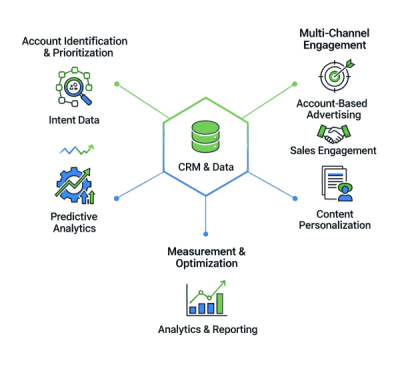
Your ABM tech stack needs to be a tightly integrated, data-driven machine that can support complex, multi-channel campaigns.
Key Characteristics of an ‘Enterprise-Class’ ABM Program
- Scale: Managing a large and complex target account list.
- Integration: A fully integrated ABM martech stack is crucial for data accuracy and workflow efficiency.
- Predictive Analytics: Using AI and machine learning to identify and prioritize accounts.
- Goals: To drive significant revenue growth from a large-scale, always-on ABM strategy and further cement ABM as a core enterprise growth competency.
The Enterprise ABM Tech Stack
| Tool Category | Generic Description | Vendor Examples |
|---|---|---|
| CRM | The enterprise-grade source of truth for all customer data. | Salesforce Sales Cloud (Enterprise), Microsoft Dynamics 365 |
| ABM Platform | A centralized platform to manage all aspects of ABM. | 6sense, Demandbase, Terminus, Other |
| Data Enrichment & Management | To ensure data accuracy and a complete view of your accounts. | Clearbit, ZoomInfo, Dun & Bradstreet |
| Predictive Analytics | AI-powered insights to predict which accounts are most likely to buy. | 6sense, Demandbase, Lattice (now part of Demandbase) |
| Advanced Personalization | Dynamic personalization across all channels. | Adobe Target, Optimizely, Mutiny |
| Multi-Channel Advertising | Sophisticated advertising orchestration across all digital channels. | The Trade Desk, Adobe Advertising Cloud, and ABM platform ad features |
| Comprehensive Analytics & Attribution | End-to-end measurement from engagement to revenue. | Bizible (Marketo Measure), Full Circle Insights, and advanced ABM platform analytics |
Large B2B enterprises with major ongoing ABM commitments need maximum capabilities and larger budgets to match.
Related: Learn more here about AI features and capabilities in modern ABM platforms, plus more on B2B sales intelligence solutions.
All-in-One ABM Platforms vs Point Solutions
Which Approach to ABM Martech is Right for You?
A key strategic decision when building your ABM tech stack is whether to invest in an ‘all-in-one’ ABM platform or to assemble a best-of-breed ABM stack from various ‘point solutions.’
Point solutions are specialized tools that excel at one specific function, such as intent data, account-based advertising, B2B website visitor ID and tracking, or sales engagement. The ‘Starter Stack’ outlined above is a classic example of a point solution approach.
All-in-one ABM platforms (like Demandbase, 6sense, Terminus, and other ABM platforms in this segment) aim to be a central command center, combining many of these functions — from account identification and intent data to cross-channel engagement and analytics — into a single, integrated system.
Related: Learn more about ABM platform and tool options and costs.
When Does an All-in-One ABM Platform Make Sense?
Investing in a comprehensive ABM platform is a significant commitment. It generally makes the most sense for companies in the Growth and Enterprise stages (outlined above) for the key reasons described below.
Unified Data and a Single Source of Truth
As you scale, managing data across a dozen different tools becomes a major challenge. Discrepancies lead to inaccurate targeting and reporting. An all-in-one ABM platform consolidates account data, engagement signals, and campaign performance, providing a unified view for both sales and marketing.
Streamlined Workflows and Efficiency
Instead of toggling between multiple systems, your team can manage the entire ABM lifecycle from one place. This improves efficiency, reduces manual work, and ensures a more coordinated approach to account engagement.
Deeper, Integrated Insights
All-in-one ABM platforms are designed to connect the dots between different activities. They can show you how your advertising efforts are influencing website engagement, which in turn is driving sales conversations. This level of integrated analytics is very difficult to achieve with a collection of disparate point solutions.
Simplified Vendor Management
Managing contracts, renewals, and support for one platform is far simpler than for five or ten.
For companies just getting started, the cost and complexity of an all-in-one ABM platform can be prohibitive. A curated set of point solutions offers a more flexible and cost-effective ABM approach in the early stages and for smaller B2B firms.
However, as your ABM program matures and your need for scale, data integrity, and operational efficiency grows, the value proposition of an integrated ABM platform becomes increasingly compelling.
What About ABM Agencies?
Another variable in this equation is the use of a specialized ABM marketing agency. Partnering with an agency can significantly impact your tech stack decisions:
- Access to Enterprise-Grade Tools: B2B marketing agencies often own licenses for top-tier ABM platforms. This allows smaller companies (agency clients) to benefit from powerful technology without bearing the full cost of a direct subscription.
- Reduced Overhead: An ABM-focused agency provides the human expertise to run the technology. This means you don’t have to hire and train an in-house team to manage the complexities of intent data, ad orchestration, and analytics, which can be a major cost-saver.
- Informed Tech Selection: If you do decide to build your own ABM stack, a good agency can act as a consultant, helping you navigate the vendor landscape and choose the right tools for your specific goals and budget.
For many companies, particularly those in the ‘Starter’ and ‘Growth’ phases, a hybrid approach involving an outside agency can be the most effective way to leverage advanced ABM capabilities without the full investment in technology and personnel.
Related: Learn more in this post about using B2B account-based marketing agencies.
Want to stay updated on my B2B account-based marketing (ABM) content? Add your email details below for periodic updates straight from me (David).
Your email info is safe here. We don’t sell, rent, or share your details with outside parties. You can easily unsubscribe at any time.
Like this post? Quickly share it with your social networks here.
ABM Tech Stacks — Closing Thoughts
Your ABM Stack Should Evolve with You
Building the right ABM tech stack is a journey, not a destination. The key is to start with a solid foundation, focus on your immediate needs, and then add new tools and capabilities as your ABM strategy matures.
No matter what business size or stage you’re at, remember that technology is just an enabler. The success of your ABM program will always depend on a clear strategy, strong alignment between sales and marketing, and a deep understanding of your target accounts.
Questions or Comments?
I hope this brief overview and examples of ABM tech stacks for different company sizes have been informative. I’ll close with a few related questions for you:
- Are you utilizing ABM strategies and tactics in your B2B business today? What resources (team, tools, etc.) have you applied to these efforts?
- How has your company’s size impacted your approach to ABM?
- If you use a dedicated ABM platform or toolkit, what do you think are its main strengths and weaknesses?
Feel free to add more in the comments below with any thoughts, feedback, or related questions. Thanks also for any social shares on this post!
