
New Tracking Priorities for AI-Powered Organic Search
Now that AI-based search is here to stay, tracking organic search performance is shifting rapidly from keyword-centric analysis to more complex and conversational AI prompt-level tracking.
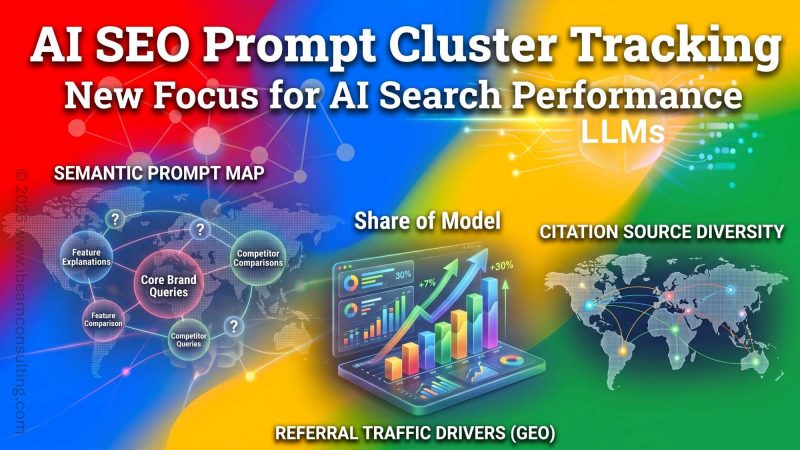
As a result, building and tracking groups of related AI prompts is now a top priority for website owners and brands that need to maintain and grow strong online visibility.
This post takes a closer look at AI SEO, GEO, and “prompt cluster” tracking, including insights, tips, and tools to help simplify, manage, and scale this ongoing SEO/GEO activity.
Let’s dive in and learn more below!
This post may contain a few referral links to select vendor partners. We may receive compensation for purchases made through these links, at no additional cost to the buyer.
Last updated Aug 16, 2026
Tracking AI Prompt Clusters — Brief Introduction
The Shift from Traditional SERPs to AI-Synthesized Answers
For over two decades, search engine optimization was governed by a familiar, deterministic reality: a user typed a keyword into a search box, and a search engine returned “10 blue links.”
Success was measured in rank positions (1 through 10) on a Search Engine Results Page (SERP), and organic visibility was driven by matching pages to explicit search queries.
That paradigm is rapidly unraveling.
Today, millions of users bypass traditional search engines altogether, turning instead to Generative Engines – such as ChatGPT, Perplexity, SearchGPT, Claude, and Gemini – to find answers, make purchasing decisions, and solve complex problems.
Instead of browsing a list of external web links, users receive synthesized, narrative answers compiled directly by Large Language Models (LLMs).
This fundamental shift has given rise to Generative Engine Optimization (GEO).
While traditional SEO focuses on getting web pages indexed and ranked by crawlers based on keyword relevance and backlinks, GEO focuses on positioning a brand, product, or source as an authority that LLMs extract, cite, and recommend during answer generation.
However, as marketers shift their focus to GEO, they immediately run into a major hurdle: traditional rank-tracking methods do not work in generative AI.
Tracking a single rigid keyword like “best CRM” tells you almost nothing about your brand’s presence inside an LLM.
In an AI-driven search interface, users do not search in isolated fragments; they ask rich, conversational, multi-turn questions tailored to their specific constraints.
To adapt, marketers need a new framework for measurement. Enter the Prompt Cluster — the foundational unit of measurement and optimization in the age of AI-powered search.
What is a “Prompt Cluster” in AI SEO/GEO?
A New Measurement Focus in Generative Engine Optimization
A Prompt Cluster is a logically grouped set of semantically related prompts, conversational variations, and follow-up queries that represent a unified user goal or decision-making intent within an AI model.
Rather than looking at a single standalone prompt, a prompt cluster evaluates how an LLM responds across dozens of natural phrasing permutations that share the same underlying objective.
Key Characteristics of LLM Prompts vs. Traditional Search Queries
To understand why prompt clusters are necessary, we must analyze how prompt behavior differs from keyword queries.
Rich Context & Conversational Framing
Traditional search queries are short and keyword-dense (e.g., “B2B CRM software”). LLM prompts are conversational and full of explicit parameters (e.g., “What is the best CRM for a 20-person B2B SaaS startup integrated with HubSpot, under $100/user/month?”).
Multi-Turn Iteration
Generative search is rarely a one-and-done transaction. A user might start with a broad prompt, then follow up with secondary constraints (“Which of these options has the best native mobile app?” or “Compare Option A vs. Option B on security”).
Non-Deterministic Outputs
Search engine rankings are generally static for all users searching a keyword at a given moment. LLMs, by contrast, are non-deterministic. Factors like prompt temperature, system instructions, web retrieval (RAG) sources, and minor phrasing tweaks can cause the model to recommend completely different products or sources across two similar prompts.
Why Clustering is Essential for AI Visibility
Because an AI model’s output can vary dramatically based on how a question is framed, checking whether your brand appears in a single prompt gives a dangerously incomplete – and often misleading – picture.
If you ask ChatGPT, “What are the top analytics platforms?”, your software might not be mentioned. But if you frame it as “What analytics tools work best for product managers in B2B SaaS?”, your brand might be the #1 recommendation.
By measuring visibility across an entire Prompt Cluster – incorporating varying personas, constraints, synonyms, and follow-up paths – you smooth out model variance and calculate your true, statistically sound Share of Model (SoM).
Moving from Traditional SEO to AI-Focused GEO
Comparative Analysis: Traditional SEO vs. AI GEO Frameworks
Transitioning from traditional SEO to GEO requires more than just replacing old tools; it demands a mental re-calibration of how search concepts map to generative AI architectures.
The table below outlines how foundational SEO concepts translate into the GEO paradigm.
| Traditional SEO Concept | AI GEO Equivalent | Key Difference / Mindset Shift |
|---|---|---|
| Keyword / Keyphrase | Single Prompt / Query Variation | Keywords are rigid search fragments; prompts are natural language contexts with rich constraints and user personas. |
| Keyword Group / List | Prompt Cluster | Keyword lists track exact syntax; prompt clusters group syntactically diverse, semantically identical conversational prompts around a single buyer goal. |
| Topic Cluster / Hub & Spoke | Contextual Knowledge Graph / Entity Cluster | Topic clusters structure web pages for site crawlers; entity clusters ensure LLMs associate your brand node with specific concepts, categories, and attributes in vector space. |
| SERP Rank (#1 – #10) | Share of Model (SoM) / Citation Rate | Rank position is a fixed slot on a SERP; Share of Model measures the percentage of cluster runs where your brand is included or cited. |
| Search Intent | Generative Prompt Intent & Workflow Stage | Search intent focuses on getting a user to a webpage; prompt intent focuses on helping the user complete a task or make a decision directly within the AI interface. |
Three Core Mindset Shifts
1. From Syntax Match to Semantic Intent
In traditional SEO, matching exact or phrase-level keywords was long the primary mechanism for signaling relevance.
In GEO, LLMs operate entirely in high-dimensional “vector spaces.” They process meaning, context, and intent rather than specific token combinations.
Therefore, prompt clusters track whether your brand occupies the correct semantic territory across varied natural language expressions.
2. From Webpage Ranks to Recommendation Frequency
Tracking rank #1 vs. #3 on Google SERPs was straightforward because the output was a structured list of web URLs.
In stark contrast, LLMs generate synthesized prose, bulleted lists, and structured tables dynamically. Instead of asking “Where do we rank?”, GEO marketers must ask “How frequently is our brand recommended across all context variations in this cluster?”
3. From Internal Hubs to Multi-Source Entity Graphs
Traditional topic clusters use internal linking to show Google crawler bots how pages relate to one another.
Generative models, however, evaluate your brand as an entity relative to other entities. They weigh content across your website alongside third-party review platforms, Reddit discussions, news coverage, and industry benchmark reports.
Optimizing for an entity cluster requires managing your brand’s total digital footprint, not just your owned website.
Why Track Prompt Clusters?
The Business & Strategy Cases for Tracking AI Prompt Clusters
Investing time and resources into prompt cluster tracking isn’t just an exercise in modern search analytics — it provides actionable business intelligence that directly shapes your brand’s organic positioning and product messaging.
Here are the five key business drivers for implementing prompt cluster tracking.
1. Measuring True “Share of Model” (SoM) & Share of Voice (SoV)
Traditional Share of Voice (SoV) measures impression share and SERP coverage for keyword sets.
In generative search, Share of Model (SoM) measures the percentage of generated responses within a prompt cluster that recommend, cite, or feature your brand.
If you test a cluster of 30 conversational prompts for “Enterprise Security Software,” and your product is recommended in 21 of those responses, your Share of Model for that cluster is 21/30 or 70%.
Tracking this metric over time allows you to benchmark your generative market share directly against key competitors.
2. Source Attribution & RAG Citation Discovery
When an AI LLM performs Retrieval-Augmented Generation (RAG) to answer a prompt, it pulls real-time web data from cited sources. Tracking prompt clusters reveals which specific domains feed the model’s responses.
You might discover that for a high-intent prompt cluster, 60% of citations come from G2 and TrustRadius, 25% come from Reddit threads, and only 15% come from brand websites.
This insight tells you precisely where to deploy your marketing resources — such as doubling down on community management or third-party review collection rather than purely writing and “GEO-optimizing” new blog posts.
3. Detecting Sentiment & Narrative Framing
Unlike a SERP link, an LLM provides qualitative commentary about your brand. Tracking a prompt cluster allows you to analyze LLM sentiment across variations:
- Is your brand described as premium or overpriced?
- Is your software praised for ease-of-use or criticized for poor customer support?
- Is your product framed as ideal for enterprise companies or small businesses?
Understanding these synthesized narratives helps you correct brand misperceptions through updated website content, press releases, and customer documentation.
4. Spotting Hallucinations & Critical Information Gaps
LLMs often perpetuate outdated or inaccurate information. A model might tell users that your platform lacks an integration that you in fact launched six months ago, or quote pricing that is two years out of date.
By running systematic checks across a prompt cluster, you can spot where LLMs hallucinate or rely on outdated information.
Once identified, you can publish structured update notes, schema-marked pages, and PR releases to overwrite those outdated connections in the model’s retrieval index.
5. Demonstrating GEO ROI to Company Leadership
Marketing teams need concrete metrics to justify investments in GEO, digital PR, and structured content. Prompt cluster tracking provides tangible, quantitative proof of performance over time.
Demonstrating that your brand’s Share of Model grew from 25% to 65% in a key product category gives senior executives and budget approvers clear visibility into the return on your GEO strategy.
How to Define & Build Effective Prompt Clusters
Five Steps to Logical Prompt Clusters for AI SEO
Building effective prompt clusters requires shifting from traditional keyword research to buyer-intent modeling and conversational query extraction.
A well-architected cluster should contain 20 to 50 prompt variations that reflect real-world user pathways across generative AI engines.
Here is a step-by-step framework for creating production-ready prompt clusters.
Step 1: Map the Generative Buyer Journey
Users interact with LLMs across every phase of the funnel, but their phrasing style evolves as they move closer to a decision.
Informational / Problem Exploration: High-level educational queries seeking foundational context.
- Example: “Why is our customer churn increasing in B2B SaaS, and how can automated onboarding help?”
Solution Discovery: Category-level inquiries seeking options and tool recommendations.
- Example: “What are the best customer onboarding platforms for mid-market software companies?”
Evaluation / Comparison: Direct feature, pricing, and capability comparisons.
- Example: “Compare Tool A vs Tool B for integration complexity, SOC2 compliance, and pricing.”
Implementation / Technical: Post-selection operational or setup queries.
- Example: “How do I connect Tool A to Segment and HubSpot using Webhooks?”
Step 2: Seed Prompts Using First-Party Webmaster Data
Rather than guessing how real users phrase complex questions, use your first-party search engine data as a springboard for conversational query discovery.
Google Search Console (GSC)
Google Search Console is a goldmine for discovering ultra-long-tail, conversational queries that mimic LLM prompts.
Look beyond high-volume head terms by applying Regex filters in the Performance report to extract natural question structures:
^(how|why|what|which|where|who|is|can|should|best|vs|difference between)\b
Filter for queries with high word counts (e.g., 6+ words). These long-tail impressions reflect how real users articulate nuanced constraints, providing authentic seed ideas for your prompt variations.
Bing Webmaster Tools (BWT)
Microsoft Bing Webmaster Tools offers unique visibility into AI-native search behavior due to its deep integration with Copilot and Bing Generative Search.
Analyze BWT’s AI and conversational search performance reports to identify verified generative query templates, user follow-up phrases, and multi-turn interaction patterns.
Related: Learn more here about finding ultra-long-tail question keywords in Google Search Console.
Step 3: Generate Conversational Prompt Variations
Once you have established seed topics from GSC, BWT, and buyer journey mapping, expand each core intent into 20–50 prompt variations.
You can execute this manually via LLM prompts, or automatically using specialized GEO platforms (see below) that generate persona-based variations at scale.
Vary the prompts across four primary dimensions:
User Personas: “As a CTO…”, “As a solo founder…”, “As a growth marketer…”
Explicit Constraints: Budget limits, tech stack integrations, team size, compliance needs (“under $50/month,” “with native Salesforce integration”).
Tone & Style: Formal, concise, detailed tabular requests, pros-and-cons evaluations.
Synonyms & Categorization: Interchanging industry terminology (e.g., “customer success platform” vs. “churn prevention software”).
Step 4: Account for Multi-Turn Follow-Up Pathways
Generative search is an interactive conversation. Include multi-turn sequences in your prompt cluster definitions to track how brand recommendations persist or change after follow-up queries:
- Initial Prompt: “What are the top 5 email marketing tools for e-commerce stores?”
- Follow-up Prompt 1: “Which of these five tools has the best Shopify integration for automated flows?”
- Follow-up Prompt 2: “What are the main pricing complaints for the top two recommendations?”
Step 5: Categorize and Tag Clusters
Organize your prompt library within a structured taxonomy – either in a central database or inside your GEO tracking software – so you can slice and dice performance metrics across your organization:
- Funnel Stage: Top of Funnel (TOFU), Middle of Funnel (MOFU), Bottom of Funnel (BOFU)
- Product Line / Category: e.g., CRM, Marketing Automation, Analytics
- Persona: SMB, Mid-Market, Enterprise
- Priority Tier: Tier 1 (Core revenue drivers), Tier 2 (Secondary features), Tier 3 (Exploratory topics)
How to Track AI Prompt Clusters
Monitoring Prompt Cluster Performance Over Time
Tracking prompt clusters requires a shift from static periodic SERP scraping to dynamic, probabilistic metric monitoring across multiple generative engines (ChatGPT, Perplexity, SearchGPT, Claude, Gemini).
Key Metrics to Monitor
To build a holistic view of your brand’s AI visibility, track four core quantitative and qualitative metrics across every prompt cluster:
1. Inclusion / Citation Rate (%)
The percentage of generated outputs in a cluster that explicitly mention or cite your brand or website URL.
Inclusion Rate = (Number of Prompts Mentioning Brand / Total Prompts in Cluster) * 100.
2. Top-Position / Primary Recommendation Rate (%)
The percentage of cluster responses in which your brand is named as the #1 overall recommendation or listed first in a bulleted selection.
3. Sentiment Score
An automated NLP/LLM sentiment classification of the text surrounding your brand mention, scored on a scale from -1.0 (Strongly Negative) to +1.0 (Strongly Positive).
4. Source Diversity Index
A breakdown of the underlying domains feeding the LLM’s RAG citations for that cluster (e.g., 30% Owned Site, 40% Review Platforms, 20% Community/Reddit, 10% News Publications).
Handling LLM Non-Determinism Through Multi-Run Sampling
Because LLMs generate text probabilistically based on model temperature and retrieval state, running a single prompt once can yield a false positive or negative result.
To achieve statistical validity without forcing teams into laborious manual testing, automated GEO analytics platforms and API pipelines execute multi-run sampling:
Run Frequency: Sample each prompt in a cluster 3–5 times per benchmark cycle (e.g., weekly or bi-weekly).
Cross-Engine Comparison: Run the exact cluster automatically across multiple target engines (e.g., ChatGPT-4o, Perplexity Pro, SearchGPT, Claude 3.5 Sonnet).
Calculate Confidence Intervals: Average the results across runs to establish a reliable baseline Share of Model (SoM) percentage.
If your product is recommended in 4 out of 5 runs across 30 prompt variations, you can confidently report an 80% Share of Model for that cluster, eliminating the noise of single-run variance.
Good to Know: In the context of Generative Engine Optimization and AI prompt tracking, model temperature is a parameter (typically ranging from 0.0 to 1.0 or 2.0) that controls how predictable or random an LLM’s output will be. Lower = more predictable; higher = more random and “creative”.
Tools for Prompt Cluster Tracking
The Tooling Ecosystem for Prompt Cluster Discovery & Tracking
Navigating the prompt cluster tracking landscape involves a hybrid tool stack that combines first-party search data, dedicated GEO analytics platforms, custom API monitoring (optional), and web analytics integration.
1. First-Party Search Console Seeding
Before automating cluster monitoring, start with verified first-party user data to surface authentic long-tail conversational patterns:
- Google Search Console: Utilize regex filtering on long-tail question queries to harvest real search phrases that can be expanded into prompt variations.
- Bing Webmaster Tools: Leverage Copilot and AI-search performance reporting features to capture verified AI query formulations and multi-turn user intent signals.
2. Dedicated AI Visibility & GEO Analytics Platforms
A specialized class of Generative Engine Optimization platforms has emerged to automate the creation, structuring, management, and continuous tracking of prompt clusters at enterprise scale.
Rather than forcing digital marketers and SEO/GEO pros to manually assemble spreadsheets of prompts and execute them one-by-one, these platforms streamline the entire GEO lifecycle through four core capabilities.
Automated Discovery & Cluster Generation
Utilizing AI engines to take core product categories or target keywords and automatically generate 20–50 natural, persona-driven prompt variations (including edge-case constraints and comparative questions).
Cluster Lifecycle Management & Taxonomy Tagging
Organizing hundreds of prompts into structured libraries categorized by buyer persona, product line, decision funnel stage, and priority level — enabling SEO/GEO teams to monitor portfolio-wide Share of Model (SoM) across various product groups.
Automated Parallel Execution & Multi-Run Sampling
Scheduling automated, multi-engine execution cycles (e.g., running clusters across ChatGPT, Perplexity, Claude, SearchGPT, and Gemini 3–5 times per week) to handle LLM non-determinism and establish statistically reliable baselines.
Aggregate Dashboarding & Citation Attribution
Aggregating cluster performance into macro health metrics (Inclusion Rate, Sentiment, #1 Recommendation Share) and mapping exact citation sources (G2, Reddit, brand docs) driving LLM recommendations across each prompt set.
Key platforms pioneering these prompt cluster workflows include:
- Peec AI: An AI search analytics platform designed for marketing teams to discover prompt variations, structure custom prompt sets, and track brand visibility, citation sources, sentiment, and Share of Model across engines like ChatGPT, Perplexity, Gemini, and Copilot.
- Profound: An enterprise-grade GEO platform built for large organizations to build and manage complex prompt clusters, execute synthetic buyer journeys across personas, and perform deep RAG source attribution.
- Otterly AI: An accessible AI search monitoring suite focused on prompt set management, brand mention tracking, website URL citations, and prompt discovery across major answer engines.
- Rankscale: A dedicated platform for structured prompt set management, multi-engine benchmarking, prompt taxonomy tagging, and time-series visibility analytics.
- BrightEdge: Provides enterprise generative parsing tools and AI overview tracking that integrate traditional SERP insights with LLM response data and prompt set auditing.
3. Custom Analytics & API Solutions
For organizations with custom data pipelines, in-house data teams often build custom monitoring scripts directly using model developer APIs:
- OpenAI API: Programmatically query GPT models with system prompts and fixed seed parameters to conduct daily cluster checks.
- Perplexity API: Audit web-grounded RAG responses and extract real-time citation links directly from generated payloads.
- Anthropic Claude API: Benchmark complex multi-turn prompts and deep analytical reasoning outputs using advanced Claude models.
4. Social & Third-Party Citation Listening
Because LLMs and web-retrieval agents prioritize high-authority community platforms for real-time answers, monitoring these hubs is essential for prompt cluster health:
- Reddit: Regularly scraped by live RAG search web agents and heavily weighted in LLM training sources.
- Quora: High-indexing Q&A network frequently pulled into generative summaries for comparison and evaluation prompts.
Related: Learn more here about using Reddit & Quora for SEO/GEO visibility gains.
5. Web Analytics Referral Attribution
To complete the tracking loop, measure how AI visibility converts into actual website visitors:
- Google Analytics 4: Monitor your “AI Assistant” traffic channel in addition to organic search, other referrals (non-AI), social, ppc, email, etc. Look for indicators that your AI “impressions” are actually converting to click-throughs and website visits.
Prompt Clusters & Content Optimization
Winning Strategies: How to Optimize Content for Prompt Clusters
Understanding your prompt cluster metrics is only half the battle; the ultimate goal is improving your Share of Model. Winning visibility inside prompt clusters requires optimizing both your owned digital assets and your broader web footprint.
1. Structure Content for Entity Density & LLM Extraction
LLMs process web content using automated parsers and chunking mechanisms during RAG indexing. To make your owned content easily extractable:
- Use Direct Q&A Formatting: Frame headings (H2, H3) as natural questions matching your seed prompt variations, followed immediately by concise, 2–3 sentence direct answers.
- Implement Structured Data Schema: Use JSON-LD schemas – specifically FAQPage, Product, Organization, and HowTo – to help LLM parsers extract unambiguous entity facts and product specifications.
- Incorporate Comparison Tables: Use clear HTML <table> structures for pricing, feature breakdowns, and technical specs. LLMs consistently convert table markup into formatted summary matrices.
2. Practice Off-Page GEO (Digital PR & Community Authority)
In generative search, off-page authority is just as important as on-page content. Because LLMs synthesize answers from multiple third-party web sources, you must establish brand authority across the entire digital ecosystem:
- Maintain Active Community Presence: Participate in relevant Reddit discussions and Quora threads. Authentic user conversations in these forums are frequently retrieved as evidence during buyer evaluations.
- Optimize Review Platform Profiles: Ensure your product details, enterprise features, and user reviews on major directories (G2, TrustRadius, Capterra) are complete and accurate.
- Earn High-DR Earned Media: Pitch industry publications, analyst reports, and digital news outlets. Citations from high-domain-rating news sites strongly influence RAG model retrieval confidence.
3. Maintain Fresh Information & Prevent Data Stagnation
LLM retrieval algorithms prefer up-to-date sources when answering user queries. Outdated information leads directly to hallucinations or non-inclusion:
- Publish Frequent Content Updates: Keep key product specs, pricing tables, and integration documentation updated with explicit publication dates (dateModified schema).
- Issue Press Releases for Major Launches: When launching new features or integrations, publish clear, entity-dense press releases to create immediate web-indexed signals that overwrite older model associations.
4. Harness Mainstream Social Media for Live RAG Signals & Entity Consensus
Beyond Reddit and Quora, mainstream social media platforms play a pivotal role in feeding real-time RAG web agents and establishing knowledge graph consensus:
- YouTube Transcripts as Semantic Search Goldmines: Search engines (especially Google/Gemini and Perplexity) heavily crawl and index automated YouTube video transcripts. Publishing structured video tutorials, product walkthroughs, and keynotes with clear spoken phrasing gives LLMs rich text content to index and cite in response to conversational prompts.
- LinkedIn for B2B Entity Verification & Founder Authority: Published LinkedIn Pulse articles, executive posts, and official company pages serve as primary entity verification sources for B2B queries in models like ChatGPT and Claude. Strong executive presence on LinkedIn boosts model confidence when evaluating company credentials and market leadership.
- X (Twitter) for Real-Time Event Retrieval & Sentiment: Web-retrieval agents continuously query X for real-time news, software release notes, and public sentiment (notably integrated into models like Grok and live search tools in Perplexity). Maintaining active announcements on X helps ensure models capture real-time developments within hours.
- Cross-Platform Co-Mentions & Entity Consensus: LLMs build vector confidence when the same entity facts (e.g., product name, category, pricing tier, key integration) are consistently verified across LinkedIn, YouTube, X, and your owned website. High co-mention consistency reduces hallucination risk across prompt clusters.
Sidebar: Are Keywords Really Dead? The Evolving Role of Keywords in AI SEO
With all the emphasis on prompt clusters and generative AI responses, a natural question arises: Are keywords completely dead?
The short answer is no — but their function has changed dramatically. Keywords are no longer the destination or the final metric of SEO success; instead, they serve as RAG retrieval seeds, semantic anchors, and vector connectors.
Here is how keyphrases function inside modern AI search architectures.
Web Retrieval & RAG Query Formulation
When an LLM processes a complex, conversational prompt (e.g., “What is the best CRM for a 20-person B2B SaaS startup integrated with HubSpot?”), the underlying model often strips down or translates that prompt into traditional keyphrase queries (like “B2B SaaS CRM HubSpot integration”) behind the scenes to execute live search queries across web indices.
Optimizing for relevant keyphrases ensures your pages match these internal RAG lookup queries.
Entity Co-occurrence & Knowledge Graphs
In vector embeddings, keywords are the connective tissue between entities. Terms like “SOC2 compliant,” “open-source,” or “enterprise API” act as key attribute descriptors.
Strategic keyword usage signals to the model which semantic categories and entity attributes your product belongs to.
The Hybrid Reality of Modern Search
Millions of users still type traditional 2-to-3-word keywords into Google and Bing SERPs every day. Hybrid search experiences – such as Google AI Overviews and Bing Copilot – bridge traditional SERP ranking with AI synthesis.
The Takeaway: Keywords aren’t dead; they’ve simply been demoted from top-level strategy to foundational infrastructure. You build your content around entities and keywords, but you measure and track your AI GEO success through Prompt Clusters.
Like this post? Quickly share it with your social networks here.
Want to make sure you never miss our updates? Click below to add us as a preferred source on Google Search.

Prompt Cluster Tracking for AI SEO/GEO — Closing Thoughts
Shifting Focus from Keywords to Prompts
The shift from blue SERP links to synthesized AI responses marks the most significant evolution in search marketing since the launch of Google itself.
As AI engines become the primary interface through which decisions are made, traditional keyword rank tracking is no longer sufficient to protect or grow your online visibility and digital market share.
Prompt clusters bridge the gap between traditional SEO strategy and generative AI behavior.
By measuring brand visibility across logically structured sets of conversational prompts, constraints, and follow-up paths, prompt clusters provide the statistically sound metrics marketers need to quantify Share of Model (SoM), identify RAG citation sources, monitor brand sentiment, and prove tangible GEO return on investment.
To succeed in this new landscape, digital marketing leaders must stop optimizing for isolated keywords and short keyphrases and start actively managing prompt cluster portfolios that reflect the full depth of the buyer’s generative journey.
🚀 Practical Next Steps to Launch Your Prompt Cluster Strategy Today
If you’re ready to transition your search strategy into the generative AI era, here are three actionable steps you can take right now.
1. Audit a 10-Prompt Mini-Cluster Manually
Pick one core product or category. Extract 10 conversational long-tail queries from Google Search Console or Bing Webmaster Tools, add persona constraints, and run them manually through ChatGPT, Gemini, Perplexity, and Claude.
Record how many times your brand is recommended, which sites are cited, and what sentiment is expressed.
2. Map Your RAG Citation Ecosystem
Analyze the citation links generated across your test cluster. Identify whether LLMs are pulling primarily from your owned domain, G2 reviews, Reddit threads, or news media.
Use this map to reprioritize your content and digital PR strategy toward the sources models actually trust.
3. Evaluate Dedicated GEO Tracking Software
Explore dedicated AI visibility platforms – such as Peec AI, Profound, Otterly AI, or Rankscale – to automate multi-run sampling, taxonomy tagging, and portfolio-wide Share of Model dashboarding as your prompt library expands.
Questions or Comments?
I hope this overview of AI SEO and prompt cluster tracking has been insightful and helpful. Let’s close this post with a few related questions for you:
- In your SEO performance tracking today, has AI model prompt tracking become part of the analysis? If so, how do you build and test those prompts?
- Is keyword-level rank tracking still part of your SEO measurement process? How does this continue to support or complement your SEO & GEO performance dashboard?
- Are you monitoring the latest free features and tools provided inside Google Search Console and Bing Webmaster Tools? What other 3rd-party prompt tracking tools look good to you today?
Feel free to add more in the comments below with any thoughts, feedback, or related questions. Thanks also for any social shares on this post via the buttons below!
