
Last updated Jan 16, 2026
New Opportunities for Revenue Growth & Productivity
AI in B2B marketing and sales is moving well beyond the ‘generative’ phase enabled by Large Language Models (LLMs) like ChatGPT, etc.
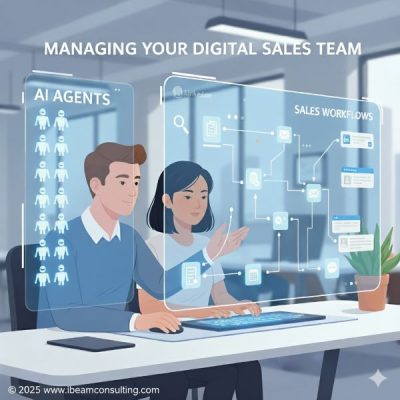
Today, AI is empowering ‘agentic’ capabilities that transform AI from ‘tool’ to ‘teammate’ — with new autonomous capabilities.
This post highlights AI agents in B2B marketing and sales, with insights, tips, and tools to help you move forward in this exciting new area.
Let’s take a closer look below!
This post contains a few referral links to select vendor partners. We may receive compensation for purchases made via these links, at no additional cost to buyers.
Key Takeaways
- Hire a Digital Teammate: Stop thinking of AI as a tool and start treating it as a reasoning, acting member of your revenue team.
- The ‘Boring Parts’ Revolution: Why AI agents are the secret to reclaiming 50% of your sales team’s time by automating the ‘Admin Tax.’
- Zero-Friction Funnels: How predictive scoring and dynamic site personalization are turning anonymous traffic into high-intent leads in seconds.
- The New Tech Stack: A breakdown of the no-code orchestrators and enterprise ecosystems (like Salesforce and HubSpot) leading the charge.
- Human-in-the-Loop (HITL): Why the most successful ‘Autonomous Enterprises’ still keep humans at the center of the strategy.
AI Agents in B2B — Moving from Chatbots to Digital Teammates
The Rapid Evolution of AI in B2B
For the past two years, the B2B world has been obsessed with Generative AI. We’ve used it to draft emails, summarize meetings, generate blog posts, and more.
However, a fundamental paradigm shift is occurring today: we are moving from Generative AI (which chats about things) to Agentic AI (which actually does things).
What exactly is an AI Agent?
Unlike a standard LLM chatbot that waits for a prompt to provide a response, an agent is characterized by autonomy, reasoning, and tool-use.
In a B2B context, an agent doesn’t just write a follow-up email; it logs into your CRM, researches the prospect’s latest quarterly earnings, checks their LinkedIn for recent promotions, and then decides the optimal time to send a personalized message across the right channel.
We are entering the era of the ‘Digital Teammate.’ B2B companies are no longer just looking for AI-assisted workflows where a human drives a tool; they are building ‘Agent-led’ workflows where the AI manages the process, and the human provides the strategic oversight.

AI Agents and Impact on B2B Marketing
B2B Revenue Teams Get a Productivity Boost from AI
In the traditional B2B marketing stack, automation was often synonymous with ‘rigid.’ You built a workflow, and if a prospect did X, the system did Y. AI agents are shattering this rigidity by introducing a layer of intelligent orchestration.
Autonomous Campaign Orchestration
Today’s marketing agents are evolving into full-scale campaign managers. Instead of a marketer manually building out every branch of a nurture sequence, they can now define a goal — such as ‘increase demo requests for our mid-market segment’ — and the agent will build, route, and optimize the sequence autonomously.
A well-tuned AI agent can pivot the messaging in real-time if it detects a shift in prospect engagement, moving a lead from an email track to a LinkedIn touchpoint without human intervention.
Hyper-Personalization at Scale
We’ve all seen the ‘Insert First Name’ email personalization of the past. AI agents take this to a level that was previously impossible without a massive team.
By consuming financial reports, recent podcast appearances, and social signals, an agent can craft a unique value proposition for every single lead in a database of thousands. This isn’t just better personalization — it’s relevance at scale.
The ‘Listener’ Agent
Marketing teams are increasingly deploying AI ‘Listener’ agents that operate 24/7. These agents monitor the digital horizon for specific signals: a competitor’s customer complaining on social media, a target account hiring for a specific role, or a surge in intent data on third-party review sites.
When a signal is detected, the agent doesn’t just alert a human; it can automatically trigger a targeted marketing action, such as serving a specific ad or enrolling that account in a high-priority campaign sequence.

AI Agents and Mining B2B Website Visitor Analytics
Example: AI-Powered Website Visitor Intelligence
For years, B2B website visitor tracking was a game of what we call ‘reverse IP lookups.’ A specialized software tool would tell you that ‘someone from IBM’ visited your pricing page, and then a sales rep would spend thirty minutes guessing which of IBM’s 280,000 employees it might have been.
AI agents have turned this time-consuming ‘guessing game’ into a precision science.
Beyond IP Lookups: Decoding the Buying Group
Today’s agents don’t just report a visit; they consume raw behavioral data — mouse pathing, dwell time on technical docs, and the sequence of pages viewed — to decode the intent of the entire ‘Buying Group.’
If five different IPs from the same company visit your site within 48 hours to look at security whitepapers and API documentation, an AI agent identifies this as a high-intent evaluation phase and alerts the appropriate account owner with a consolidated summary of the group’s concerns.
Deanonymization 2.0 and Tools Evolution
The industry leaders in this space are fundamentally changing how they present data. Tools like Dealfront and Leadfeeder have evolved from static dashboards into conversational intelligence hubs.
Instead of forcing a marketer to filter through rows of data, Dealfront’s AI Activity Summaries now provide a plain-language briefing: ‘A decision-maker from a mid-sized German manufacturing firm just spent 12 minutes on the ROI calculator. They arrived via your LinkedIn ‘Sustainability’ campaign and have visited three times this week. They are likely comparing your energy efficiency features against Competitor X.’
Predictive Scoring and Real-Time Personalization
AI agents are now bridging the gap between web behavior and external ‘trigger events.’ By correlating a spike in website traffic with a target account’s recent $50M funding round or a new executive hire, predictive agents can assign a ‘Ready to Buy’ score that is far more accurate than traditional lead scoring.
Furthermore, these agents can trigger Dynamic Site Personalization in milliseconds. When a high-intent visitor lands on the homepage, the agent can instantly swap out a generic case study for one that matches the visitor’s specific industry and current pain points, effectively turning the website into a personalized sales pitch before the visitor ever fills out a form.

Dealfront: EU-Native B2B Go-To-Market Platform
Dealfront is a ‘revenue engine’ for B2B sales and marketing teams, especially those with European / EU account targets.
Dealfront combines the strengths of Echobot and Leadfeeder into a full-cycle, AI-assisted platform for B2B revenue growth.
Pros:
Boosts revenue and sales/marketing efficiency
Integrates multiple sales intelligence tools and data for B2B revenue teams
Offers new AI-powered capabilities
Supports affordable Account-Based Marketing (ABM) programs
Provides strong GDPR/regulatory compliance for EU markets
Cons:
May be pricey for smaller B2B’s with limited account targets
Lacks some features of enterprise-scale ABM platforms
AI Agents and the Evolution of the B2B Sales Cycle
Digital Teammates for Productivity & Revenue Growth
If marketing agents are about building the funnel, AI sales agents are about closing the gaps within it. The B2B sales cycle is notoriously leaky, often bogged down by administrative ‘drag’ that prevents Account Executives (AEs) from actually selling.
The AI SDR: Sourcing and Qualification
The role of the Sales Development Representative (SDR) is being redefined by autonomous agents like Ava from Artisan or platforms like Lindy.
These agents don’t just find emails — they perform end-to-end prospect research, handle multi-channel outreach, and manage the back-and-forth of scheduling.
By the time a human AE sees a lead, the agent has already qualified the prospect’s budget, authority, and timeline.
Revenue Intelligence and Real-Time Coaching
AI agents are also now entering the ‘meeting room.’ Tools like Gong and Salesloft are deploying agents that analyze live sales calls to provide real-time revenue intelligence.
If a prospect mentions a specific competitor or a pricing concern, the agent can privately nudge the salesperson with the exact battle card or discount approval threshold needed to keep the deal moving.
Eliminating the ‘Admin Tax’
Perhaps the biggest win for sales teams is the elimination of CRM drudgery. Modern sales agents automatically update records, draft post-call summaries, and generate follow-up action plans based on the verbal commitments made during a call. This reduces the deal cycle by ensuring that momentum is never lost to a rep’s busy schedule.
The B2B AI Agent Toolkit
Building and Managing AI Agents for B2B
The entry barrier for deploying AI agents has dropped significantly. We are seeing a three-tiered ecosystem emerge for building and managing these digital teammates:
- No-Code/Low-Code Orchestrators: For marketing and sales ops teams who want to build custom logic without writing code. Tools like Relevance AI, n8n, and Zapier Central allow users to train an agent on their specific company playbooks and connect them to thousands of apps.
- Enterprise Ecosystems: Major SaaS platforms are baking agentic capabilities directly into their cores. Salesforce Agentforce and HubSpot Breeze represent a future where your CRM isn’t just a database, but a hub of autonomous workers that already have access to all your customer data.
AI Agents in B2B — Pros and Cons
A Balanced View
The deployment of AI agents in B2B marketing and sales is a high-reward, high-risk proposition. To succeed, organizations must balance the undeniable efficiency gains and revenue growth opportunities against the complexities of autonomous software.
AI Agent Benefits
Unprecedented Efficiency: Early adopters are reporting a 30–50% reduction in manual administrative tasks (Source: McKinsey & Company, “The economic potential of generative AI”). By offloading lead research and CRM entry to agents, humans can focus on the high-value emotional intelligence required to close complex deals.
ABM at Scale: Account-Based Marketing (ABM) has traditionally been expensive because it requires intense manual research. Previously, many B2B companies had to choose between a 1:1 approach (customized campaigns for hand-picked top-tier accounts) or a 1:Few approach (targeting accounts by narrow industry segments).
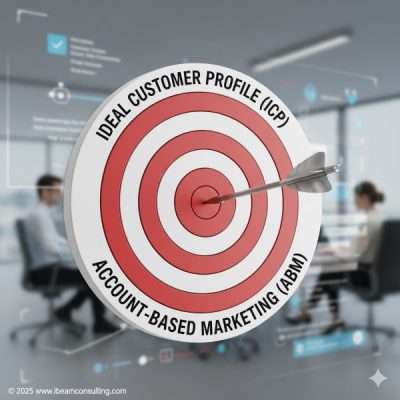
AI agents effectively blur these lines, allowing companies to run ‘1:1’ levels of deep research and personalization for every target ABM account in their database, regardless of size.
By automating the deep-dive research into financial reports and executive interests, agents transition the entire funnel to a personalized ‘1:1’ experience at ‘1:Many’ speed.
AI Agent Challenges
The ‘Black Box’ Problem: As AI agents gain more autonomy, it becomes harder for managers to see exactly how an AI-led decision was reached. Maintaining visibility and robust logging is essential to ensure that AI agents aren’t working against company strategy.
Brand and Hallucination Risk: If an agent is allowed to communicate directly with prospects, there is always a non-zero risk of ‘AI hallucinations’ — making up pricing, features, or commitments the company cannot honor.
A high-profile example occurred when an Air Canada chatbot hallucinated a bereavement fare policy that didn’t exist, leading a Canadian tribunal to rule that the airline was legally liable for the AI’s misleading promises.
In a B2B context, a hallucinating AI agent promising an unauthorized 40% discount or a non-existent security certification could lead to significant legal and contractual liability.
Change Management: The shift from ‘doing the work’ to ‘orchestrating the agents’ can be a difficult cultural transition for many B2B teams.
AI Agents in B2B — Best Practices for Implementation
Getting Started with B2B AI Agents
Don’t try to automate your entire revenue engine on day one. Implementation of AI agentic systems should be a deliberate, staged process.
Start Small and Low-Risk: Identify a high-friction, low-risk workflow. A common starting point is website lead qualification or ‘stale lead’ reactivation. These are areas where if an agent makes a minor error, the brand impact is minimal, but the efficiency gain is high.
Human-in-the-Loop: Design your agentic workflows with specific ‘HITL’ checkpoints. For example, an agent can research a prospect and draft a personalized outreach sequence, but a human must click ‘send’ after a quick review. As trust in the agent grows, these checkpoints can be loosened.
Prioritize Data Hygiene: An AI agent is a high-performance engine, and data is its fuel. If your CRM is a mess of duplicates and outdated contact info, your agents will simply automate bad decisions. Clean data is no longer a ‘nice-to-have’; it is the foundation of the autonomous enterprise.
Want to stay updated on my B2B marketing-related content? Add your email details below for periodic updates straight from me (David).
Your email info is safe here. We don’t sell, rent, or share your details with outside parties. You can easily unsubscribe at any time.
Like this post? Quickly share it with your social networks here.
AI Agents in B2B Marketing and Sales — Closing Thoughts
The Future of the ‘Autonomous Enterprise’
The transition from Generative AI to Agentic AI marks the beginning of the ‘Autonomous Enterprise.’ In this new era, the distinction between ‘marketing software’ and ‘marketing staff’ will begin to blur.
We aren’t just buying martech tools anymore; we are hiring and managing digital teammates that can reason, act, and learn.
The bottom line is that AI agents aren’t here to replace the creative and strategic heart of B2B. They are here to replace the boring parts — the data entry, manual research, repetitive cold outreach, and scheduling loops.
By liberating your team from these tasks, you allow them to return to what human revenue teams do best: crafting high-level strategy, building authentic relationships, and closing new deals.
Competitive advantage going forward will not be defined by who has the best AI. It will be defined by who has the best collaboration between humans and well-tuned AI agents.
The companies that win will be those that treat AI agents as a scalable extension of their human expertise, not a substitute for it.
Your Next Steps: A 30-Day Checklist
Ready to move beyond the hype and start deploying? Here is how to begin:
- Week 1: Audit Your Friction. Identify the three most repetitive, time-consuming tasks in your current sales or marketing funnel.
- Week 2: Clean the ‘Fuel.’ Perform a data audit on your CRM and website analytics. Ensure your lead scoring logic and contact data are accurate.
- Week 3: Launch a Pilot. Select a no-code tool (like Zapier Central or n8n) and build a simple ‘Listener’ or ‘Researcher’ agent for one specific campaign.
- Week 4: Review and Refine. Evaluate the agent’s output. Where did it hallucinate? Where did it save time? Use these insights to design your first ‘Human-in-the-Loop’ agentic workflow.
The era of the AI agent in B2B is here. Don’t wait for the technology to be perfect — start building your digital workforce today.
Questions or Comments?
I hope this introduction to using AI agents in B2B marketing and sales has been helpful! Let’s wrap up with a few related questions for you:
- How are you using AI (and generative AI) in your B2B sales and marketing processes today?
- How is your current martech stack evolving to incorporate AI — and more specifically, AI agent functionality? Are there new features available that you can enable at minimal budget impact?
- Have you automated any recurring processes yet with AI agents? What has worked well so far (and not so well)?
- Can you attribute any revenue gains to AI agents yet?
Feel free to add more in the comments below with any thoughts, feedback, or related questions. Thanks also for any social shares on this post!
