
Leverage Google’s AI for Keywords Insights, Content Planning, & More
Keyword research has evolved quickly and is no longer focused on the pre-AI days of “traditional” SEO.
Google Trends has also evolved into an AI-assisted data source for keyword and query discovery. There are now many ways to use it with Gemini’s AI capabilities.
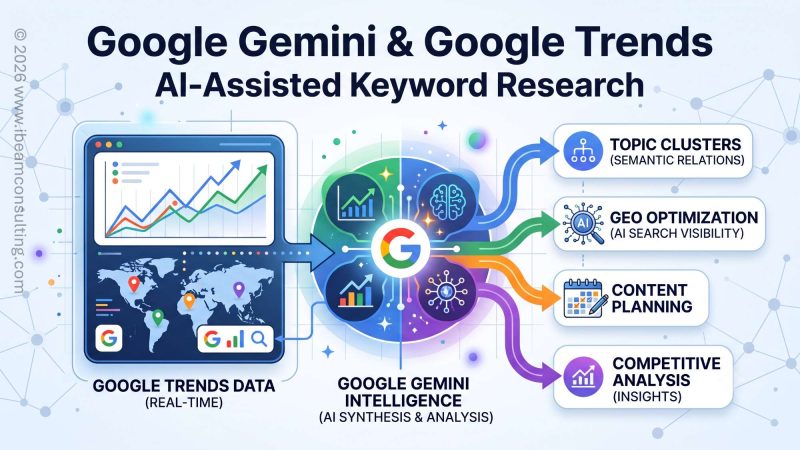
This post highlights ways to use Gemini and Google Trends together for SEO and GEO growth, including insights, tips, and supporting tools.
Let’s get started below!
This post may contain a few referral links to select vendor partners. We may receive compensation for purchases made through these links, at no additional cost to the buyer.
Last updated Jul 31, 2026
Gemini & Google Trends — Brief Introduction
Unlocking Gemini & Google Trends for Modern Search Strategy
For over two decades, search engine optimization and content strategy relied on a familiar, comfortable keyword metric: Monthly Search Volume (MSV).
Marketers built entire content calendars around static, historical averages — trusting that a keyword showing 10,000 monthly searches last quarter would deliver the same steady stream of organic traffic today.
However, the modern web moves too fast for static metrics. Search intent is no longer a fixed target; it is a dynamic, fast-moving target driven by breaking news, algorithmic shifts, social media virality, and the rapid rise of generative AI search.
Relying strictly on trailing 12-month keyword averages means marketers are constantly reacting to where consumer attention was, rather than capitalizing on where it is moving right now.
Enter the intersection of Google Gemini and Google Trends.
By pairing Google Trends – the gold standard for real-time demand signals and relative search interest – with Gemini’s generative intelligence and reasoning capabilities, digital strategists can bridge the gap between raw search data and actionable execution.
This synergy manifests in two distinct modes: native AI features embedded directly within the Google Trends UI, and advanced external workflows where query trend datasets are synthesized inside standalone Gemini environments.
Whether you are a content strategist seeking rapid trend context, an SEO manager navigating Generative Engine Optimization (GEO), or a brand strategist analyzing competitive shifts, understanding how to leverage Gemini alongside Google Trends is essential for building a forward-looking search strategy.
In this post, we will examine the architectural differences between native in-app features and standalone AI workflows, explore Gemini’s capabilities and limitations in search analysis, detail key marketing use cases, and outline a complete technology ecosystem to maximize your search visibility in an AI-first world.
Using Google Trends & Gemini Together
Native vs. Standalone: The Two Ways to Combine Gemini & Google Trends
To build an efficient search intelligence workflow, digital marketers must first distinguish between the two primary ways Gemini interacts with Google Trends: native in-app capabilities embedded directly within the Google Trends user interface, and standalone generative workflows executed outside the tool.
1. Gemini Inside Google Trends (Native In-App Features)
Google has incrementally integrated Gemini’s underlying capabilities directly into the Google Trends platform, particularly across the Explore experience.
This native integration is designed to reduce friction during the initial discovery phase, giving creators immediate assistance without forcing them to context-switch between browser tabs.
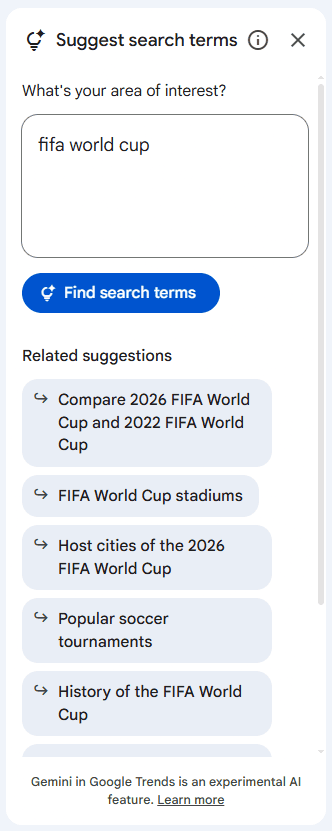
- The Explore Side Panel: When exploring a core topic or keyword, users can trigger the native Gemini side panel (see example below) to get real-time recommendations, related entity breakdowns, and topic suggestions.
- Automated Expansion & Comparative Suggestions: Rather than requiring marketers to manually brainstorm seed terms, the native assistant can auto-generate multi-term comparisons (expanding across up to 8 comparative terms simultaneously). It groups related search queries logically by user intent or geographic nuance.
- Instant Trend Summaries: For sudden breakouts or seasonal spikes, native AI highlights provide quick micro-summaries explaining high-level shifts directly above or beside the trend graphs.
- Best For: Fast, surface-level trend discovery, rapid seed-term expansion, and lightweight visualization during early-stage brainstorming.
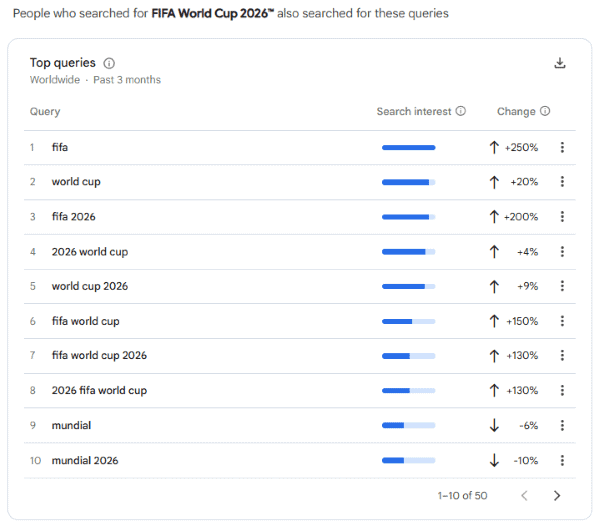
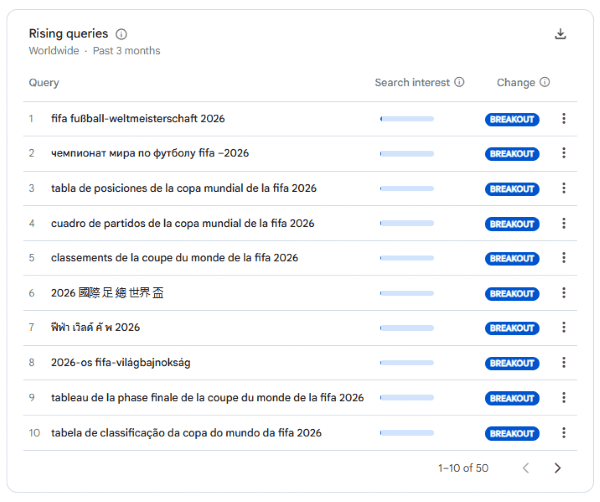
Good to Know: In Google Trends, “Breakout” indicates that a search term or topic experienced a sudden, massive surge in search frequency — specifically a growth rate of more than +5,000% over the selected timeframe. It usually signifies a fast-breaking news story, viral event, or rapidly emerging consumer interest. It may be due to new queries that have had few or no prior searches.
Pro Tip: Note the “download” icon in the upper right corner of the last two screenshots above. This is where you grab a CSV file with the full dataset from Google Trends. E.g., for use with Gemini as described in this post.
2. Gemini Alongside Google Trends (External & Advanced Workflows)
While native AI features in Google Trends excel at quick UI-driven exploration, deep strategic analysis requires exporting Trends data into standalone Gemini environments (such as Gemini Advanced or custom-trained Gems).
In this external workflow, Google Trends acts as a raw keyword/query data source engine, while Gemini serves as the analytical engine (providing context, reasoning, and content production).
- Data Export & Deep Synthesis: Marketers export granular CSV datasets – covering multi-year timeframes, subregion interest breakdowns, and rising related queries – and feed them directly into Gemini alongside first-party metrics (e.g., Google Search Console data) or competitor benchmarks.
- End-to-End Content Execution: Standalone Gemini can transform abstract interest curves into comprehensive deliverables: structured content briefs, ideal customer persona (ICP) mappings, semantic topic clusters, and draft editorial copy tailored for both traditional Google Search and generative AI engines.
- Custom Prompting & Frameworks: Operating outside the constraints of the Trends UI allows marketers to apply custom prompt engineering, brand voice guidelines, and multi-step reasoning frameworks.
- Best For: Strategic editorial planning, cross-channel campaign ideation, multi-source data fusion, and complete full-funnel content creation.
Understanding when to stay inside the Trends interface versus when to move outside into a standalone Gemini workflow allows marketing teams to streamline their research phase while maintaining deep analytical depth.
Google Trends Data & Gemini Analysis
Core Capabilities: What Gemini Brings to Trend Analysis
Google Trends has always been exceptional at showing what people are searching for and when search interest changes. However, raw trend graphs leave a crucial gap: they lack reasoning.
A vertical spike (e.g., a “breakout”) in search velocity tells you that a term is exploding, but it doesn’t tell you why consumers suddenly care or how your brand should respond.
This is precisely where Gemini transforms trend analysis from passive observation into active intelligence.
1. Contextualization of Spikes & Anomalies
The primary pain point in traditional trend analysis is explaining sudden anomalies. When a term hits a relative interest value of 100 or experiences a “+5000% Breakout” status in Google Trends, marketers traditionally had to spend hours searching news feeds and social platforms to piece together the underlying cause.
Gemini solves this by cross-referencing temporal search spikes with real-time web context, news indexing, and cultural event knowledge:
- Root Cause Attribution: Gemini identifies whether a spike was triggered by a product release, a viral TikTok trend, an algorithmic update, an unexpected supply chain event, or a major news cycle.
- Sentiment & Angle Identification: Beyond naming the catalyst, Gemini evaluates consumer sentiment around the spike, helping marketers discern whether an anomaly represents a PR crisis to mitigate or a commercial opportunity to capture.
2. Semantic Expansion & Intent Clustering
Keyword research often suffers from “seed term blindness” — focusing narrowly on literal string matches rather than the broader semantic ecosystem surrounding a search topic.
When processing Google Trends export data, Gemini performs multi-dimensional semantic mapping:
- Topic Cluster Construction: Gemini takes a list of rising “Related Queries” and organizes them into cohesive hub-and-spoke content architectures, identifying primary parent topics and secondary supporting subtopics.
- Search Intent Categorization: It classifies rising queries according to user intent across four core stages:
- Informational: “What is…” / “How does… work”
- Commercial Investigation: Best for “Brand A vs. Brand B”
- Transactional: “Pricing for…” / “Where to buy…”
- Navigational: Direct brand or product portal queries
- Entity Relationship Mapping: Gemini links abstract search terms to recognized Knowledge Graph entities, ensuring that resultant content covers the precise semantic entities search engine algorithms expect.
3. Data Structuring & Synthesis
Raw Google Trends data is unformatted and dispersed across multiple widgets —subregional interest maps, timeline series charts, and related query tables. Gemini excels at turning these disparate data streams into structured, actionable formats:
- Comparative Matrix Generation: Gemini can take comparative trends across multiple regions or categories and build normalized comparison tables highlighting competitive performance.
- Automated Content Brief Generation: By feeding rising search terms and intent clusters into Gemini, content managers can instantly output fully formed content briefs — complete with suggested H2/H3 headings, target audience pain points, primary entities to mention, and recommended meta descriptions.
4. Predictive & Seasonal Campaign Ideation
Google Trends provides historical multi-year interest curves that expose predictable seasonal cycles. However, manually analyzing these curves across dozens of product lines is time-consuming.
Gemini automates seasonal forecasting by:
- Identifying Historical Inflection Points: Pinpointing the exact calendar week (e.g., “Interest consistently begins ramping during Week 34”) when search demand begins its upward inflection.
- Pre-Peak Content Schedules: Calculating recommended content publishing schedules (working backward 4 to 6 weeks from peak demand) to allow search engines sufficient time to index and rank new pages before consumer demand reaches its zenith.
Trends & Gemini — Practical Limitations
Limitations & Boundaries: What Gemini & Trends Cannot Do
While Gemini dramatically speeds up trend interpretation and content production, marketers must understand its technical and analytical boundaries.
Relying blindly on AI analysis without understanding the underlying mechanics of Google Trends can lead to flawed strategic decisions.
1. Relative Interest vs. Absolute Search Volume
The most fundamental misunderstanding in trend analysis is confusing Google Trends’ relative index with absolute search volume:
- The 0–100 Scale Explained: Google Trends normalizes data on a relative scale from 0 to 100, where 100 represents the peak popularity for the selected location and time frame. A score of 100 for a niche query might represent only 500 total monthly searches, while a score of 50 for a broad query might represent 500,000 monthly searches.
- The Gemini Boundary: Gemini cannot calculate exact Monthly Search Volume (MSV), impression counts, or click-through rates solely from Google Trends data. If prompted to provide absolute volumes without external data integration, Gemini may hallucinate estimated search counts. Search volume estimation still requires traditional SEO databases like Ahrefs or Semrush.
2. Hallucination Risks in Spike Attribution
While Gemini is highly effective at contextualizing major news events and macro-trends, it faces hallucination risks when analyzing highly obscure, hyper-niche, or B2B micro-spikes:
- Plausible Misattribution: If a niche B2B keyword experiences a sudden spike with sparse public news coverage, Gemini may construct a highly plausible, professional-sounding explanation for the spike that is entirely incorrect.
- Verification Mandate: Strategists must treat Gemini’s spike explanations as hypotheses rather than absolute facts, validating high-stakes claims against primary sources or news outlets before making major campaign investments.
3. Granular Localized Nuance
Google Trends offers subregional data (such as state, metro area, or city-level filtering), but data density drops significantly as geographic granularity increases:
- Low Volume Thresholds: In smaller geographic regions or low-density search categories, Google Trends returns zero or insufficient data points.
- AI Extrapolation Risk: When presented with sparse localized datasets, Gemini cannot invent localized consumer insights. Attempting to force AI analysis on low-density regional trends often results in generic, unhelpful generalizations rather than actionable hyper-local strategy.
Understanding these boundaries ensures that teams use Gemini for what it does best – synthesizing patterns, mapping intent, and drafting content – while leaving absolute volume validation and fact checking to specialized tools and human expertise.
Related: Learn more in these posts about the potential value of “zero search volume” keywords, and organic search difficulty metrics.
Google Trends & Gemini — Use Cases
Top Use Cases for Marketers & Content Creators
When Gemini’s analytical power is combined with real-time search signals from Google Trends, SEOs and digital marketing teams can deploy highly specialized strategies across content creation, brand positioning, and search optimization.
Here are five top use cases where this integration delivers immediate impact.
Use Case 1: Reactive Content Strategy & Newsjacking
In fast-moving industries like finance, tech, and consumer culture, being first to provide authoritative context on a breaking trend can yield massive traffic dividends.
- The Workflow: Monitor Google Trends’ “Trending Now” feed or set up automated alerts for breakout terms in your industry. Once a breakout query is detected, paste the raw term and top related queries into Gemini.
- The Prompt Goal: Instruct Gemini to synthesize the breaking news context, extract the core consumer questions, and generate a structured 800-word rapid-response article outline within minutes.
- The Outcome: Editorial teams publish well-researched, semantically complete commentary hours or even days before competitors, capitalizing on the initial search spike.
Use Case 2: Seasonal Lifecycle & Pre-Peak Content Optimization
Publishing seasonal content during peak demand is often too late; search engine crawlers require several weeks to index, evaluate, and rank new content.
- The Workflow: Export 5-year historical trends data from Google Trends for seasonal topics (e.g., “tax preparation software” or “summer skincare routine”). Upload the CSV to standalone Gemini.
- The Prompt Goal: Ask Gemini to identify the exact week search interest begins its ramp-up phase (the inflection point), rather than just the peak week.
- The Outcome: Gemini builds a backward-indexed editorial calendar. If demand ramps up during Week 12 and peaks in Week 18, Gemini schedules draft completion for Week 6, guaranteeing content is fully indexed and ranking before consumer search velocity takes off.
Use Case 3: Generative Engine Optimization (GEO)
As search transitions toward AI-driven answer engines – such as Gemini Overviews, Perplexity, and SearchGPT – optimizing strictly for short-tail keywords is no longer sufficient. AI engines answer multi-sentence, conversational user queries.
- The Workflow: Extract rising natural-language queries and conversational question patterns from Google Trends’ “Related Queries” tab.
- The Prompt Goal: Prompt Gemini to re-architect existing static content into direct, authoritative Q&A modules, structured bullet points, and clear entity definitions designed to be cited directly inside LLM search summaries.
- The Outcome: Higher inclusion rates in AI-generated answer boxes, securing brand visibility across both traditional search engine result pages (SERPs) and conversational AI environments.
Use Case 4: Brand vs. Competitor Interest Mapping
Understanding competitive market share requires evaluating regional brand dominance.
- The Workflow: Run a comparative search in Google Trends featuring your brand name alongside key competitors across different subregions or states (e.g., Brand A vs. Brand B vs. Brand C). Export the geographic breakdown.
- The Prompt Goal: Feed regional comparative index scores into Gemini and ask it to segment geographic territories into three strategic categories: Dominant Strongholds, Contested Battlegrounds, and Underperforming Markets.
- The Outcome: Gemini outputs localized positioning recommendations — suggesting tailored ad copy angles and region-specific content themes for battleground markets where competitive search interest is nearly tied.
Use Case 5: Product & Keyword Messaging Validation
Consumer vocabulary evolves constantly. Using outdated terminology in web copy or product listings degrades search relevance and ad conversion rates.
- The Workflow: Compare shifting search interest between evolving terms over a multi-year horizon (e.g., comparing “AI tools” vs. “AI agents” or “plant-based diet” vs. “vegan diet”).
- The Prompt Goal: Use Gemini to analyze the inflection points where newer terminology surpasses legacy phrasing, and ask it to audit existing marketing copy for vocabulary alignment.
- The Outcome: Copywriters update H1 headings, product descriptions, and ad headlines with the precise terms consumers actively use today, improving organic click-through rates (CTR) and messaging clarity.
Supporting Tools for Gemini & Trends
The Complementary Tech Stack: External SEO & GEO Tools
Gemini and Google Trends form a powerful intelligence core, but a modern search strategy requires a multi-tool stack to cover absolute metrics, on-page optimization, and AI brand citation tracking.
1. Traditional Keyword & Volume Verification
- Role: Supplying absolute search volumes and keyword difficulty metrics.
- Integration Point: While Google Trends and Gemini establish directional interest and semantic intent, toolsets like Ahrefs, Semrush, SEO PowerSuite, or Mangools provide essential metrics: Monthly Search Volume estimates, Keyword Difficulty (KD) scores, and domain authority scores. Marketers validate Gemini’s content ideas against these databases before allocating production budgets.
2. Generative Engine Optimization & Brand Monitoring
- Role: Tracking brand visibility within generative AI answer engines.
- Integration Point: Specialized GEO monitoring tools like Otterly.AI, ZipTie, or Peec AI monitor how often your brand is cited in Gemini Overviews, Perplexity answers, and SearchGPT responses. Combining Google Trends signals with GEO tracking reveals whether rising organic trend interest translates into increased citations inside AI engines.
3. On-Page Semantic & Content Optimization
- Role: Fine-tuning content readability, term density, and on-page entity structure.
- Integration Point: Once Gemini generates the primary content brief based on Google Trends clusters, tools like Frase, Surfer, Scalenut, or Clearscope audit the live draft against currently top-ranking competitors in real time. This ensures ideal keyword frequency, heading distributions, and structural readability.
4. First-Party Search Context
- Role: Connecting macro market trends to internal site performance.
- Integration Point: Google Search Console (GSC) supplies first-party data regarding impressions, clicks, and average positions. By uploading GSC performance exports into a Gemini Custom Gem alongside Google Trends data, content strategists can pinpoint internal pages experiencing impression growth aligned with broader market trends, allowing for timely content updates.
- Note: Bing Webmaster Tools also provides useful data in this area.
Related: Learn more here about comparing Google Search Console to Bing Webmaster Tools.
Google Trends & Gemini Workflow
Step-by-Step Practical Workflow
To operationalize this suite of tools into a repeatable weekly process, digital marketing teams can implement a streamlined four-phase workflow: Discover, Synthesize, Validate, and Execute.
Phase 1: Discover (Inside Trends)
- Open Google Trends and navigate to the Explore tab.
- Input core industry seed terms and toggle the native Gemini side panel to generate up to 8 comparative terms and identify breakout queries.
- Quick-filter by geographic region and temporal frame (e.g., Past 90 Days) to confirm momentum.
Phase 2: Synthesize (Alongside Standalone Gemini)
- Export the rising queries and interest-over-time datasets as CSV files.
- Upload the files into standalone Gemini or a dedicated Custom Gem configured with your brand guidelines.
- Run structured prompts to extract intent clusters, customer persona pain points, and comprehensive content briefs with targeted H2/H3 headings.
Phase 3: Validate (SEO Tech Stack)
- Cross-reference Gemini’s proposed content topics against traditional SEO tools (Ahrefs, Semrush, SEO PowerSuite, Mangools, etc.).
- Verify minimum absolute search volume thresholds and evaluate Keyword Difficulty (KD) to ensure traditional ranking feasibility.
- Check internal performance metrics in Google Search Console to see if existing URL assets can be updated rather than creating new pages from scratch.
Phase 4: Execute & Optimize (GEO & Editorial Alignment)
- Draft content using Gemini as a collaborative writing assistant, adhering to authentic brand tone and human editorial standards. Include manual fact-checking where needed, keeping a “human-in-the-loop” (HITL) approach.
- Structure key takeaways into concise Q&A blocks, bullet points, and clear entity definitions designed for Generative Engine Optimization.
- Run final drafts through on-page optimization tools (Frase, Surfer, Clearscope, Scalenut, etc.) and monitor subsequent LLM citations via Otterly.AI, ZipTie, or similar AI search visibility trackers.
Like this post? Quickly share it with your social networks here.
Want to make sure you never miss our updates? Click below to add us as a preferred source on Google Search.

Using Gemini with Google Trends — Closing Thoughts
Conclusion & Strategic Takeaways
The transition from static, backward-looking keyword metrics to dynamic, real-time search intent represents a fundamental leap forward in modern search strategy.
By combining the real-time empirical signals of Google Trends with the reasoning and generative capabilities of Gemini, SEOs and digital marketers gain an unprecedented ability to anticipate market movements rather than react to them.
Key Strategic Takeaways
- Agility Over Stagnation: Real-time demand signals combined with AI synthesis allow digital marketing teams to move from quarterly planning cycles to agile, weekly trend capitalization.
- Context Over Raw Data: Google Trends shows what is changing; Gemini explains why it matters and how to respond.
- Dual-Engine Visibility: Strategically structuring content using trend-derived intent patterns strengthens visibility across both traditional search SERPs and generative AI engines. Gain visibility in both dimensions of the AI Search Visibility Matrix.
- Human-in-the-Loop Imperative: Machine intelligence accelerates research, clustering, and drafting, but strategic positioning, fact validation, and authentic brand voice remain strictly human responsibilities.
Questions or Comments?
I hope this introduction to using Google Trends and Gemini together has been insightful and helpful! Let’s wrap up now with a few related questions for you:
- Do you currently use Google Trends for keyword research for organic or paid search marketing? Have you tried the integrated Gemini tools there?
- Do you use Gemini (or other AI LLMs) for keyword research today? What is your current AI-assisted workflow here?
- Which of the use cases outlined above would give you the most value when using Gemini and Google Trends together?
Feel free to add more in the comments below with any thoughts, feedback, or related questions. Thanks also for any social shares on this post!
