
Unlock Major Cost Savings and Lifetime Access to SEO & GEO Tools
SEO and AI GEO software costs can really start to add up, especially for smaller businesses and website owners with thin martech budgets.
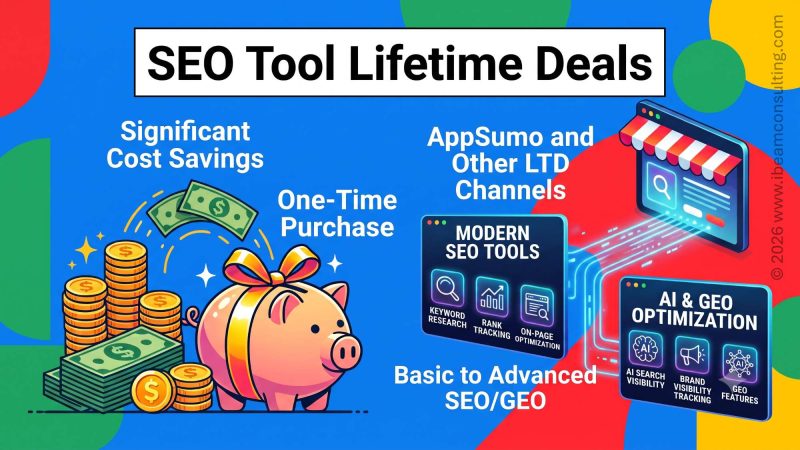
Buying SEO & GEO tools via “Lifetime Deals” (LTDs) is one way to resolve the cost crunch while gaining ongoing access to truly useful search optimization toolkits.
This post explores lifetime deals on SEO & GEO tools, including insights, tips, example toolkits, and LTD marketplaces that make it all possible.
Let’s look closer at the world of SEO lifetime deals below!
This post contains a few referral links to select vendor partners. We may receive compensation for purchases made through these links, at no additional cost to the buyer.
Last updated Jul 25, 2026
SEO Tools and Lifetime Deals — Introduction
A Few SEO LTD Basics
If you run an online business, manage client websites, or build content networks, you already know the painful reality of the modern SEO tech stack: monthly subscription fatigue.
Industry staples like Ahrefs, Semrush, and Moz carry hefty entry prices — often starting at $99 to $129 per month for basic plans, and easily scaling past $500 per month as your tracking limits and team size grow.
Add in the rapidly expanding need to optimize for AI search platforms like ChatGPT, Claude, Perplexity, and Google AI Overviews, and software overhead can quickly become prohibitive.
For freelancers, bootstrapped startups, smaller SMBs, and boutique marketing agencies, these recurring costs can devour profit margins and martech budgets before a single campaign yields results.
Enter the SEO Lifetime Deal (LTD).
An LTD is a pricing model where software creators offer full or tiered access to their software for a single, one-time payment — eliminating monthly or annual subscription fees forever.
Instead of paying $1,200 every year for rank tracking, Generative Engine Optimization (GEO), or content optimization, an LTD buyer might pay a flat fee of $49, $149, or $299 once, securing ongoing SEO/GEO utility for as long as the product exists.
While paying once for software sounds like an obvious win, the world of lifetime deals is far more complex than simple savings.
It is an ecosystem filled with massive success stories, ambitious bootstrapped startups, high-risk ventures, cutting-edge AI visibility platforms, and questionable workarounds like shared “group buy” accounts.
In this article, we will unpack the history and mechanics of SEO lifetime deals, evaluate the top platforms and tools, and analyze a historic LTD case study in the SEO space.
We’ll also compare LTDs against unauthorized account-sharing services and equip you with a decision framework to build a high-performing, cost-effective SEO and GEO tech stack without breaking the bank.
SEO Lifetime Deals — The Origin Story
LTDs Provide a Win-Win for SEO Software Vendors & Buyers
To understand why lifetime deals exist, you have to understand the modern SaaS (Software as a Service) funding landscape.
In the early 2010s, building a software company typically required significant venture capital or years of slow, painful self-funding. Founders needed immediate cash flow to pay developers, license APIs, and cover cloud infrastructure costs.
The Early SaaS Bootstrap Era
As specialized marketplace platforms like AppSumo rose to prominence in the early 2010s, founders discovered a powerful alternative to traditional venture funding: customer-funded bootstrapping.
By offering early adopters a “lifetime” license at a steep discount, software creators could generate $50,000 to $500,000 in non-dilutive capital within a few weeks.
Instead of giving up equity to investors, founders traded lifetime product access to an enthusiastic group of early backers who acted as product champions, bug testers, and word-of-mouth marketers.
The Evolution of the LTD Market
Over the last decade, lifetime deals transformed from simple software pre-orders into a highly structured, competitive growth channel.
Today’s LTD ecosystem includes multi-tiered reward structures (“stackable codes”), vibrant buyer communities, and sophisticated marketplace vetting.
For search software in particular, the LTD model became a trial by fire. Early tools offered simple XML sitemap generators or basic rank trackers.
However, as web development, search algorithms, and artificial intelligence advanced, search tools required vastly more resources — data scraping engines, proxy management, massive keyword indexes, and, more recently, costly Large Language Model (LLM) API integrations for AI search visibility tracking, brand citation monitoring, and Generative Engine Optimization (GEO).
Why SEO & GEO Tools Turn to LTDs
SEO and GEO software is uniquely expensive to build and maintain compared to static utilities like project management boards or design tools. Yet, founders in the search space consistently turn to lifetime deal promotions for three primary reasons:
1. Extreme Market Saturation: The market for keyword tools, backlink monitors, AI writers, and brand visibility trackers is crowded.
A brand-new tool competing against established industry leaders cannot win through standard organic search or paid ad campaigns alone. Launching an LTD instantly puts the tool in front of tens of thousands of active buyers.
2. Stress-Testing Infrastructure: Search tools rely heavily on crawlers, scrapers, API endpoints, and LLM response parsers.
Running an LTD brings an immediate influx of power users who run large audits, track thousands of prompts, and submit edge-case support tickets. This provides the ultimate stress-test for server infrastructure before targeting full-price Enterprise SaaS clients.
3. Rapid User Feedback Loops: Search engines and AI answer engines change constantly.
A passionate LTD community acts as an extended product team, requesting urgent feature adjustments, reporting broken scrapers, and helping founders refine their product-market fit in real time as new search experiences emerge.
Finding SEO & GEO Lifetime Deals
Top LTD Marketplaces & Discovery Hubs
Navigating the world of lifetime deals requires knowing where to look. While some software companies host promotions independently, the vast majority launch through centralized SaaS marketplaces that provide built-in distribution, payment processing, and buyer protection.
AppSumo: The Undisputed Market Leader
AppSumo remains the heavyweight champion of lifetime deal marketplaces. Founded in 2010, the platform has generated millions of dollars for bootstrapped startups and saved entrepreneurs hundreds of millions in software costs.
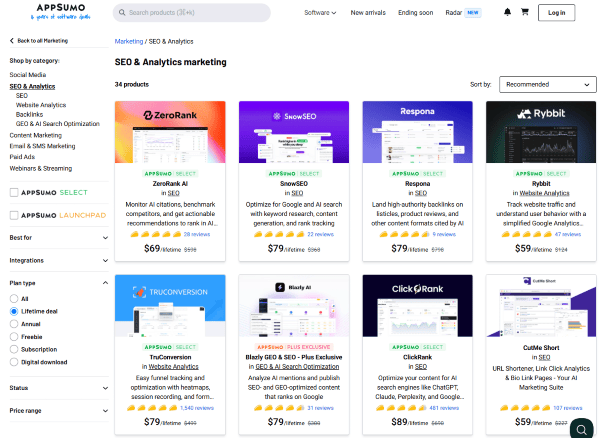
AppSumo operates primarily through two distinct promotional channels:
- AppSumo Select: Curated, highly vetted launches managed directly by AppSumo’s internal team. Select deals undergo rigorous technical and security audits, offering multi-tiered license structures that allow buyers to “stack” codes for increased usage limits, client workspaces, or white-label reporting.
- AppSumo Launchpad: An open marketplace where independent developers can list their tools directly. While Launchpad features raw and innovative early-stage tools, it requires buyers to perform extra due diligence regarding long-term founder commitment.
AppSumo’s hallmark feature is its generous 60-day no-questions-asked refund policy, which serves as a crucial safety net for buyers testing emerging software.
Alternative LTD Platforms
While AppSumo dominates mindshare, several competing marketplaces cater to specific niches within the SaaS community:
- Dealify: A marketer-focused deal site that frequently highlights SEO utilities, AI content generators, and specialized web tools with straightforward tiering.
- StackSocial: A broader marketplace offering software, consumer tech, and online courses, often hosting perpetual promotions for established software utilities and VPN services.
- SaaS Mantra: A community-centric platform focusing on long-term sustainability, helping founders build sustainable revenue models while offering exclusive deals to early adopters.
Direct-to-Consumer Launches
Not all founders use LTD marketplaces. Some choose to run LTD campaigns directly on their own websites, marketing through specialized private Facebook groups (such as SaaS Growth Hacks or LTD Hunt), Reddit subreddits, or dedicated email newsletters.
Direct-to-consumer LTDs allow founders to avoid marketplace commission fees (which can exceed 50%), but they place full responsibility on the buyer to verify the security, refund terms, and payment processing legitimacy of the offer.
SEO LTDs — Example Categories & Tools
Popular Types of SEO Tools Offering LTDs
The SEO software ecosystem spans dozens of functional categories. While enterprise platforms like Ahrefs, Moz, etc., never or rarely offer lifetime access, specialized software providers frequently use LTDs to establish market share across several key operational categories.
Content Optimization & On-Page AI
Content optimization tools analyze top-ranking SERP pages to provide real-time recommendations for keyword frequency, heading structures, readability, and semantic relevance.
- Notable Examples: NeuronWriter, Scalenut, and early-stage promotional runs from tools like Frase.
- Why LTDs Work Here: Content optimization tools help users craft high-performing articles without requiring continuous live web scraping for every user request. Once a SERP analysis is cached, the marginal processing cost per document is relatively low, making tiered monthly NLP credit limits manageable for software vendors.
Generative Engine Optimization (GEO) & AI Search Visibility Tracking
As search behavior shifts from traditional Google blue links toward conversational AI platforms – such as ChatGPT, Perplexity, Gemini, Claude, and Google AI Overviews – a new generation of tools has emerged to monitor GEO performance, including AI brand visibility.
Unlike traditional rank trackers that monitor static URL positions on Google, GEO tools track brand mentions, source citations, prompt placement, and sentiment across multi-turn LLM conversations.
Notable LTD Entrants:
- Blazly GEO & SEO: Combines site audits and pillar content generation with AI citation flow monitoring and visibility scores across ChatGPT, Gemini, and Claude.
- Highlighted.ai: Focuses on tracking brand citations and competitor positioning within AI Overviews and LLM search results, often utilizing “Bring Your Own Key” (BYOK) models to keep LTD costs sustainable.
- ZeroRank AI: Monitors brand mentions, sentiment, and prompt gaps across seven major AI platforms, providing actionable recommendations to optimize content for AI recommendation engines.
- SnowSEO & AI Mentions: Multi-engine visibility trackers that automate brand citation checks and prompt tracking across emerging search assistants.
The GEO LTD Dynamic: GEO tools face real API costs when querying LLM models. Consequently, GEO lifetime deals frequently structure their tiers around tracked prompts, monthly prompt run frequencies, or custom API key integrations (BYOK) to ensure long-term platform viability.
Rank Trackers & SERP Analysis
Rank tracking remains a foundational requirement for search marketers. These tools automate daily or weekly checks of target keyword positions across desktop, mobile, and localized geo-targets.
- Notable Examples: Serpstat, Ranktracker, Wincher, and Nightwatch.
- The LTD Dynamic: Rank tracking costs scale directly with scraping proxies and IP infrastructure. To maintain profitability, rank tracking LTDs usually place strict limits on daily tracked keywords, refresh frequencies (e.g., weekly vs. daily), or local geo-locations per tier.
Technical SEO & Auditing Tools
Technical SEO tools crawl websites to discover broken links, improper canonical tags, missing schema markup, indexation issues, and Core Web Vitals performance bottlenecks.
- Notable Examples: WebSite Auditor (free desktop version), Sitechecker, and various specialized schema and speed monitoring tools.
- Why LTDs Work Here: Site auditing primarily consumes server compute power during active crawls. Since site audits are executed periodically rather than continuously, vendors can set monthly crawl page limits without incurring unpredictable daily operational expenses.
Backlink & Outreach Management
Off-page SEO tools assist marketers in discovering link opportunities, verifying backlink status, managing cold outreach campaigns, and monitoring toxic links.
- Notable Examples: Respona (early promos), Postaga, and link monitoring utilities like LinkChest.
- The LTD Dynamic: Full backlink index creation requires immense storage and web crawling resources that rival Ahrefs or Majestic. As a result, backlink LTDs usually focus on campaign management, email outreach automation, or link monitoring via third-party API connections rather than building proprietary global link graphs.
SEO Lifetime Deals — A Key Case Study
Spotlight SEO Toolkit Case Study: The Ubersuggest LTD
To understand the macro impact of lifetime deals on the SEO industry, let’s look at the single most famous – and polarizing – LTD promotion in SEO software history: Neil Patel’s Ubersuggest Lifetime Deal.
Ubersuggest Background
Originally launched as a free Chrome browser add-on and simple keyword suggestion scraper by developer Alessandro Martin, Ubersuggest was acquired by digital marketer Neil Patel in 2017.
Patel’s vision was to build an accessible alternative to complex enterprise tools like Ahrefs and Semrush.
Over several years, Patel invested millions of dollars into developing Ubersuggest into a full-featured SEO suite — adding backlink indexes, site auditing capabilities, rank tracking, and competitor keyword research.
When it came time to monetize, Patel introduced a model that shocked the digital marketing space: along with affordable monthly subscriptions, Ubersuggest introduced a lifetime payment option.
This LTD option started at roughly $290 (or $29/month vs. $290 lifetime for an individual plan) — effectively pricing the lifetime deal at the equivalent of just 10 months of recurring subscription access.
Why the Ubersuggest LTD Shook the Industry
Before Ubersuggest’s campaign, lifetime deals in the search space were largely confined to niche utilities, technical crawlers, or early-stage startups.
Mainstream industry opinion held that running a comprehensive keyword and backlink database on a lifetime model was financially impossible due to ongoing proxy, server, and web crawling overhead.
By offering a full SEO suite for a single price tag that cost less than 3 months of Ahrefs, Ubersuggest achieved several major outcomes:
- Massive Market Penetration: Hundreds of thousands of site owners, small businesses, and freelancers who could never justify $100+/month for premium SEO software quickly became paying Ubersuggest customers.
- Reframing Customer Expectations: The promotion redefined buyer expectations across the industry. Marketers began questioning why smaller software providers were charging recurring fees when an industry figurehead was offering a lifetime option.
- Loss-Leader Growth Engine: Patel viewed Ubersuggest not as an isolated software product, but as the top-of-funnel marketing asset for his consulting agency (NP Digital) and broader ecosystem. The LTD model generated millions in up-front cash flow while funneling corporate clients toward high-ticket consulting services.
Lessons & Impact for LTD Buyers and Vendors
The Ubersuggest case study provides two critical lessons for evaluating SEO lifetime deals:
1. Sustainability Requires a Business Model Beyond Software Fees: Ubersuggest sustained its lifetime offer because it was backed by an established enterprise agency and supplementary revenue channels.
When evaluating smaller LTD founders offering heavy data-scraping capabilities, buyers must ask whether the company has the auxiliary revenue or cash reserves to survive long-term data costs.
2. Quota Tiering is Necessary for Survival: To prevent abuse and manage API overhead, Ubersuggest eventually tightened daily search limits, historical report access, and project limits for LTD users.
This highlighted a universal truth of lifetime deals: a lifetime license guarantees access to the platform, but the scope of usage limits will almost always evolve over time.
SEO Lifetime Deals vs. “Group Buy” Services
LTDs vs. Shared SEO Toolkit Access: Many Key Distinctions
When cash-strapped site owners search for ways to reduce software expenses, they often encounter another popular workaround alongside lifetime deals: SEO “Group Buy” services.
While both options promise relief from expensive monthly SaaS fees, they operate on completely opposite sides of legal, ethical, and operational spectrums.
Defining Group Buys
An “SEO Group Buy” is an unauthorized, third-party service where an intermediary purchases a single high-tier enterprise account for premium software (such as Ahrefs, Semrush, Majestic, or Moz) and resells access to hundreds of individual users.
Access is typically managed through shared browser cookies, custom desktop browsers, or private proxy extensions that fool the original software into believing all traffic originates from a single user.
Key Comparison Points: SEO LTDs vs. Group Buys
| Criteria | SEO Lifetime Deals (LTDs) | SEO Group Buy Services |
|---|---|---|
| Legitimacy & Ethics | 100% Authorized. Directly created, sanctioned, and supported by the software developer. | Unauthorized & Violates ToS. Directly breaches SEO software Terms of Service and user licensing agreements. |
| Security & Privacy | High. You receive dedicated credentials, private workspace data, and isolated API access. | Severe Risk. Shared browser sessions mean strangers can potentially view your client domains, search history, and project files. |
| Reliability & Uptime | Stable. Standard SaaS reliability, direct customer support, and official SLA access. | Extremely Volatile. Accounts are constantly banned by primary software providers, leading to frequent downtime, CAPTCHA loops, and broken links. |
| Account Ownership | Permanent. You own a legitimate software license associated with your email. | Temporary Renting. You pay a monthly fee to a middleman with zero guarantee of service continuity. |
| Feature Completeness | Full Feature Access (subject to tier quotas). | Disabled Features. Export limits, API access, project creation, and team seats are usually restricted or blocked entirely. |
Security & Operational Risks of Group Buys
For professional marketing agencies, consultants, and serious business owners, using group buys introduces severe operational hazards:
- Client Data Exposure: Because group buy environments utilize shared sessions and custom browser extensions, your client lists, niche research, and competitive analysis queries are visible to other users on the shared server — or even intercepted by the group buy operator. Your SEO data may be shared inadvertently or even used against you in a competitive SEO sense.
- Malware and Browser Vulnerabilities: Many group buy providers require users to install unverified Chrome extensions or modified Chromium browsers to bypass multi-factor authentication. These extensions pose significant security risks, including potential keylogging or cookie theft.
- Sudden Business Disruption: Enterprise SaaS providers continuously update their anti-abuse algorithms. When Semrush or Ahrefs flags a group buy account, the account is instantly terminated without warning. If you rely on a group buy for an urgent client deliverable, you can easily be locked out mid-project.
- Multi-Year Project Risks: Since access to group SEO tools can easily get disrupted, relying on them for project and data continuity over many months and even years can be a huge risk. Tracking long-term SEO or GEO performance – such as keyword rankings, AI prompt visibility, brand citation Share of Voice, backlink profiles, and domain authority – becomes an ongoing worry.
The Verdict
SEO Lifetime Deals are a legitimate, authorized investment that creates a permanent business asset while supporting independent software developers.
Conversely, group buy services are a high-risk, unethical temporary patch that jeopardizes your security and operational reliability. Investing in a structured stack of legitimate LTD tools is always the superior strategic move.
SEO Lifetime Deals — Decision Factors
LTD Pros, Cons, and Key Considerations
Investing in lifetime deals can completely reshape a business’s bottom line, but it is not without financial and operational trade-offs.
To make informed purchasing decisions, you must balance the undeniable upside against the inherent risks of early-stage software.
Primary LTD Pros
- Eliminates Recurring Software Overhead: Replacing two or three $50/month SaaS subscriptions with lifetime purchases directly reduces fixed monthly expenses, improving profit margins for agencies, freelancers, and site owners.
- Tremendous ROI Potential: Early backers of platforms like NeuronWriter, Frase, or Serpstat secured lifetime access for less than $100. As these tools matured and added enterprise capabilities, early buyers gained thousands of dollars in value relative to ongoing subscription rates.
- Direct Access to Founders & Product Roadmaps: LTD communities (via Slack, Discord, or private Facebook groups) frequently offer direct interaction with tool founders. Early backers can vote on upcoming features, request API additions, and shape product development around their specific SEO/GEO workflows.
Primary LTD Cons & Key Risks
- Vendor Survival & Pivot Risk: Bootstrapped startups operate on thin margins. If a software company runs out of capital, encounters unmanageable server expenses, or pivots away from its original core capabilities, your “lifetime” deal ends when the platform shuts down. Or the toolkit may survive but depart significantly from your original needs and use cases.
- Strict Tier Quotas & Credit Limits: Lifetime licenses almost always come with hard limits — such as 30 AI articles per month, 500 tracked keywords, or 50 prompt runs in GEO tracking tools. High-volume users may find that Tier 1 licenses quickly run out of monthly credits, requiring code stacking or custom API keys.
- Data Index Quality Variations: Enterprise giants spend tens of millions of dollars maintaining proprietary web crawlers and index databases. Smaller LTD tools often rely on third-party data APIs (like DataForSEO or SERP APIs) or third-party LLM endpoints. If an upstream data provider increases prices or updates terms, the LTD tool’s feature reliability can be affected.
- “Binge Buying” and Unused Tools: SEO lifetime deals can be so attractive that it’s tempting to load up on multiple buys all at once. For example, “Black Friday” SEO sales in November can make LTDs even more compelling. If refund periods expire (see the checklist below), you may become stuck with unused LTD tools that you don’t really need or want.
Crucial LTD Pre-Purchase Checklist
Before clicking “Buy” on any SEO or GEO lifetime deal, run through this simple verification framework:
- Investigate the Vendor Team & Track Record: Look up the founders on LinkedIn. Have they built, maintained, or sold SaaS products before? Do they actively engage in community discussions?
- Analyze Tier Structures & Stacking Rules: Calculate your actual monthly usage requirements (e.g., how many sites, monthly crawls, or tracked prompts do you handle?). Determine whether purchasing Tier 1 is sufficient or if stacking multiple codes (Tier 2 or 3) is necessary to unlock white-label reporting and sub-accounts.
- Verify the Refund Window & Test Immediately: Platforms like AppSumo offer 60-day refund windows. Immediately upon purchase, run a live project: test the speed of site audits, compare rank tracking positions against Google Search Console, and verify AI citation tracking accuracy. If the data quality falls short, request a refund immediately.
Like this post? Quickly share it with your social networks here.
Want to make sure you never miss our updates? Click below to add us as a preferred source on Google Search.

SEO Tool Lifetime Deals — Closing Thoughts
LTD Conclusions & Strategic Advice
Navigating the landscape of SEO and GEO lifetime deals is ultimately about balance.
While relying entirely on LTDs for every aspect of SEO and AI GEO can present limits, ignoring lifetime deals altogether means leaving immense cost savings on the table.
Strategic Framework: When to Buy LTDs vs. Monthly Subscriptions
Buy Lifetime Deals For:
- Focused, single-purpose utilities (content optimization, schema builders, local SEO trackers, site crawlers, and AI brand visibility monitors).
- Early-stage experimentation with cutting-edge capabilities, such as tracking prompt placement across ChatGPT, Perplexity, and Claude.
- Secondary client projects, side hustles, or supplementary verification tools.
Pay Monthly Subscriptions For:
- Massive global backlink database analysis and deep competitive intelligence (e.g., enterprise seats on Ahrefs or Semrush).
- Mission-critical infrastructure where guaranteed uptime SLAs and massive multi-million-page web indexes are non-negotiable for multi-million-dollar corporate accounts.
The Ultimate Goal: Building Your Custom “LTD Stack”
The most effective digital marketers do not make a completely binary choice between premium SEO tools and lifetime deals — they combine them strategically.
By assembling a modular LTD Stack (e.g., using NeuronWriter for content optimization, Blazly GEO or ZeroRank AI for AI search visibility, and a specialized crawler for technical audits), you can cover 80% to 90% of your daily operational needs at zero recurring cost.
You save your monthly software budget for specialized SEO/GEO capabilities and data when and where you truly need it.
Questions or Comments?
I hope this introduction to SEO/GEO software lifetime deals has been illuminating and helpful! Let’s close with a few related questions for you:
- Have you purchased LTDs on SEO or GEO tools already? Which marketplace or purchasing channel do you prefer?
- Which SEO or GEO lifetime deal has delivered the highest ROI for you so far?
- How do you ideally combine SEO LTDs with more traditional monthly or annual subscriptions?
Feel free to add more in the comments below with any thoughts, feedback, or related questions. Thanks also for any social shares on this post!
