
Privacy-Focused Alternatives for EU-based Websites & Visitors
Implementing website analytics for European traffic requires “privacy-first” thinking and approaches.
Fortunately, many effective analytics tools are available for both EU-based and non-EU-based websites. They include excellent non-Google Analytics options.
This post highlights website analytics for Europe, including insights, approaches, and tools to help you achieve a “privacy-first” analytics environment.
Read on and learn more below…
Note: This post contains a few referral links to select vendor partners. We may receive compensation for purchases made through these links, at no additional cost to the buyer.
Disclaimer: The authors of this post (and iBeam Marketing Consulting Services, LLC) are not attorneys and do not provide legal advice. This post is for informational purposes only and does not constitute legal guidance. Readers should consult with and rely on their own legal counsel before implementing any of the analytics solutions mentioned in this post.
Last updated Apr 20, 2026
Website Analytics & European Site Visitors
Introduction: Web Analytics & the New Standard for Digital Trust
Recently, the landscape of website analytics for European businesses has shifted from a state of “wait and see” to one of “privacy by default.” For nearly a decade, the General Data Protection Regulation (GDPR) and the ePrivacy Directive created a complex, often fragmented set of rules for how businesses could track their visitors.
Today, that fragmentation is disappearing, replaced by a more cohesive – and stricter – regulatory environment.
The introduction of the Digital Omnibus Regulation has marked a turning point. It has officially folded cookie and tracker governance directly into the core of the GDPR framework.
For business owners, this means that data privacy is no longer just a legal hurdle managed by the IT department; it is a fundamental component of brand identity and customer trust.
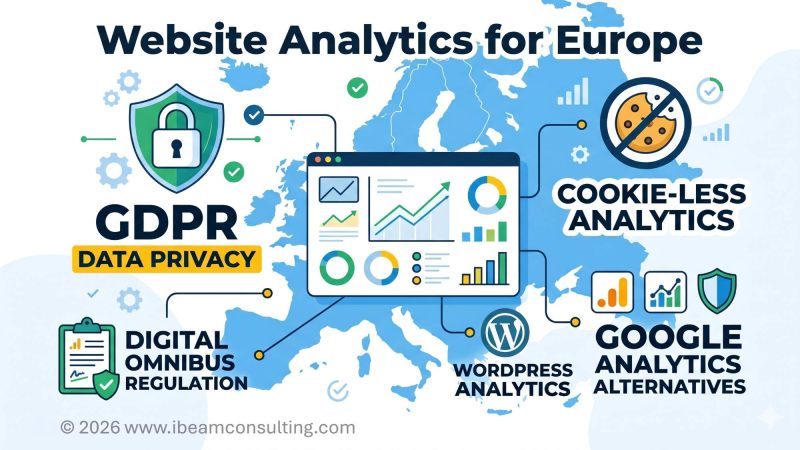
For many years, Google Analytics (GA) was the undisputed default for B2B and B2C websites alike. However, the “Post-GA4” reality is now setting in. Following intense scrutiny from European regulators over the last few years, businesses are realizing that “standard” configurations of US-based tools often fall short of the localized data sovereignty now required in the EEA.
Whether you are running a high-traffic e-commerce store or a specialized B2B service site, the choice of analytics tool now dictates your legal exposure and your user experience.
This guide explores the high-performance, EU-compliant Google Analytics alternatives that allow you to grow your business without compromising on the privacy rights of your visitors.
Website Analytics & EU Legal Issues
The Legal Landscape: Context for European Websites
To navigate the current market, it is essential to understand the three pillars of modern European data law: Consent, Localization, and the Digital Omnibus.
The GDPR & ePrivacy Foundation
Under the GDPR, identifiers like IP addresses and Client IDs (CIDs) are considered personal data. The ePrivacy Directive historically governed the “storage or access” of information on a user’s device — popularly known as the “Cookie Law.”
In 2026, the distinction between these two has blurred. If your analytics tool collects an IP address or drops a cookie, you must have a valid “lawful basis” for doing so, which almost always defaults to explicit user consent.

The Digital Omnibus Regulation (2026)
The implementation of Article 88a of the GDPR, via the Digital Omnibus package, has formally absorbed cookie consent rules into the GDPR’s heavy enforcement regime.
Crucially, the regulation now mandates Symmetry in Consent: website visitors must be able to “Reject All” non-essential trackers with the same number of clicks and visual prominence as “Accept All.”
This has effectively ended the era of “dark patterns,” making cookieless or privacy-first analytics tools more attractive than ever as a way to avoid intrusive banners entirely.
Data Sovereignty & Localization
The location of your data matters as much as how you collect it. Despite the EU-U.S. Data Privacy Framework, many European regulatory bodies (including France’s CNIL and Germany’s BfDI) express a strong preference for “Sovereign Analytics” — tools where the data is both processed and stored on servers owned and operated within the European Economic Area (EEA).
In Germany, the TDDDG (formerly TTDSG) provides specific, rigorous requirements for terminal equipment data protection that your analytics stack must meet.
The Role of Regulatory Entities
- EDPB: Sets the high-level guidelines for the entire EU.
- CNIL (France): Known for its strict enforcement and for providing an “approved list” of tools that can, in specific configurations, be exempt from consent requirements.
- BfDI (Germany): Particularly focused on the German TTDSG/TDDDG standards, emphasizing “Privacy by Design” in technical architectures.
EU Website Analytics Tools — Part 1
Category 1: Lightweight & Privacy-First (Best for B2C & Content)
For many B2C businesses, the primary goal of analytics is simply to understand traffic trends and content performance.
If you don’t need complex user-stitching or cross-device tracking, “lightweight” analytics allow you to ditch the cookie banner entirely.
Plausible Analytics (Estonia)
Based in Estonia, Plausible is a leader in the “Anti-Google” movement. It is open-source, uses no cookies, and collects no personal data. By discarding IP addresses and using anonymous hashes, it remains 100% compliant without requiring a consent banner.
Fathom Analytics (Canada)
While based outside the EU, Fathom is a top choice for international businesses due to its EU Isolation technology. This ensures that any traffic from a European IP is routed through a German-owned infrastructure where personal data is stripped before it ever touches a Canadian or US server.
Simple Analytics (Netherlands)
Taking a “radical privacy” approach, Simple Analytics does not even store an IP address in temporary memory. Their dashboard is minimalist, making it a favorite for publishers and content creators who prioritize page speed and UX.
Pirsch Analytics (Germany)
Built for the strictest German standards (TTDSG), Pirsch uses a cookieless fingerprinting method that is highly accurate yet completely anonymous. Their use of Hetzner (a German cloud provider) ensures the data never leaves the “sovereignty” of German law.
EU Website Analytics Tools — Part 2
Category 2: Feature-Rich & Enterprise Alternatives (B2B & Complex Sites)
If your business requires deep-dive funnels, attribution modeling, or multi-site management, the lightweight tools above may feel restrictive.
Fortunately, European enterprise solutions now offer feature parity with GA4 without the compliance baggage.
Matomo Analytics (New Zealand / EU)
Formerly Piwik, Matomo is the most popular open-source alternative. While the parent company (InnoCraft) is in New Zealand, the software is built for EU compliance.
Its greatest strength is the Self-Hosting option; by running Matomo on your own EU servers, you ensure that you – and only you – own the data. It is one of the few tools recognized by France’s CNIL as potentially consent-exempt.
Piwik PRO (Poland)
Piwik PRO is a managed enterprise SaaS that feels very familiar to former Google Analytics 360 users. It includes an integrated Consent Manager and Tag Manager, allowing you to orchestrate your entire marketing stack from a single, GDPR-compliant dashboard.
PostHog Web Analytics (USA/UK)
Founded in the UK and headquartered in California, USA, PostHog combines analytics with heatmaps and session recording. Crucially, they offer an EU-resident cloud option, ensuring that sensitive product-usage data stays within the EEA borders.
EU Website Analytics Tools — Part 3
Category 3: B2B-Specific Analytics & Intent Data
In B2B marketing, knowing that a visitor arrived is less important than knowing who that visitor represents. This category focuses on “Account-Based” analytics, identifying the companies behind the traffic.
Leadfeeder (Finland)
Recently reunified as a single platform following a brief period as Dealfront, Helsinki-based Leadfeeder is the leader in B2B intent data. Its Web Visitors tool identifies the companies visiting your site by cross-referencing IP addresses against its massive, GDPR-compliant database of corporate entities.
Leadfeeder serves as a full-funnel engine, helping sales teams identify high-intent prospects before they ever fill out a website form.
Related: Learn more about why and how Dealfront rebranded to Leadfeeder.
Leadinfo (Netherlands)
A strong challenger in the European market, Leadinfo is known for its high-quality data in the Benelux and DACH regions. It provides real-time “company profiles” of your website visitors, including industry, size, and contact information for decision-makers — all while operating under a strict “corporate-only” tracking model that avoids identifying individual natural persons.
Good to Know: Leadinfo acquired Canada-based Visitor Queue in early 2026.
By focusing on corporate identity rather than personal tracking, these tools allow B2B firms to maintain high-impact outreach strategies while adhering to the spirit and letter of European privacy law.
European Visitors & Non-EU Websites
The Global Player Strategy: Managing EU Visitors from Abroad
For companies headquartered outside of Europe, the GDPR is not just a “European problem.” Due to the extra-territorial nature of the law, any business targeting European residents or monitoring their behavior is legally required to comply.
International firms with European website visitors are adopting sophisticated technical and legal strategies to manage this.
The “EU Isolation” Model
Forward-thinking international providers have moved away from simple “Global Clouds.” Instead, they use EU Isolation techniques. When an EU visitor hits a site, their traffic is automatically routed to a proxy server located within the EEA.
This proxy strips away personal identifiers (like the full IP address or specific device headers) before any data is sent back to the company’s primary headquarters in a non-EU country.
This ensures that the “export” of website visitor data – the most legally sensitive part of the process – is minimized or eliminated.
Hybrid Infrastructure
Using “Zero-Knowledge” architectures where the software provider is international but the data encryption keys and storage remain on European soil.
Leveraging Adequacy and SCCs
Companies in countries like Canada, the UK, and New Zealand benefit from “Adequacy Rulings,” meaning the EU recognizes their local laws as essentially equivalent to the GDPR.
This makes using tools from these regions (like Fathom or Matomo) much simpler. For US-based firms, the reliance on Standard Contractual Clauses (SCCs) remains the fallback, though many now prefer to simply use EU-hosted instances of their chosen software to bypass the headache entirely.
Article 27 Representation
A critical compliance requirement often missed by non-EU companies is the appointment of an Article 27 Representative. If you do not have a physical office in the EU but process the data of EU residents, you must legally designate a representative within one of the member states.
This person serves as the point of contact for Data Protection Authorities (DPAs) and ensures that your global operations remain accountable to local laws.
EU Website Analytics for WordPress Sites
WordPress-Specific Options for EU-Compliant Analytics
With over 40% of the web running on WordPress, many European businesses need solutions that integrate directly with their CMS without adding technical bloat.
WP Statistics (USA)
This is the ultimate “privacy-by-design” plugin for WordPress, developed by VeronaLabs. Unlike most tools that send data to a third-party server, WP Statistics keeps everything in your own site’s database.
No data ever leaves your server, making it a powerful choice for businesses that want total control over their data footprint.
MonsterInsights (USA — with EU Compliance Addon)
For those who are not yet ready to leave Google Analytics, MonsterInsights (part of the Florida-based Awesome Motive family) provides a “compliance bridge.”
Its specialized EU addon automatically anonymizes IP addresses, disables demographic tracking, and integrates with major consent plugins to ensure GA4 only fires after the user has opted in.
Burst Statistics (Netherlands)
Developed by the team behind the popular Complianz plugin, Burst is a lightweight, cookieless analytics tool built specifically for the modern WordPress ecosystem. It focuses on essential metrics like page views and referrers without the need for a cookie banner, ensuring your site remains fast and compliant.
The Role of Consent Managers
In 2026 and beyond, the integration between your website analytics and consent management platform (CMP) is vital.
Plugins like Complianz (EU) or Borlabs Cookie (Germany) are essential for companies using cookie-based enterprise tools, as they provide the required “Symmetry in Consent” (the one-click Reject All button) mandated by the Digital Omnibus Regulation.
Picking EU-Friendly Website Analytics Tools
Choosing Your EU Website Analytics Stack: A Decision Framework
With so many high-quality options available today, the right choice depends on your specific business goals and technical appetite. Here is a framework to help you decide.
The “Conversion-First” Path
- Best for: B2C e-commerce, high-volume content sites, and startups.
- Primary Tools: Plausible, Pirsch, or Simple Analytics.
- The Logic: In an era where “Reject All” click rates are high, using a cookieless tool allows you to recapture nearly 100% of your traffic data without ever showing a banner. You sacrifice deep cohort analysis in exchange for much higher data accuracy and a faster, cleaner user experience.
The “Data-Deep” Path
- Best for: Large enterprise websites, government entities, and highly regulated industries (Finance/Health).
- Primary Tools: Matomo (Self-Hosted) or Piwik PRO.
- The Logic: When you cannot afford any legal ambiguity, “Sovereign Analytics” is the answer. By hosting the data in your own EU-based cloud or using an enterprise platform like Piwik PRO, you maintain the same level of granular detail found in GA4 but with total control over the data governance and consent journey.
The “B2B Sales” Path
- Best for: B2B service providers, manufacturing, and SaaS sales teams.
- Primary Tools: Leadfeeder or Leadinfo.
- The Logic: If your primary KPI is “Sales Pipeline” rather than “Page Views,” individual tracking is often less valuable than company identification. Identifying that a specific blue-chip company is researching your solution is worth more than a thousand anonymous hits. Use these tools to fuel your ABM (Account-Based Marketing) strategy while keeping your personal data collection to a minimum.
Like this post? Quickly share it with your social networks here.
Website Analytics for Europe — Closing Thoughts
Conclusion: The Future of Web Analytics is Sovereign
The shift we are seeing in website analytics approach represents a fundamental change in the digital social contract.
For decades, the “free” tools of the web were paid for with the personal data of citizens. Today, European businesses are leading the way in proving that high-performance marketing and radical privacy are not mutually exclusive.
The emergence of “Zero-Knowledge” architectures and “Sovereign Analytics” has provided a robust alternative to the data-hungry models of the past.
As the Digital Omnibus Regulation continues to standardize compliance across the EEA, the businesses that thrive will be those that treat privacy as a core product feature rather than a legal burden.
Suggested Next Steps
- Audit Your Website’s Cookies: Use a tool like Complianz or CookieYes to see what you are currently tracking.
- Verify Data Residency: Ask your current providers exactly where your “data at rest” is stored.
- Shadow Test: Run a privacy-first analytics tool like Plausible or Matomo alongside your current stack (e.g., GA4) for 30 days to see the difference in data accuracy.
In the end, respecting your visitor’s privacy is the single most effective brand-building exercise you can undertake in the 2020s. By choosing the right analytics stack, you aren’t just complying with regional laws — you’re building a foundation of trust that will last long after the latest regulation has passed.
Quick Appendix — Resources & References
Legal & Regulatory Frameworks
- GDPR (Official Text): EUR-Lex – Regulation (EU) 2016/679
- ePrivacy Directive: EUR-Lex – Directive 2002/58/EC
- Digital Omnibus Regulation (2026): EU Digital Omnibus Proposal & Guidance
- Schrems II Judgment Summary: European Parliament Fact Sheet
- Standard Contractual Clauses (SCCs): European Commission – Standard Contractual Clauses
- Article 27 Representation Guide: GDPR.eu – Representative for non-EU companies
- TTDSG / TDDDG (German Law): TDDDG – valantic Glossary
Regulatory Entities & Oversight
- EDPB (European Data Protection Board): Official Website
- CNIL (France): Official Website (English)
- BfDI (Germany): Federal Commissioner for Data Protection
Technical Infrastructure & Concepts
- Hetzner Cloud (EU Sovereign Hosting): Official Website
- EU Isolation Technology: Fathom Analytics – EU Isolation Explanation
Questions or Comments?
I hope this overview of website analytics for European websites has been helpful! I’ll close with a few related questions for you:
- If you operate an EU-based website, how strong is your GDPR compliance today? What website tactics or toolkits have helped you the most with data privacy and regulatory compliance? Also, do you still use Google Analytics?
- For websites based outside of Europe, how do you handle GDPR or other regulatory compliance for your EU-based website visitors?
- For WordPress site owners, which WP-specific analytics tools have helped you the most in this area?
Feel free to add more in the comments below with any thoughts, feedback, or related questions. Thanks also for any social shares on this post!
