
Boosting AI Search Visibility When Users No Longer Click
As you may know, the “10 Blue Links” of traditional organic search are dying.
In AI-powered search, your brand may be invisible to over half of your target search audience.
You can fix that. This post highlights “zero-click” search, its AI SEO impact, and ways to boost your AI search visibility.
Let’s take a closer look below!
This post may contain a few referral links to select vendor partners. We may receive compensation for purchases made through these links, at no additional cost to the buyer.
Last updated Apr 24, 2026
Introduction to “Zero-Click” Search & SEO
The Death of the Blue Link?
For decades, the “North Star” of SEO was the organic click. We measured success by how many users we could peel away from the search engine results page (SERP) and onto our own websites. But the tides have shifted dramatically.
Data from the 2024 SparkToro and Datos study reveals a startling reality: for every 1,000 searches performed on Google, nearly 600 result in the user staying within the Google ecosystem.
While the US sees a zero-click rate of 58.5%, European markets have surged even further, with nearly 60% of journeys ending right on the search page.”
This means that for more than half of the queries performed, the “Ten Blue Links” are effectively invisible, or at least unnecessary.
This poses a fundamental problem: If our traditional metric of “Organic Traffic” is in a structural decline, does that mean SEO is dying?
Far from it.
It simply means that SEO is evolving. We are moving away from a game of capturing clicks and toward a more sophisticated era of commanding visibility and influence.
In an AI-first world, your brand’s presence within the search interface itself can be more valuable than the visit that never happened.
What is “Zero-Click” Search?
Defining and Understanding the Zero-Click Phenomenon
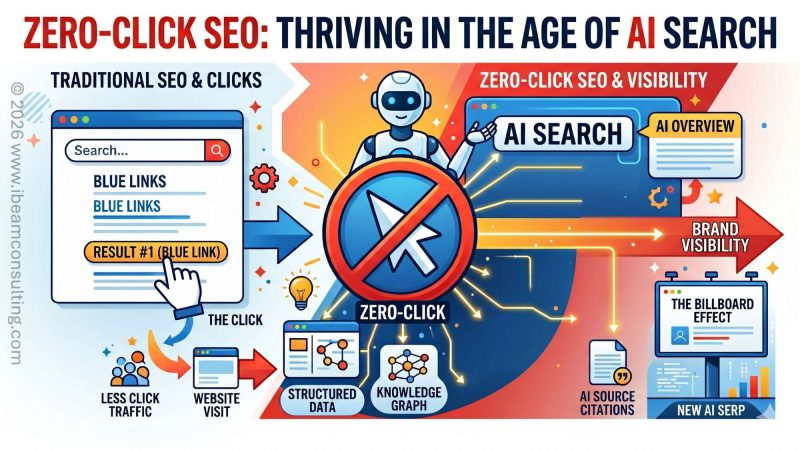
At its core, a Zero-Click Search occurs when a search engine satisfies a user’s intent directly on the results page, eliminating the need for the user to navigate to a third-party website.
The Mechanism of Modern Search Results
Google and other engines achieve the zero-click effect through several built-in features:
- Direct Answers: Think of “weather in London” or “current stock price of Google.”
- Knowledge Panels: The information boxes on the right side of the desktop SERP that provide biographies, company overviews, or entity relationships.
- Interactive Tools: Calculators, currency converters, and metronomes.
- Local Packs: Google Maps integrations that give you a phone number or address without needing to visit the business’s actual homepage.
The Search User Perspective
From the user’s standpoint, zero-click is a feature, not a bug. It offers speed, convenience, and friction-free information retrieval. Why wait for a heavy website to load when you just need to know if it’s going to rain this afternoon?
For the SEO professional or website owner, however, it represents a “walled garden” that requires a new set of rules for engagement.
“Zero-Click” Search Predates AI SEO
A Brief History: The Pre-AI Zero-Click Landscape
Zero-click search didn’t start with ChatGPT, Perplexity, or Google’s Gemini-powered AI Overviews. It has been a slow-burn evolution that began over a decade ago.
The Rise of Featured Snippets (The “Answer Box”)
Around 2014, Google introduced “Featured Snippets.” This was the first major step toward zero-click dominance. Google began “borrowing” specific paragraphs, lists, or tables from websites to answer questions like “How to tie a tie” or “What is a mortgage.”
The initial SEO response was one of panic. Critics called it “content theft,” arguing that Google was using their data to keep users on Google’s own platform.
However, a “Phase 1” SEO response soon emerged: The realization of Position 0.
SEOs discovered that being the “Featured Snippet” provided massive brand authority and “billboard” visibility. Even without the click, being the “chosen” answer established trust.
From Keywords to Entities: The Knowledge Graph
In 2012, Google launched the Knowledge Graph, famously moving from “strings to things.” This allowed Google to understand that “Taj Mahal” wasn’t just a sequence of letters, but a specific landmark in a specific city.
By understanding entities and their relationships, Google could provide robust summaries without requiring users to dig through multiple sites to piece information together.
Strategic search optimization during this era shifted toward Schema Markup and structured data — giving Google the “map” it needed to parse our content more effectively.
We weren’t just writing for humans anymore; we were labeling our data so the engine could use it to satisfy users on the SERP itself.
Zero-Click in the Age of AI LLMs
The Modern Shift for AI-Centric Search
The transition from Featured Snippets to AI-generated answers marks the end of “Search” as a library and the beginning of “Search” as a concierge.
While featured snippets plucked a single authoritative source to display, modern Large Language Models (LLMs) – like Google’s Gemini, Perplexity, and ChatGPT – synthesize information from dozens of sources to create a customized narrative.
The “Concierge” Model vs. The Librarian
If traditional search functioned like a reference librarian pointing you to the right shelf, AI search acts as a high-speed research assistant. It doesn’t just locate the relevant volumes; it digests the text, synthesizes the core arguments, and delivers a condensed brief before you’ve even had a chance to open a single page.
By early 2025, data showed that Google’s AI Overviews (AIO) appeared for over 50% of informational queries in the US. The impact on traffic is severe: according to Pew Research (2025), users who encounter an AI summary are nearly twice as likely to leave the search page without clicking any link (26% session-end rate vs. 16% for standard results).
The Threat to Informational Intent
Keywords like “How to…” or “What is…” are now high-risk areas for SEOs. When an AI Overview provides a comprehensive, step-by-step guide directly on the screen, the incentive for a user to click through to a blog post drops by as much as 61%.
We are witnessing what industry experts, such as Darwin Santos, have termed ‘The Great Decoupling.’ It is a fundamental severing of the historic link between search visibility and site visits: your brand’s impressions may be skyrocketing as you’re cited in AI summaries, even as the resulting click-through rates plummet.
Zero-Click SEO & Visibility Tracking
New Metrics: Measuring “Brand Visibility” and “AI SEO” Performance
If the click is no longer the primary success signal, what is? In the zero-click era, we must adopt a new framework of measurement often referred to as Generative Engine Optimization (GEO) or Agentic Search Optimization (ASO).
Moving Beyond Google Search Console (GSC)
GSC has traditionally been a toolkit for measuring basic content visibility in organic search. To succeed today, we need better AI-focused metrics:
- AI Share of Voice (AI SOV): What percentage of AI-generated responses in your category actually mention your brand? If an LLM is asked for “the best CRM for startups,” and you appear in 40% of the answers, that is your new market share.
- Sentiment and Contextual Perception: It’s not just if you are mentioned, but how. AI SEO tools now use sentiment analysis to track whether your brand is described as a “leader,” a “budget-friendly option,” or a “legacy player” in AI responses.
- Citation Share: LLMs like Perplexity cite sources heavily. Tracking how often your URL appears in the footnotes of these answers is a critical indicator of your site’s perceived authority in the eyes of the model.
The Tools of the Trade
A new category of tools has emerged to help marketers “spy” on what AI says about them.
Platforms like Nightwatch, Semrush’s AI Toolkit, and HubSpot’s AEO Grader allow brands to monitor their “AI Reputation Index.” These tools prompt various models (ChatGPT, Gemini, Claude) with thousands of queries to see who gets recommended and why.
In this new reality, SEO success is measured by Influence, not just Visits. A user might never click your link, but if the AI mentions your brand three times as the “industry standard” during their research, the SEO has done its job.
More AI SEO Tools: Discover more top tools in this post about Free AI Search Visibility Tools.
Overcoming Zero-Click Challenges
Strategic SEO Pivot: Best Practices for Today’s Zero-Click Landscape
The game has changed from “how do I rank #1” to “how do I become the primary source for the AI’s summary.”
To win now, you need to move away from the “Skycraper Technique” – simply making a slightly better and longer version of existing content – and move toward generating true Information Gain.
The “Information Gain” Strategy
Google’s own patents define an Information Gain score as a measure of how much new value your content adds beyond what a user has already seen. If your article is just a rehashed 101 guide, an LLM has no reason to cite you.
- Primary Data is the New Moat: Proprietary surveys, internal product usage statistics, or original research are the only types of content AI cannot hallucinate or steal from your competitors.
- The “Answer-First” Structure: AI crawlers look for immediate resolution. Lead your sections with a clear, 2–3 sentence answer to the user’s primary question, then expand into the “why” and “how.” This is related to concepts of content chunking and BLUF – “Bottom Line Up Front” methods.
Related: Learn more here about the value of information gain for SEO.
Optimize for Citation
To get cited in AI Overviews, you must speak the machine’s language while serving the human’s needs.
- Structured Data 2.0: It’s no longer just about Article schema. Use FAQ, HowTo, and Dataset schema where appropriate to explicitly label the “nuggets” of information you want the AI to extract.
- Modular Content Blocks: Think of your content page as a collection of “extractable modules.” Use clear H2/H3 headers that mirror natural language questions (“How does X work?”) so the AI can easily snip your answer into its overview.

Related: Learn more in these posts about AI SEO and structured content, and website schema audits for SEO.
Zero-Click Search & CRO Importance
The Rising Role of CRO (Conversion Rate Optimization)
With organic referral traffic dropping, the traffic that does reach your site is more precious than ever. This is leading to “The Great Decoupling” — where traffic drops by 20–30% but high-intent conversions remain stable.
Click Value: Quality over Quantity
The users who click through an AI Overview or a complex featured snippet are usually looking for nuance, pricing, or purchase options that the search engine couldn’t provide. They are “warm” leads that have chosen your site/content for more detailed information.
- Optimizing for the “Hard Click”: Since simple answers are commonly now resolved on the SERP, your website should double down on Bottom-of-Funnel (BOFU) content: side-by-side comparisons, case studies with real ROI, and interactive demos.
- Treating the SERP as a Billboard: Even if search users don’t click, your brand name in the AI citation builds the “familiarity effect” that may lead to direct visits and conversions later.
Measuring Assisted Conversions
Traditional attribution models (e.g., “Last-Click”) are failing in the modern zero-click world. You need to look for Assisted Conversions and Branded Search Lift.
- The Invisible Funnel: If a user sees your brand in an AI Overview for “best CRM,” and then three hours later types your brand name directly into Google to sign up, that conversion was “assisted” by your zero-click visibility. (The billboard or familiarity effect)
- CRO for the “Remaining 40%”: As referral volume tightens, your on-page conversion rate must improve to maintain revenue. A 0.3-point lift in conversion rate (e.g., from 2.7% to 3.0%) can outweigh the impact of a 10% traffic spike. Focus on site speed (Core Web Vitals), benefit-first copy, and “frictionless” checkouts and other high-value conversions to make every remaining click count.
Related: Learn more here about SEO and conversion rate optimization.
AI SEO, the Knowledge Graph, & Digital PR
Entity-Based SEO & Digital PR
In a world where LLMs synthesize their own answers, being a “string” of keywords is no longer enough. You must become an Entity — a recognized “thing” in the digital world with established relationships and authority. This is where modern AI SEO merges with Digital PR (Public Relations) activities.
Building Your Knowledge Graph Presence
AI models don’t just “read” your website; they look for consensus across the web to verify who you are. This is known as the Knowledge Graph effect.
- Co-occurrence and Mentions: AI models interpret the web through associations, not just hyperlinks. When premier outlets like The Verge or The New York Times discuss your brand alongside ‘enterprise security,’ they are essentially hard-coding your authority into the model’s weights. These ‘digital footprints’ – or unlinked mentions – function as the new backlinks for an agentic search world.
- Becoming a “Trusted Source”: LLMs are trained on massive datasets like Common Crawl. By appearing consistently on trusted industry portals, Reddit (which established a multi-million dollar data deal with Google), and Wikipedia, you ensure that your brand is baked into the model’s training data.
Related: Learn more about using social forums like Reddit and Quora for SEO purposes.
The Synergy of Digital PR and SEO
Modern PR is the new link building. Its role is to create “brand signals” that AI models cannot ignore.
- Feeding the LLM Training Data: When a journalist at a reputable outlet reviews your product or service, they aren’t just sending you traffic; they are creating a record that the AI uses to “learn” that your product/service is a market leader.
- The “Default” Answer: The ultimate goal of Entity SEO is to become the “default” answer. When a user asks, “What’s the best software for X?”, the AI shouldn’t just list you; it should speak about you with the confidence of an established fact. This only happens through a consistent “Digital PR” strategy that builds consensus across the entire web ecosystem.
Like this post? Quickly share it with your social networks here.
Zero-Click Search & SEO Strategy — Closing Thoughts
Conclusion: Embracing the Invisible Funnel
The rise of zero-click search is not the death knell for SEO; it is the professionalization of search marketing. For years, SEO was treated as a technical silo focused on traffic volume.
Today, it has merged with brand marketing, digital PR, and product experience. We are no longer just optimizing for a click; we are optimizing for an AI-recognized reputation.
The Evolution from “Result” to “Answer”
The fundamental shift is psychological. In the old world, we wanted to be a result — one option among many that a user might choose.
In the new world, our goal is to be the answer — the definitive source that the AI concierge trusts above all others.
Success in this landscape requires a “Billboard Mindset.” You must accept that many users will encounter your brand, learn from your data, and be influenced by your perspective without ever visiting your domain.
This “invisible funnel” is harder to track, but it is the foundation of modern market authority.
Final Thought: Don’t Fight the AI-Defined Walled Garden, Own It
Traditional traffic will continue to be a valuable component of your digital strategy, particularly for navigational and transactional queries. However, the baseline informational layer of the web now belongs to the LLMs.
Instead of fighting the search engines for every scrap of traffic, embrace the platform. If the user is going to stay on the search page, make sure the information they find there is yours.
Call to Action: Your Zero-Click Roadmap
If you’re ready to move beyond SEO vanity metrics and secure your place in the AI-driven search future, here are three good next steps:
- Conduct a Zero-Click Audit: Use tools like Nightwatch or HubSpot’s AEO Grader to see your current “AI Share of Voice.” Identify which high-volume queries are currently being answered by AI and whether your brand is part of that summary.
- Audit for “Information Gain”: Review your top 10 informational blog posts. Do they offer proprietary data, original interviews, or a unique point of view? If not, rewrite or update them to include “AI-moat” content that machines cannot replicate.
- Modernize Your Schema: Move beyond basic Article markup. Implement more specific schema types (e.g., FAQ, HowTo, and Speakable) to help AI agents parse and attribute your most valuable insights directly on the SERP.
Stop chasing the click. Start commanding the conversation.
Questions or Comments?
I hope this overview of the zero-click search effect and its SEO impact has been helpful! Let’s wrap up with a few related questions for you:
- Has your website or blog been heavily impacted (e.g., traffic loss) by zero-click search activity? If so, which analytics tools are helping you understand this further?
- Are you tracking AI search visibility and/or AI brand visibility today? What insights are you gaining from this?
- What content adjustments or updates do you think would help you most in these areas? What can you start doing this week to move things along?
Feel free to add more in the comments below with any thoughts, feedback, or related questions. Thanks also for any social shares on this post!
