
Last updated Feb 1, 2025
How Account-Based Marketing Compares to Traditional B2B Marketing Approaches
Key Differences and Similarities
Account-based marketing, or ABM for short, has been gaining momentum in business-to-business (B2B) industry segments for 2+ decades now.
Slowly at first, in the 2000s. Then faster after ~ 2010, and especially since around 2015-2016.
With ABM, many B2B firms now have a growing and viable alternative to traditional marketing and sales models.
This post looks at ABM vs traditional marketing in B2B — with insights, resources, and a few related tools.
Let’s take a closer look below…

This post contains a few referral links to vendor partners. We may receive compensation for purchases made via these links, at no additional cost to buyers.
Quick Summary
- For many years now, ABM has been widely accepted as a good alternative to traditional demand or lead generation strategies in B2B industries.
- ABM uses an ‘inverted demand gen’ funnel concept as a key distinction vs traditional marketing-centric lead gen models.
- Great teamwork between sales and marketing is also a hallmark of effective account-based marketing.
- There are other important distinctions between ABM and traditional lead gen programs, but many traditional B2B sales and marketing tactics still apply.
- ABM and traditional marketing programs often run side-by-side, enabling ROI comparisons and future marketing investment decisions.
- ABM software platforms and tools can help bridge the gap between ABM and traditional marketing programs. Jump to the ABM tools section here.
Brief Intro to Account-Based Marketing (ABM)
The Slow But Steady Advance of ABM
As I mentioned above, the roots of account-based marketing go back more than 20 years. Starting slowly and primarily within the B2B IT services industry, ABM interest and adoption have really taken off since ~ 2015.
ABM Origins and Timeline — A Long and Growing Trend
Initial work in ABM development came out of the IT Services Marketing Association, or ITSMA, which is now part of the Momentum group.
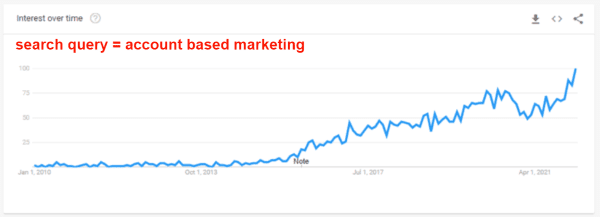
The graph below from Google Trends shows the interest in ‘account based marketing’ as a Google search query. User queries for ABM really started picking up around 2015, and interest in the topic continues to grow.
For more basics, see this ABM FAQ — a set of common ABM questions and answers about account-based marketing.
ABM Definitions from ITSMA — Three Main Types
The ITSMA consulting organization developed three main definitions of account-based marketing. As a quick summary, they are:
Strategic ABM (One-to-One ABM)
Highly customized and tightly coordinated sales and marketing for individual accounts. This is truly a case of treating a high-value strategic B2B account as a ‘market of one’. In many cases, B2B firms will have more than a single 1:1 ABM account but will approach each with a very customized account-specific plan.
ABM Lite (One-to-Few ABM)
Lightly customized programs for smaller clusters of target accounts with similar issues, pain points, and solution needs. This is a ‘one-to-few’ ABM model.
Programmatic ABM (One-to-Many ABM)
The newest approach to ABM, this model leverages technology to tailor marketing campaigns for larger numbers of specific named accounts. With the right technology and processes in place, programmatic ABM can scale to hundreds or even thousands of identified accounts.
“Account-Based Marketing (ABM) is a strategic approach to designing and executing highly-targeted and personalized marketing programs to drive business growth and impact with specific, named accounts.”
— ABM 2020 Benchmark Study (ITSMA and ABM Leadership Alliance)
Download the full ITSMA and ABM Leadership Alliance report here. (It’s an instant PDF download; no registration required.)
Pro Tip: ABM is sometimes also known as ‘key account marketing’, focusing on ‘right fit’ customers and clients. Defining the ICP — Ideal Customer Profile — is an important part of the process here.
ABM vs Traditional Marketing — Key Differences
Main Differences Between ABM and Traditional B2B Marketing
This section outlines some of the major changes that come with an account-based marketing approach. It starts with the inverted lead gen funnel as shown below.
Note: Comparing ABM vs ‘traditional marketing’ is also directly related to topics like ABM vs demand generation or demand marketing, account-based marketing vs lead generation, and account-based marketing pros and cons for B2B marketing.
Inverted Demand Generation and Lead Funnel
The most visually obvious distinction between account-based marketing and traditional demand generation is that the demand gen funnel is ‘flipped’ or inverted in ABM.
This is often called ‘Flipping the Funnel’, where the ABM funnel looks like the one below. It is inverted, or upside-down vs the traditional B2B lead gen funnel.

Related: Learn more here about ABM funnels in B2B marketing and sales.
Quality Beats Quantity
As suggested by the ABM funnel diagram above, in account-based marketing we intentionally limit the number of account prospects at the top of the funnel.
As a result, ABM lead generation looks quite different vs traditional B2B demand generation.
Unlike the traditional B2B lead gen funnel model, ABM-based pipeline development is no longer a pure numbers game that seeks to maximize lead quantities at the top of the funnel.
The focus is on identifying and naming a limited number of target accounts that fit a defined Ideal Customer Profile (ICP), then engaging these accounts with a joint sales and marketing ABM plan of attack.
More Personalization
Having a finite set of named target ABM accounts also provides better opportunities for personalization. When done correctly, this drives better response, engagement, and win rates.
Personalization comes naturally to direct salespeople, who thrive on developing strong 1:1 personal relationships within their accounts. It is now becoming more embedded in B2B marketing tactics, in part due to ABM adoption and supporting technologies.
Better Sales and Marketing Teamwork
In traditional B2B demand generation, the marketing team is responsible for maximizing lead generation (top of funnel) through various marketing tactics, then handing off so-called ‘qualified’ leads (e.g., MQLs) to sales for further pursuit and closed transactions (lower and bottom-funnel layers).
Sometimes this traditional B2B funnel and marketing-sales handoff process works fine.
Oftentimes, however, it does not.
ABM differs by joining B2B marketing and sales from the very start, agreeing on an ICP and a specific set of named target accounts to pursue together.
It’s no longer a linear handoff of leads from marketing to sales.
Marketing Spend and Focus
With an account-based approach, marketing naturally becomes more focused, in direct alignment with sales targets.
This may translate into lower overall marketing spend, though that effect is not guaranteed.
In any case, the marketing spend that does occur is more focused with ABM-centric strategies. It is more likely to help ‘move the needle’ with specific accounts and is also more likely to be perceived as helpful and effective by the ABM sales team members.
Marketing Mix Changes
Connected to the point above, in ABM the various well-known marketing tactics in B2B may shift and change, by a little or a lot.
A few examples:
- Purchasing cold lead lists of dubious quality and then mass emailing them is definitely out. That’s about as opposite to ABM as you can get. Using email tools carefully to reach specific people within specific named accounts is in. This includes 1:1 and 1:N crafted campaigns.
- Social media still matters but becomes much more targeted in ABM. Less noise; more value. Social selling also becomes a key B2B skill within the sales team.
- Digital advertising (Google Ads, PPC, etc.) becomes more focused, casting a narrower net vs traditional PPC.
- Outbound marketing and sales become more prominent vs broad inbound tactics. Learn more about ABM vs inbound marketing here.
- SEO and content marketing become more focused. Branded search results matter more than before as a reputation and authority enhancer. Learn more about how SEO and ABM complement each other.
- Events (live and virtual) still matter but transition to smaller and more account-targeted events. Less emphasis and spending on massive industry events where lead flow is often random, small, and untargeted.
- CRMs and Marketing Automation tools still help, but may play smaller overall roles depending on the number of target ABM accounts and contacts.
- Specialized web analytics tools, such as B2B website visitor tracking software, play important roles in multiple ABM areas. Learn more about ABM and website visitor tracking tools here. Also, SEO and website visitor tracking can work well together in B2B to help make the inbound-to-outbound connection for ABM revenue teams.
ROI Expectations
This almost goes without saying, but the whole reason to undertake an ABM strategy is that you expect better ROI from it, compared to what you’re currently doing.
More revenue and net income per unit of investment.
The good news? Most adopters of ABM strategy and tactics report achieving higher ROI.
According to the ITSMA and ABM Leadership Alliance study in 2020:
- Over 75% of ABM survey respondents reported significantly or somewhat higher ROI for ABM vs traditional B2B marketing initiatives.
- Only 12% reported experiencing lower ROI from ABM.
For more details and a graphic on ABM ROI stats, see this item from MarketingCharts.
Regarding marketing ROI calculations, it’s also worth noting that the metrics used to track ABM performance are different from traditional B2B marketing metrics.
Related: See this post to assess your readiness for ABM. It includes insights and an ABM readiness checklist of key points to consider.
Want to stay updated on my B2B account-based marketing (ABM) content? Add your email details below for periodic updates straight from me (David).
Your email info is safe here. We don’t sell, rent, or share your details with outside parties. You can easily unsubscribe at any time.
ABM vs Traditional Marketing — Key Similarities
Several Traditional Marketing & Sales Tactics Remain in Play
True, there are many significant differences between traditional B2B marketing and ABM. However, many familiar tactics still work and can play key roles in account-based marketing.
Here are some areas where ABM and traditional methods can overlap.
Traditional Outreach Methods Still Matter
Since account-based marketing relies on understanding named accounts and (eventually) named individuals and roles within those accounts, every traditional outreach tool in the B2B sales toolbox can be put to work.
Telephone and 1:1 email outreach. Social media outreach (e.g., LinkedIn). Customized and personalized content offers, etc.
Anything that can help create connection and engagement within your ABM target accounts is fair game.
Sales team members with strong experience in ‘strategic account sales’, ‘strategic account planning’, and similar named account selling skills will be especially comfortable with this aspect of ABM.
Outbound and Inbound Still Work Together
ABM is more about targeted outbound business development rather than wide-funnel inbound tactics.
However, inbound marketing can still play a key role in ABM. For example, if a target ABM account visits your company website (via any traffic acquisition channel), you definitely want to know about it.
This is where tools that perform B2B website visitor tracking come into play. They can help your ABM team spot target account activity on your website in near real-time, track the pages visited and events triggered for lead scoring and intent data insights, and alert the right team member(s) for potential follow-up activity.
Learn more here about how B2B website visitor tracking supports account-based marketing.
These tools also enable a super lightweight, simplified approach to ABM as described here. This is a minimalist approach to ABM that even a resource-limited B2B sales team can employ.
SEO efforts can also support and complement ABM, directly and indirectly. For example, B2B website visitor tracking tools can help identify SEO-driven target account visitors and turn those into productive sales follow-up efforts.
Strong Sales Closing Skills Are Still Key
Traditional B2B selling skills like closing the complex sale, selling to buying committees, influencing multiple buyer roles, etc., are all very important in ABM-centric sales situations.
The more ‘strategic’ the target ABM account is, the more these skills will matter.
Success Story Amplification (e.g., customer case studies)
Closer to the bottom of the inverted ABM funnel, we want to find ways to replicate ABM wins and identify even more ‘lookalike accounts’ that fit our Ideal Customer Profile (ICP).
B2B customer success stories and case studies with named accounts can provide very helpful content in this area, especially with the potential for social media distribution and amplification.
On an interesting related note, learn here how website visitor tracking vendor Leadfeeder used their own tools, and ABM tactics, to win one of their largest customers.
Websites Play Key Roles (plus content personalization opportunities)
When using ABM, the corporate website still plays a huge role as an information resource for target accounts.
There’s less focus on broad top-of-funnel landing pages and more on content designed to engage members of your ICP and move them further along in their buyer’s journey — hopefully to a decision that includes your solution(s).
With the right tools, you may even be able to present more customized website content to your target accounts, providing a more personalized (vs generic) user experience for your most important website visitors.
As previously noted, the role of B2B website analytics tools for visitor identification and tracking is very important in ABM.
Social Media Still Important (but more focused)
A complete ABM program leverages social media marketing to drive target account contact discovery and engagement. LinkedIn and Twitter (now ‘X’) are top target channels for many B2B firms.
Beyond 1:1 social outreach and engagement efforts, LinkedIn also helps ABM teams reach more potential buyers and influencers within target accounts through its strong B2B advertising capabilities.
For more details, see this post on how Leadfeeder supports ABM retargeting and account-based advertising.
Choosing ABM Over Traditional Marketing & Lead Generation
When Does ABM Beat Traditional B2B Marketing?
For many B2B firms, account-based marketing can perform better than traditional marketing and demand generation in several of the following situations:
- Your company and solutions are naturally better suited to larger, strategic accounts that together drive the bulk of your annual revenues.
- Your solutions fall into a ‘complex sale’ category.
- Your products and services are high-priced and high-value, with substantial financial risk/reward for buyers.
- Your sales and marketing teams are ‘mature’, disciplined, and focused. They can be trusted to stick with an agreed-upon ABM strategy and not chase every shiny new object that comes into view.
- Your sales and marketing leadership have expressed a mutual desire to work better together as a team, breaking down organizational silos if they exist.
- Your team’s ‘strategic selling’ skills are strong but your overall marketing budget is limited and not likely to increase much in the near term.
- You see an opportunity for ‘target account replication’ to expand and scale the ABM program if it proves to be successful.
Sticking with Traditional B2B Marketing
When Does Traditional Marketing and Lead Gen Work Best?
Like anything that’s gaining popularity and momentum as a marketing tactic, there’s always the temptation to jump on the ABM bandwagon and hope for the best.
In some cases, including the account-based marketing push, that could be a big mistake — an unnecessary distraction and waste of company resources.
You might be wiser to stick with the more traditional approach to B2B demand generation and sales follow-up when:
- It’s already working! (so don’t ‘fix’ it)
- Current lead quality is acceptable and conversion rates are good
- Your addressable market is large or very large (number of potential buyers)
- You have mostly lower-value accounts and/or smaller deal sizes
- The current lead acquisition and sales cycle is short and easy to replicate
- You sell simpler products and services (and have a less complex sales cycle)
- You have limited upsell and cross-sell opportunities
- Your sales and marketing team is less ‘focusable’ as required by ABM
If enough of these factors apply, you may want to skip ABM for now.
Or perhaps consider a hybrid approach, as described next.
The Hybrid B2B Marketing Model — Traditional Plus ABM
If you’re in a typical B2B firm with a large number of small to mid-tier accounts, plus a handful of large strategic target accounts, why not try a combined traditional and ABM marketing approach?
Stay in traditional lead gen funnel mode for the small-medium market opportunity, and pilot an integrated ABM team to go after the more strategic accounts with an ABM-centric model.
You’ll get ABM experience where it’s most likely to work well, without risking your entire pipeline and revenue model. If it works well, you can then apply ABM further down into another set of target ABM accounts — perhaps in a mid-sized account tier.
SEO and ABM can also work well together in this hybrid marketing approach. You may want to use SEO as a secondary/supporting marketing tactic even in ABM-first situations.
Related: Learn more here about B2B lead generation agencies and also about B2B lead generation in European markets more specifically.
ABM Software Platforms and Tools
Adding ABM to the Digital Marketing ‘Tech Stack’
Naturally, once account-based marketing got a decent foothold in B2B industries, vendor software solutions followed to help out.
Some of these tools were ABM-specific from the very start. Other software vendors have added ABM capabilities, positioning, and marketing messaging to take advantage of the steadily growing interest in all things ABM-related.
ABM Leadership Alliance
For a look at some of the leading ABM solution vendors available today, check out the ABM Leadership Alliance here.
Founded by Demandbase in 2016, the ABM Leadership Alliance is made up of a handful of ABM technology vendors. Their website offers a wide range of resources to support successful ABM initiatives.
Learn more here about ABM platform costs and vendor options.
B2B Website Visitor Analytics Tools
Focused on B2B website visitor identification and tracking, this class of website analytics tools helps sales and marketing teams track corporate visitors on B2B websites.
B2B revenue teams can then take appropriate proactive follow-up action based on this enhanced level of sales intelligence and buyer intent information. These insights into website visitor activity can be hugely beneficial in account-based marketing.
Learn more here about how B2B website visitor tracking supports ABM. Also, see how these tools can enable affordable, lower-cost account-based marketing.
Related: Learn how Leadfeeder supports ABM strategies and campaigns.

An EU-Native ABM Platform Option for B2B Markets in Europe

Dealfront: EU-Native B2B Go-To-Market Platform
Dealfront is a ‘revenue engine’ for B2B sales and marketing teams, especially those with European / EU account targets.
Dealfront combines the strengths of Echobot and Leadfeeder into a full-cycle, AI-assisted platform for B2B revenue growth.
Pros:
Boosts revenue and sales/marketing efficiency
Integrates multiple sales intelligence tools and data for B2B revenue teams
Supports affordable Account-Based Marketing (ABM) programs
Provides strong GDPR/regulatory compliance for EU markets
Cons:
May be pricey for smaller B2B’s with limited account targets
Lacks some features of enterprise-scale ABM platforms
ABM Training and Certification Programs
Several Good Options for ABM Certification and Education
Given the ongoing interest in account-based marketing, several good ABM training and certification options have become available. They are useful for gaining a deeper understanding of ABM vs demand gen or lead gen programs.
Here are a few of the more notable options that include actual ABM certification.
- Terminus Learning Paths and Certifications
- Demandbase Go-to-Market (GTM) Certification Program
- Forrester’s B2B Marketing Certification (ABM track available)
Some of these are free and others are fee-based. Software vendor-provided certifications are often free to active customers, and sometimes to non-customers as well.
Short of actual ABM certification, other ABM solution vendors will almost always have free blog content, e-books, webinars, and YouTube channels that include useful ABM training.
Like this post? Quickly share it with your social networks here.
ABM vs Traditional Marketing in B2B — Closing Thoughts
Account-Based Marketing is Great for Many, But Not for All
ABM is now a proven B2B marketing and sales strategy for many companies that have implemented it.
It has boosted marketing ROI, increased revenue attainment and high-value deal flow, enabled better sales/marketing teamwork, and provided other benefits to B2B firms.
ABM is not, however, the undisputed best marketing approach for absolutely everybody in B2B. Companies need to consider account-based marketing strategies with a good understanding of ABM’s pros and cons vs more traditional B2B marketing and lead generation.
For those who choose to move forward with ABM, there’s never been a better time for action. Resources, ABM-focused tools/platforms, and education are plentiful and are ready to help maximize results from your ABM programs at any level.
Questions or Comments?
I hope this breakdown of ABM vs traditional marketing and demand generation has been helpful. Here are a few closing questions for you:
- Are you using any form of ABM in your B2B business today? If so, what is the scale and breadth of your ABM initiatives?
- Or is the more traditional B2B lead gen and sales handoff model working well enough for you?
- Are you combining ABM and traditional B2B demand generation in any interesting and effective ways?
- What ABM software solutions, if any, have played key roles in your ABM efforts so far?
Feel free to add your insights in the comments below with any thoughts, feedback, or related questions. Thanks also for any social shares on this post via the buttons below!
