
Boost SEO with Gemini, ChatGPT, Claude, and Perplexity
If you’re working in digital marketing, you’re probably using leading AI LLMs in one way or another.
Did you know they can also serve as powerful SEO and GEO toolkits? And for far more than simple content generation?
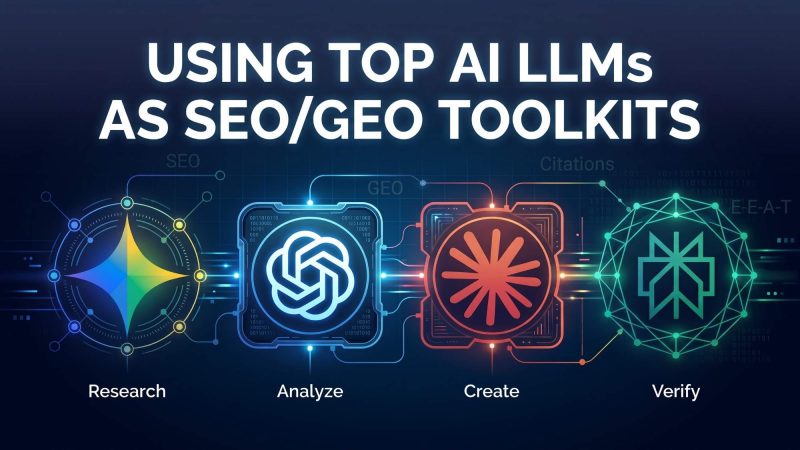
This post looks closer at using popular AI LLMs as SEO & GEO toolkits, including insights, tips, and related resources in this area.
Let’s jump in now for a more detailed look!
This post contains a few referral links to select vendor partners. We may receive compensation for purchases made through these links, at no additional cost to the buyer.
Last updated Oct 28, 2026
AI Chatbots & Modern SEO
Introduction: The Dual Mandate of Modern Search
For two decades, the playbook for getting discovered online rarely changed in its fundamentals. You researched keywords, optimized page titles and headings, built quality backlinks, and tracked your position across pages of ten blue links.
If you executed those steps better than your competitors, qualified organic traffic landed on your site.
That predictable environment has permanently fractured into two distinct disciplines. Search is no longer just an indexing engine that points users to external web destinations.
It has evolved into a real-time conversational ecosystem that reads, synthesizes, and directly answers user questions before anyone clicks a link.
Today, website owners and digital marketing teams face a dual mandate:
- Traditional SEO (Search Engine Optimization): The art and science of earning clicks from classic search engine result pages. It focuses on indexability, site speed, structured data, and securing top organic placements.
- GEO (Generative Engine Optimization): The emerging practice of earning direct mentions, positive brand sentiment, and authoritative source citations across AI synthesis engines. These include Google AI Overviews, ChatGPT Search, Perplexity, and conversational chat interfaces.
In this new reality, getting to page one of the traditional SERPs is only half the battle. If an AI summary answers a prospect’s question without naming your brand or linking to your research, your good conventional organic ranking loses a huge chunk of its business impact.
Many digital teams still treat frontier Large Language Models (LLMs) like ChatGPT, Claude, Gemini, and Perplexity merely as automated writing assistants.
When you use them only to generate draft articles, you miss their real value. Modern frontier models are interactive analytical engines.
When you know how to prompt and direct them, these models act as an agile, on-demand SEO and GEO command center.
They can audit technical scripts, simulate how discovery bots read your content, cluster thousands of semantic ideas, and evaluate whether an AI platform considers your company an authority worth citing.
Sound interesting and worthwhile? Let’s learn more about it below!
AI LLMs & SEO/GEO Essentials
Core Operational Capabilities: How Modern LLMs Handle Foundational SEO & GEO Tasks
Before we pit specific AI platforms against each other, it helps to understand what modern language models actually excel at across the optimization workflow.
LLMs fundamentally process concepts, context, and structural relationships between ideas. That makes them well suited for four core search disciplines.
Keyword Strategy and Semantic Topic Modeling
Traditional keyword research often traps marketers in a spreadsheet mindset, chasing exact phrases, estimated monthly search volumes, and keyword difficulty scores.
Generative engines do not evaluate web pages purely on keyword match count; they look for conceptual completeness and topical depth.
- Intent Clustering: LLMs group hundreds of fragmented keyword queries into clean conceptual buckets, showing you which ideas can live together on a single comprehensive page. They highlight the natural conversational follow-ups users type after reading an initial answer.
- Entity Mapping: Modern search algorithms evaluate pages based on recognizable named entities such as people, organizations, places, and industry concepts. LLMs identify the core entities your top-ranking competitors cover that your own drafts overlook.
- Conversational Query Simulation: Instead of guessing what buyers search for, you can instruct AI models to roleplay specific customer personas across distinct stages of consideration. This exposes long-tail conversational questions that rarely show up in standard SEO/SEM keyword databases.
On-Page and Technical Auditing Assistance
While general AI chatbots will not crawl a 100,000-page enterprise website on their own, their code interpretation abilities make them fast technical problem solvers for individual templates and pages.
- Structured Data Creation and Debugging: LLMs turn raw article text into flawless Schema.org markup formatted in JSON-LD within seconds. They can spot missing required attributes, unclosed brackets, and syntax errors that break rich snippet displays.
- Directives and Configuration Rules: You can feed messy code snippets or redirection goals into a model to generate accurate
robots.txtinstructions and.htaccessrewrite rules. This eliminates manual syntax errors that cause accidental indexation issues.
- Page Source and DOM Inspection: Pasting raw HTML source code into a frontier model lets you quickly spot header tag hierarchy issues, duplicate title tags, and render-blocking scripts. It provides clear, plain-language troubleshooting steps for you or your website development team.
Content Optimization for High “Information Gain”
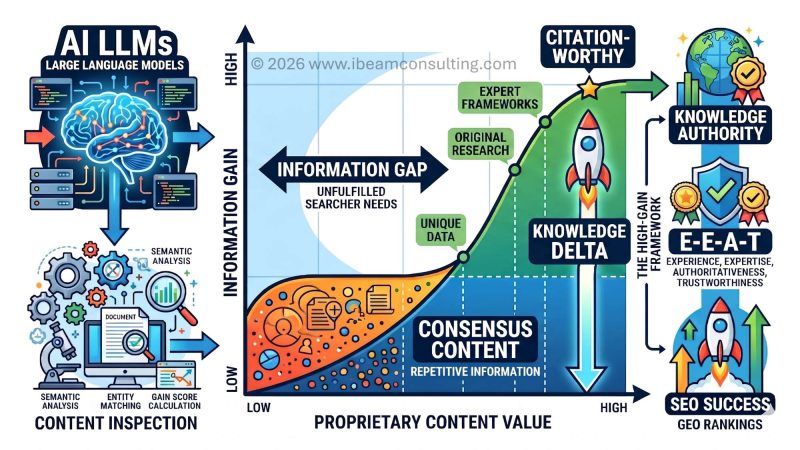
Search engines and generative bots are increasingly tuning their ranking algorithms – specifically leveraging patented “information gain” scoring models – to penalize consensus echo chambers and filter out generic, repetitive text.
If your article repeats the same surface-level summary found on the top five SERP results, neither Google’s core algorithms nor conversational synthesis engines have any incentive to rank or cite you.
- Spotting The Consensus Gap: Frontier models can ingest your drafts alongside competitor URLs to highlight where everyone is saying the exact same thing. They pinpoint the missing perspectives, counter-arguments, and fresh angles your article needs to stand out from the SEO/GEO content crowd.
- Structuring for Machine Citations: AI bots prefer pulling citations from clear definitions, distinct takeaways, and authoritative data summaries. Models can reformat wordy paragraphs into crisp informational blocks that conversational search tools quote directly.
- Original Research Extraction: You can drop messy survey results, whitepapers, or customer interviews into a model to pull out unique proprietary statistics. Highlighting these original numbers gives other writers and search crawlers a clear reason to link back to your work.
Brand Entity and Digital PR Profiling
In Generative Engine Optimization, your brand’s digital reputation across third-party sources is everything. AI models pull their recommendations and summaries from the consensus they find across industry review sites, trusted news hubs, and community discussions.
- Knowledge Graph Footprint Auditing: Asking an LLM to explain your brand without letting it browse the live web reveals what it learned about your company during pre-training. This shows whether your brand is firmly associated with its primary category or confused with competitors.
- Citation Source Discovery: AI models can analyze where AI search tools like Perplexity and ChatGPT pull their citations for your high-value terms. This reveals which industry publications, forum threads, or review directories you must target with digital PR outreach.
- Brand Sentiment and Narrative Auditing: LLMs can evaluate the framing, tone, and common criticisms surrounding your brand across the web. This helps your team correct outdated product descriptions and inaccurate summaries before they get baked into AI search answers.
Related: See this glossary of key terms for AI SEO to learn more about AI’s impact on SEO and Generative Engine Optimization (GEO).
The Leading LLM Chatbots & SEO/GEO
Head-to-Head Comparison: The Big Four AI LLMs & Their Ecosystem Toolkits
While every major LLM can easily draft good meta descriptions and rewrite awkward sentences, each flagship platform has evolved its own personality, technical focus, and specialized tool family.
Treating them as identical chatbots is one of the fastest ways to underutilize their best SEO and GEO capabilities.
To build an effective optimization workflow, you need to match the specific search task to the AI engine best suited for the job.
| Platform | Primary SEO/GEO Role | Standout Ecosystem Tools | Core Superpower |
|---|---|---|---|
| Google Gemini | Google Ecosystem Pipeline | Notebook, Imagen, Veo, Skills (Gems) | Knowledge Graph alignment & AI Overviews |
| OpenAI ChatGPT | Data Orchestration & Search Hub | Advanced Data Analysis, Canvas, Custom GPTs | In-session Python data work & consumer search reach |
| Anthropic Claude | Deep Analysis & Code Architecture | Artifacts, Projects, Claude Code CLI | Nuanced editorial voice & interactive code sandboxes |
| Perplexity AI | Attribution & Citation Research Lab | Pro Search, Spaces, Pages, Discover | Live source transparency & synthetic citation tracking |
Google Gemini: The Direct Pipeline to the Google Ecosystem
If your primary objective is understanding how Google views the web, Gemini is your most direct listening post.
Because Gemini shares architectural lineage and training data principles with Google’s search algorithms, it gives you intuitive insight into the entities and structures that power Google AI Overviews.
The Gemini Family of Tools in Action
- Notebook: Upload up to dozens of URLs, PDFs, or technical briefs into an isolated research Gemini Notebook (formerly branded NotebookLM) to generate reliable, zero-hallucination summaries. It acts as an authoritative source synthesizer for creating deeply sourced, high-E-E-A-T research hubs.
- Imagen & Veo Generation: Gemini’s native multimodal engines create high-resolution custom imagery and short video assets tailored for modern visual search surfaces. These assets feed Google Lens discovery, Google Discover feeds, and rich snippet thumbnail requirements.
- Skills (Transitioning from Gems): Google is evolving custom Gems into Skills, turning isolated customized bots into reusable instructions callable via inline slash commands in any chat. Marketers can build persistent evaluators – such as a “Search Quality Rater” skill grounded in Google’s Quality Evaluator Guidelines – and stack them directly alongside brand guidelines.
- Google Workspace & Cloud Extensions: Direct connections to Google Drive and Docs streamline collaborative editing across cross-functional marketing teams. It allows you to audit enterprise briefs and internal documentation directly within your existing workflow.
Gemini Strengths and Weaknesses
- Key Strengths: Gemini handles massive context windows with ease, letting you analyze hundreds of competitor pages simultaneously. Its direct connection to the Google Knowledge Graph makes it unmatched at understanding how Google connects concepts and brands.
- Weaknesses: Its conversational writing tone can occasionally swing between generic promotional text and overly robotic explanations. It also enforces aggressive safety guardrails that sometimes refuse to analyze competitor claims or sensitive business queries.
The Superpower: Gemini is the premier engine for reverse-engineering Google’s internal content preferences and seeing how AI Overviews assemble answers for your topic.
OpenAI ChatGPT: The Flexible Orchestrator & Conversational Benchmark
ChatGPT remains the industry benchmark for conversational search and analytical versatility. With the rollout of ChatGPT Search, the platform is no longer just a standalone reasoning model — it is a live consumer search engine that dictates which websites receive generative traffic.
The ChatGPT Family of Tools in Action
- ChatGPT Search: Query high-intent commercial terms to review which competitor resources the engine cites across its live search results. Because ChatGPT Search relies heavily on the Bing index alongside publisher partnerships, maintaining strong visibility in Bing Webmaster Tools is a critical prerequisite for winning these generative citations.
- Advanced Data Analysis (Code Interpreter): Upload massive CSV crawl files, Google Search Console query exports, and log files for automated Python processing. It can calculate internal PageRank decay, cluster tens of thousands of keywords, and produce instant visual charts.
- Canvas: An interactive split-screen workspace where you can edit content side-by-side with the model in real time. It enables you to adjust target reading grade levels, adjust section length, and refine schema scripts without losing your place.
- Custom GPTs: Teams can package repeatable workflows into standalone micro-tools like automated
robots.txttesters, internal link suggestors, or title tag generators. These custom GPTs maintain uniform guidelines across an entire marketing department.
- DALL-E & Multimodal Vision: Feed screenshots of competitive SERPs or live web pages into the model to diagnose visual hierarchy and user intent matches. It also produces custom editorial illustrations to support featured snippet capture.
ChatGPT Strengths and Weaknesses
- Key Strengths: The integrated Python environment makes ChatGPT the best platform for heavy analytical lifting and raw data hygiene. It also holds the largest consumer search audience among standalone LLMs, making it the primary target for direct GEO visibility.
- Weaknesses: Live web queries can yield inconsistent citation lists across back-to-back queries. Web-fetching capabilities can also choke on complex single-page JavaScript applications.
The Superpower: The marriage of native Python code execution for deep data parsing with the largest consumer generative search engine footprint on the market.
Anthropic Claude: The Deep Analytical Engine & Structural Architect
Claude has earned a devoted following among senior content strategists and technical search practitioners. It avoids the repetitive formulas and corporate marketing clichés that plague many generative models, delivering writing that sounds human and code that works on the first run.
The Claude Family of Tools in Action
- Claude Projects & Knowledge Bases: Load comprehensive project spaces with your brand style manual, target customer profiles, technical site architecture, and approved product specifications. Every team member working inside the project benefits from consistent brand voice and topical accuracy.
- Artifacts: Claude creates standalone interactive windows right beside the chat to generate, edit, and test technical assets. You can visually inspect complex JSON-LD structured data graphs, test HTML layouts, or generate interactive JavaScript calculators.
- Claude Code / CLI & Tool Calling: Technical practitioners can point Claude directly at local website repositories to audit site builds, static generator templates, and navigation configurations. It identifies template bloat and crawl efficiency issues right inside your codebase.
Claude Strengths and Weaknesses
- Key Strengths: Claude excels at maintaining a nuanced, human tone across complex long-form guides while strictly honoring intricate, multi-step prompts. It processes long documents without hallucinating details or wandering off-topic.
- Weaknesses: Claude does not have a built-in consumer search engine like Perplexity or ChatGPT Search. It relies entirely on the text, documents, and code you supply directly to the conversation.
The Superpower: Best-in-class long-form content synthesis, pitch-perfect tone matching, and clean technical code generation inside dynamic Artifact sandboxes.
Perplexity AI: The Live Attribution & Citation Research Lab
Perplexity approaches AI from a fundamentally different direction than traditional chat platforms. Built from the ground up as an answer engine, its entire architecture revolves around real-time indexing, search multi-querying, and transparent source attribution.
The Perplexity Family of Tools in Action
- Pro Search (Multi-Step Reasoning): When you submit a prompt, Pro Search dissects your query into multiple underlying web searches and cross-references dozens of live sources. This mapping reveals the sub-intents and related entities necessary to earn topical authority in your niche.
- Perplexity Spaces: Set up dedicated workspaces centered around specific search verticals, competitor domains, or ongoing link outreach initiatives. You can attach persistent prompt instructions and curate specific source libraries for collaborative, repeatable competitor tracking.
- Perplexity Pages: Turn conversational research threads into beautifully structured, publicly viewable web pages with a single click. These assets can serve as fast starting points for external digital PR distribution and shareable research reports.
- Perplexity Discover & Trend Engines: Track real-time news breakouts and trending conversational questions across social platforms and live feeds. This exposes rising consumer queries days before traditional SEO keyword tools record measurable search volume.
Perplexity Strengths and Weaknesses
- Key Strengths: Perplexity provides immediate, clickable citations for every factual claim it generates. It is the fastest platform for reverse-engineering the exact digital publications, forum discussions, and review platforms that feed modern AI answers.
- Weaknesses: Perplexity is not built for extensive creative writing or raw programmatic data manipulation. It restricts long-form document drafting and does not support native code execution environments.
The Superpower: The ultimate reconnaissance engine for Generative Engine Optimization, revealing the exact third-party citation footprints required to win AI visibility.
AI LLMs and SEO/GEO Workflows
The Multi-Model Stack: Orchestrating an End-to-End SEO/GEO Workflow
No single AI chatbot covers every corner of search strategy on its own. Attempting to force one tool to do everything – from live web citation audits to heavy log file crunching and nuanced editorial polish – usually produces mediocre results.
High-performing teams combine these platforms into an orchestrated workflow where each model handles the exact phase it does best.
Phase 1: Discovery & Reverse-Engineering (Perplexity + Gemini)
Before drafting a single paragraph, you need to understand how the AI machines currently summarize your subject and who they rely on for factual backing.
- Mapping Live Citations: Run your core target questions through Perplexity Pro Search to record which publications, forum threads, and comparison directories consistently appear in the footnotes. This reveals your essential digital PR targets and the exact proof points conversational engines expect to see.
- Auditing Google’s Entity Preferences: Take those same topic queries to Gemini to examine how Google frames the overview and what adjacent sub-topics it pulls into the fold. This shows you how Google’s Knowledge Graph categorizes the subject and highlights related entities you must include.
Phase 2: Data Crunching & Technical Parsing (ChatGPT)
Once you know the competitive landscape, it is time to ground your strategy in hard analytics and resolve technical barriers.
- Processing Large Crawls and Queries: Upload your Google Search Console query exports and Screaming Frog crawl spreadsheets into ChatGPT’s Advanced Data Analysis sandbox. The model can automatically flag pages suffering from keyword cannibalization, calculate internal link decay, and highlight thin content clusters.
- Generating Clean Technical Fixes: Use ChatGPT to quickly turn URL mapping spreadsheets into clean
.htaccessredirect rules or draft initial robots directives. It handles tedious syntax calculations cleanly, saving you or your developers hours of manual formatting.
Phase 3: Deep Architecture & High-E-E-A-T Content Strategy (Claude)
With your data organized and your targets identified, you need to produce an authoritative, genuinely helpful piece of content that doesn’t sound like robotic boilerplate.
- Building Entity-Rich Content Blueprints: Feed your research notes, brand guidelines, and target entity lists into a dedicated Claude Project. Claude can structure comprehensive content briefs with specific sub-sections designed to deliver clear information gain and answer complex follow-up questions.
- Drafting and Validating Complex Code: Use Claude’s Artifacts window to draft detailed, multi-type JSON-LD structured data trees linking your authors, organization, and primary entities. You can inspect the code syntax directly in the sandbox to guarantee it renders without errors.
Phase 4: Pre-Publish GEO Validation (ChatGPT Search + Perplexity)
Before pushing new content live, run an editorial extraction stress test to evaluate whether generative engines can cleanly parse and quote your core ideas. (Remember: this is a structural readability check, not a substitute for scaled enterprise rank monitoring.)
- Testing Synthesis and Quotability: Paste draft sections into Perplexity or ChatGPT to ask conceptual questions answered only within your new text. If the models struggle to summarize your points cleanly, your sentence architecture is too dense or ambiguous for automated answer extraction.
- Verifying Unique Angles: Ask both engines to compare your draft’s core claims against the current top-ranking consensus. This editorial check confirms that your article delivers fresh information gain rather than simply echoing the existing web.
AI LLMs & The Model Context Protocol (MCP)
Model Context Protocol (MCP): The Game Changer for AI-Driven SEO
Until recently, running SEO workflows through an AI chatbot always hit an annoying roadblock: the copy-paste barrier. You had to export CSV files from your analytics tools, drag them into a chat window, ask your questions, and manually paste the model’s recommendations back into your website.
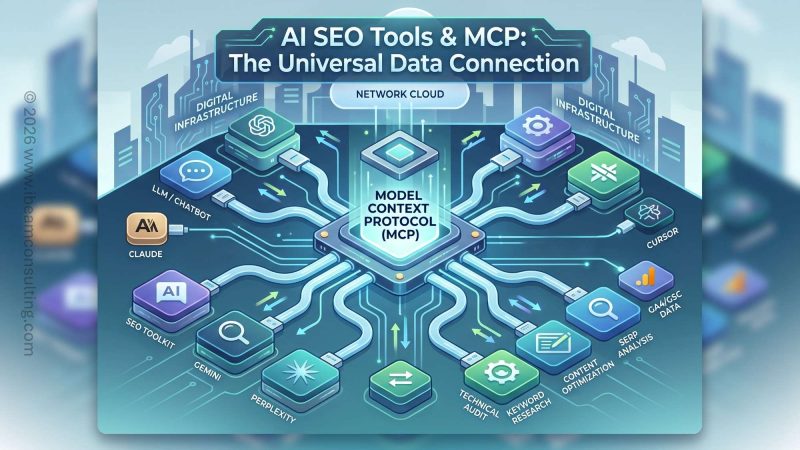
The Model Context Protocol (MCP) completely dissolves that friction. Developed as an open standard, MCP gives LLMs a universal plug-and-play adapter to talk directly with your live tools, databases, and servers.
Instead of acting as an isolated conversationalist, your preferred chatbot becomes a connected operations manager that can see your live site data and take real action.
What MCP Actually Means for Everyday Search Work
Think of MCP as an open-standard API layer built specifically for AI agents. Rather than relying on custom-coded API integrations for every single software tool in your marketing stack, MCP gives models a standardized protocol to read and write data across different applications safely.
- Goodbye Data Silos: MCP allows models to securely query your private databases and web analytics on demand without tedious manual exports. This turns static chatbots into dynamic analytical dashboards that answer questions using your latest live performance numbers.
- Two-Way Technical Execution: Because MCP handles tool actions as well as data reading, models can draft, validate, and execute technical changes directly. It shifts AI search work from passive advisory prompts to interactive site operations.
High-Impact MCP Use Cases in Modern SEO & GEO
When you connect an LLM to your established search tools using MCP, routine optimization workflows transform from multi-hour chores into natural-language conversations.
- Querying GA4 and Search Console via MCP Servers: Rather than downloading static CSVs, models can interface directly with GA4 via official developer MCP servers and connect to Google Search Console through API-backed community servers. This allows your assistant to run real-time traffic queries, flag ranking drops, and compare performance periods on command.
- Headless Browser Crawling on Demand: Connecting an MCP server equipped with a headless browser like Puppeteer gives your LLM full browsing vision. The model can render JavaScript-heavy URLs, capture screenshots of responsive layouts, and diagnose render-blocking scripts in real time.
- Direct Content Management Integrations: By connecting models to CMS platforms like WordPress or Shopify via MCP, the AI can stage approved content optimizations automatically. It can update missing alt text, insert canonical references, and adjust meta descriptions directly within staging drafts.
- Vector Database and Internal Knowledge Retrieval: Teams can connect their LLMs to proprietary content archives and backlink databases stored in vector databases. This allows the model to map internal linking recommendations based on your entire historic library of published assets.
The Strategic Shift: From Prompt Engineering to Agent Architecture
The introduction of MCP changes how marketing teams interact with AI technology. The focus is no longer just on writing the perfect prompt; it is about assembling the right network of connected tools around your model.
By giving frontier LLMs persistent, permissioned access to your search telemetry and content infrastructure, MCP transforms chatbots into autonomous optimization partners.
You spend far less time formatting spreadsheets and far more time deploying high-impact organic strategies.
AI LLMs & Comprehensive SEO Platforms
Reality Check: Where General LLMs Fall Short vs. Dedicated SEO/GEO Platforms
Frontier AI LLMs have made tremendous strides as analytical partners, but they are not silver bullets. Replacing your entire commercial SEO toolkit with a handful of chatbot subscriptions is a fast recipe for blind spots and bad strategic bets.
Specialized SEO/GEO platforms remain essential because enterprise search still demands things probabilistic models cannot deliver on their own.
SEO/GEO Limitations of General Chatbots
- Data Scale and Historical Telemetry: In search, “telemetry” – the automated collection, measurement, and transmission of live performance metrics and diagnostic signals – is the bedrock of strategic planning. Whether you call this tracking instrumentation, performance telemetry, or historical crawl logs, general chatbots lack native longitudinal databases and cannot reconstruct how a SERP looked eighteen months ago.
- Deterministic Accuracy vs. Probabilistic Guesswork: LLMs are prediction engines that guess the most plausible answer, which can produce dangerous hallucinations in hard technical audits. When tracking exact ranking positions, crawl response codes, and absolute monthly search volume, deterministic data from dedicated SEO tools is mandatory.
- The Breadth of Cloud and Desktop Toolsuites: All-in-one suites like Ahrefs, Semrush, and Mangools provide user-friendly web interfaces for rapid competitive research, SERP volatility checks, and keyword difficulty scoring. Meanwhile, heavy-duty desktop platforms like SEO PowerSuite and Screaming Frog SEO Spider deliver unlimited local project management, deep crawling, and custom reporting without recurring cloud usage caps.
- Continuous Automated Monitoring: Dedicated SEO tools work around the clock, alerting you the moment a critical page drops rankings or an unauthorized redirect wipes out traffic. Chatbots only evaluate the data you actively remember to feed them during an active working session.
The Specialized Challenges: Backlink Profiles and Internal Linking
Two foundational pillars of search – off-page link authority and site architecture – highlight the massive operational divide between conversational LLMs and dedicated search platforms.
Backlink Profile Analysis and Competitive Auditing
A strong backlink profile requires analyzing millions of web connections to assess domain trust, link velocity, and toxicity. General LLMs have no independent index of the web’s link graph and cannot independently discover who links to your site.
- Proprietary Link Databases: Dedicated suites like Ahrefs, Semrush, Mangools (via LinkMiner), and SEO PowerSuite (via SEO SpyGlass) index trillions of live backlinks. They allow marketers to evaluate referring domain quality, anchor text distribution, and historical link acquisition rates with absolute empirical certainty.
- Competitive Gap and Risk Detection: Identifying competitor backlink intersections and flagging toxic, spammy networks requires massive graph calculations across competing domains. Chatbots can brainstorm creative outreach angles, but they cannot crawl the web to verify whether a prospect’s link is live, indexed, or marked with a
nofollowattribute.
Internal Linking Analysis and Automation
Strategic internal linking distributes PageRank, establishes topical hierarchies, and guides AI crawlers through your most important content. While an LLM can recommend related articles when handed a short list of titles, it cannot evaluate whole-site architecture in a vacuum.
- Click Depth and PageRank Distribution: Specialized site auditing tools like SEO PowerSuite (WebSite Auditor) and Screaming Frog visualize your entire internal linking topology. They instantly flag orphan pages, excessive click depth, broken redirects, and internal PageRank bottlenecks across tens of thousands of URLs simultaneously.
- Automated Internal Linking Workflows: Modern CMS plugins and specialized tools automate contextually relevant internal links by scanning site-wide text against target keyword clusters. LLMs lack full-site structural awareness in isolated chat sessions, making dedicated site architecture tools indispensable for systematic internal link equity management.
The Rise of Dedicated Enterprise GEO Trackers
Just as classic search spawned specialized SEO suites, Generative Engine Optimization has driven its own class of enterprise tracking software.
Purpose-built platforms like Peec AI, Profound, Otterly.AI, and AthenaHQ solve problems that manual prompting cannot address:
- Synthetic Share of Voice (SSOV) at Scale: These dedicated GEO engines query thousands of prompt variations across multiple regions and user personas every day. They provide statistically significant visibility benchmarks instead of the anecdotal observations you get from running five test prompts manually.
- Algorithmic Citation Tracking: Enterprise GEO platforms catalog exactly which third-party URLs and domains drive brand mentions across all major answer engines simultaneously. They alert your digital PR team whenever competitor domains gain traction inside synthetic citations.
- AI Crawler Log Verification: Specialized platforms monitor server logs to verify whether user agents like GPTBot, ClaudeBot, and PerplexityBot are successfully retrieving your site content. They identify subtle server blocks and JavaScript rendering hurdles that stop LLMs from indexing your primary resources.
Like this post? Quickly share it with your social networks here.
Want to make sure you never miss our updates? Click below to add us as a preferred source on Google Search.

Using AI LLMs for SEO & GEO — Closing Thoughts
Strategic Synthesis & Future Outlook
The rise of generative engines does not mean traditional search is dead, but it does mean the definition of success has fundamentally shifted. When answers appear directly in conversational summaries, winning search is no longer just about driving immediate page clicks — it is about commanding brand equity and synthetic citations across every platform your audience uses.
The Three-Layer Modern Search Stack
Top-performing digital marketing teams are moving away from the false choice between classic tools and generative chatbots. Instead, they organize their workflow into a three-layer operating model:
- The Telemetry & Data Foundation: Enterprise cloud platforms like Ahrefs, Semrush, and Mangools, alongside desktop powerhouses like SEO PowerSuite and Screaming Frog, deliver hard historical ranking data and full-site crawl verification. Meanwhile, dedicated GEO monitors like Peec AI and Otterly.AI capture synthetic share of voice metrics across conversational engines.
- The Connectivity Layer (Model Context Protocol): MCP bridges your external data sources, internal content repositories, and headless browsers directly into your AI working environments without manual data export friction.
- The Orchestration & Synthesis Engine: Frontier LLMs – Google Gemini, OpenAI ChatGPT, Anthropic Claude, and Perplexity AI – synthesize insights, brainstorm conceptual clusters, validate schema architectures, and refine nuanced editorial voice.
Actionable Weekly Workflow Checklist
To make this modern optimization model part of your daily routine, implement this practical four-step workflow each week:
- Run a Brand Citation Audit: Use Perplexity and ChatGPT Search to audit your highest-converting buyer questions. Check whether your brand is cited in the footnotes and identify the top third-party sources powering those answers.
- Uncover Consensus Gaps Before Drafting: Feed your working content briefs and competitor URLs into Gemini or Claude. Ask the engine to spot missing angles, overlooked entities, and unaddressed reader concerns before you write your first sentence.
- Parse Technical & Crawl Data Programmatically: Upload your recent crawl logs and query exports into ChatGPT Advanced Data Analysis. Let the integrated Python environment isolate traffic cannibalization and flag decaying pages in minutes rather than hours.
- Verify Schema & Machine Readability: Test your structured data and key informational sections inside Claude Artifacts and Schema.org validators before publishing. Ensure definitions and core statistics are cleanly structured so generative discovery bots can parse and cite them effortlessly.
Questions or Comments?
I hope this overview of using the leading AI LLMs and chatbots as SEO and GEO tools has been both insightful and helpful! Let’s wrap up this post with a few related questions for you:
- In the context of website SEO and GEO tasks and workflows, how are you using leading AI chatbots today? How do these intersect with your dedicated SEO/GEO platforms?
- Which of the top AI LLMS provides the most value for your SEO/GEO efforts today? What are the “killer features” that keep you using it?
- Are the AI features being integrated directly into leading SEO/GEO toolkits reducing your need for tools like ChatGPT, Gemini, etc.? Why or why not?
- How is the Model Context Protocol (MCP) helping your SEO & GEO efforts today?
Feel free to add more in the comments below with any thoughts, feedback, or related questions. Thanks also for any social shares on this post via the buttons below!
