
Boost AI Search Visibility with Unique Content
For AI-powered search visibility today, moving beyond commodity B2B SEO content is essential.
This is where “Information Gain” plays a huge role. It can be your top competitive weapon for B2B SEO growth in the AI era.
This post focuses on adding information gain for B2B SEO content, with insights, tips, and tools to help you do it right.
Let’s take a closer look below…
This post contains a few referral links to select vendor partners. We may receive compensation for purchases made through these links, at no additional cost to the buyer.
Last updated May 9, 2026
The Information Gain Advantage in B2B SEO
Welcome to the “Verification Era” of B2B Search & SEO
Welcome to the new age of SEO! If you’ve looked at a B2B search result recently, you’ve likely noticed a paradox: there is more content than ever, yet it is harder than ever to find something that’s completely new.
For the last two years, the internet has been flooded with “commodity content” — perfectly synthesized, AI-generated summaries that repeat the same consensus-level facts.
For B2B marketers, the traditional Skyscraper Technique (finding the top-ranking post and simply making it longer) has become a recipe for invisibility. Google’s AI-powered search and the rise of autonomous answer engines like Perplexity and OpenAI Search have shifted the goalposts.
These systems no longer need a human to summarize the web; they do that themselves.
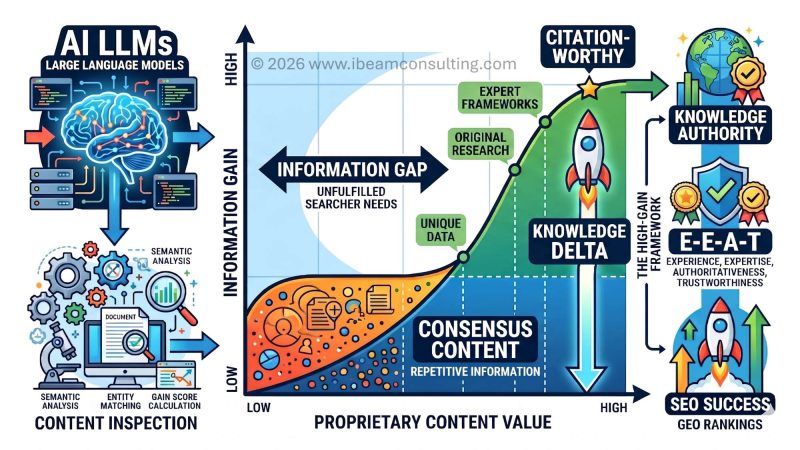
We have entered the Verification Era. In this landscape, search engines and AI models prioritize “Primary Source” signals. They aren’t looking for who can write the best summary; they are looking for who provides the Information Gain.
Today’s Reality: Your B2B firm is sitting on a goldmine of “Dark Matter” — proprietary data, niche engineering skills, and hard-won operational expertise. Today, these assets are no longer just internal secrets; they are your only sustainable SEO moat.
By focusing on the delta between what an AI already knows and what only you can prove, you unlock a new level of search visibility and LLM citation authority.
Let’s take a closer look…
The Science of Information Gain
Quick Backgrounder on Information Gain Patents
The term “Information Gain” is often thrown around as a buzzword, but it is a concrete technical metric with a paper trail in the US patent system (e.g., the USPTO).
To understand why your content might be failing despite “hitting all the right keywords,” we have to look at how the algorithms actually weigh information novelty.
Here’s the primary relevant Google patent today:
Contextual Estimation of Link Information Gain
US Patent 11,354,342 B2 — “Contextual estimation of link information gain.”
This is the definitive current patent (granted in June 2022) describing how Google uses machine learning models to track a user’s “information state.” It calculates the likelihood that a specific link or resource will provide additional, non-redundant information.
In the 2026 environment, this is the algorithm that powers AI Overviews: it identifies which specific facts in your whitepaper are unique relative to the general training data, ensuring that only original contributors get cited.
When an AI engine “reads” the top 100 pages on a topic to generate an answer, it identifies the unique data points found only in specific sources. Those sources get the citation; the rest are ignored as redundant noise.
Strategic Impact for B2B SEO
This patent confirms that Google’s algorithms are specifically looking for the “Information Delta.”
For B2B firms, it means that even if you have a high-authority site, simply “matching” the content of a competitor will result in a low information gain score, potentially leading to your content being skipped in AI Overviews or relegated to lower positions in a multi-stage search journey.
If your content is a synthesis of existing top-ranking pages, you are effectively training the AI to replace you. To win, you must provide “new” information that did not exist in the training set or the current search results until you published it.
Related: See my glossary of AI SEO terminology for key definitions in this overall subject area. Also, learn more here about proprietary content value for SEO.
SEO and Defining the B2B “Information Delta”
Commodity Content and Filling Information Gaps
In the previous decade of SEO, we focused on “Keyword Difficulty” — a measure of how many backlinks it would take to outrank a competitor for a specific string of text. Today, it’s more useful to think about and track “Information Saturation.”
Information Saturation occurs when the “answer” to a user’s search query is so well-documented that an AI can generate a perfect response without ever sending a click to a third-party website.
To break through this saturation, B2B firms must identify their “Information Delta”: the gap between the public AI consensus and your proprietary company reality.
The B2B High-Gain Advantage
Many B2B firms are uniquely positioned to provide this delta because they operate in high-complexity environments. This isn’t just about “tech” companies; it’s about any firm with deep operational roots.
- Proprietary Data Sets: If your SaaS platform processes 10,000 transactions a day, you have real-time visibility into market shifts that a general LLM (trained on historical data) cannot see.
- The Clinical Perspective: An AI can explain the theory of “Predictive Maintenance,” but it cannot provide the specific failure-rate data from a fleet of 500 industrial turbines that your engineering team has monitored for five years.
- Technological Logic: Your proprietary implementation methodologies or internal “bench rules” are original knowledge assets.
The “Boring” B2B Moat (The Legacy Advantage)
Traditional firms in manufacturing, logistics, or industrial processes often feel they lack “fresh” content. The opposite is true. These legacy firms possess decades of historical trends – pricing fluctuations, material durability tests, and supply chain bottlenecks – that are absent from the public internet.
By digitizing this “Dark Matter” into public-facing benchmarks, a “boring” firm creates an Information Gain signal that modern SEO generalists cannot replicate.
Information Gain Signals in Structured Data
Winning in the Age of LLM Citations & GEO
By 2026, “SEO” has largely been subsumed by Generative Engine Optimization (GEO). The goal is no longer just to be “Link #1” or even on Google’s first page of a SERP, but to be the cited source inside the AI’s generated response.
Answer engines like Perplexity, Gemini, and SearchGPT don’t just guess; they use a process called Retrieval-Augmented Generation (RAG). They “read” the top-performing pages and look for the most authoritative “Source of Truth” to back up their claims.
If your page provides the most unique, verified data point (high Information Gain), you earn the citation link.
Structured Information Gain: The Role of JSON-LD
Information Gain is a conceptual win, but structured data is the technical delivery mechanism. Today, standard “Article” schema is the bare minimum. To signal high-gain value, B2B firms use advanced JSON-LD:
- Dataset Schema: Explicitly defining your proprietary benchmarks or survey results so the search engine can “see” the raw data you are contributing to the web.
- ClaimReview & AnalysisNewsArticle: Used to frame contrarian insights or technical breakthroughs as verified “Analysis” rather than generic opinion.
- Machine-Readable Footnotes: Structuring your citations within your own content to show the AI that your conclusions are grounded in verifiable reality.
Structuring for Retrieval
The way we write has changed. In modern AI SEO, “fluff” is penalized because it increases the computational cost for the AI to parse your page. We now use Assertion-Evidence structures:
- The Assertion: A clear, data-backed header (e.g., “Why 40% of Cold-Chain Failures Occur in the Final Mile”).
- The Evidence: A 200-300 word “Knowledge Chunk” that contains the proprietary data point or technical logic that proves the assertion.
- The Delta: A direct statement of how this information differs from the industry consensus.
By making your content easy to cite, you ensure your brand remains the authoritative anchor in the AI’s response loop.
Information Gain and Google E-E-A-T
E-E-A-T: Verification as the New Authority
For years, E-E-A-T (Experience, Expertise, Authoritativeness, and Trustworthiness) was a directional guideline. Now, it is a binary filter.
As AI models become capable of simulating “Expertise” by mimicking the tone and structure of top-tier whitepapers, the emphasis has shifted entirely to Experience and Trustworthiness through Verification.
In the “Verification Era,” search engines aren’t asking “Is this content accurate?” (The AI already knows the accuracy baseline).
Instead, they are asking: “Is there evidence that this information was generated through first-hand experience?”

The “First-Person” Filter
To bypass AI detection and achieve a high Information Gain score, B2B content must be structured around verified experience.
- The “I/We” Factor: Content that details specific internal experiments, project logs, or failures (e.g., “How we migrated 5PB of data and what broke on day three”) creates a signature that LLMs recognize as non-synthetic.
- Entity Grounding: We no longer write for “the brand.” We write for Subject Matter Experts (SMEs). In 2026, we use Person schema to link every technical insight to a verified human expert’s digital footprint. The knowsAbout property in your JSON-LD should explicitly link to the SME’s past publications, patents, and project contributions.
Trust as “Evidence Search”
The modern B2B buyer uses search engines differently. They aren’t looking for “Answers” (they get those from their local AI assistant); they are looking for Evidence.
When they land on your site, they are auditing your authority. If your content provides a “Knowledge Delta” that can be cross-referenced with your proprietary technological logic, you’ve earned the rarest commodity in AI-savvy SEO today: Unsimulated Trust.
Extracting B2B Information Gain Insights
Mining Your Proprietary B2B “Dark Matter” (Tactical Execution)
The biggest hurdle for B2B firms is not a lack of knowledge, but a “knowledge extraction” problem.
Your most valuable Information Gain assets are trapped in internal “Dark Matter” — Slack channels, internal customer support tickets, engineering wikis, process workflows, and the brains of your senior staff.
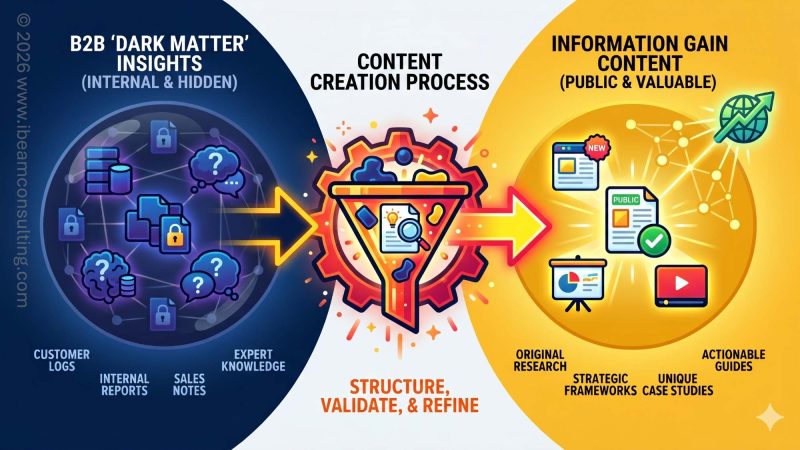
The SME Interview Pipeline
To win at GEO, you must stop treating content as a “Marketing” task and start treating it as a “Knowledge Extraction” task.
- The Slack Audit: Your technical support and engineering channels are filled with “Information Delta.” When an engineer explains a nuanced fix to a customer, that explanation is high-gain content.
- The “Technical Blueprint” Case Study: Move away from the generic “Problem, Solution, Result” case study. Instead, publish “Blueprints” — detailed technical breakdowns of how a specific result was achieved. These blueprints act as “Source of Truth” assets that AI models love to cite.
The “Legacy” Mine
For many B2B firms (including non-tech), Information Gain is found in historical industry nuance.
- The “Old-Timer” Audit: Your most senior technicians or consultants have “mental benchmarks” for the industry. Interviewing them for the “hidden rules” (e.g., “Why the industry-standard pressure sensor fails in humidity levels above 80%, despite the spec sheet”) creates high-value novelty.
- Archive Digging: Digitize old “analog” project logs or spec sheets to create historical industry benchmarks. In a world focused on “now,” being the source of “how things have changed over 30 years” is a massive authority signal.
The Contrarian Wedge
The highest Information Gain score is achieved when your data contradicts the “AI consensus.” If Every AI says “X is the best practice,” but your internal data shows that “Y is 20% more efficient,” you have found a Contrarian Wedge.
This is a powerful visibility signal. Search engines will surface your content as a “divergent perspective,” ensuring you appear in the “Alternative Views” or “Critical Insights” sections of AI Overviews.
B2B SEO and Information Gain Audits
The B2B Content Audit (Checklist)
In the Verification Era of modern SEO, content “quality control” is no longer just about checking for grammar issues and on-page SEO elements; it’s about checking for novelty.
Before you hit publish, run every B2B content asset through this “Information Gain Checklist”:
- The “Commodity Test”: Prompt a leading AI LLM to write a 1,000-word post on your exact topic. Compare its output to your draft. If your draft is 90% identical in structure and data, you have an Information Gain problem. You are publishing duplicative noise, not knowledge.
- The Machine-Readability Audit: Crawl your draft with a schema validator. Does your JSON-LD explicitly define the unique entities, datasets, or claims introduced in the text? If your “Knowledge Delta” isn’t declared in the code, the AI retrieval engines may miss it.
- The Citation Audit: Does the piece contain at least three “cite-worthy” assets? This could be a proprietary statistic, a unique framework diagram, or a specific technological breakthrough. If an AI can’t find a specific fact to attribute to you, it won’t link to you.
- Visual Information Gain: Don’t use stock photos or AI-generated generic illustrations. Today, “AI Vision” models scan your images for data. Use original, data-driven diagrams and charts. These are often the first thing an answer engine ingests and credits.
Like this post? Quickly share it with your social networks here.
Information Gain and SEO Tools
The Information Gain SEO Tech Stack
To operationalize Information Gain (IG) in this era of AI search, B2B teams can use a specific class of tools designed for Generative Engine Optimization.
Here are some examples, including their connections to information gain (IG) value.
Ahrefs — The Infrastructure & Discovery Specialist
- Value Proposition: Industry-leading competitive analysis and citation gap discovery. Ahrefs remains the gold standard for uncovering the “Information Delta” through its multi-platform index.
- IG Usage: Use the Brand Radar feature to identify specific queries where competitors are cited in AI Overviews but your proprietary B2B data is absent.
xSeek — The AI Visibility Specialist
- Value Proposition: A pure-play AI Search Visibility platform. xSeek is designed to monitor bot behavior (GPTBot, PerplexityBot) and predict how LLMs will interpret your technical content.
- IG Usage: Assigns an Information Gain Density score to drafts, identifying areas where AI responses are currently “thin” and high-gain intervention is needed.
MarketMuse — The Semantic Modeling Specialist
- Value Proposition: Leverages AI-driven topic modeling to map Authority Gaps. It uses vector-shift analysis to compare your expertise against the general web corpus.
- IG Usage: Generates a real-time Information Gain Score (IGS), identifying semantic nuances and technical “micro-niches” that competitors have overlooked.
Semrush — The Authority & Citation Toolkit
- Value Proposition: A comprehensive toolkit for monitoring the “Source of Truth” signal. Its 2026 feature set includes real-time citation metrics for your most valuable claims.
- IG Usage: Maps Query Fan-Outs to build Information Gain into the deeper layers of a pillar strategy, helping your brand to stay in the conversational loop.
AirOps — The Extraction & Automation Hub
- Value Proposition: Specializes in “Dark Matter” extraction. AirOps automates the workflow between technical documentation and public-facing content assets.
- IG Usage: Uses a Commodity Score audit to find pages that match AI training data too closely, automatically flagging them for SME-led novelty injections.
Clearscope — The Grading & Entity Specialist
- Value Proposition: Focuses on the machine-readability of expertise. Clearscope provides a real-time environment for grading how well your “Assertion-Evidence” loops are working.
- IG Usage: Leverages Unique Entity Identification to ensure your proprietary frameworks and data points are recognized by AI crawlers as original contributions.
Frase — The Research & GEO Specialist
- Value Proposition: Frase is the leader in “Dual-Scoring,” providing a standard SEO score alongside a GEO Score to measure cite-readability.
- IG Usage: Uses SERP Synthesis to identify the “Common Wisdom,” allowing SMEs to focus exclusively on the “Missing 10%” of unique information.
Surfer SEO — The On-Page Execution Engine
- Value Proposition: Built for building “Knowledge Moats.” Surfer connects on-page optimization with site-wide topical mapping.
- IG Usage: The Real-Time Content Editor ensures unique data points are phrased for maximum attribution by RAG retrieval systems.
Scalenut — The End-to-End GEO Hub
- Value Proposition: Designed for factual velocity. Scalenut bridges the gap between technical research and polished, citation-ready drafts.
- IG Usage: The “Fix-It” Auto-Optimization tool aligns headers with the structured data requirements of modern AI search engines.
B2B SEO and Information Gain — Closing Thoughts
Conclusion: From Content Producer to Knowledge Authority
The shift toward Information Gain represents the most significant change in search since the introduction of PageRank. For twenty years, SEO was about who could play the “structural” game the best — keywords, backlinks, site speed, etc.
Today, the SEO structural game is just a baseline, and the “Knowledge Game” is where the winners are decided.
Information Gain is the technical bridge between traditional SEO and the new world of AI visibility. B2B firms that continue to produce “curated” or “synthesized” content will find themselves invisible to the algorithms that now gate-keep human attention.
However, those that embrace their internal “Dark Matter” and turn their proprietary expertise into a public Knowledge Delta will thrive.
In the end, search engines aren’t just looking for pages; they are looking for sources. If you aren’t adding to the world’s total knowledge base, you aren’t just “falling in the rankings” — you are becoming non-existent to the machines that guide B2B buying decisions.
Ready to Find Your Information Delta?
Don’t let your proprietary knowledge stay trapped inside your organization. The time to transition from a content producer to a knowledge authority is now.
Suggested Next Steps:
- Audit Your Content Pillars: Run your top 5 traffic-driving pages through the Information Gain Checklist above to see if they are at risk of being replaced by AI Overviews that leave you out.
- SME Strategy Session: Schedule an AI SEO strategy session to build a “Knowledge Extraction” pipeline that turns your internal expertise into a search engine moat.
- Data-to-SEO Blueprint: Brainstorm ways to turn your internal B2B solution data into a public-facing industry benchmark that AI engines will discover and cite.
Questions or Comments?
I hope these insights into using Information Gain concepts to improve your AI SEO performance have been helpful!
I’ll wrap up this post with a few related questions for you:
- For your current B2B website and content base, how much true information gain material do you already have in place? Which public-facing pages or posts/articles communicate the most information gain?
- Are you auditing your AI search visibility yet for your core B2B topics? If so, what have you discovered in this area?
- What internal resources (e.g., people and things) can you leverage most easily to extract information gain material? What can you put in motion this week or month?
Feel free to add more in the comments below with any thoughts, feedback, or related questions. Thanks also for any social shares on this post!
