
The Evolving Importance of External Backlinks
In the “Good Old Days” of traditional SEO, people spent significant time and resources building backlinks to boost their organic search visibility.
Now, in the age of AI-powered search, the role of backlinks has evolved quite a bit!
This post highlights backlinks in the age of AI SEO, including insights, tips, and a few related tools.
Let’s take a closer look at backlink evolution below…
This post contains a few referral links to select vendor partners. We may receive compensation for purchases made through these links, at no additional cost to the buyer.
Last updated May 16, 2026
Backlinks in the Context of AI-Centric SEO
Introduction: The “Death” vs. Evolution of the Backlink
For over two decades, the hyperlink has been the undisputed currency of the web. In the “Classic SEO” era, backlink building was a volume game — a digital popularity contest where the site with the most votes (links) typically sat on the throne of Page 1.
But today, the landscape has fundamentally shifted. With the rise of AI-powered search engines like Perplexity, ChatGPT, and Google’s AI Overviews, many are asking a very serious question:
“Is the backlink finally dead?”
The answer is a resounding no, but the role of the backlink has undergone a radical transformation. We are moving away from the simplistic PageRank model and toward a world of Authority Graphs and Entity Mapping.
In this new era, AI models don’t just count links; they use them as “grounding signals” to verify facts and determine which sources are trustworthy enough to be cited in a generative response. Backlinks are no longer just bridges for crawlers; they are the digital signatures of trust.
Backlinks Then and Now
Classic SEO vs. AI SEO: How Have Backlinks Changed?
To understand how to build links today, we first have to recognize how the “Rules of Engagement” have changed between the classic linear model and the modern relational AI model. Let’s start with the quick comparison table below.
Comparison: Traditional SEO vs. AI SEO Backlinks
| Feature | Traditional SEO Backlinks | AI SEO Backlinks |
| Primary Goal | Pass “Link Juice” (PageRank) to a specific URL. | Act as a “Grounding Signal” to verify facts and authority. |
| Success Metric | Domain Authority (DA) and raw quantity of links. | Entity Authority and frequency of citations. |
| Contextual Value | Anchor text relevance is the primary signal. | Semantic Proximity (the meaning of the text surrounding the link). |
| Attribute Role | Binary: dofollow passes value; nofollow does not. | Relational: All links are “hints” that define entity connections. |
| Primary Platform | High-authority blogs and news sites. | “Human Proof” platforms (Reddit, Quora) and Seed Sites. |
| Crawl Value | Essential for indexing (and ranking) new pages. | Essential for RAG (Retrieval-Augmented Generation) grounding. |
| Brand Mentions | Largely ignored if not linked (Unlinked Mentions). | Highly valued as Implied Links via Entity Mapping. |
Related: See this post to learn more about SEO tools for backlink profile analysis. There are some free basic options here.
The Linear Model: Classic SEO
In the pre-AI era, SEO was largely transactional. You identified a keyword or keyphrase, built a page, and pointed a specific number of high-Domain Authority (DA) links with keyword-rich anchor text at that page.
Success was measured by how well you gained these external signals to convince a search engine crawler of your relevance.
The Relational Model: AI SEO
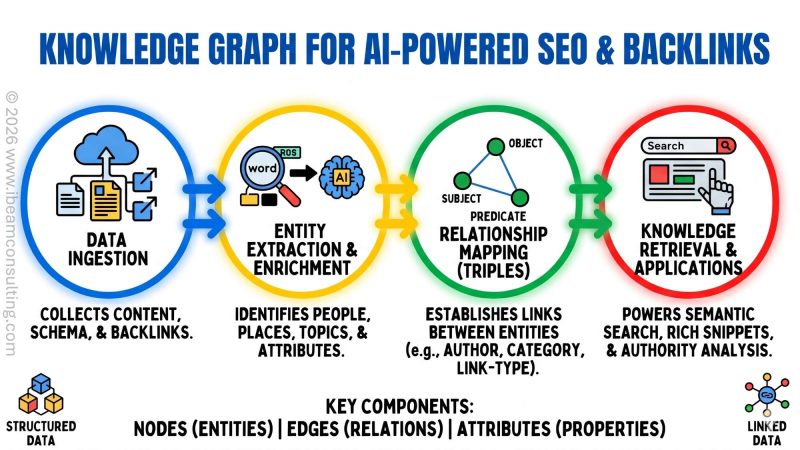
AI search engines operate differently. They aren’t just looking for “votes”; they are building a map of the world’s knowledge. This shift introduces three critical new dynamics:
Contextual Proximity
It is no longer enough to have a link from a high-DA site. AI evaluates the semantic context surrounding that link. If you are a financial software company, a link from a top-tier tech blog carries more weight if the surrounding paragraph discusses “SaaS accounting hurdles” than if it’s tucked into a generic list of “Cool Sites We Like.”
Citation vs. Link
We are seeing the rise of the “Implied Link.” Large Language Models (LLMs) are trained on massive datasets where they learn to associate brands with specific topics.
A high-profile unlinked mention in a publication like The Wall Street Journal can now be more impactful for AI visibility than a “followed” link from a low-tier niche blog. The AI recognizes the entity relationship regardless of the HTML tag.
Grounding & RAG
When an AI generates an answer, it often uses a process called Retrieval-Augmented Generation (RAG). It “retrieves” facts from the web to “ground” its response. Backlinks act as the primary signal of which sources are the “Gold Standard” for those facts.
If the top-cited experts in your field all link to your original research, the AI is significantly more likely to use your data as the foundation for its answer.
Related: See my AI SEO glossary of key terms for more terminology definitions related to AI-powered search.
Backlinks Play Multiple Roles Now
Dofollow vs. Nofollow Backlinks: The Blur of the “Hint” System
In the classic SEO handbook, the distinction between “dofollow” and “nofollow” was binary. Dofollow links passed “link juice” (authority), while nofollow links were effectively ignored by crawlers, serving only as paths for human traffic.
However, as Google first signaled in its 2019 announcement, “Evolving nofollow – new ways to identify the nature of links,” these attributes are now treated as “hints” rather than directives. AI has now completed this transition.
The AI Perspective: Links as Relationships
Large Language Models (LLMs) do not view the web through the lens of a ranking algorithm. They view it as a massive dataset of relationships. To an AI model, a link is a connection between two entities, regardless of whether a rel=”nofollow” tag is present.
Nofollow as an Entity Signal
If your brand is linked from a high-authority news site like The New York Times or Forbes, even with a nofollow tag, that link serves as a massive validation of your “entity” status.
The AI notes that a trusted source is referencing you. In the context of “Entity Mapping,” that relationship is logged as high-trust, helping the AI decide to cite you in generative answers.
Diversification as “Human Proof”
Ironically, a backlink profile consisting of 100% “dofollow” links now looks suspicious to modern AI filters. Real, organic brand growth creates a messy mix of nofollow links from social media, UGC (User Generated Content) platforms, and sponsored content.
AI models are trained to recognize these patterns of “Human Proof” — if people are talking about you in places where links are naturally restricted, you are likely a legitimate authority.
Backlinks, Digital PR, and Authority
The New “Digital PR”: Building Authority, Not Just Links
The SEO “Link Building” departments of the past are rapidly morphing into “Digital PR” and “Brand Authority” teams. The goal has shifted from acquiring a URL on a page to becoming a Citable Brand.
The Rise of the “Citable Brand”
In an AI search environment, the most valuable “backlink” is a citation. This means your strategy must move beyond guest posting on generic blogs. You want to be the source that other people must reference.
Reddit & Social Community Signals
Recent industry studies by researchers like SparkToro and Searchbloom indicate that a significant portion – up to 40% – of AI citations now originate from user-led platforms like Reddit and Quora.
AI models prioritize these because they represent “Human Proof.” A brand being recommended in a specific subreddit thread carries enormous weight in the AI’s recommendation engine.
Expert Positioning
Digital PR is now about placing your brand experts into the right industry conversations. When your CEO is quoted in an industry report or interviewed on a reputable news site, it builds “Entity Authority.”
The AI connects the person, the brand, and the topic into a single node of expertise.
Multimedia Backlinks
We are entering the era of the “Invisible Link.” AI models are increasingly trained on video transcripts and audio from podcasts. A verbal mention of your brand or a link in a YouTube description is now indexed and understood as a vote of confidence.
Your “backlink” profile is no longer just text; it’s a cross-platform web of mentions.
Related: Learn more in these posts about using Reddit & Quora for SEO, top SEO discussions on Reddit, and Reddit users’ favorite SEO tools.
Earning Backlinks for AI Visibility
Best Methods for Building Backlinks for AI Visibility
If traditional backlink building is losing its edge, what tactical maneuvers should you use to ensure your brand is cited by AI? The focus must shift toward creating “unavoidable” value.
The “Original Data” Strategy
AI models thrive on accuracy. If you create proprietary research, conduct industry-wide surveys, or publish unique case studies, you create a “primary source.” When other sites link to your data, they are essentially telling the AI: “This is the source of truth for this statistic.”
The AI must cite the primary source to maintain its own factual grounding.
Semantic Clustering
AI views the web semantically. To win, your external backlink strategy should mirror your internal topic clusters. If you are building authority around “Renewable Energy Infrastructure,” your backlinks shouldn’t just come from general environmental blogs.
They should come from a cluster of sources including engineering journals, government policy sites, and economic forecasts. This “Semantic Clustering” signals to the AI that you are a central node in a specific knowledge graph.
Targeting “Seed Sites”
AI models aren’t trained on the entire web equally. They use “Seed Sites” – highly trusted domains rooted in early concepts like TrustRank – to anchor their understanding of truth.
A single link or mention on a Seed Site (Wikipedia, major news outlets, academic databases) is worth more than a thousand links from low-tier blogs because it places you inside the AI’s “Trust Circle” from the moment of training.
The Answer Capsule Framework
How you format the content that people link to matters. Use the “Answer Capsule” approach (often referred to as a Semantic Summary Block): place a concise, data-rich summary (30–50 words) at the top of your research.
This makes it incredibly easy for an AI to extract your core finding and credit your brand as the source.
SEO Tools for Backlink Growth
The SEO Tool Landscape & New Backlink Capabilities
The tools we use to measure SEO success are evolving just as fast as the search engines themselves. We are moving away from keyword-centric “Rank Tracking” and toward AI search-focused “Visibility Analytics.”
Legacy Tools Adapting
Industry staples like Ahrefs and Semrush have integrated AI to move beyond raw metrics. They now offer “Predictive Link Impact,” which uses LLMs to guess how a specific backlink will influence your “Entity Authority” rather than just your Domain Authority.
They also highlight “Topic Gaps” where your competitors are being cited by AI but you are not.
The New Guard
A new generation of citation/backlink tracking tools has emerged specifically for the AI era:
Visibility Trackers
Platforms like Wellows, ZipTie.dev, and Ahrefs Brand Radar (representing their evolving brand-tracking roadmap) allow you to track your “Share of Voice” within AI-generated answers.
They show you exactly which fragments of your content are being retrieved and which competitors are stealing your citations.
Related: See this post for more about free AI search visibility trackers.
AI Outreach Agents
Specialized toolkits like the Semrush AI PR Toolkit and BuzzStream AI use LLMs to personalize outreach for link-building campaigns.
The best PR outreach agents use AI to research a journalist’s previous coverage rather than just automating the delivery of a template.
Sentiment Analysis & Reputation
Tools like Profound, Brandwatch, and Revuze now measure the sentiment of your backlink profile.
AI models prefer to cite sources that are spoken of positively by other experts; if your backlinks come from controversial or negative contexts, your visibility in “Safe Search” AI outputs will plummet.
Visibility with Zero (or Very Few) Backlinks
Contrarian Perspectives & The “Backlink-Free” Question
As we redefine the utility of external backlinks, a controversial question has emerged: In the age of AI, can you actually rank – or be cited – without any traditional backlinks at all?
Ranking Without Backlinks: The Possible Dream
While Google’s Gary Illyes has famously stated – most notably during PubCon and the Search Off the Record podcast – that links are no longer a top-three ranking factor for all queries, the reality is more nuanced.
There are specific scenarios where AI models can bypass link equity entirely:
Topical Dominance
If you produce the most exhaustive, well-structured, and technically accurate coverage of a hyper-niche topic, you can trigger “Topical Authority” signals. AI models, particularly in Retrieval-Augmented Generation (RAG), prioritize the “best-fit” answer for the user’s specific context.
If your site provides that fit consistently, you become an authority in the AI’s internal weights regardless of external links.
Low-Competition “Answer Voids”
AI search often identifies “Information Gaps” where high-DA sites haven’t provided a clear, direct answer. If you fill this “Answer Void” with high-quality content, you can secure the primary citation in an AI Overview because the AI has no better “grounding” source to choose from.
Technical SEO as the Surrogate
In the absence of links, AI relies on machine-readable signals. Extensive use of Schema.org markup, strong Core Web Vitals, and the implementation of emerging standards like llms.txt (which gives direct instructions to AI crawlers) can act as a surrogate for authority.
Arguments and Counter-Arguments
Argument A (The Formatting Win)
Proponents of “Zero-Link SEO” argue that for transactional or niche informational queries, AI models prioritize formatting and clarity over volume. A well-organized table or a clear bulleted summary often beats a 3,000-word guide with a thousand links.
Argument B (The Direct Pipeline)
Some experts predict a future where direct brand-to-model relationships – facilitated through API integrations or specialized AI feeds – will allow brands to bypass the “middleman” of the web link entirely.
The Counter-Counter Argument
Despite these trends, the industry consensus remains that links are the web’s only decentralized trust mechanism. AI models are prone to hallucination; they need a way to verify that a piece of information isn’t just well-formatted, but actually vetted by other humans.
Backlinks provide that “reality check.” You might rank in an answer void without them, but you won’t maintain a seat at the table of authority in a competitive space without a web of trust.
Related: See this post to learn more about SEO and ranking without backlinks. For traditional (web links) search rankings, it is possible to rank high with zero or very few backlinks. (I’ve seen it on this website and blog!)
Like this post? Quickly share it with your social networks here.
AI SEO and Backlinks — Closing Thoughts
Conclusion: The Backlink Roadmap Ahead
As we navigate the complexities of modern AI-driven SEO, it is clear that the “currency of the web” hasn’t been devalued — it has just been upgraded.
Backlinks are no longer simple votes of popularity; they are the proof of work for your brand’s expertise. They represent the human friction required to earn trust in a world of frictionless AI content generation.
The roadmap for the future of SEO isn’t found in exploiting a crawler’s algorithm, but in building a resilient Authority Graph.
This requires a fundamental shift in mindset. You must stop building links for robotic crawlers and start building meaningful mentions for the humans that AI systems are watching.
When you focus on being the primary source of truth in your niche, the citations from AI search engines will follow naturally.
The age of AI SEO isn’t about doing less; it’s about doing better. It’s about ensuring that every link in your profile serves a purpose beyond just ranking — serving as a beacon of reliability for both AI “brains” and human readers.
Call to Action: Ready to future-proof your authority? Take steps to identify your current topic gaps, discover where your competitors are stealing your AI share-of-voice, and find the “Authority Nodes” your brand is currently missing.
Questions or Comments?
I hope this brief overview of backlinks and their changing role and importance in AI SEO has been helpful! Let’s wrap up with a few related questions for you:
- How strong is your website’s “traditional” backlink profile today? Do you check it periodically with common backlink tracking tools? Is it gaining or losing strength over time?
- Have you started tracking AI search citations to measure your AI-specific SEO visibility?
- What steps could you take in the next week or month to grow and diversify your backlinks and AI search citations?
Feel free to add more in the comments below with any thoughts, feedback, or related questions. Thanks also for any social shares on this post!
