
The New Role of Keywords in AI Search
In traditional SEO, keywords were king.
Today? Not so much.
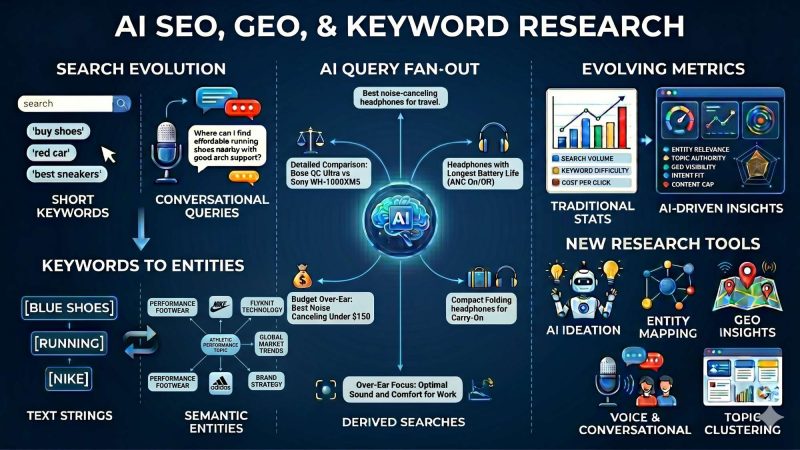
In modern AI-focused search optimization, “SEO keywords” are still part of the picture, but their role and importance are shifting.
This post looks at AI SEO, GEO, and keyword research, including insights, tips, and tools for moving forward.
Let’s take a closer look below…
This post contains a few referral links to select vendor partners. We may receive compensation for purchases made through these links, at no additional cost to the buyer.
Last updated May 28, 2026
AI SEO and the Role of Keywords
Introduction: “Keywords” in an AI-Driven SEO Context
Look closely at your own browsing behavior over the last year.
When you need to resolve a highly specific problem or compare complex options, how often do you still type a fragmented search string into a search engine, click through three different websites, reject cookie consents, dodge pop-up newsletters, and manually piece together the answer yourself?
The answer is likely “far less than before.”
With the explosive maturation of AI Large Language Models (LLMs) and conversational search interfaces, user behavior has reached a tipping point.
Instead of typing “best CRM software,” today’s users are dropping paragraphs of hyper-specific context directly into ChatGPT, Perplexity, Claude, or Google’s AI Overviews.
A more typical example today looks more like this:
“What is a budget-friendly, user-friendly CRM for a 15-person remote agency that integrates natively with Slack and handles basic sprint-style deal pipelines?”

For more than two decades, search engine optimization (SEO) was dominated by a singular goal: rank number one on a search engine results page (SERP) to capture organic traffic.
But in a landscape where search engines synthesize the web on the fly to write custom, direct answers for users, the goalpost has dramatically moved.
Success is no longer measured solely by blue-link click-through rates. It is measured by becoming the synthesized citation inside the LLM’s final response.
In the wake of this monumental paradigm shift, search marketers have scrambled to define the boundaries of optimization.
This effort reached a critical milestone with the release of Google’s landmark AI Optimization Guide, which officially bridged the gap between classic technical indexing and generative search engines.
Google formally confirmed what the industry had suspected: generative AI search relies fundamentally on core search ranking and quality systems to retrieve and ground its findings.
As the official documentation states: “Is SEO still relevant for generative AI search? In short, yes! The best practices for SEO continue to be relevant because our generative AI features are rooted in our core Search ranking and quality systems.”
So, despite the panicky industry declarations that “SEO is dead” or “Keyword research is dead,” we are actually witnessing an evolution.
Keyword research is transforming from an exact-match string-guessing game into a highly strategic map of semantic entity relationships, user intent models, and the hidden “sub-queries” that power generative search engines behind the scenes.
If you want to keep your brand visible as generative search scales, you must understand how to optimize your digital footprint for both humans and the machines that summarize your work.
Welcome to the era of Generative Engine Optimization (GEO) and its new keyword realities!
Keyword Evolution — Traditional SEO vs. GEO
A Layered View of AI Search Visibility
To understand how keyword strategy is changing, we must first define the operational landscape. For decades, the SEO playbook was built on a series of structural compromises.
Search optimization professionals designed pages to cater to simple search index algorithms.
Today, that playground has split. While traditional search engines still handle billions of navigational queries, informational and transactional queries are increasingly processed by generative engines.
This has forced the birth of Generative Engine Optimization (GEO).
Where traditional SEO focuses on helping a user find your page, GEO focuses on helping an AI model comprehend, summarize, and cite your page.
To win in this dual-world environment, growth teams are adopting a 3-Layer Visibility Framework:
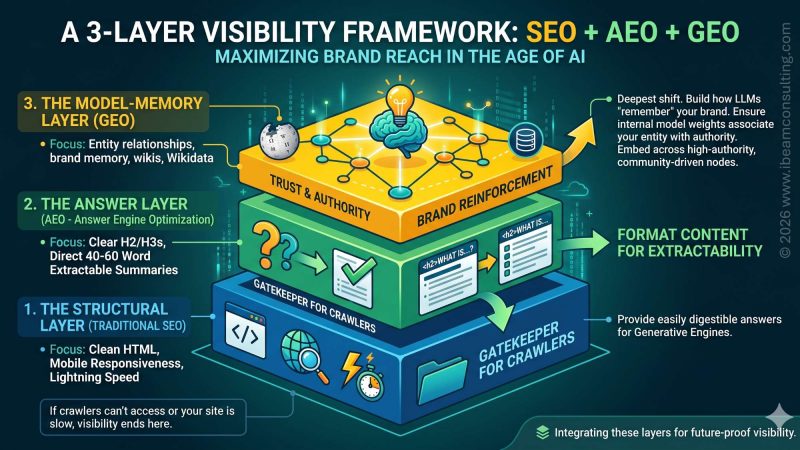
Layer 1 — The Structural Layer (Traditional SEO)
This remains your foundation. If search crawlers can’t access your pages, or if your site loads like a dial-up connection on mobile, neither traditional search engines nor AI crawlers will spend the computing budget to read your site.
Sound basic SEO is the gatekeeper here.
Layer 2 — The Answer Layer (AEO – Answer Engine Optimization)
Generative engines have a voracious appetite for direct, easily digestible answers. This layer is about formatting your content so it is highly extractable.
It requires structured lists, clear question-answer formatting (e.g., using precise headers like “What is X?”), and summarizing key conclusions in crisp, 40-to-60-word blocks.
Layer 3 — The Model-Memory Layer (GEO)
This is the deepest, most critical shift. AI models rely on pre-trained neural networks and semantic maps. This layer is about reinforcing how the LLM “remembers” your brand.
When a user asks an AI to recommend a tool in your niche, the model shouldn’t just run a live web search; its internal weights should already associate your brand entity with high authority and trust.
This is achieved by embedding your brand across high-authority, community-driven nodes like Wikipedia, Wikidata, Reddit, Quora, and niche-specific industry directories.
Side-by-Side: Traditional SEO vs. GEO
| Strategic Dimension | Traditional SEO | Generative Engine Optimization (GEO) |
|---|---|---|
| Primary Metric | Organic Keywords, Impressions, Click-Through-Rate (CTR) | AI Citation Share, Brand Share of Voice, Referral Traffic |
| Content Strategy | Keywords-in-headers, long-form comprehensiveness, exact phrase matching | Entity semantic mapping, highly structured summaries, factual claim verification |
| Authority Engine | Domain PageRank, backlink volume, keyword anchor text | Source Chain Optimization (Reddit, Wikidata, Wikipedia, trusted industry journals) |
| User Experience | Engaging design, low bounce rate, high scroll depth | High readability for crawlers, zero-JavaScript text accessibility, instant direct value |
Understanding this split is the key to evolving your keyword research. If your keywords are optimized only for traditional SEO (e.g., matching search volume strings), your content will remain invisible to the crawlers feeding the conversational summaries.
If you optimize for GEO, you secure your brand a seat at the table where the AI makes its ultimate recommendation.
Related: See my glossary of AI search-related terminology for many key terms used in this overall area.
Keywords and the Query Fan-Out Process
Conversational Language & The “Query Fan-Out” Phenomenon
Historically, searching the web was an exercise in compromise. Humans adapted their natural speech to fit the structural limitations of database indexing.
We didn’t search how we thought; we searched in text fragments using “keywords” or “keyphrases” containing multiple words.
For example: “best project management tool agile remote.”
Generative AI has shattered this compromise. The rise of conversational interfaces – powered by AI Large Language Models (LLMs) – has shifted user inputs from robotic shorthand to highly contextual, natural-language prompts.
Today, a user is just as likely to type:
“I run a boutique 15-person design agency. We’ve been using Trello but we’ve outgrown it because we need better sprint planning and dependency mapping, but we don’t have the budget or setup time for Jira. What are my best alternatives that also have a clean Slack integration?”
This is an ultra-long-tail query on steroids. In the pre-AI era, targeting this search query directly would have been considered a waste of marketing resources.
No keyword tool would report search volume for it, and no single static landing page could perfectly match all of its hyper-specific, multi-clause parameters.
But behind the screen of a modern search-centric AI (like Perplexity, Gemini, or Google’s AI Overviews), a fascinating technical process occurs to bridge the gap between this ultra-long prompt and the static web.
This process is known as the “Query Fan-Out” Phenomenon.
How the “Fan-Out” Query Works
When you submit a 50-word, multi-variable prompt to an AI search engine, the model does not run a search query for that entire paragraph. Doing so would yield zero exact-match index results.
Instead, the LLM acts as an orchestrator. It parses the prompt, identifies the core constraints, and “fans out” the single complex prompt into a cluster of distinct, highly targeted sub-queries.
It then runs these sub-queries in parallel across its search index.
In its official documentation, Google formally defines this step:
Query fan-out: “A set of concurrent, related queries generated by the model to request more information and fetch additional relevant search results to address the user’s query.”
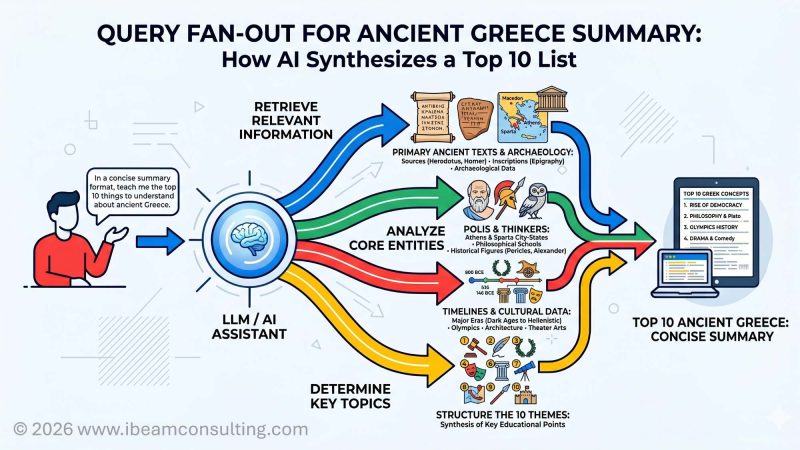
The AI model retrieves the top search results for all three “fan-out” queries, scrapes the underlying pages, synthesizes the collective information, filters it through the lens of your budget and team size constraint, and serves you a perfectly tailored recommendation complete with inline citations.
The Strategic Takeaway for Digital Content Marketers
If the AI is breaking complex prompts down into traditional search queries behind the scenes, then your content must be designed to satisfy those specific sub-queries.
True keyword research today is no longer about finding the single “golden keyword” to write a 3,000-word guide around. It is about mapping the entire matrix of potential fan-out queries that an AI engine will generate when a user asks about your product category.
If your site ranks number one for Sub-query 2 and Sub-query 3, the AI is more likely to cite you as the primary recommendation, even if you never explicitly optimized for the user’s highly specific 50-word prompt.
Conducting AI SEO Keyword & Topic Research
Adjusting Your Approach to SEO Keyword Research
Because the path from user search to final answer has changed, our methodology for finding, analyzing, and prioritizing keywords must change too.
Here is the modern three-step blueprint for keyword and topic research.
The Hybrid Anchor: Where Traditional Keyword Research Meets GEO
Before diving into entity extraction or prompt testing, we must address a common strategic pitfall: discarding legacy keyword frameworks entirely.
Traditional SEO keyword research is not obsolete today; it is the foundational engine that makes advanced GEO possible.
There are four specific reasons traditional keyword research must remain anchored in your AI SEO action plan:
Seeding the “Query Fan-Out” Matrix
When an LLM splits a complex prompt into multiple sub-queries, those sub-queries are almost always traditional, high-volume search terms.
To capture those invisible micro-searches, you must first identify the raw “head” and “mid-tail” keywords that the LLM uses to retrieve its source content.
Navigational & High-Intent Transactional Queries
When a user is ready to execute a direct action (e.g., “Figma pricing”, “ActiveCampaign login”, or “buy red lightweight running shoes”), they rarely use open-ended conversational threads. They demand instant, blue-link utility.
Traditional search volume (MSV) is still the ultimate proxy for prioritizing these conversion-driving terms.
Optimizing Structured Merchant & Location Feeds
As e-commerce and local search engines evolve, generative models pull directly from databases like Google Merchant Center (GMC) and Google Business Profile (GBP) rather than raw web copy.
Traditional keyword research is vital to determine the exact product specifications, category fields, and attributes your target market queries.
Triage of Technical & Editorial Budgets
You cannot optimize every page for GEO simultaneously. Traditional search volume allows you to prioritize which legacy URLs to optimize first, ensuring you protect your highest-traffic, highest-revenue assets.
With this hybrid anchor established, we can execute the three-step workflow of modern topic mapping.
Step 1: Shift from Keywords to Entities (Entity-Based SEO)
Generative models do not see the web as a collection of string characters; they see it as an interconnected web of entities (people, places, concepts, software, brands) and the relationships between them.
This is the foundation of semantic search.
Instead of organizing your keyword spreadsheets by search volume and/or difficulty scores, organize them by Topical Entity Nodes.
- Identify Your Core Entities: If you sell a customer support tool, your core entities might be Help Desk (Concept), Customer Satisfaction Score (Metric), SaaS (Industry), and Zendesk (Competitor/Entity).
- Build Semantic Maps: Use tools like Google’s Knowledge Graph API or open databases like Wikidata to see how Google associates your niche’s entities.
- Map the “Is-A” and “Has-A” Relationships: Build topic clusters that define these relationships. For example, your software is a CRM alternative, has a shared inbox feature, and solves ticket backlog issues.
The “Non-Commodity Content” Quality Rule
In its guidelines, Google heavily stresses the production of non-commodity content. Since AI engines are already trained on the basic web consensus, they do not need to cite another webpage that merely regurgitates and summarizes existing information.
Instead, search engines seek out original, non-commodity insights. When designing your topical entity clusters:
- Integrate Proprietary Data: Conduct unique industry surveys or compile proprietary usage statistics.
- Prioritize First-Person Narratives: Frame your content around firsthand experience (e.g., writing “We ditched Sprint Planning for Kanban: Our 60-Day Retrospective” rather than a generic “Benefits of Kanban”).
- Build Visual Citation Cards: Generative UI is highly visual. Support your text with original high-resolution infographics, diagrams, and videos. Google’s generative models actively pull relevant, labeled media directly into visual citation cards, meaning a well-tagged custom graphic can earn you a premium citation above the text.
Related: Learn more in these posts about SEO and adding information gain, and information gain advantages for B2B SEO.
Step 2: Uncovering Latent Conversational Queries
To capture long-tail and ultra-long-tail AI traffic, you must find out how your audience actually phrases complex problems when they talk to a human — or an AI assistant.
The Google Search Console (GSC) Regex Hack
Your current users are already starting to use conversational queries to find you, but these queries are buried deep in your GSC data. You can unearth them by filtering your queries using custom Regular Expressions (Regex) designed to look for long, question-based strings.
In GSC, go to Performance > Search Results, click Add filter > Query (By keyword), select Custom (regex), and input the following pattern for matching:
^([^\s]+\s+){6,}[^\s]+$
What this does: This matches any search query containing 7 or more words.
(Just change the “6” above to whatever number “N” you want. The resulting GSC user queries should have at least N+1 words/terms in them.)
When you run this filter, you will instantly bypass the generic head terms and uncover a goldmine of highly specific, latent conversational queries that your audience is typing into search boxes.
Many of these longer user queries will be in question formats.
These make perfect H2 subheadings or dedicated Q&A blocks for your content.
Related: Learn more in these posts about using Regex filters in Google Search Console and finding question keywords in GSC.
Tapping Human-to-Human Networks
Beyond GSC, study the spaces where humans seek unvarnished advice:
- Reddit and Quora: Mine subreddits in your industry. Pay attention to how users frame their frustrations (e.g., “I’m sick of X because…”).
- People Also Ask (PAA): Use SERP scraping tools to map out the secondary and tertiary questions Google automatically associates with your core topics.
Step 3: Prompt Research & Testing
Just as you used to “Google” your target keywords to see what the competition looked like, you must now “Prompt” the leading LLMs to see how your brand is positioned.
Create a Prompt Testing Matrix in a spreadsheet with the following columns:
| Target Prompt | Intent Category | Claude Response (Citations) | ChatGPT Response (Citations) | Gemini Response (Citations) | Gaps / Opportunities |
|---|---|---|---|---|---|
| “What is the best CRM for a small agency?” | Commercial Investigation | Hubspot, ActiveCampaign | Hubspot, Copper | Salesforce, Close, Hubspot | No mention of our brand. Need to build comparison pages optimized for “agency CRM”. |
| “How do you calculate customer churn in SaaS?” | Informational / Educational | Outlines formula, cites Mixpanel | Outlines formula, cites Stripe | Cites ChartMogul, Baremetrics | Our guide to churn isn’t cited. We need clearer schema and more direct answers on our page. |
The Testing Workflow
- Write down 20-30 conversational prompts your buyers would ask at various stages of the funnel.
- Input these prompts into Claude, ChatGPT, Gemini, and Perplexity.
- Analyze the results: Who is getting cited? Why? Is it because they have a clean table comparing features? Is it because they have a highly authoritative, original case study?
- Use these insights to optimize your existing articles, ensuring they are formatted to be easily scraped, parsed, and cited by leading AI engines.
AI SEO and New Keyword Metrics
Redefining SEO Metrics: Moving Beyond Keyword “Search Volume” and “Search Difficulty”
If you try to run a modern search strategy using metrics from just a few years ago, you will end up optimizing for an internet that no longer exists.
For decades, search engine marketing relied on a comfortable binary: Search Volume (how many people search for a phrase, typically per month) and Keyword Difficulty (how hard it is to rank on the first page of organic search results).
In the era of GEO and AI search, both of these common keyword metrics are breaking down. To survive, marketers must learn to see through the data mirage.
Related: Learn more in these posts about traditional keyword search volume estimates and organic keyword ranking difficulty scores.
The Mirage of Traditional Keyword Search Volume
In the classic SEO funnel, 10,000 monthly searches was a goldmine. You knew that ranking in position #1 would net you roughly 30% of those clicks (~3,000 visitors).
Today, that math is broken. Generative AI Overviews (AIOs) and answer blocks occupy the most valuable real estate at the top of the search results page.
When an LLM completely answers a user’s informational query within the search interface itself, the user has zero incentive to click through to any external link.
This is the Zero-Click Search.
A keyword with 10,000 monthly searches might now yield 80% fewer clicks to traditional search listings.
Relying solely on raw monthly search volume (MSV) leads to overestimating the traffic potential of informational content, wasting valuable production budgets on terms that will never convert to pageviews.
The Fallacy of Classic “Keyword Difficulty”
Traditional keyword tools calculate “search difficulty” by evaluating the backlink profiles (PageRank) of the domains ranking in the top 10 positions. If the SERP is filled with heavyweights like HubSpot, Forbes, or TechCrunch, the difficulty score is marked as “Hard.”

Good to Know: The terms “keyword difficulty” (KD), “search difficulty” (SD), and “ranking difficulty” (RD) are often used interchangeably by different SEO vendors. They are all the same concept when applied to traditional organic (not paid) search marketing.
In the GEO ecosystem, however, the barrier to entry is entirely different. AI search engines do not compile answers solely based on who has the most backlinks. Instead, they look for semantic relevance, factual clarity, and information density.
An AI engine may bypass a massive domain with thousands of weak links if it finds a hyper-specific, beautifully structured, original case study on a small, niche blog.
Thus, “difficulty” in GEO is no longer a measure of domain authority — it is a measure of topical friction.
If the web already has an abundance of highly structured, consensus-level answers on a topic (e.g., “What is the capital of France?”), the topical friction is extremely high.
If the existing answers are highly fragmented, subjective, or outdated, the topical friction is low, making it incredibly easy for a new, clear voice to be cited as the definitive source.
The New Suite of AI SEO Metrics
To accurately measure performance in this new landscape, modern growth teams must monitor a completely different set of key performance indicators (KPIs).
1. AI Share of Voice (SoV)
This metric measures how frequently your brand appears as a cited answer across a broad spectrum of conversational category queries.
Example: If you test 100 conversational prompts related to “SaaS billing software” across Claude, ChatGPT, and Perplexity, and your brand is cited in 35 of the responses, your AI SoV is 35%.
2. Citation Rate
It is not enough to be mentioned; you must be linked. The Citation Rate evaluates the percentage of time your brand name is explicitly hyperlinked back to your domain, rather than simply mentioned as static, unlinked text in the LLM’s prose.
3. Brand Sentiment & Association Matrix
Because LLMs synthesize opinions, you must track how your brand is being described. Are you cited under the “Budget” category, the “Enterprise” category, or the “Difficult to set up” category?
Tracking the adjacent adjectives used when an AI references your entity is the new frontier of brand tracking.
4. Real AI Traffic (GA4 Analytics)
While we can’t see the exact prompts users type into ChatGPT, we can measure the traffic that actually makes it to our site. You can monitor this in Google Analytics 4 (GA4) by isolating referral traffic originating from known AI user interfaces.
To see this in GA4:
- Go to Reports > Acquisition > Traffic acquisition.
- Set the primary dimension to Session source/medium.
- Use the search/filter bar to match sources like chatgpt.com, perplexity.ai, or claude.
Though this traffic might represent a smaller volume of clicks than historic organic searches, the user intent and true interest can be drastically higher.
These visitors have already been educated by the AI and are more likely to be clicking through specifically to buy, sign up, or deep-dive into your proprietary resources.
The Evolving Tech Stack — SEO & GEO Tools in Action
Keyword Rankings, AI Visibility, and Other Impacts
As the operational rules change, so does the tooling required to execute them. Marketers can no longer rely on singular legacy SEO platforms.
The modern SEO tech stack is undergoing a profound split, dividing into traditional search monitoring and active GEO mapping.
How Traditional SEO Tools are Adapting
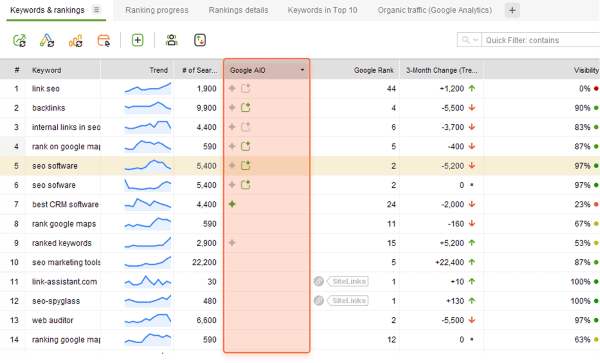
The giants of the SEO software industry (such as Semrush, Ahrefs, and Moz) are racing to integrate AI tracking features. Instead of just monitoring blue links, these tools now scrape search results pages to identify:
- AI Overview Presence: Identifying which of your target keywords trigger an AI Overview.
- AIO Attribution Gaps: Flagging cases where you rank in the top 3 “traditional” blue links but are not included as a citation in the Google AI Overview above the fold.
- SERP Feature Analysis: Monitoring how PAA (People Also Ask) boxes, video carousels, and Reddit threads interact with generative modules.
The Rise of Dedicated GEO Tools
While traditional tools focus on Google’s search results page, a new wave of native GEO platforms (like Gauge and CitationWatch) has emerged to track search activity where traditional web scrapers cannot easily go: inside conversational app interfaces.
These tools function by deploying continuous prompt arrays across the API interfaces of OpenAI (ChatGPT), Anthropic (Claude), Google (Gemini), and Perplexity. They simulate thousands of user paths daily, mapping out:
- Which domains dominate citations in specific industries.
- What structural changes to content (e.g., adding a table vs. adding a bulleted list) cause an LLM to drop a competitor and cite your site instead.
- Real-time changes in model “memory” following major model updates (such as GPT-4o to GPT-5 transitions).
Related: See these free AI search visibility tools for several more options in this growing area. Many AI SEO tools have a free basic “AI visibility checker” plus more feature-rich paid plans above that.
The Local and E-commerce Exception: GMC & GBP Feeds
When optimizing for transactional, local, or product-specific search strings, the traditional rules of scraping raw web pages take a back seat.
For these types of queries, search engines pull from structured product and geographic databases rather than raw HTML.
Google Merchant Center (GMC)
If a user prompts Google’s generative search for “red lightweight running shoes under $100 nearby,” the model relies directly on real-time GMC merchant feeds for price, availability, and specs.
No matter how many keywords are on your product landing pages, if your structured product data feed is inaccurate, your products will not appear in the AI comparison card.
Google Business Profile (GBP)
For local intent prompts, generative search constructs localized map layouts using your GBP data. True local GEO means optimizing GBP categories, securing consistent physical citations, and encouraging semantic keywords inside real customer reviews.
Like this post? Quickly share it with your social networks here.
AI SEO, GEO, and Keywords — Closing Thoughts
Conclusion: SEO Keywords & the Path Forward Today
The transition from traditional SEO to Generative Engine Optimization is not a shift you can ignore. But it is also not a shift that requires you to throw out everything you know about search engine marketing.
Keywords are not dead; they are simply no longer the destination. They are the structural footprints that users leave behind when they speak to an AI, and they are the queries that AI engines run behind the scenes to synthesize their answers.
To succeed in this new landscape, you must expand your toolkit. You must shift your focus from chasing exact-match strings to mapping semantic entities, formatting content for effortless extraction, producing non-commodity assets, and building genuine, undeniable brand authority across the wider web.
AI search engines today are highly intelligent, highly dynamic machines. But the core goal of digital marketing has not changed: provide the absolute best, most trustworthy answer to a user’s problem.
If you focus on that goal while building a clean, technically accessible platform, the AI models will naturally carry your brand along with them.
Your 4-Step Quick-Start GEO Checklist
- Audit Your Technical Accessibility: Review your robots.txt and check your CDN security settings. Ensure that leading AI indexing bots (like GPTBot, ClaudeBot, and PerplexityBot) are not trapped behind strict Cloudflare WAFs or JavaScript-heavy client-side rendering setups.
- Structure Your Answer Layer: Redesign your target pages to answer core questions directly. Structure your headers clearly (H2 and H3 tags) and provide dense, extractable, 40-to-60-word summaries in your introductory paragraphs.
- Establish Your Source Chain & Non-Commodity Proof: Embed your brand across high-authority, community-driven nodes. Focus on acquiring organic mentions in niche subreddits, updating your entity profiles on Wikidata, and getting cited by authoritative, independent industry journals. Support your copy with first-person data and high-quality, labeled visual assets.
- Deploy a Prompt Testing Matrix: Build your first matrix of 20-30 natural conversational prompts your ideal buyers would use. Run these prompts across Claude, ChatGPT, Gemini, and Perplexity once a month to track your brand’s AI Share of Voice and spot citation gaps.
Questions or Comments?
I hope this closer look at the role of keywords in AI-powered SEO has been helpful! Let’s wrap up this post with a few related questions for you:
- How are you (or your SEO team) doing keyword and topic research today? How is AI search impacting this process?
- How do your traditional keyword rankings compare vs. your AI search visibility and AI citations?
- How are your current SEO tools helping with keyword research today? Are they evolving fast enough to meet your AI SEO needs?
Feel free to add more in the comments below with any thoughts, feedback, or related questions. Thanks also for any social shares on this post!
