
Last updated Aug 17, 2026
What Popular AI Assistants Think They Can Do for Your SEO
If you’re managing website/blog content and doing SEO for it, there’s a good chance you’re also at least considering using various AI-powered tools to help out.
Aside from dedicated SEO toolkits like Ahrefs, Semrush, and others, what can ‘mainstream’ AI assistants already do for SEO by themselves?
So I thought we should just ask them directly!
This post looks at what ChatGPT, Google Gemini, and Perplexity AI can do for your SEO — in their own words, with or without other SEO tools involved.
Let’s take a closer look below…

This post may contain a few referral links to select vendor partners. We may receive compensation for purchases made through these links, at no additional cost to the buyer.
Using Popular AI Assistants for SEO
Harnessing the Power of Mainstream AI Tools for SEO Gains
The power and promise of artificial intelligence (AI) is seemingly everywhere these days, in many areas of business and life.
Digital marketing is certainly no exception, with AI chatbots, writing assistants, and other AI/ML-based tools available in many martech software tools, platforms, and utilities.
As part of digital marketing overall, search engine optimization (SEO) is also becoming heavily influenced by AI technologies. Many well-established SEO toolkits, and new entrants, are bringing infusions of AI capabilities with each new feature set upgrade.
But, what about the more general-purpose, mainstream AI tools that already have many uses outside of SEO? What can they do when applied to common SEO tasks?
That’s what this post is about. I asked three popular mainstream AI tools — ChatGPT, Google Gemini, and Perplexity AI — what they could do specifically in the area of SEO.
The answers they gave are below! Let’s take a look…
Note: This post includes unedited AI text generated by the AI tools and LLMs used. I’ve also left the AI text formatting intact, so you can see how each AI tool handled content formatting and presentation.
ChatGPT for SEO Tasks
An AI Leader Takes on SEO
This section shows my AI prompt and the resulting answer back from OpenAI’s ChatGPT. I used ChatGPT’s free access here, not the paid Plus or Pro versions.
This interaction (query and response) used ChatGPT-4 Turbo. It’s a faster and more optimized version of GPT-4 tailored for interactive conversations and task-specific assistance.
My AI Prompt for ChatGPT
Here’s the prompt I used for ChatGPT:
“What can ChatGPT do for websites or blogs, specifically in the area of search engine optimization (SEO)? How do your SEO capabilities vary for ChatGPT free vs premium users? For SEO improvement purposes, how does ChatGPT differ from Google Gemini and Perplexity AI?”
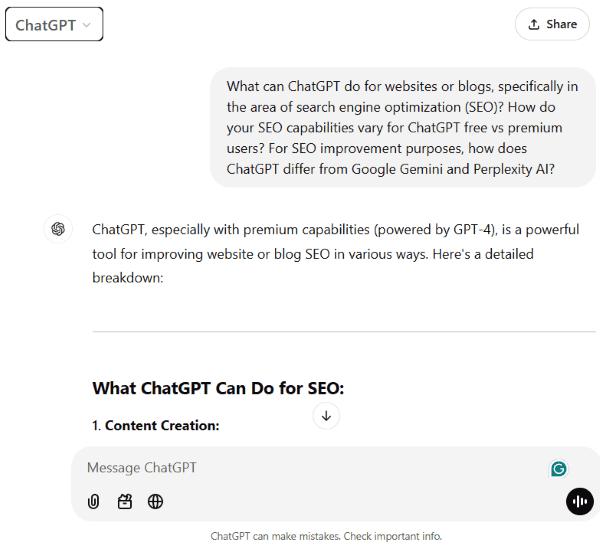
ChatGPT’s Direct Response — Actual Text Below
ChatGPT, especially with premium capabilities (powered by GPT-4), is a powerful tool for improving website or blog SEO in various ways. Here’s a detailed breakdown:
What ChatGPT Can Do for SEO:
1. Content Creation:
- Keyword-Optimized Blog Posts: Generate high-quality, well-researched blog posts optimized for specific keywords.
- Meta Titles and Descriptions: Create click-worthy meta titles and descriptions tailored to target keywords.
- Alt Text for Images: Generate descriptive and keyword-rich alt text to improve accessibility and rankings.
- Internal Linking Suggestions: Identify opportunities to add internal links for better site structure and user flow.
- Content Updates and Refreshes: Suggest ways to refresh and repurpose outdated content for better rankings.
2. Keyword Research:
- Long-Tail Keywords: Provide lists of long-tail keyword suggestions based on your niche.
- Trending Topics: Highlight trending topics in your industry to capitalize on timely search traffic.
3. Technical SEO Assistance:
- Schema Markup Suggestions: Recommend structured data formats (e.g., FAQ schema, product schema).
- URL Optimization: Suggest user-friendly and keyword-rich URLs for new pages or existing ones.
- Site Speed Optimization: Provide general tips and resources for improving page load times.
4. Analytics Interpretation:
- Analyze reports (e.g., Google Search Console or Google Analytics) and provide actionable insights.
- Recommend solutions for fixing issues like high bounce rates, low CTR, or declining rankings.
5. Content Localization:
- Translate content into multiple languages while keeping SEO in mind.
- Optimize for local search results with localized keywords and culturally appropriate phrasing.
6. Competitor Analysis:
- Identify gaps in your competitors’ content strategies.
- Suggest opportunities to outrank competitors in targeted SERPs.
Free vs Premium Capabilities:
- Free Users (GPT-3.5):
- Limited in-depth analysis compared to GPT-4.
- Can generate keyword-rich content but may struggle with nuanced optimization or strategic suggestions.
- Basic assistance with meta descriptions, blog drafts, and keyword suggestions.
- Premium Users (GPT-4):
- Advanced capabilities for understanding complex SEO strategies and content optimization.
- Better at nuanced keyword usage, semantic SEO, and structured content.
- Can provide more detailed competitor analysis and actionable strategies.
Comparison with Google Gemini and Perplexity AI:
Google Gemini:
- Focuses heavily on integrating AI with Google’s ecosystem, likely offering real-time access to the latest search trends and algorithm updates.
- Superior for direct insights into Google’s ranking factors due to its proprietary connection to the Google ecosystem.
- Strong for real-time data, live search trends, and algorithm-tailored optimization.
ChatGPT vs. Gemini:
- ChatGPT is more versatile for creative and exploratory tasks, like generating content or brainstorming.
- Lacks real-time integration with Google’s search algorithms or live data.
Perplexity AI:
- Primarily an AI-powered search engine that provides concise answers based on real-time web searches.
- Useful for quick competitor research and retrieving current SEO data.
- Focuses more on answering queries than creating or optimizing content.
ChatGPT vs. Perplexity:
- ChatGPT excels in content creation, ideation, and strategy.
- Perplexity is better for retrieving real-time insights or competitive data directly from the web.
Summary of Key Advantages of ChatGPT:
- Ideal for content creation and strategic planning rather than live search trends.
- Offers flexibility and creative ideation that Gemini and Perplexity might lack.
- With premium access (GPT-4), ChatGPT becomes a comprehensive tool for crafting SEO-optimized content, designing strategies, and interpreting analytics.
If your goal is to improve SEO holistically (especially through content), ChatGPT is a great choice. For direct algorithmic insights or live search data, combining ChatGPT with tools like Google Gemini or Perplexity can be a powerful strategy.
My Thoughts on ChatGPT’s Claims Regarding SEO
ChatGPT’s claims about its SEO capabilities are certainly impressive, especially with its more advanced (and premium/paid) AI models.
Interestingly, the response above did not reference ChatGPT’s newer ‘Canvas’ mode or capabilities for more interactive content creation. This is likely due to the knowledge cut-off date limitation of ChatGPT’s large language model (LLM) based text generation.
Some SEO-focused capabilities I don’t see from ChatGPT’s self-assessment above include:
- Comprehensive website audits (technical SEO)
- Conducting backlink profile analysis
- Comprehensive automated rank-tracking
- Keyword and content gap analysis (your site vs SEO competitors)
- Flexible SEO reporting
- Automated internal linking
While AI chatbots like ChatGPT may touch on some of these areas, the dedicated SEO platforms would seem to still retain key advantages. Many of them are incorporating AI-powered features where it makes the most sense.
OK, that’s the response straight from ChatGPT. Now let’s ask essentially the same questions of Google Gemini next.
Google Gemini for SEO Tasks
A Natural Advantage for Google AI-Driven SEO?
This section shows my AI prompt and the resulting answer back from Google Gemini. I used Gemini’s free access here, not the paid ‘Gemini Advanced’ version.
The response below uses Gemini 2.0 Flash Experimental, which is supposed to be stronger than the default free 1.5 Flash.
The formatting is also straight (‘as is’) from Gemini, with no complete line breaks (blank lines) between bullet points.
My AI Prompt for Google Gemini
Here’s the prompt I used for Gemini:
“What can Google Gemini do for websites or blogs, specifically in the area of search engine optimization (SEO)? How do your SEO capabilities vary for Gemini free vs premium/advanced users? For SEO improvement purposes, how does Gemini differ from ChatGPT and Perplexity AI?”

Google Gemini’s Direct Response — Actual Text Below
As Gemini, I can assist with website and blog SEO in several ways, leveraging my ability to process and understand information from the web:
How Gemini can help with SEO:
- Keyword Research and Analysis: I can help identify relevant keywords, analyze their search volume and competition, and suggest long-tail keywords. I can also analyze existing content to identify keyword gaps and opportunities.
- Content Optimization: I can analyze website content for SEO best practices, including keyword usage, heading structure, meta descriptions, and readability. I can suggest improvements to optimize content for target keywords and improve search engine rankings.
- Content Generation (with limitations): While I can generate text formats useful for SEO, such as meta descriptions, title tags, and alt text for images, I emphasize supporting human content creation rather than replacing it. High-quality, original content crafted by humans is still crucial for SEO. Over-reliance on AI-generated content can be risky.
- Technical SEO Audits: I can help identify common technical SEO issues such as broken links, slow page speed, and mobile-friendliness problems by analyzing website structure and providing insights based on web best practices.
- Competitor Analysis: I can analyze competitor websites to identify their top-performing keywords, content strategies, and backlink profiles, providing valuable insights for your own SEO strategy.
- Staying Up-to-Date: I can access and process information from the real-time web, which means I can keep track of the latest SEO trends, algorithm updates, and best practices.
Gemini Free vs. Premium/Advanced for SEO:
While specific details about feature differences between free and premium versions of Gemini are not always publicly disclosed, here’s a general idea of how advanced versions could provide enhanced SEO capabilities:
- Deeper Analysis: Premium versions may offer more in-depth analysis of websites, including more comprehensive technical SEO audits, more detailed keyword research data, and more sophisticated competitor analysis.
- API Access: Access to an API (Application Programming Interface) in a premium offering could allow for integration with SEO tools and workflows, enabling automated tasks and data analysis.
- Higher Usage Limits: Free versions often have usage limits. Premium versions would likely offer higher limits or unlimited usage, allowing for more extensive SEO analysis and tasks.
- Priority Support and Updates: Premium users typically receive priority support and faster access to new features and updates.
Gemini vs. ChatGPT and Perplexity AI for SEO:
All three models have capabilities relevant to SEO, but there are some key differences:
- Gemini: Designed with a strong focus on multimodal understanding and integration with Google’s vast information resources, I can offer more contextually relevant and up-to-date SEO information. My direct connection to web search results provides an edge in analyzing current trends and data.
- ChatGPT: Excels at generating creative text formats and can be helpful for brainstorming content ideas and drafting content outlines. However, it may sometimes struggle with factual accuracy and real-time information, which is critical for SEO.
- Perplexity AI: Focuses on providing answers with citations, which can be useful for verifying information and conducting research. It is good at summarizing information from multiple sources. However, it might not be as strong as Gemini in providing specific SEO recommendations based on real-time data and best practices.
Key Difference for SEO: Gemini’s direct access to and understanding of real-time web information, coupled with its multimodal capabilities, makes it particularly well-suited for SEO tasks that require up-to-date data, context, and analysis of website structure and content.
It’s important to remember that AI tools are aids, not replacements for human SEO expertise. A sound SEO strategy still requires human oversight, creativity, and strategic thinking.
My Thoughts on Gemini’s Claims Regarding SEO
Like ChatGPT, Gemini’s self-assessment includes a variety of important SEO capabilities, but with less content production focus vs ChatGPT.
Google Gemini’s potential for deeper integration with Google Search and SEO-related tools like Google Search Console and Google Analytics seems very compelling. Its ability (now or future) to connect directly to tools like the Google Keyword Planner for up-to-date keyword research is also very interesting.
Gemini claims that it is also useful for more traditional SEO tasks like technical site audits and building SEO competitor backlink profiles. These are areas I would need to test further.
Overall, Gemini’s emphasis that it (and other AI tools) should be used primarily as SEO-supporting aids and not replacements for human-generated content or other human SEO skills seems correct and encouraging.
That’s it for Gemini’s response. Now let’s try our third and final AI competitor next — Perplexity.
Perplexity AI for SEO Tasks
Can Perplexity Compete with ChatGPT and Gemini for SEO Work?
This section shows my AI prompt and the resulting answer back from Perplexity AI.
I used my Perplexity Pro access here, which provides several more advanced features vs standard free Perplexity.
As before, the text formatting below is also straight (‘as is’) from Perplexity Pro. Note the numerous (48!) citations included with this Perplexity Pro response. These would normally have live hyperlinks for the sources, though I didn’t link them below.
My AI Prompt for Perplexity
Here’s the prompt I used for Perplexity AI:
“What can Perplexity AI do for websites or blogs, specifically in the area of search engine optimization (SEO)? How do your SEO capabilities vary for Perplexity free vs premium/pro users? For SEO improvement purposes, how does Perplexity differ from ChatGPT and Google Gemini?”

Perplexity’s Direct Response — Actual Text Below
Perplexity AI offers several capabilities that can benefit websites and blogs in terms of search engine optimization (SEO):
Content Creation and Optimization
Perplexity AI can assist in generating SEO-optimized content by:
- Providing up-to-date information and insights on topics relevant to your website or blog[1]
- Helping create comprehensive, well-structured content that aligns with user intent[4][10]
- Suggesting semantically relevant entities and keywords to incorporate into your content
- Assisting in crafting engaging titles and meta descriptions[26]
Keyword Research and Analysis
Perplexity AI can aid in keyword research by:
- Generating ideas for niche-specific and localized keywords[21]
- Analyzing competitor content to identify relevant keywords and topics[21]
- Providing insights into user intent and search behavior[4]
Content Strategy
The tool can help develop effective content strategies by:
- Identifying content gaps and trending topics in your niche[40]
- Suggesting ideas for blog posts and articles based on current trends and user interests[42]
- Assisting in creating topical maps and content outlines[12]
Technical SEO
Perplexity AI can support technical SEO efforts by:
- Helping optimize content structure and formatting for better readability and search engine understanding[4]
- Assisting in the creation of structured data to enhance search engine interpretation of content[10]
Free vs Premium/Pro Users
The SEO capabilities of Perplexity AI vary between free and premium/pro users:
Free Users:
- Limited to 5 Pro searches per day[23]
- Access to basic search functions and standard AI model[23]
Premium/Pro Users:
- Unlimited Pro searches (300+ per day)[23]
- Access to advanced AI models like GPT-4 and Claude 3[23]
- Ability to upload and analyze files, including PDFs and images[23]
- Access to Perplexity Pages for creating and publishing optimized content[26][31]
- Enhanced customization options for AI responses[27]
Comparison to ChatGPT and Google Gemini
Perplexity AI differs from ChatGPT and Google Gemini in several ways for SEO improvement:
- Real-time information: Perplexity AI can access and provide up-to-date information, unlike ChatGPT which has a knowledge cutoff[35][33].
- Source citations: Perplexity AI provides direct citations for its information, enhancing credibility and allowing for further research[8][9].
- Web search integration: Perplexity AI combines AI capabilities with web search functionality, providing more comprehensive and current results compared to ChatGPT[3][6].
- Specialized features: Perplexity AI offers features like Perplexity Pages, which allow for direct content creation and publishing optimized for search engines[26][31].
- Focus on search queries: Perplexity AI is designed specifically for search-like queries, making it potentially more effective for SEO-related tasks compared to the more general-purpose ChatGPT and Google Gemini[8][33].
By leveraging these unique features and capabilities, Perplexity AI can be a valuable tool for improving SEO strategies and outcomes for websites and blogs.
Citations:
[1] https://www.perplexity.ai
[2] https://www.scalenut.com/blogs/study-on-perplexity-ai
[3] https://www.jasper.ai/blog/what-is-perplexity-ai
[4] https://www.marketingaid.io/ai-search-optimization/
[6] https://hackernoon.com/new-chatgpt-search-vs-perplexity-ai-which-one-should-you-use
[7] https://influencermarketinghub.com/perplexity-ai-seo/
[8] https://zapier.com/blog/perplexity-vs-chatgpt/
[9] https://martech.org/chatgpt-vs-gemini-vs-perplexity-the-definitive-ai-chatbot-battle-of-2024/
[10] https://consultusdigital.com/blog/mastering-perplexity-ai-top-seo-strategies-for-success/
[11] https://searchengineland.com/how-to-gain-visibility-in-generative-ai-answers-geo-for-perplexity-and-chatgpt-448121
[12] https://www.youtube.com/watch?v=PVwSHdqEQdU
[13] https://www.brightedge.com/perplexity
[14] https://www.semrush.com/contentshake/content-marketing-blog/ai-seo-tools/
[16] https://www.marketingaid.io/ai-search-optimization/
[17] https://www.searchenginejournal.com/perplexity-ai-seo/513039/
[18] https://www.reddit.com/r/perplexity_ai/comments/1dmcf20/what_are_some_use_cases_for_perplexity_ai/
[19] https://ai-businessplans.com/p/seo-advantage-with-perplexity-ai-pages
[20] https://www.webfx.com/blog/seo/perplexity-ai-vs-google/
[21] https://juliangoldie.co.uk/perplexity-ai-seo-strategies/
[22] https://www.youtube.com/watch?v=wZNTWHpstGg
[23] https://www.instituteofaistudies.com/insights/perplexity-ai-free-vs-pro
[24] https://www.reddit.com/r/perplexity_ai/comments/1c5apk0/how_does_seo_for_perplexityai_work/
[25] https://www.youtube.com/watch?v=aEgvH2U6kyM
[26] https://pathmonk.com/rank-searchgpt-perplexity-ai/
[27] https://anthemcreation.com/en/artificial-intelligence/perplexity-spaces-research-online-and-locale-premium/
[28] https://www.perplexity.ai/hub/faq/what-is-perplexity-pro
[29] https://www.toolsurf.com/seo-tools/perplexity-ai-group-buy/
[30] https://www.elegantthemes.com/blog/business/perplexity-ai
[31] https://www.linkedin.com/pulse/why-seo-experts-buzzing-perplexity-pro-pages-pete-gypps-5ehce
[32] https://www.reddit.com/r/perplexity_ai/comments/1bepv98/perplexity_free_vs_pro/
[33] https://dev.to/proflead/chatgpt-search-vs-perplexity-ai-a-side-by-side-comparison-4353
[34] https://www.reddit.com/r/SEO/comments/1fpmbso/this_is_how_i_rank_on_perplexity_chatgpt_gemini/
[35] https://www.reddit.com/r/perplexity_ai/comments/1dw8vmg/perplexity_ai_vs_chatgpt_answer_comparison_is/
[36] https://www.youtube.com/watch?v=xsApgHt4CPA
[37] https://www.linkedin.com/pulse/perplexity-ai-vs-chatgpt-future-ai-powered-search-content-mohamed-ezz-vjprf
[38] https://www.linkedin.com/pulse/ai-overviews-dominate-screen-space-gemini-20-debuts-perplexity-j2fef
[39] https://www.blackhatworld.com/seo/chatgpt-v-s-perplexity.1628380/
[40] https://www.elixirrdigital.com/2024/10/24/supercharging-seo-with-perplexity-ais-social-insights/
[41] https://www.linkedin.com/pulse/mastering-ai-optimisation-perplexity-game-changer-seo-jousef-murad-a4qme
[42] https://www.youtube.com/watch?v=fAv9B9LBY5U
[44] https://www.youtube.com/watch?v=a4c4Ir8GXKA
[45] https://www.youtube.com/watch?v=5u9pnYC2rmE
[46] https://seoisntdead.com/seo-forum/perplexity-ai/how-to-quickly-create-and-rank-content-with-perplexity-ais-new-pro-features/
[47] https://www.youtube.com/watch?v=AllsBIZxtO0
[48] https://www.veronika-hoeller.de/post/optimising-your-website-for-ai-tools-like-chatgpt-gemini-and-perplexity-ai
My Thoughts on Perplexity AI’s SEO Capabilities
Perplexity’s ability to provide some areas of SEO support based on deep, real-time search sources could be highly useful for many SEO practitioners.
For example, building new content outlines based on up-to-date internet sources and fresh competitor analysis. You could use Perplexity to help construct a great outline and then bring in ChatGPT (including Canvas mode) to further flesh out the content prior to your human refinement, editing, polishing, etc.
The Perplexity Pages option is also interesting as a way to publish search-friendly (and crawlable) related content that could also include ‘do-follow’ backlinks to your blog articles or posts.
However, extensive use of Perplexity Pages with lots of backlinks to your site(s) could run afoul of Google’s guidelines, link spam policies, etc.
Overall, Perplexity’s SEO capabilities — used alone or in conjunction with other AI tools like ChatGPT, Gemini, or other AI platforms — could be part of an effective AI-assisted SEO workflow.
Like this post? Quickly share it with your social networks here.
ChatGPT, Gemini, and Perplexity AI for SEO Work — Closing Thoughts
Use AI Tools Alone and in Combination for Better SEO
Based on my AI prompts and chatbot answers above, it looks very promising to use popular mainstream AI tools like ChatGPT, Gemini, and Perplexity — either alone or in combined workflows — in support of common everyday SEO activities.
Beyond these general-purpose AI options, also consider the fast-growing AI capabilities of SEO-specific tools and platforms today. These include areas such as:
- AI-assisted content optimization toolkits
- AI-assisted WordPress SEO plugins
- AI-powered internal linking tools
- All-in-one SEO platforms boosted by AI features
- AI SEO browser extensions (e.g., with ChatGPT integrations)
- And more…
The best tools and AI-assisted SEO workflows will vary by user and specific SEO requirements, of course.
But, it’s good to know that even the more general-purpose AI assistants can provide significant value in some aspects of SEO work. This area seems primed to evolve very quickly, so just keep an eye on it if SEO activity is part of your regular routine.
Questions or Comments?
I hope this Q&A with popular AI chatbots about their current SEO-related capabilities has been helpful! I’ll leave you with a few related questions to ponder:
- What (if any) free or premium AI tools do you currently use to support your SEO activities? Which aspects of AI are most important to your work today?
- How much time and/or money (budget) do AI tools help save in your SEO work? Do you have any ‘cost vs quality’ considerations or concerns when using AI for SEO tasks?
- Do you leverage any AI capabilities in modern SEO platforms like Ahrefs, Semrush, or similar SEO toolkits? Which of their AI-enabled features provide the most value?
Feel free to add more in the comments below with any thoughts, feedback, or related questions. Thanks also for any social shares on this post.
