
Last updated Nov 26, 2021
Do automated rank tracking tools affect metrics in Google Search Console?
A Brief SEO Case Study
When people ask about the reliability and accuracy of Google Search Console data, one of the topics that comes up is the potential impact of SEO rank tracking tools on GSC metrics.
Since 3rd-party rank tracking software queries Google and other search engines on a huge range of keywords and keyphrases, does this somehow get reflected in our own Google Search Console data? Can it distort the GSC data we see for our own websites?
The short answer is YES, definitely!
I provide more details and insights into this automated rank tracking effect below, all based on a live website with GSC connected.
Read on to get the full story…
Google Search Console and Automated Rank Tracking
SEO Tools and Google Search Console Impact
One of the primary functions of a complete SEO toolkit is to check organic search rankings for any keywords or keyphrases that we want to track for our website(s).
Naturally, we want to know how our website pages and posts are ranking for the topics we care about.
And so we check them from time to time, using paid software tools designed for rapid rank checking, and even free tools like Google Search Console.
Rank Checking Creates GSC Impressions
When an SEO software tool checks ranking positions for any keywords (search queries in Google), it simulates normal human search activity to avoid being challenged or blocked as a bot by Google or whatever target search engine is being queried.
This allows the rank checking tool to efficiently cruise through large lists of keyword checks and return ranking pages and positions to the user. All complete SEO software tools can handle this.
A side-effect of all this software-driven rank checking going on is that it produces actual ‘search impressions’ for website pages… and these impressions are counted by tools such as Google Search Console.
How Automated Rank Checking Impacts Google Search Console Metrics
In general, this is how automated rank checks from 3rd-party SEO tools will impact your GSC data:
Total Impressions — Will be artificially increased *if* your content ranks highly enough to show up in a tool-driven Google search. For example, if your site ranks in the top 50-100 positions for a popular search term, you’ll probably have inflated impressions in GSC. This is especially true for user queries that are both very common and commercially valuable.
Total Clicks — Will not increase or decrease from automated rank checkers. Since there’s not an actual curious human user driving the extra search impressions, there should be zero incremental click activity on the organic listings.
Average CTR — Will go down, again artificially since we have zero incremental clicks vs the increased impressions. So, the overall average click-through rate must go down.
Average Position — May go up or down, depending on where your content ranks in the automated search activity, vs where it appears for normal human-driven search.
Finding Suspicious Patterns in the GSC Data
Automated Keyword Rank Checking Can (Sometimes) be Detected
In one case, while working with GSC I spotted a strange repeating pattern that begged for closer inspection.
Here’s an example screenshot. In all cases below, the purple line is the total impressions metric in GSC; the orange line is average (ranking) position.
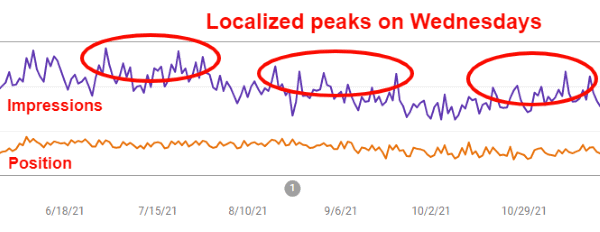
The key here was in seeing that the tallest spikes in impressions were always on Wednesdays. This looked unusual so I did more digging into the details.
Drilling Down into Search Console Details
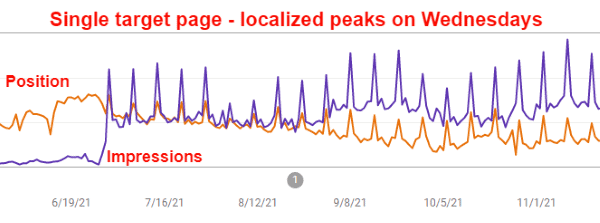
I focused on the pages with the most GSC impressions during this time period. This revealed the following pattern starting at the end of June 2021 for a specific page with high overall impressions. The repeating peak pattern is much more pronounced!
The corresponding peaks in ranking positions were also very suspicious. Impressions and average positions in GSC don’t usually move in tight lockstep, so this was another big clue.
Whatever site content was tied to the impressions spikes must have also ranked much higher than the normal averages, thereby causing the position spikes as well on these Wednesdays.
Isolating the Search Query
Then, taking it one step further just for the target page, I found a specific search query (‘keyword’) that was really driving the GSC data spikes. Here’s what that looked like.
Interestingly, this was for a ‘branded’ search query targeted at a popular marketing software vendor. The picture was becoming clearer.

Root Cause Analysis… and a Theory
Based on the analysis above, I concluded that somebody somewhere had set up a weekly automated rank tracking check in their favorite SEO tool.
They have been running this check every Wednesday since June 30, 2021, and up to several hundreds of times per day, for one or a small number of related keywords that triggered the same content impressions in Google search.
No doubt it’s an automated rank checking routine driving these incremental data spikes in Search Console!
Also, based on the ‘branded’ keyword and target page driving all of these impressions, I’m guessing it was from a leading SEO software vendor or one of their competitors.
That’s my working theory at this point, at least.
I should point out that I don’t really mind this now that I see what’s going on.
But, it does seem excessive for someone to repeatedly run hundreds of rank checks on a single branded keyphrase, every Wednesday for several months straight!
How to Handle Distorted Data in Search Console
First Step is Just Awareness That it Happens
Probably in most cases, it’s fine to just be aware that our GSC data is being impacted from time to time by the automated rank tracking effect. This is yet another reason not to rely too much on the highest-level search console metrics when using GSC data.
In a minority of situations, it may call for further analysis to try to remove the data distortions and get a cleaner view of GSC impressions, clicks, CTR, and average ranking positions.
For example, exporting search console data to Excel or Google Sheets and refining metrics and calculations in those tools.
Dig Deeper for Better Insights
I certainly would not advise making important SEO-focused decisions on keywords or content adjustments just based on raw high-level GSC metrics.
Drilling deeper into the analytics is almost always more illuminating, whether it’s Google Search Console, Google Analytics, or some other website or SEO analytics platform.
Food for Thought
How much drill-down do you do in your own Google Search Console analysis?
Do you ever see suspicious repeating patterns that might be from this automated rank tracking effect?
Questions or Comments?
I hope this brief SEO case study has been helpful.
Feel free to add your own insights in the comments below with any thoughts, feedback, or related questions. Thanks also for any social shares on this post via the buttons below!
Related Topics
Also see the posts highlighted below for related information.