
Getting Google AI Certified — Is it Worthwhile?
With “AI-everything” being so pervasive these days, I was staying tuned in early 2026 for some good structured learning options.
Then along came Google and their “AI Professional Certificate” program, and I jumped in.
This post provides an overview of the Google AI Professional Certificate program, with my personal insights and conclusions after having completed the certification.
Let’s take a closer look below!

Last updated Sep 28, 2026
The Goal: Getting “Google AI Certified”
Beyond the Buzz: My Experience Earning the Google AI Professional Certificate
If your online news feed looks anything like mine, you have likely waded through dozens of hot takes on generative AI over the past two years. Most advice swings between abstract futurism that offers little day-to-day utility and dense machine learning theory meant strictly for research engineers.
Like most working professionals, I needed something in the middle: practical, repeatable workflows to handle real operational friction. That led me to complete the Google AI Professional Certificate, hosted on Coursera.
Developed by Google in partnership with the Burning Glass Institute and a consortium of enterprise employers, this eight-course track focuses squarely on applied workplace fluency rather than model architecture.
While built with enterprise rigor, the skills are just as potent for non-corporate operators — solopreneurs, freelancers, and side-hustlers looking to multiply their output and punch well above their weight class.
Below is a pragmatic overview of the program’s structure, what the curriculum actually covers (including “vibe coding”), and who will get the highest return on investment.
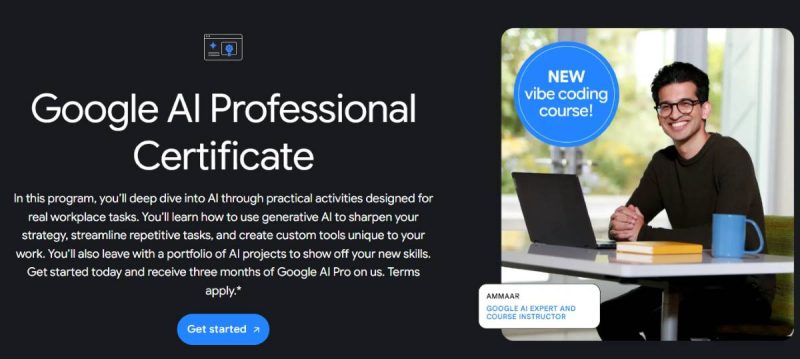
Program Snapshot and Logistics
Here’s the operational breakdown of what the certificate entails:
- Official Program Hub: Grow with Google AI Professional Certificate
- Platform & Enrollment: Coursera Course Page
- Format: 100% online, self-paced, modular delivery.
- Duration: 8 courses. Expect roughly 1 to 2 hours per course depending on how thoroughly you complete the interactive sandboxes (under 12 hours total).
- Cost: Standard Coursera subscription ($49/month in North America; financial aid available through Coursera).
- Included Perk: Enrollees receive 3 months of Google AI Pro at no added cost, unlocking access to advanced Gemini models, expanded context windows, Gemini Deep Research, and integrated Workspace tooling. Using Google AI Pro is optional but recommended at various points during the course sequence.
- Core Philosophy: Applied execution over theory. The curriculum skips complex AI/ML theory, replacing it with 20+ workplace scenario labs.
- Primary Tool Ecosystem: Gemini App, Gemini Canvas, Gemini Deep Research, Gemini Live, Gemini Notebook, Gemini in Google Workspace (Docs, Sheets, Slides, Meet), and Google AI Studio.
Program Pacing, Timing, and Cost
Since the courses are online and self-paced, you can cover the material, lab assignments, and quizzes as quickly or as leisurely as you want.
Some may choose to cram the whole program into a couple of days’ effort, e.g., over a weekend.
In my case, I completed it over a couple of weeks in mid-late July of 2026. I just fit it in with other things I was working on.
Pro Tip: By completing the certification program in well under a month, I was able to pay $49 for Coursera access (first month) but then stop the monthly subscription before the next $49 would have come due.
Google AI Pro Certificate — Target Audience
Who Should Pursue This Google AI Certificate?
With numerous AI credentials on the market today, it helps to be clear about who gains the most value earning this specific Google AI certificate.
The best-fit target audience includes corporate staffers and executives, plus independent professionals operating outside of traditional corporate structures.
Let’s break it down further:
1. Corporate & Functional Teams
Corporate Communications & Content Marketers: For maintaining voice consistency across high-volume channels. The coursework demonstrates how to set custom brand guidelines, adapt a single message across multi-tier stakeholder personas using Gemini Canvas, and generate presentation-ready slide decks without design bottlenecks.
People Operations, HR, & Talent Leads: For transforming dense compliance documentation into digestible resources. HR professionals can use Gemini Notebook to ground employee handbooks, roleplay sensitive performance reviews with Gemini Live, and vibe-code simple policy triage bots in Google AI Studio to field routine benefits questions.
Executive Assistants & Chiefs of Staff: For multiplying administrative velocity. Learners practice turning rambling executive syncs into clear decision logs in Meet, compiling fast background dossiers using Gemini Deep Research ahead of board meetings, and tracking multi-team dependencies inside Gemini Notebook.
Sales Enablement & Customer Success Managers: For streamlining account prep and proposal turnaround. This track shows how to simulate difficult client negotiation scenarios via Gemini Live, run automated competitive audits with Deep Research, and clean up exported CRM pipeline metrics directly in Sheets.
Business Analysts & Financial/Operations Coordinators: For accelerating ad-hoc reporting. Course 6 specifically covers normalizing inconsistent operational logs, generating dynamic formulas via plain English, and creating executive-ready trend charts in Google Sheets without needing Apps Script or advanced SQL.
Project, Product, and Operations Managers: For instant leverage in drafting roadmaps, summarizing cross-functional meetings, and stress-testing dependency risks in enterprise environments.
2. Independent Operators, SMBs & Lean Teams
SMB Owners & Sole Proprietors with Small Teams: When operating a lean company with 1 to 15 team members, there are rarely dedicated budgets for specialized research analysts, full-time copywriters, or custom software engineers.
For small business owners and sole proprietors managing tight headcounts, this curriculum acts as an operational multiplier. It demonstrates how generalist staff and leadership can use grounded AI models to draft standardized operating procedures (SOPs), audit vendor quotes, and spin up custom intake or pricing tools in Google AI Studio without hiring third-party agencies.
Solopreneurs and Independent Consultants: For solo operators, AI is the ultimate leverage multiplier. This program functions like hiring a research analyst, an executive assistant, a copy editor, and a junior web developer without taking on overhead.
You learn how to run comprehensive market audits with Gemini Deep Research, maintain client knowledge hubs in Gemini Notebook, and draft polished proposals in minutes.
Freelancers and Agency Contractors: If you bill clients for deliverables, speed and consistency dictate margins. The labs show you how to clean up messy client spreadsheets in Sheets, repurpose rough kickoff call transcripts into structured action items with Canvas, and deliver custom brand assets adhering to strict client guidelines.
Side-Hustlers and Bootstrap Builders: If you have an idea for a digital product or service but lack a software engineering background, Courses 7 and 8 are gold. “Vibe coding” in Google AI Studio allows you to build working web apps, interactive calculators, lead-qualification widgets, or customer intake tools over a weekend using conversational English instead of waiting on developer bandwidth.
Who Should Look Elsewhere
Machine Learning Engineers & Data Scientists: This track does not teach model training, fine-tuning, Python architecture, or mathematical optimization.
Passive Watchers: If you skip the 20+ interactive prompts and AI Studio exercises, the educational return drops significantly.
Google AI Professional Certificate — The Courses
The 8-Course Breakdown: What You Actually Learn
The eight modules progress systematically from foundational prompt mechanics to functional app prototyping.
| Curriculum Stage | Course Title | Core Focus & Practical Deliverables |
|---|---|---|
| Stage 1: Core Foundations | Course 1: AI Fundamentals | Structured prompting frameworks, bias detection, hallucination mitigation, and data governance. |
| Stage 1: Core Foundations | Course 2: AI for Brainstorming & Planning | Idea prioritization, roadmapping, dependency risk analysis, and assembling project hubs in Gemini Notebook. |
| Stage 1: Core Foundations | Course 3: AI for Research & Insights | Automated multi-step synthesis with Gemini Deep Research, fact auditing, and source file grounding. |
| Stage 2: Workplace Execution & Multimedia | Course 4: AI for Writing & Communicating | Persona and tone drafting in Gemini Canvas, meeting distillation in Meet, and scenario rehearsal via Gemini Live. |
| Stage 2: Workplace Execution & Multimedia | Course 5: AI for Content Creation | Brand-aligned visual asset generation, custom prompt style guidelines, and deck production in Google Slides. |
| Stage 2: Workplace Execution & Multimedia | Course 6: AI for Data Analysis | Natural-language data cleaning, dynamic formula synthesis, and presentation-ready charts directly in Google Sheets. |
| Stage 3: Custom App Building & Vibe Coding | Course 7: AI for App Building | Vibe coding functional prototypes from plain English specifications using Google AI Studio. |
| Stage 3: Custom App Building & Vibe Coding | Course 8: AI for App Deployment | Edge-case stress testing, access configuration, input validation, and secure tool publishing. |
Course Elements & Materials
All of the Google AI courses on Coursera have a consistent “look and feel”, including most or all of these elements (depending on topic and complexity):
- Brief video introductions from Google AI experts
- Reading materials with optional spoken audio
- Optional supporting materials (e.g., related PDF downloads)
- Practical “online lab” assignments with supporting video
- Final quizzes to test what you just learned (usually 5-10 multiple choice questions)
Note: You’ll need to pass the multiple choice quizzes with 80% or higher correct answers. So… 4 out of 5, 8 out of 10, etc. You can retake quizzes as needed, within reasonable limits.
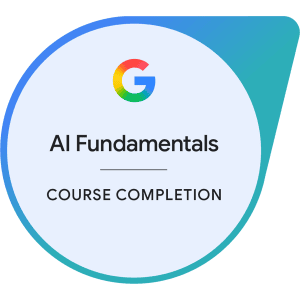
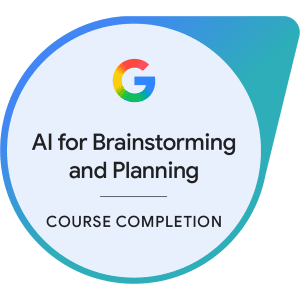
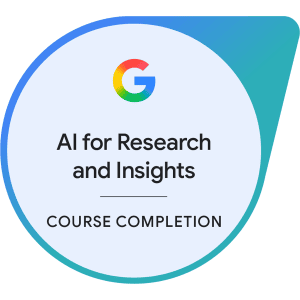
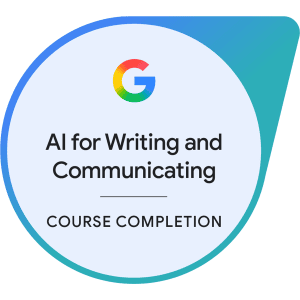
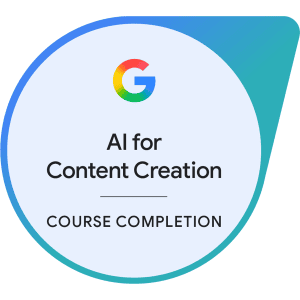
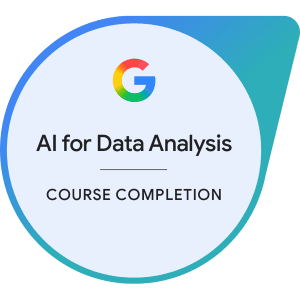
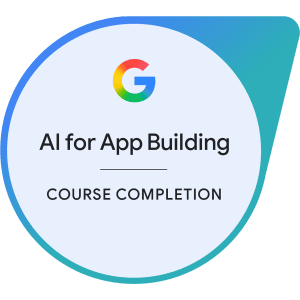
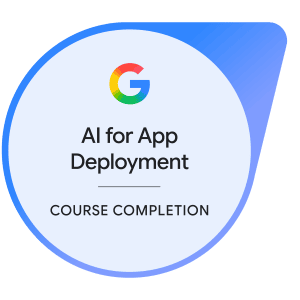
These are the 8 course completion “badges” you will earn along the way to completing the program. (The flow is left to right and top to bottom.)
1. The Core Foundations (Courses 1–3)
- Course 1: AI Fundamentals: Establishes structured prompting frameworks (defining context, persona, constraints, and target output schema). It introduces practical threat models around bias, hallucinations, and data governance.
- Course 2: AI for Brainstorming and Planning: Treats AI as an operational thought partner. You map work-breakdown structures, stress-test roadmaps against resource constraints, and assemble central project hubs in Gemini Notebook.
- Course 3: AI for Research and Insights: A standout module. You use Gemini Deep Research to run multi-step syntheses on complex reports, cross-reference assertions directly against source files, and verify facts to mitigate fabrication.
2. Workplace Execution and Creative Assets (Courses 4–6)
- Course 4: AI for Writing and Communicating: Focuses on editorial workflows using Gemini Canvas for tone matching and structural revisions, automated meeting action-item extraction in Google Meet, and role-playing difficult presentations or client pitches via Gemini Live.
- Course 5: AI for Content Creation: Covers the generation of brand-aligned visual assets, presentation deck generation in Google Slides, and creating custom prompt guidelines so creative outputs adhere to organizational or client brand standards.
- Course 6: AI for Data Analysis: Centers on Google Sheets. You use plain-language prompting to clean unstructured tables, generate complex formulas, and produce presentation-ready visualizations without writing Apps Script.
3. Custom Solutions & Vibe Coding (Courses 7–8)
- Course 7: AI for App Building: Introduces “vibe coding”—building functional web tools and interactive prototypes in Google AI Studio using plain English. You define system instructions, test UI components, and debug logic errors iteratively through conversation rather than manual coding.
- Course 8: AI for App Deployment: Covers how to package, test, and share these prototypes with team members or clients while implementing input validation and user safety guardrails.
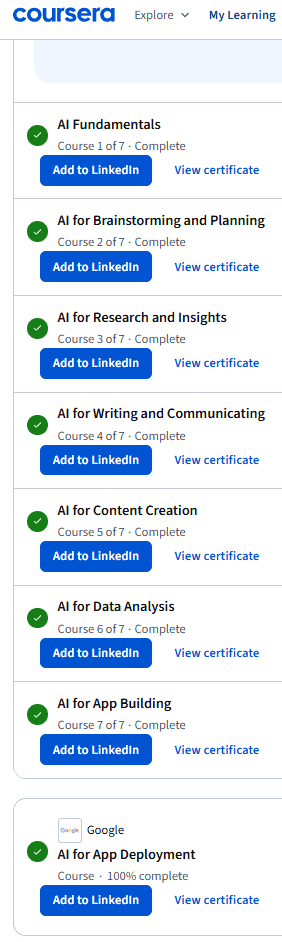
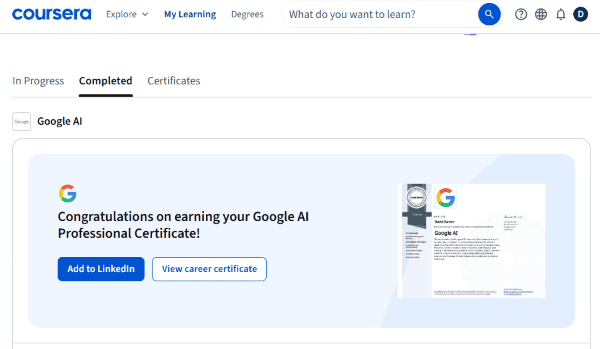
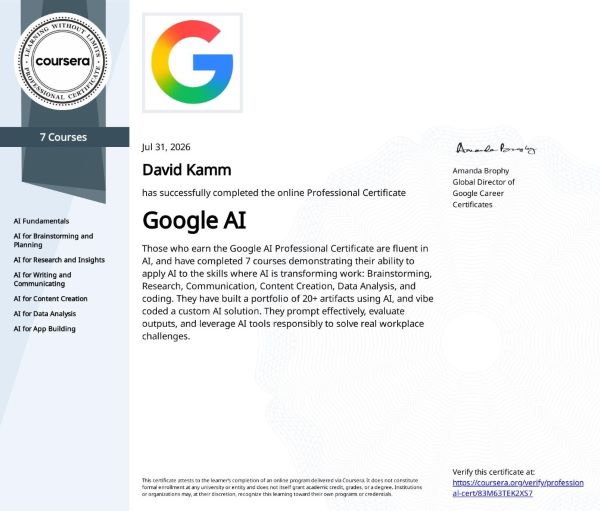
Good to Know: You will earn individual badges (see image grid above) and certificates for each course in the series, though the final certificate (above) is the ultimate prize here. Coursera also provides good sharing options, adding new AI credentials to your LinkedIn profile, etc. You will also have options to claim these new digital credentials on the Credly platform.
The Google AI Certificate Practice Labs
Under the Hood: The “Build with AI” Scenario Labs
The biggest operational differentiator between this certificate and standard video courses is the hands-on lab model. Rather than forcing learners through passive multiple-choice recall or rigid, automated code graders, the program centers around guided “Build with AI” scenario sandboxes.
These labs are structured around practical prompt architecture frameworks, but they are deliberately flexible in how you execute them. For every exercise, Google provides two distinct pathways:
- Google-Supplied Templates: If you want a zero-friction ramp, each lab offers pre-packaged sample assets — such as mock project roadmaps, unformatted meeting notes, sample research briefs, messy spreadsheet tables, and starter app specs in Google AI Studio. These are typically supplied as Google Docs, Sheets, etc.
- “Bring Your Own Work” (BYOW): For immediate workplace utility, the instructions actively encourage you to swap out Google’s sample files with your own authentic materials — your team’s actual project briefs, client transcripts, operational data logs, or business ideas.
This flexible sandbox model spans key workplace competencies, as in the examples below. (Your actual course sequence may vary from these examples.)
- Strategic Planning & Dependency Mapping (Course 2): You practice feeding multi-page planning notes into Gemini Notebook, testing prompt patterns to uncover timeline bottlenecks, prioritize deliverables, and build centralized resource hubs for cross-functional alignment.
- Source Grounding & Fact Auditing (Course 3): Using Gemini Deep Research, you run automated multi-document syntheses, testing prompts that force the model to cite sources directly, verify metrics against underlying reports, and eliminate hallucinated assumptions.
- Audience Reframing & Meeting Distillation (Course 4): You take raw discussion notes or meeting transcripts and use Gemini Canvas alongside Google Meet summaries to refactor the information into targeted formats—such as high-level executive updates or granular task lists for direct reports and clients.
- Brand Guidelines & Deck Iteration (Course 5): You build reusable style constraint prompts to enforce brand voice, design rules, and formatting guardrails when producing visual assets and collaborating with Gemini inside Google Slides.
- Conversational Data Normalization (Course 6): Working inside Google Sheets, you use natural-language instructions to parse messy unstructured columns, synthesize lookup formulas on the fly, and generate executive trend summaries without writing formula syntax or code by hand.
- Vibe Coding Interactive Prototypes (Courses 7 & 8): Rather than writing code manually, you act as the system architect in Google AI Studio. You craft natural-language system instructions, prompt the model to generate and iterate functional UI components, troubleshoot edge cases through plain conversation, and configure guardrails for secure sharing.
Because the labs emphasize reusable prompt frameworks rather than static answers, you finish the coursework with an applied library of Gemini-based prompt templates, grounded documents, and custom prototypes tailored to your real-world workflow.
Good to Know: While this course program urges you at multiple points to upgrade from free Gemini to Google AI Pro via a free 90-day trial, it’s not mandatory to upgrade. Consider it a strong recommendation from Google, but not an absolute requirement for course completion or credit.
Like this post? Quickly share it with your social networks here.
Want to make sure you never miss our updates? Click below to add us as a preferred source on Google Search.

Google AI Professional Certificate — The Verdict
Personal Takeaways & ROI for Corporate Teams, SMBs, and Solo Operators
While there are many pathways for learning more about AI for business uses, the Google AI certificate program stands out as a highly-recognized credential from a global AI leader. For many, it will also serve as a great “bio booster” on LinkedIn and other social platforms.
Here are five areas where I think this program delivers solid ROI for the relatively small time and money investment required.
1. Building Strong Baseline AI Skills
For those who have only dabbled in AI LLMs, the baseline skill-building in this course program are highly practical and valuable. Learning the core concepts of effective AI prompt-building, then more advanced techniques like “meta prompting” and “prompt chaining”, help you build a solid foundation. Building more customized, task-specific tools like Gemini Gems takes this even further.
2. Learning the Gemini Toolkit Portfolio
Becoming competent in the full range of tools available within the Gemini platform is another valuable highlight of this program. Going well beyond simple AI prompting and chat threads, tools like Gemini Gems, Canvas, Deep Research, Gemini Notebook (formerly Notebook LM), AI image and video generation, Google AI Studio, and Google Workspace tie-ins all become powerful new resources for businesses of all sizes.
3. “Vibe Coding” Levels the Playing Field
Building functional application prototypes inside Google AI Studio without writing raw code was also a highlight of the program. For a solopreneur or side-hustle builder, this eliminates initial engineering bottlenecks. You can prototype an internal tool or an app widget for a side venture in an afternoon, test it with real users, and iterate in real time.
4. Frameworks Outlive Any Single AI Platform
While the curriculum naturally highlights Google’s Gemini ecosystem and Google Workspace, the structural disciplines – role setting, negative constraints, source grounding, and iterative refinement – apply identically to Claude, ChatGPT, or other mainstream AI models.
5. The 3-Month AI Pro Access Provides Immediate ROI
The complimentary three months of Google AI Pro removes artificial paywalls during the coursework. For an independent freelancer or solopreneur, this perk alone offsets the Coursera subscription cost, granting immediate access to deep research pipelines, generous cloud storage, and high-context inputs on real client work from day one.
My Verdict
In my case, as a solopreneur digital marketer and consultant, I fould this program to be very worthwhile, per the reasons above.
The Google AI Professional Certificate will not turn you into a machine learning researcher, nor does it attempt to. What it provides is a pragmatic, employer-endorsed blueprint for eliminating routine administrative drag and building custom AI-powered workplace tools with confidence.
Whether you are navigating enterprise bureaucracy, steering a one-person business, managing a growing SMB, or spinning up a new side-hustle idea, the Google AI professional certification program gives you the practical frameworks to stop experimenting with random AI prompts and start building repeatable, business-supporting systems.
Questions or Comments?
I hope this overview of the Google AI Professional Certificate program has been helpful! Let’s close now with a few related questions for you:
- If you are a current AI user or “AI-curious” professional, how could you see this certificate program helping you? What areas of your current work could potentially benefit the most?
- What other AI certifications, if any, are you considering besides this one? How do they compare vs. the Google program?
- How do you like the Gemini platform (entire toolkit) vs. other popular AI toolkits such as ChatGPT, Claude, MS Copilot, Perplexity, etc?
Feel free to add more in the comments below with any thoughts, feedback, or related questions. Thanks also for any social shares on this post!
