
Powerful & Affordable Toolkits for Modern SEO & AI GEO
Today’s SEO platforms are evolving quickly to embrace the new realities of AI-powered search. But keeping them effective and still affordable is a challenge.
That’s where tools like Mangools and Ubersuggest shine — providing true SEO/GEO value at compelling price points.
This post looks closely at Mangools vs. Ubersuggest as a head-on comparison, with insights and tips for deciding between them.
Let’s dive in for a detailed look!
This post contains a few referral links to select vendor partners. We may receive compensation for purchases made through these links, at no additional cost to the buyer.
Last updated Oct 3, 2026
Mangools vs. Ubersuggest: The Budget SEO & GEO Showdown
Introduction: The Rise of Budget SEO Suites
If you have looked at your SEO software spend recently, you already know the story: traditional flagship SEO platforms like Semrush and Ahrefs have steadily raised their entry prices.
What used to be accessible $99/month plans for solo marketers have transformed into $130 to $250+ monthly commitments, especially once you add team seats, API access, or rank-tracking expansion packs.
For freelancers, niche site creators, boutique agencies, and bootstrapped startups, these enterprise price tags present a real dilemma. Do you absorb an extra $1,500–$3,000 per year in overhead, or do you look for leaner alternatives?
Enter Mangools and Ubersuggest — the two undisputed heavyweights in the budget SEO space. Both platforms claim to give you 80% to 90% of the core capabilities found in enterprise suites for less than half the price (or, in Ubersuggest’s case, for a single one-time payment).


The Modern SEO Challenge: Traditional Search vs. Generative Engine Optimization (GEO)
However, choosing a budget SEO tool isn’t just about comparing classical search metrics like keyword volume or backlink counts anymore. We are operating in an era dominated by Google AI Overviews, ChatGPT, Perplexity, Claude, and Gemini.
Search behavior has shifted from basic keyword matching to conversational discovery, making Generative Engine Optimization (GEO) and AI brand visibility essential parts of any organic search optimization strategy.
Can lower-cost SEO platforms keep pace with this dual demand? Can they handle traditional rank tracking and technical data while also helping you measure how AI engines answer user prompts about your brand?
The short answer is yes — but they approach the problem from completely different angles.
- Mangools is built like a precision toolkit: sleek, modular, laser-focused on data cleanliness, intuitive UX, and lightweight multi-model AI tracking.
- Ubersuggest is built like a Swiss Army knife: feature-dense, broad-reaching, offering site audits, AI content generation, and an aggressive lifetime pricing model that is nearly impossible for bootstrapped founders to ignore.
Here is a quick reference guide to help you decide upfront:
⚡ At-a-Glance Verdict
- Choose Mangools if: You value design and workflow efficiency, rely heavily on precise Keyword Difficulty (KD) scores, need fast backlink analysis powered by Majestic, and want a clean multi-LLM brand tracking utility without clutter.
- Choose Ubersuggest if: You want a single all-in-one platform with a built-in technical site crawler, integrated AI content writing, direct step-by-step remediation tasks, and want to eliminate monthly SaaS subscriptions via a lifetime license.
Let’s examine more key platform details and differences below…
Mangools & Ubersuggest Platform Overviews
Core SEO/GEO Modules & Key Features
To understand how these platforms fit into your daily workflow, let’s unpack their design philosophies, core modules, free entry-level tools, and main strengths and weaknesses.
Mangools: The Modular, Design-First Specialist

Mangools was founded on a simple premise: SEO software shouldn’t require a master’s degree to navigate. Instead of forcing users into a massive, multi-nested dashboard with hundreds of menus, Mangools splits its ecosystem into six distinct, interconnected micro-apps.
1. KWFinder (Keyword Research): Frequently cited as Mangools’ flagship tool, KWFinder excels at surfacing long-tail keyword opportunities with realistic Keyword Difficulty (KD) scores. It displays search volume trends, historical seasonality, search intent markers (informational, transactional, commercial, navigational), and localized country/city-level data.
2. SERPChecker (SERP Analysis): Enables deep evaluation of Google search results for any location or device. It overlays more than 45 metrics per ranking URL– including Domain Authority (DA), Page Authority (PA), Citation Flow (CF), and Trust Flow (TF) – allowing you to quickly identify weak spots in top 10 rankings.
3. SERPWatcher (Rank Tracking): Offers a streamlined, visually clean approach to rank tracking. Instead of focusing solely on position changes, SERPWatcher uses a proprietary Performance Index (PI) that factors in search volume and position weight to calculate your site’s actual organic visibility in one metric.
4. LinkMiner (Backlink Analysis): Powered by Majestic’s industry-standard link database, LinkMiner lets you evaluate backlink profiles for any domain or competitor page. Key features include live website link previews (showing exact link placement on the donor page) and metric filtering by Citation Flow and Trust Flow.
5. SiteProfiler (Competitor Analysis): A rapid domain-level overview tool displaying target site authority, top-performing content, backlink distribution, and audience overlap graphs.
6. AI Search Watcher (Generative Engine Tracking): Mangools’ dedicated AI visibility module. It monitors how often and in what context your brand, products, or website URLs are cited inside responses generated by 8 major AI engines (including ChatGPT, Google AI Overviews, Claude, Gemini, Grok, Mistral, and Llama).

Mangools Free Tools & Entry-Level Utilities
Mangools provides several free tools that double as high-utility standalone products:
- Mangools AI Search Grader: A free web utility that lets anyone enter a brand name and product category to receive an instant AI Search Score (0–100) across major LLMs, evaluating brand citation rate, ranking position, and context.
- AI Search Watcher (Free Tier): A permanent free tier inside the platform allowing users to track 1 brand across 5 custom prompts with weekly automated updates.
- Mangools SEO Extension: A popular browser plugin for Chrome and Firefox that injects DA/PA scores, keyword ideas, and backlink previews directly onto any webpage or SERP you visit.
- SERP Simulator & Volatility Checker: Free web utilities for previewing title tag/meta description pixel widths and monitoring daily Google algorithm fluctuations.
Mangools Pros & Cons
Pros:
- Exceptional UI/UX: Clean, intuitive design with practically zero learning curve.
- Reliable Keyword Difficulty: KWFinder’s KD score is widely regarded as one of the most accurate budget metrics in the industry.
- Majestic Link Data: Taps directly into Majestic’s trusted index for link intelligence.
- Multi-LLM Generative Visibility: Tracks brand mentions across 8 distinct AI models, with prompts queried twice per run to filter out AI hallucination variances.
Cons:
- No Native Site Crawler: Lacks a built-in technical crawler for site-wide audit checks (e.g., broken links, missing canonicals).
- Lower Daily Limits: Lower subscription tiers cap keyword lookups and SERP lookups relatively tightly.
- Modular Navigation: Users who prefer having all metrics on a single screen may dislike switching between separate apps.
Ubersuggest: The All-in-One Growth Machine
Originally created several years ago as a basic keyword scraper, Ubersuggest was acquired and expanded by marketing entrepreneur Neil Patel.
Today, it is positioned as a comprehensive, direct alternative to all-in-one SEO platforms like Semrush, targeting small business owners, generalist content creators, and growing digital teams.
Ubersuggest Core Modules:
1. Keyword Analyzer: Generates keyword ideas categorized by Related, Questions, Prepositions, and Comparisons. It also includes a Content Ideas tab that pulls high-performing articles matching your target keyword, showing social shares and estimated backlink counts.
2. Traffic Analyzer (Domain Overview): Provides estimated organic search traffic, overall organic keyword counts, top-ranking site pages, and competitor traffic distributions over time.
3. SEO Analyzer (Site Audit): Ubersuggest’s built-in technical search engine crawler. It scans your entire website, generating a overall site health score (0–100) and pinpointing technical issues (critical errors, warnings, duplicate content, slow page speeds, missing schema) accompanied by step-by-step remediation guides.
4. Backlink Tool: Displays domain backlink growth, referring domain counts, anchor text distributions, and newly discovered or lost backlinks using Ubersuggest’s proprietary web index.
5. Rank Tracker: Monitors target desktop and mobile keywords across specific geographic locations (country, state, city) with automated daily/weekly email notifications.
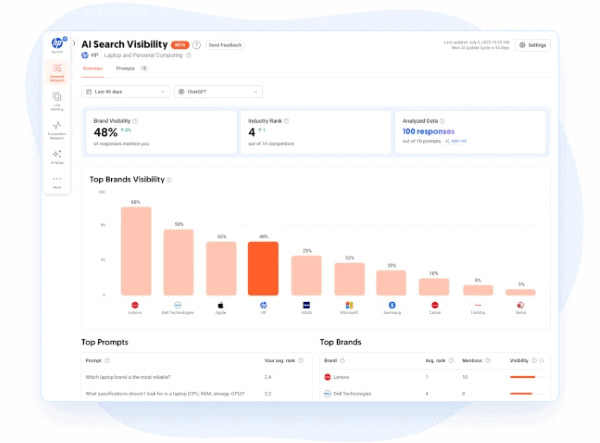
6. AI Search Visibility (AI Brand Presence Module): Tracks prompt-level brand presence, calculating your overall brand mention percentage, industry position rank, and competitive mention share within generative AI engine outputs (focusing primarily on ChatGPT prompts).
Ubersuggest Free Tools & Entry-Level Utilities
Ubersuggest offers a generous entry layer designed to introduce users to the platform:
- Free AI Brand Presence Scanner: A fast web lookup tool that analyzes prompt responses in ChatGPT to calculate your brand’s citation share against named competitors.
- 3 Free Daily Searches: Allows non-paying web visitors to run up to 3 keyword or domain lookups per day on Ubersuggest.com without creating an account.
- Ubersuggest Chrome Extension: Displays monthly search volume, CPC, and domain authority overlays directly inside Google search result pages.
- Free AI Writer & Title Generators: Quick utilities that generate blog outlines, headline ideas, and automated meta tags on demand.
Ubersuggest Pros & Cons
Pros:
- Comprehensive Feature Set: Includes a full technical site crawler, keyword research, rank tracking, and content generation in one dashboard.
- Lifetime License Option: Unbeatable long-term value via a one-time purchase, eliminating ongoing monthly charges.
- Integrated AI Content Creation: Built-in AI copywriting tools help turn keyword research directly into published drafts.
- Educational Resources: Embedded video guides, actionable task checklists, and SEO playbooks designed for beginners.
Cons:
- Dashboard Clutter: Interface can feel busy, with occasional upsell prompts for additional coaching or higher tiers.
- Variable Data Precision: Traffic estimates and long-tail volume accuracy for smaller niche sites or local regions can be less consistent than Mangools or enterprise suites.
- Repetitive Keyword Suggestions: Keyword expansion lists occasionally group subtle variants without providing deeper semantic grouping.
Mangools & Ubersuggest — Target Users
Who Is Each Tool Actually For?
Because Mangools and Ubersuggest prioritize different aspects of search engine marketing, they naturally fit different user profiles.
Mangools Best Fit Users
1. Niche Bloggers & Affiliate Marketers
- The Need: You need to evaluate hundreds of prospective low-competition long-tail keywords quickly and accurately.
- Why Mangools: KWFinder’s KD score gives you reliable difficulty indicators, preventing you from wasting weeks producing content for keywords that are far too competitive for your site’s authority level.
2. Freelance SEO Specialists & Copywriters
- The Need: You need to analyze SERPs, inspect competitors’ backlink profiles, evaluate AI visibility, and craft reports for clients without getting lost in bloated menus.
- Why Mangools: The clean visual aesthetic makes data analysis swift, and exporting reports or link tables to CSV or PDF takes seconds.
3. Agencies Demanding Clean, White-Label Client Visuals
- The Need: Your clients get overwhelmed by dense, overly technical spreadsheets and complicated dashboards.
- Why Mangools: SERPWatcher’s “Performance Index” and visually polished rank charts provide intuitive progress summaries that non-technical business owners can digest at a glance.
Ubersuggest Best Fit Users
1. Solopreneurs & Bootstrapped Founders (Seeking Max ROI)
- The Need: You want to handle your own search marketing without incurring recurring monthly SaaS bills.
- Why Ubersuggest: The Lifetime Deal allows you to make a one-time investment that pays for itself in just a few months compared to ongoing subscription plans.
2. Generalist In-House Marketers
- The Need: You are managing marketing for a company and need to monitor technical site health, research content topics, track rankings, and draft blog posts all within a single tool.
- Why Ubersuggest: Having a built-in site crawler combined with AI content writing utilities means you don’t need to purchase separate auditing software (like Screaming Frog) or dedicated AI copywriting tools.
3. Beginners & DIY Business Owners Learning Search
- The Need: You know SEO matters, but you aren’t an expert and need step-by-step guidance on what to fix first.
- Why Ubersuggest: The SEO Analyzer flags technical errors and prioritizes them by impact level, providing clear explanations and video tutorials from Neil Patel on how to resolve each issue.
Mangools & Ubersuggest — AI Features
Modern AI Capabilities & Generative Engine Optimization (GEO)
Search engine optimization is undergoing its biggest structural shift in twenty years. As users increasingly turn to ChatGPT, Claude, Perplexity, and Google AI Overviews for instant answers, SEO professionals must track both traditional blue links and conversational AI engine citations.
Both Mangools and Ubersuggest have added modern AI features, but they approach Generative Engine Optimization (GEO) with distinct architectures.
A. Free & Entry-Level AI Search Visibility (The Gateway Tier)
Before committing to paid tracking suites, marketers often need a fast, low-friction way to audit a brand’s visibility in generative responses. Both platforms offer zero-cost entry tools, but their scope and methodology differ significantly.
The table below provides a quick comparison.
| Gateway Tool | Target LLM Scope | Key Capabilities & Limits |
|---|---|---|
| Mangools AI Search Grader | 8 LLMs simultaneously (multi-model) | • Generates composite AI Search Score (0–100) • Prompts queried twice per run (anti-hallucination) • Includes 5-prompt permanent free tracker |
| Ubersuggest AI Brand Scanner | ChatGPT conversational prompts | • Calculates brand citation share vs. industry rivals • Fast competitive share-of-voice snapshot • Direct prompt share-of-voice metric |
Mangools AI Search Grader & Free Watcher Tier
- Mangools’ free AI Search Grader queries 8 major LLMs simultaneously: Google AI Overviews, ChatGPT, Claude, Gemini, Grok, Mistral, Llama, and Perplexity.
- The Anti-Hallucination Mechanism: Because LLM responses are non-deterministic (stochastic), Mangools runs every tracked prompt twice per audit cycle. If an AI engine mentions your brand in one run but drops it in the second, Mangools accounts for this volatility to produce a calibrated AI Search Score (0–100).
- In addition, Mangools includes a permanent free tier inside its AI Search Watcher app, permitting ongoing weekly tracking for 1 brand across 5 custom prompts without requiring a credit card.
Ubersuggest AI Brand Presence Scanner
- Ubersuggest’s entry scanner focuses primarily on ChatGPT prompt dynamics. By entering your brand name, target industry, and key competitors, the scanner generates a high-level report showing what percentage of relevant buyer prompts return your brand vs. top competitors.
- While less multi-model than Mangools, it gives small business owners a straightforward summary: “Out of 20 typical buyer queries in ChatGPT, your brand appears in 3, while your main competitor appears in 8.”
B. Full AI Search Visibility & GEO Tracking
For brands actively optimizing for generative citations, both platforms provide paid dashboard tools to track long-term GEO trends.
Here’s the general GEO-tracking workflow:
| Stage 1: Prompt Discovery | Stage 2: Citation Tracking | Stage 3: Share-of-Voice |
|---|---|---|
| Uncover conversational user prompts | Monitor URL and brand citations per LLM | Benchmark visibility vs. industry rivals |
Mangools AI Search Watcher
- Allows you to track customized prompt clusters (e.g., “What is the best budget CRM for real estate agents?”).
- Measures whether your domain URL is cited as a source link, whether your brand is mentioned in text, your average ordinal rank position within the generated summary, and how your sentiment is framed across all 8 supported LLMs.
Ubersuggest AI Search Visibility
- Integrated directly into the main Ubersuggest project view. It focuses on prompt tracking, brand mention counts, and estimated competitive share-of-voice within ChatGPT.
- Its main advantage is contextual integration: it links your prompt visibility directly with your overall site health and backlink counts, helping you see whether increased domain authority corresponds to higher AI citation frequency.
C. On-Platform AI Content Creation & Semantic Utilities
Beyond tracking AI search engine outputs, how do these platforms use AI internally to help you produce better search content?
Ubersuggest (The Generative Approach)
- Ubersuggest includes an active AI Writer directly inside the app. It can generate complete article outlines, draft paragraphs, rewrite existing meta tags, and produce headline options.
- Additionally, when the SEO Analyzer flags technical or on-page issues, Ubersuggest uses AI to generate suggested fixes (such as rewritten title tags or missing meta descriptions) with a single click.
Mangools (The Semantic & Structural Approach)
- Mangools takes a deliberate pass on automated long-form AI drafting, choosing instead to apply AI to data analysis and structure.
- Inside KWFinder, AI algorithms handle semantic keyword clustering (grouping thousands of raw keyword suggestions into logical sub-topics), search intent classification, and entity extraction within top-ranking SERPs.
- Mangools’ philosophy is that human writers should craft the final prose, while AI should handle the tedious task of organizing keyword relationships and mapping SERP competitive structures.
D. API, MCP (Model Context Protocol), & AI Agent Workflows
As search workflows migrate toward autonomous AI agents (such as Claude Code, custom LLM scripts, and programmatic SEO pipelines), platform data accessibility through APIs and Model Context Protocol (MCP) standards is increasingly relevant.
Mangools Developer Accessibility & Dedicated MCP Server
- Mangools provides clean, well-documented REST APIs for KWFinder and SERPChecker data, allowing developers and SEO automation teams to programmatically pull keyword difficulty scores, volumes, and SERP overlay metrics.
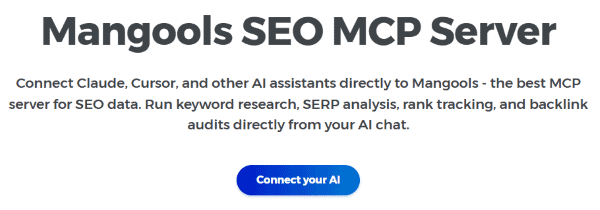
- Unlike platforms requiring custom web wrappers, Mangools provides a dedicated Mangools SEO MCP Server (mcp.mangools.com/mcp). This allows AI agents (such as Claude, Cursor, or custom LLM scripts) to natively run KWFinder keyword queries, SERP checks, and backlink audits through direct, natural language prompts without building custom API infrastructure.
Ubersuggest API Ecosystem
- Ubersuggest offers limited API access primarily tailored for high-tier enterprise plans or white-label reporting platforms.
- Because Ubersuggest’s infrastructure is tightly bound to its proprietary web UI, building custom programmatic workflows or automated AI agent data pipelines is less direct than with Mangools.
Mangools vs. Ubersuggest — Pricing Models
Budget Impact & Long-Term Value Breakdown
Pricing is often the deciding factor when choosing between budget SEO suites. While both platforms cost significantly less than enterprise SEO alternatives, their financial structures are fundamentally different.

Side-by-Side Pricing Comparison Table
The following table compares equivalent pricing tiers and core metric caps for both platforms (reflecting standard annual billing discounts).
| Metric / Plan Tier | Mangools Basic | Ubersuggest Individual | Mangools Premium / Agency | Ubersuggest Business / Enterprise |
|---|---|---|---|---|
| Monthly Cost (Billed Annually) | ~$38 / mo | ~$16 / mo | ~$53 to $98 / mo | ~$27 to $55 / mo |
| Monthly Cost (Billed Monthly) | ~$61 / mo | ~$29 / mo | ~$81 to $141 / mo | ~$49 to $99 / mo |
| Lifetime Option Available? | ❌ No (Subscription only) | Yes (~ $290 one-time) | ❌ No (Subscription only) | Yes (~ $490–$990 one-time) |
| Daily Keyword Lookups | 100 / 24h | 150 / day | 500 to 1200 / 24h | 300 to 500+ / day |
| Tracked Keywords | 200+ | 125+ | 700+ to 1500+ | 300 to 1000+ |
| Site Audit Crawl Pages | N/A (No crawler) | 1000 pages / crawl | N/A (No crawler) | 5,000 to 10,000 pages / crawl |
| Backlinks | 100k / mo | 2k / mo | 500k to 1.2M / mo | 5k to 10k / mo |
| AI Visibility Prompts | 500 (bundled add-on) | ~ 10 / mo | 500 (bundled add-on) | ~ 15 to 20 (weekly or bi-weekly) |
| User Seats Included | 1 seat | 1 seat (extra cost for more) | 4 to 6 seats | 1 seat (extra cost for more) |
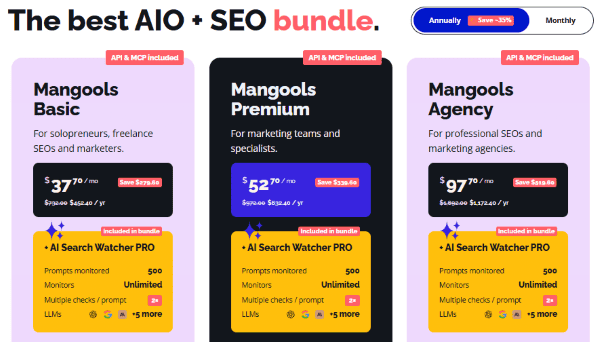
Good to Know: The Mangools pricing above includes “AI Search Watcher PRO” bundled in at all levels. Things may change, so check the Mangools pricing page for the very latest pricing tiers and AI SEO feature bundles.
The “Ubersuggest Lifetime Deal” Factor
The defining feature of Ubersuggest’s commercial model is its Lifetime License.
How the Financials Work: An Individual Lifetime License for Ubersuggest costs around $290 (possibly less, depending on active promotional discounts).
The Payback Math: When compared to standard $69–$99+/month SaaS subscriptions (or Semrush at $139.95/mo), the Ubersuggest lifetime deal pays for itself in just 3 to 4 months.
When compared directly against Ubersuggest’s own monthly Individual plan ($29/mo), the break-even point is approximately 10 months. In either scenario, after reaching break-even, your ongoing software cost drops to zero.
Important Caveats to Keep in Mind:
- The Ubersuggest Lifetime plan purchases are “final and non-refundable.” Make very good use of the 7-day free trial before committing to the lifetime deal.
- Metric Caps Are Permanent: A lifetime license fixes your usage limits (e.g., 150 keyword searches/day). If your business or agency grows and needs 1,000 daily lookups, you will need to pay for account upgrades or additional add-on packs.
- Advanced AI & Add-on Limits: While core SEO functionality (site audit, rank tracker, keyword analysis) is included lifetime, premium high-volume AI tracking or specialized agency reporting features may occasionally carry usage caps or add-on costs.
Mangools’ Subscription Structure
Mangools relies strictly on a traditional recurring SaaS model (Monthly or Billed Annually with up to ~35% discount).
Why Mangools Uses a Subscription Model:
- Tapping into Majestic’s live backlink index requires ongoing infrastructure licensing fees.
- Maintaining live, multi-LLM scraping nodes across 8 distinct AI engines requires continuous server resources and API maintenance.
Mangools Value Proposition:
- Mangools’ Basic tier remains accessible for active content creators.
- You receive clean, verified data updates, dedicated customer support, and constant UI enhancements without hidden upsell notifications.
Value-for-Money Verdict
- Choose Ubersuggest if: Your primary objective is eliminating monthly SaaS expenses. The lifetime deal provides extraordinary value for solo founders, local business owners, and small teams that need a reliable, permanent SEO baseline.
- Choose Mangools if: You rely heavily on accurate keyword difficulty metrics, prioritize fast workflow design, demand deep Majestic link data, and prefer a clean multi-model AI tracking suite — making a modest monthly fee well worth the investment.
Mangools & Ubersuggest Features — A Closer Look
Head-to-Head Comparison: Modules & Data Quality
When evaluating budget SEO software, looking past marketing claims to examine underlying data providers and daily usability is critical. A platform can boast millions of keywords or backlinks, but if the data is stale or difficult to interpret, it adds friction to your SEO workflow.
To provide a clear side-by-side view, the matrix below compares how Mangools and Ubersuggest perform across core search dimensions, followed by a more detailed breakdown of key operational differences.
Side-by-Side Module & Data Quality Matrix
| Capability / Dimension | Mangools | Ubersuggest | Winner / Nuance |
|---|---|---|---|
| Keyword Research (Accuracy & KD) | KWFinder | Keyword Analyzer | Mangools (more reliable difficulty formula) |
| Technical Site Auditing | None (Relies on 3rd-party) | Built-in SEO Analyzer | Ubersuggest (clear win for technical health) |
| Backlink Data Quality | Powered by Majestic | Proprietary Crawl | Mangools (Majestic link index depth) |
| Rank Tracking UX | SERPWatcher (Performance Index) | Standard Rank Tracker | Mangools (UI/reporting clarity) |
| Free AI Visibility Tools | AI Search Grader + Free Watcher Tier | AI Brand Presence Scanner | Mangools (multi-model breadth & free tier) |
| AI Content Generation | Minimal (Clustering & Intent) | Built-in AI Writer | Ubersuggest (generates drafts & copy) |
| Feature Breadth | Modular (6 distinct apps) | Single unified dashboard | Ubersuggest (more complete toolkit) |
| UI & Ease of Use | Modern, minimal, intuitive | Feature-dense, promotional | Mangools (cleanest workflow in SEO) |
Detailed Capability Breakdown
1. Keyword Research & Difficulty Precision: KWFinder vs. Keyword Analyzer
Winner: Mangools (KWFinder)
Why it matters: Keyword research is only as useful as the difficulty metric guiding your targeting. Selecting terms based on inaccurate difficulty scores wastes time and content budget.
The Nuance: KWFinder’s Keyword Difficulty (KD) metric is widely considered one of the most reliable in the budget software category because it evaluates actual SERP competition using real-time authority scores rather than relying solely on domain age or raw backlink volume.
While Ubersuggest’s Keyword Analyzer generates massive lists of related queries and questions, its difficulty ratings can occasionally understate competition for competitive commercial terms, making KWFinder the safer choice for strategic content planning.
2. Technical Site Health & Auditing: SEO Analyzer vs. Modular Stack
Winner: Ubersuggest (SEO Analyzer)
Why it matters: Off-page and on-page optimization mean little if your website suffers from technical crawling blockers, indexation errors, or severe page speed bottlenecks.
The Nuance: Ubersuggest claims an absolute victory here. Its built-in SEO Analyzer operates like a streamlined site auditor, crawling thousands of pages to identify broken links, missing canonical tags, schema errors, and performance bottlenecks — complete with step-by-step remediation advice.
Mangools offers no technical site crawler whatsoever; users must pair Mangools with third-party utilities (like Screaming Frog, SEO PowerSuite, or Google Search Console) to perform technical health checks.
Pro Tip: As an option for adding site audits for Mangools users, SEO PowerSuite’s Website Auditor offers a free-forever desktop version that is great for periodic “one-off” website audits. It has some feature limitations vs. the full paid version, but is still a good option as a free-forever SEO site audit tool.
3. Backlink Intelligence: Majestic API Integration vs. Proprietary Crawler
Winner: Mangools (LinkMiner)
Why it matters: Evaluating competitor link profiles and uncovering link-building targets requires a vast, continually updated web index.
The Nuance: Mangools licenses data directly from Majestic, one of the oldest and most respected web index databases in the search industry. This gives LinkMiner immediate access to trusted Trust Flow (TF) and Citation Flow (CF) metrics, as well as live visual previews of linking source pages.
Ubersuggest relies on its own proprietary backlink crawler, which provides adequate high-level domain backlink metrics for established sites but can miss fresh long-tail links or smaller domain connections.
4. Rank Tracking Usability & Visual Reporting: SERPWatcher vs. Standard Tracker
Winner: Mangools (SERPWatcher)
Why it matters: Communicating ranking progress to clients or stakeholders requires intuitive metrics that reflect actual organic traffic impact, not just raw position shifts.
The Nuance: While both tools offer automated daily rank updates, Mangools’ SERPWatcher stands out for its user-centric interface. Its proprietary Performance Index (PI) calculates overall search visibility by weighting position improvements against search volume.
Ubersuggest provides functional table-based position updates, but its reporting interface lacks the visual elegance and white-label polish of SERPWatcher.
5. Ecosystem & Feature Breadth: Unified Growth Suite vs. Specialized Micro-Apps
Winner: Ubersuggest (All-in-One Value)
Why it matters: Solo marketers and small business owners often prefer managing all digital marketing activities within a single, integrated platform.
The Nuance: Ubersuggest delivers a broader suite of integrated tools under one login— combining keyword discovery, site auditing, backlink analysis, rank tracking, and generative AI writing assistants.
Mangools deliberately focuses on doing five or six core SEO tasks exceptionally well, choosing modular specialization over all-in-one breadth.
Mangools & Ubersuggest vs. Ahrefs & Semrush
Positioning vs. Industry Giants
It is impossible to discuss Mangools and Ubersuggest without addressing the two elephant-sized platforms in the SEO room: Semrush and Ahrefs. Both Semrush ($139.95/month starting) and Ahrefs ($129/month starting) represent the gold standard of enterprise search intelligence.
But when evaluating budget tools, the real question isn’t whether Mangools or Ubersuggest can match Semrush feature-for-feature — it is whether you actually need those enterprise features to accomplish your business goals.
The Reality Check: What Do You Give Up with Budget SEO Suites?
When you step down from a $1,500–$3,000/year enterprise suite to a $200–$400/year budget platform (or a one-time lifetime deal), you are sacrificing specific enterprise capabilities. Here’s a quick breakdown of the major trade-offs:
| Flagship Suites (Semrush / Ahrefs) | Budget Suites (Mangools / Ubersuggest) |
| Massive global clickstream indexes | Standard search volume & SERP data |
| Daily/hourly backlink crawling | Periodic backlink index refreshes |
| Complex content/keyword gap tools | Core competitor overview metrics |
| PPC, PLA, & social ad intelligence | Organic search focus |
| Toxic link disavow & log crawlers | Essential site health or 3rd-party audit |
Database Scale & International Coverage
- Enterprise suites process billions of keywords and maintain vast historical clickstream databases across virtually every country and regional sub-market.
- Budget tools provide excellent coverage for primary markets (US, UK, CA, AU, EU), but their keyword discovery depth and backlink fresh rates can taper off in smaller regional niches or non-English languages.
Advanced Competitive & Advertising Intelligence
- Neither Mangools nor Ubersuggest provides enterprise-level Pay-Per-Click (PPC) competitive intelligence, Product Listing Ad (PLA) research, or social display ad monitoring. Semrush excels at showing you your competitor’s exact Google Ads copy and historical bidding strategy; budget tools stick almost entirely to organic search dynamics.
Complex Enterprise SEO Utilities
- Enterprise suites include specialized workflows like server log file analysis, toxic backlink audit/disavow management, multi-domain Content Gap matrices, and custom API query builders. Budget tools intentionally omit these complex features to maintain streamlined interfaces and lower subscription overhead.
The “Good Enough” Threshold: The 80/20 Rule in Action
Despite those trade-offs, here is the operational truth that every frugal marketer discovers: 80% to 90% of daily SEO work involves just four core tasks:
- Finding realistic, low-competition keywords to target in new content.
- Checking the authority and link profile of competing top-10 SERP URLs.
- Tracking daily keyword ranking positions over time.
- Keeping an eye on technical site health and generative AI search visibility.
Both Mangools and Ubersuggest handle these four core tasks with remarkable efficiency.
For a solo blogger, a local services business, or a boutique content agency, paying an extra $1,200 to $2,000 per year for Semrush or Ahrefs often yields limited marginal returns — you end up paying for enterprise features you never open.
The “Smart Hybrid Stack”: How Modern Marketers Save $1,500+/Year
Instead of choosing between an overpriced enterprise suite or an underpowered setup, many growth marketers build a Lean Hybrid Stack:
| Stack Layer | Primary Tool Options | Key Role & Cost Profile |
| Core Keyword & SERP Intelligence | Mangools KWFinder (or Ubersuggest Lifetime) | Long-tail keyword discovery, SERP analysis, and rank tracking (Budget SaaS or Lifetime) |
| Technical Site Auditing | Screaming Frog (Free < 500 URLs) + Google Search Console | Deep crawl diagnostics, error detection, and indexation checks (Free / 100% Free) |
| AI Visibility & Indexing | Mangools AI Search Grader + Google Search Console | Multi-LLM brand citation checking and generative search monitoring (100% Free) |
By pairing a budget suite like Mangools or Ubersuggest with free, best-in-class specialized tools, you get full coverage without the enterprise price tag. This hybrid approach gives you enterprise-grade strategic intelligence while keeping your software overhead under $300 a year.
Mangools or Ubersuggest — Other Considerations
Critical Differentiators & Practical Buying Advice
Beyond raw metric capabilities and database counts, subtle operational factors can make or break your daily experience with either platform. Let’s look at team accessibility, customer support infrastructure, and a final decision framework.
A. Team Access, Sub-Accounts, & Concurrent Sessions
If you collaborate with virtual assistants, clients, or team members, account accessibility is an essential consideration.
Mangools Collaboration Rules
- Mangools strictly enforces concurrent session rules. On Entry and Basic plans, logging in from a second device will log out the primary session.
- Multi-user capabilities unlock at the Premium (3 seats) and Agency (10 seats) levels, allowing team members to operate with distinct credentials, managed permissions, and shared rank-tracking lists.
Ubersuggest Multi-User Management
- Ubersuggest ties seat counts directly to account tiers. The Individual plan is strictly single-user, whereas Business and Enterprise tiers include 2 to 5 user seats respectively.
- Client access in Ubersuggest is primarily handled through project sharing, enabling team members or clients to view specific project dashboards without granting full administrative or billing access.
B. Support Infrastructure & Educational Ecosystems
When you encounter technical questions or need strategic guidance, the onboarding resources provided by each platform reflect their core user philosophies.
Mangools Support & Usability
- Offers responsive live chat and ticket-based support directly within all six micro-apps.
- The documentation is intentionally concise: step-by-step visual guides, interactive tooltips, and straightforward SEO glossary definitions that get straight to the point without overwhelming marketing spin.
Ubersuggest Support & Learning Academy
- Benefiting from Neil Patel’s extensive media engine, Ubersuggest is built as an educational hub as much as a software tool.
- The platform is filled with embedded video mini-courses, step-by-step action plans, downloadable templates, and live weekly Q&A sessions for subscribers. If you are learning search engine optimization from scratch, this built-in guidance acts as a virtual coach.
Final Buying Decision Framework
To simplify your final software choice, match your current operational goals to one of these three real-world purchasing scenarios:
Scenario A: The Content-First Blogger, Affiliate Marketer, or Freelance SEO Specialist
- Recommendation: Mangools
- Why: Your success hinges on selecting keywords you can actually rank for and presenting clean reports to clients. KWFinder’s difficulty scoring and Majestic’s link data provide superior precision, preventing wasted content spend.
Scenario B: The Solopreneur, Local Business Owner, or Bootstrapped Team
- Recommendation: Ubersuggest (Lifetime License)
- Why: Your priority is minimizing fixed operational overhead. Paying a one-time fee of $120–$290 for Ubersuggest gives you a permanent, lifetime suite covering site audits, keyword ideas, rank tracking, and AI drafting — eliminating monthly software fees entirely.
Scenario C: The Hybrid Value Maximizer
- Recommendation: Ubersuggest Lifetime + Mangools Free AI Utilities
- Why: Grab the Ubersuggest Lifetime deal for permanent technical crawling and baseline tracking. Pair it with Mangools’ free AI Search Grader and AI Search Watcher Free Tier to get best-in-class multi-LLM generative search visibility without adding recurring subscription costs.
Like this post? Quickly share it with your social networks here.
Want to make sure you never miss our updates? Click below to add us as a preferred source on Google Search.

Mangools vs. Ubersuggest — Closing Thoughts
Conclusion & Final Verdict
The debate between Mangools and Ubersuggest isn’t about finding a single “victor” — it is about selecting the right tool for your specific workflow, data precision requirements, and financial philosophy.
Summary of Key Takeaways
- UX vs. Breadth: Mangools delivers the best user experience, cleanest interface, and most dependable Keyword Difficulty score in the budget category. Ubersuggest delivers the widest feature set, combining technical site auditing, rank tracking, and AI content generation into one platform.
- GEO & Modern AI Tracking: Mangools takes the lead in Generative Engine Optimization by tracking brand visibility across 8 major LLMs with double-check sampling to account for AI hallucination. Ubersuggest focuses on prompt-level brand mention share within ChatGPT.
- Financial Value: Ubersuggest’s Lifetime License remains an unrivaled financial deal for bootstrapped business owners, paying for itself in under four months. Mangools’ modest monthly subscription model ensures access to Majestic backlink data and lightweight multi-model AI tracking.
What’s Your Next Step?
Before committing to any paid plan, test both ecosystems using their zero-cost utilities:
- Run a free brand audit on the Mangools AI Search Grader to test your current multi-model visibility across ChatGPT, Gemini, and Google AI Overviews.
- Run a site check using Ubersuggest’s 3 free daily lookups or test the Free AI Brand Presence Scanner to evaluate your basic domain health and prompt visibility.
By testing both platforms against your active website data, you can choose the exact tool – or hybrid stack – that accelerates your search growth without straining your marketing budget.
Questions or Comments?
I hope this Mangools vs. Ubersuggest comparison has been useful and insightful! Let’s close this post with a few related questions for you:
- Are you currently a Mangools or Ubersuggest user at a free or paid level? Why did you choose one over the other?
- Which other SEO/GEO toolkits do you consider to be in the same “class” as Mangools and Ubersuggest?
- Which other tools are essential to your SEO & AI GEO tools stack? What gaps do they fill that Mangools and/or Ubersuggest do not?
Feel free to add more in the comments below with any thoughts, feedback, or related questions. Thanks also for any social shares on this post!
