
A Battle for B2B Website Visitor ID & Tracking Supremacy
Leadfeeder and Leadinfo are two of the main contenders for market share in the martech segment of B2B website visitor identification, tracking, intent, and lead generation.
Both are based in Europe, but have significant strengths to offer North American customers as well.
This post looks more closely at Leadfeeder vs. Leadinfo, including insights, pros, potential cons, and buyer tips for both.
Let’s dive in below!
— VS —

This post contains a few referral links to select vendor partners. We may receive compensation for purchases made through these links, at no additional cost to the buyer.
Last updated Jul 17, 2026
Leadfeeder & Leadinfo — Brief Introductions
Converting B2B Website Visitors into Actionable Leads & Revenue
Consider this frustratingly common scenario: your marketing team executes a flawless demand generation campaign, driving hundreds of high-intent B2B professionals to your website.
They spend minutes scrolling through your pricing page, reviewing your product documentation, and reading your case studies.
Then, they click away to a different website. Gone forever? Only time will tell.
In fact, industry statistics show that over 97% of B2B website visitors leave without ever filling out a contact form or initiating a live chat.
Historically, this meant those high-intent accounts vanished into the “dark funnel of B2B” — anonymous website traffic that your sales development representatives (SDRs) could never hope to identify or act upon.
However, B2B website visitor identification technology has undergone a massive paradigm shift. What once started as a simple, “nice-to-have” add-on for Google Analytics has evolved into the cornerstone of modern, real-time Go-to-Market (GTM) data engines.
Today, reverse-IP tracking tools do not just identify that an organization is browsing your site; they feed dynamic intent signals directly into your CRM, enabling revenue operations (RevOps) teams to orchestrate highly targeted outbound cadences, trigger automated Slack alerts to sales reps, and power highly targeted programmatic ad campaigns.

If you are currently evaluating the website visitor ID market, two primary heavyweights dominate the conversation: Leadfeeder and Leadinfo.
- Leadfeeder is the newly reunified industry titan. After a brief period under the “Dealfront” umbrella, the company has officially returned to its well-established brand roots, bringing with it a powerful suite of European-compliant sales intelligence features and a highly anticipated North American data engine.
- Leadinfo is the fast-growing European challenger. Backed by the massive European digital enablement group team.blue, Leadinfo has expanded rapidly beyond its Dutch roots, armed with slick visual dashboards and a major recent North American acquisition.
With both platforms executing massive corporate maneuvers recently, the B2B buying landscape looks radically different today than it did even in late 2025.
This head-to-head guide breaks down the rebrands, analyzes the data accuracy, compares key integrations, and ultimately helps you decide which B2B website visitor ID and tracking platform deserves a spot in your martech stack today.

Leadfeeder & Leadinfo Strategic Moves
The 2026 Landscape: Major Rebrands & Acquisitions
To understand where Leadfeeder and Leadinfo stand today, we have to look at the major corporate consolidation that has redefined their B2B SaaS landscape.
Leadfeeder’s Brand Unification & The “US Data Pack”
The journey of Leadfeeder over the last few years has been a masterclass in market consolidation. In 2022, Helsinki-born Leadfeeder merged with German sales intelligence giant Echobot (the undisputed leader in the highly regulated DACH region).
Good to Know: “DACH” is an acronym representing the primary German-speaking countries in Europe:
D: Deutschland (Germany)
A: Austria (Austria)
CH: Confoederatio Helvetica (Switzerland)
In B2B marketing and sales, the DACH region is recognized as having the most stringent data protection, e-privacy, and cold-outreach regulations in the world, making strict compliance a primary requirement for any local operations.
In 2023, the combined entities launched under a new, unified platform brand: Dealfront.
While the Dealfront brand successfully combined Leadfeeder’s web visitor tracking with Echobot’s deep EU business directory, it also introduced market confusion.
Customers missed the highly recognizable Leadfeeder name, which had defined the web visitor tracking category for a decade.
To solve this, in late March 2026, the company executed a strategic brand pivot: they officially retired the Dealfront platform name and unified it back under the globally recognized Leadfeeder banner.
A primary goal was to make a decisive brand identity move “from complexity to clarity.”
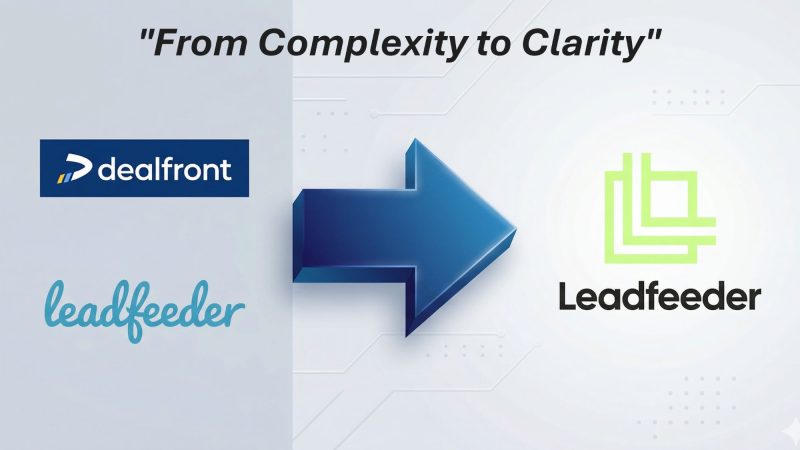
Along with this rebrand, they simplified their modular system. Leadfeeder is no longer just a “website visitor tracker”; it is a comprehensive, multi-layered lead generation platform consisting of four core modules:
- Web Visitors: Formerly the core Leadfeeder tool, it reveals companies visiting your website.
- Target: For creating prospect lists from Leadfeeder’s global database.
- Campaigns: The integrated programmatic display ad retargeting system.
- Lists: For prioritizing and taking action on your best fit (e.g., ICP) accounts.
Just a few days later, Leadfeeder dropped a major product release: the US Data Pack.
By injecting 10 million US companies, 110 million US contact profiles, and 52 million verified emails into their platform, Leadfeeder explicitly designed an equalizer to neutralize competitors aiming for the North American B2B market.
Related: Learn more in this post about Dealfront rebranding to Leadfeeder.
Leadinfo’s Acquisition of Visitor Queue
While Leadfeeder unified its global brand, Rotterdam-based Leadinfo was busy playing offense. Acquired by European hosting giant team.blue in 2022, Leadinfo has spent the last few years systematically acquiring complementary tools — including the lead capture software Futy and the sales enablement platform Leadcamp.
In January 2026, Leadinfo made its most aggressive play yet by acquiring Visitor Queue, a highly established B2B visitor tracking software based in London, Ontario, Canada.
This acquisition was highly strategic. While Leadinfo had established a strong presence across Western Europe, its North American presence was minimal.
By absorbing Visitor Queue, Leadinfo instantly inherited an extensive North American customer base and a highly accurate regional IP-to-company database, positioning itself as a legitimate transatlantic alternative to US-native tracking tools.
Related: Learn more in this post about Leadinfo acquiring Visitor Queue.
Leadfeeder vs. Leadinfo — High-Level Differences
Company Backgrounds & Core Philosophies
To choose the right tool, you must understand the underlying philosophies of the engineers and marketers who built them.
Leadfeeder: The Compliance-First Sales Intelligence Engine
Founded in Helsinki, Finland, in 2012, Leadfeeder’s core philosophy is that your website is your most valuable B2B asset, and website behavior is the ultimate indicator of buying intent.
Because of its deep integration with German-born Echobot, Leadfeeder is built on a foundation of strict, compliance-first sales intelligence. It does not just want to tell you who is visiting; it wants to act as a secure, end-to-end B2B sales development engine.
- Key Message: “We identify the B2B companies visiting your website and automatically send high-fit accounts to your CRM, so marketing and sales can act on real buying intent.”
- The Philosophy: Leadfeeder operates under the assumption that identification is useless without enrichment and secure activation. Their product philosophy centers on deep CRM synchronization, programmatic pipeline triggers, and absolute adherence to strict regional privacy regulations (i.e., GDPR), particularly within the highly sensitive DACH market.
Leadinfo: The Frictionless Visual Sales Acceleration Tool
Founded in Rotterdam, Netherlands, in 2017, Leadinfo was built to solve a different problem: sales friction. The founders believed that traditional visitor ID tools were too slow, too clunky, and too complex for fast-moving sales teams.
Leadinfo is engineered for speed, real-time visual clarity, and instant pipeline creation. Backed by the massive infrastructure of team.blue, they approach lead generation with a focus on immediate, actionable outbound prospecting.
- Key Message: “Know which company visits your website. Reveal the most interested companies in real-time. Know the decision makers searching for you right now.”
- The Philosophy: Leadinfo’s design philosophy is built on “zero friction.” They avoid complex setups and prioritize a visual, single-screen dashboard experience that sales reps can check in real-time between calls. They believe that B2B lead generation should be accessible to everyone — from local agencies utilizing their dedicated “Agency Portal” to multinational sales teams needing unlimited, seat-free software licensing.
Leadinfo & Leadfeeder Platform Highlights
Core Platform Capabilities & Head-to-Head Comparison
To truly appreciate how Leadfeeder and Leadinfo stack up, we have to look past the marketing headlines and analyze their core capabilities.
1. Data Accuracy & Match Rates (IP-to-Company Lookup)
The fundamental promise of both tools is simple: matching anonymous web visitor IP addresses to real, registered B2B organizations.
Leadfeeder
Historically, Leadfeeder held a massive data advantage in Northern and Central Europe. In recent years, by integrating Echobot’s localized data assets, Leadfeeder became the absolute gold standard for tracking across the highly restrictive DACH region.
However, North American match rates remained an uphill battle — especially given the high concentration of remote and hybrid work environments.
The launch of Leadfeeder’s US Data Pack in late March 2026 has served as the ultimate equalizer. While Leadfeeder doesn’t shout about it on their homepage, their dedicated US Data Pack operates under the hood of their Target module, quietly leveling the playing field with US-strong tools.
By infusing their global tracking engine with millions of verified US business entities and contact files, Leadfeeder has matched the North American footprint of legacy competitors, ensuring high tracking fidelity regardless of which side of the Atlantic your web traffic originates from.
Leadinfo
Leadinfo, conversely, has built its reputation on extreme IP-to-company lookups across Western Europe, particularly the Netherlands, Germany, the UK, and Denmark.
By actively leveraging the hosting networks and infrastructure of team.blue, their real-time matching speed in these areas is virtually unmatched.
With the January 2026 acquisition of Canada-based Visitor Queue, Leadinfo has aggressively bridged the transatlantic gap.
Rather than trying to build a North American database from scratch, Leadinfo absorbed Visitor Queue’s pre-existing corporate network maps.
For buyers, this means both Leadfeeder and Leadinfo now offer robust, highly competitive tracking grids spanning both European and North American markets. Great news for distributed sales teams targeting both major commercial regions.
2. Firmographic & Contact Enrichment
Knowing that “Acme Corporation” visited your homepage is only half the battle. Your sales development reps (SDRs) still need to know whom to contact.
This is where the core architectural differences between Leadfeeder and Leadinfo become most visible.
Leadfeeder
Leadfeeder approaches enrichment from a full-funnel, sales intelligence perspective. Within the Web Visitors dashboard, Leadfeeder does not just show you the visiting company.
Under the hood of its Target and Connect modules, it actively presents you with a list of verified decision-makers mapped to that organization.
You can filter these contacts by department, job title, and seniority, and then unlock their direct business emails and LinkedIn profiles.
This programmatic capability effectively consolidates your tech stack, eliminating the need to cross-reference every identified web lead with a separate database tool.
Leadinfo
Leadinfo has significantly modernized its approach to direct outreach with Leadinfo Contacts. Instead of focusing solely on corporate firmographics, Leadinfo provides direct access to a database of over 300 million mapped B2B profiles.
The system crawls public platforms like LinkedIn and Xing to pair visitor records with current decision-maker roles, using an in-house email-pattern matching algorithm to generate accurate professional emails.
To streamline outreach, Leadinfo features a dedicated B2B Contact Finder Chrome Extension. Sales reps browsing LinkedIn can instantly view email addresses and phone numbers right on a prospect’s profile, pushing them with one click into automated outreach campaigns.
💡 Sidebar Deeper Dive: The Legal Reality of “Person-Level” Tracking
The Myth: Tools like Leadfeeder and Leadinfo install a script on your website to instantly identify and reveal the names and email addresses of individual anonymous web visitors. In other words, “actual people.”
The Reality: Doing this would violate strict EU privacy laws. Instead, vendors stay 100% GDPR-compliant by separating the tracking mechanism from the contact enrichment:
1. First-Party IP Matching (The Tracker): The tracking script only identifies the organization/employer (e.g., Acme Corp). Under GDPR, Leadfeeder acts as a Data Processor, while you act as the Data Controller.
2. B2B Contact Database (The Enrichment): The software vendor acts as an independent *Data Controller for its separate, publicly sourced B2B directory. It matches the identified Acme Corp to its database and says: “Someone from Acme Corp visited. Here are the public business contacts for their decision-makers (like John Doe, VP of Sales).”
- The Legal Shield: This database relies entirely on Legitimate Interest under Article 6 of the GDPR, processing strictly professional B2B data with no cross-site personal tracking.
3. User Interface (UI) and Dashboard Experience
How your team interacts with intent data determines how consistently they will use it.
Leadfeeder
Leadfeeder’s user interface is built around custom intent feeds. The platform operates similarly to an advanced email inbox: you set up “Custom Feeds” using highly specific behavioral parameters (for instance, showing only companies from the United States that viewed your product feature page for more than 45 seconds and have over 50 employees).
This is highly efficient for targeted campaigns, though it does require a brief learning curve to configure effectively.
Leadinfo
Leadinfo takes a completely different UI approach, heavily prioritizing frictionless visual aesthetics.
The Leadinfo dashboard is designed as a single, real-time, scrolling live stream of incoming traffic. Each visiting company is represented with a clean, color-coded logo, accompanied by visual representations of their website journey (e.g., pages viewed are laid out as a visual timeline).
For sales teams that thrive on immediate, live-action prospecting, Leadinfo’s interface is incredibly intuitive and requires almost zero onboarding.
4. Integrations & Native Ecosystem
An intent tool is only as powerful as the pipeline it fuels. Both platforms understand this, but their integration philosophies reflect their target audiences.
Leadfeeder
Leadfeeder features deep, native CRM integrations with major industry systems including Salesforce, HubSpot, Pipedrive, Zoho, and Microsoft Dynamics.
The synchronization is highly automated: Leadfeeder can automatically check your CRM to see if a visiting company is already an open opportunity, a closed-lost customer, or a completely cold lead.
If it is a cold lead, Leadfeeder can dynamically create a new account in your CRM and assign it to an owner without your team lifting a finger.
Leadinfo
Leadinfo boasts a massive library of over 70 integrations, making it highly adaptable for diverse ecosystems.
While it supports global CRM staples like Salesforce and HubSpot, Leadinfo is particularly famous for its native support of European niche CRMs (like Teamleader, Tribe, and SuperOffice) and regional customer communication tools.
Furthermore, its instant Slack and Microsoft Teams integrations allow you to immediately alert your sales channels when a hot prospect triggers a visit.
5. Native AI Capabilities & Feature Highlights
In 2026, artificial intelligence (AI) has ceased to be a simple marketing buzzword in the B2B tech sector. Today, it serves as the operational engine that transforms cold, raw visitor analytics into actionable sales opportunities.
Both Leadfeeder and Leadinfo have integrated AI directly into their core applications, but they have taken fundamentally different development paths.
Leadfeeder AI: The Conversational Sales Researcher
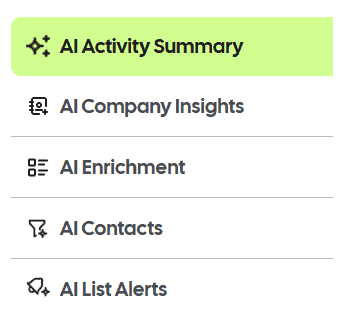
Leadfeeder has built an end-to-end, native AI assistant directly into its daily workspace, focusing heavily on minimizing manual sales research. The Leadfeeder AI suite introduces three flagship features:
AI Activity Summary: Instead of forcing SDRs to manually click through a visual list of 20 different web page visits to guess a company’s intent, Leadfeeder AI generates a plain-language summary of the visit.
For example, it might summarize a visit as: “This visitor arrived via a direct search, spent 4 minutes comparing your enterprise pricing tiers, read two technical API documentation pages, and previously visited from a UK network last week.”
AI Company Insights: This is a dedicated, conversational tab located directly inside the identified company’s profile. Sales representatives can query the AI with natural-language questions like “What products does this company sell?”, “Who are their main competitors?”, or “What technologies are they currently running on their site?”
Leadfeeder AI instantly scans its integrated database and the public web to generate a summarized, factual brief, completely eliminating the need for a rep to open Google in a separate tab.
AI Contacts: Traditionally, finding a contact required typing specific, rigid job titles into a search bar. With AI Contacts, Leadfeeder introduces semantic natural-language search.
An SDR can type: “Find me the person who runs global cloud operations in EMEA,” and Leadfeeder’s AI will parse job responsibilities to extract the closest matching decision-maker, even if their official LinkedIn title is highly unconventional.
Leadinfo AI: Frictionless Automation and Technical Debugging
Rather than building a conversational research assistant, Leadinfo has focused its AI development on infrastructure stability, error resolution, and behavioral workflows.
Explain with AI (Integration Debugging): In its major early 2026 integration rebuild, Leadinfo introduced a unique AI-driven error analyzer.
When a CRM push or Webhook triggers an integration error (e.g., due to duplicate matching or API timeouts), the system provides an “Explain with AI” button. The AI analyzes the complex server logs and translates them into simple, step-by-step troubleshooting instructions for sales teams.
AI-Driven Autopilot & Leadbot Triggers: Leadinfo relies heavily on automated “Autopilot” workflows and intelligent Leadbots to scale outreach.
Their AI works in the background to automatically categorize Leadbot submissions, predict lead warmth based on visual screen recording hover times, and trigger hyper-personalized outbound email or LinkedIn cadences through connected third-party integrations (such as AI by Zapier).
The AI Capabilities Showdown: Who is Winning in July 2026?
When analyzing which vendor is currently winning the AI race, the crown undeniably goes to Leadfeeder.
Leadfeeder’s native generative-AI integrations directly target and solve the primary day-to-day bottlenecks of sales development: prospect research and lead qualification.
By embedding a conversational sales researcher (Leadfeeder AI) directly within the Company Profile view, Leadfeeder allows SDRs to synthesize complex buying signals, summarize website journeys in plain text, and extract decision-makers via semantic natural-language search.
It acts as an active assistant, saving sales reps hours of manual desk research every week.
Leadinfo has built incredibly smart, practical utilities — most notably their groundbreaking “Explain with AI” integration debugger and automated trigger rules.
However, their core AI strategy remains heavily dependent on external connectors (such as Zapier’s AI modules) to handle deep text parsing or advanced message composition.
Leadinfo excels at visual tracking and routing, but when it comes to native, in-platform generative AI, Leadfeeder is currently setting the industry pace.
Leadfeeder, Leadinfo, and ABM
Comparing Capabilities for Account-Based Marketing (ABM)
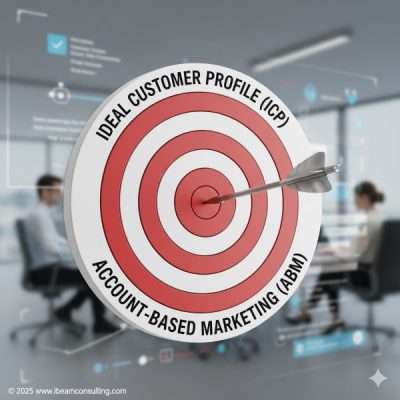
As marketing budgets and priorities shift further to “quality over quantity”, ABM has evolved from an enterprise buzzword into a baseline survival strategy.
Understanding how Leadinfo and Leadfeeder support ABM-targeted marketing campaigns is vital.
Leadfeeder for ABM: The Programmatic Funnel Loop
Leadfeeder’s ABM capabilities are remarkably mature, serving as an end-to-end intent marketing platform.
For Audience Building, Leadfeeder allows you to leverage deep web behavioral analytics to build hyper-specific target accounts.
For example, you can build a list of companies that visited your site’s “Integrations” page for more than 2 minutes, but have not filled out a form.
For Ad Activation, Leadfeeder features a native LinkedIn Campaigns connector (formerly known as Promote).
Instead of manually downloading CSV files of visiting companies and uploading them to LinkedIn Ad Manager, Leadfeeder automatically syncs your custom intent feeds directly to LinkedIn.
This allows you to serve highly targeted retargeting ads to the exact companies showing active buying intent on your site within hours of their visit.
Finally, Leadfeeder offers an Intent Signal Overlay for your sales pipeline.
When a target tier-1 account that your sales team is actively prospecting suddenly visits your pricing page, Leadfeeder triggers an instant notification directly in your CRM, ensuring your sales reps strike while the iron is hot.
Leadinfo for ABM: Real-Time Sales Alerts & Triggers
Leadinfo approaches ABM with a focus on speed, visibility, and immediate human-to-human engagement.
Through Dynamic Rules, you can upload a CSV list of your highly valued Tier-1 target accounts directly into Leadinfo. The moment any company on that target list visits your website, Leadinfo flags them in bright colors on your dashboard and tags them based on your predefined rules.
Rather than running automated programmatic ad campaigns, Leadinfo prioritizes Instant Alerts. It immediately pushes real-time notifications to dedicated account managers via Slack, Microsoft Teams, or email.
The notification displays exactly which pages the target account is viewing, allowing the account executive to pick up the phone or send a highly customized LinkedIn message in real-time.
The Main ABM Limitation: Unlike Leadfeeder, Leadinfo does not currently offer a native programmatic ad distribution engine (like Campaigns).
If you want to use Leadinfo’s intent data to power LinkedIn or Google Display campaigns, your marketing team must manually export your identified company lists and upload them to those platforms.
Related: Learn more useful B2B terminology in this glossary of B2B lead generation terms and this glossary of ABM terminology.
Leadfeeder & Leadinfo Pricing Approaches
Pricing Models & Licensing Structure
While software capabilities and dashboard interfaces matter, the practical cost structure of a tool often dictates its long-term viability inside your organization.
Leadfeeder and Leadinfo operate on different pricing philosophies here.
Leadfeeder’s Pricing: A Tiered Credit Ecosystem
Leadfeeder structures its pricing using a hybrid model based on the features you want to unlock, the volume of unique companies identified monthly, and a shared monthly allowance of data “credits.”
To keep the platform accessible to early-stage businesses, Leadfeeder continues to offer its famous Lite Plan, which is free forever.
This plan tracks up to 100 identified companies from your last 7 days of web traffic, offering basic firmographic details with zero financial commitment.
For teams ready to sync data, automate processes, and source specific contacts, Leadfeeder transitions into its paid annual plans:
- Discover Plan (starting at $79/month billed annually): Built for solo marketers or small sales teams looking to resolve up to 50 unique companies per month. It includes 50 database credits for unlocking verified emails or exporting records.
- Activate Plan (starting at $369/month billed annually): This is Leadfeeder’s primary, value-driven package. It scales up to 1,000 identified companies per month, provides 200 monthly credits, and unlocks advanced automations, CRM-triggered workflows, and the native LinkedIn display campaigns engine.
- Scale Plan (starting at $599/month billed annually): Tailored for enterprise or high-velocity revenue operations teams. It includes tracking for up to 2,000 unique companies, 1,000 database credits, automated two-way CRM data enrichment, and a dedicated Customer Success Manager (CSM).
The defining characteristic of Leadfeeder’s pricing is that all plans support unlimited user seats. Whether you are on the Lite plan or the Scale plan, you can add your entire company to the platform without facing per-seat upgrade penalties.
However, your team shares a unified credit allowance. If your sales reps are aggressively extracting decision-maker emails using the Target and Connect tools, you will need to actively purchase additional credit packs or upgrade your tier to keep workflows running smoothly.
See the latest Leadfeeder pricing and feature bundles here.
Leadinfo’s Pricing: Unlimited Seating and Usage Scaling
Leadinfo completely bypasses the credit-based enrichment model, designing a pricing structure around identified traffic volume and features.
Their core pricing philosophy is simple: no user caps on their highest tier, and no limits on the number of accounts your team can push to your connected tools.
Leadinfo structures its packages into three distinct annual options:
- Starter Plan (starting at 69 EUR/month, or about $75): Built as an entry-level package for small, fast-growing teams. It supports up to 50 identified companies per month and allows a maximum of 3 users, 3 automations, and basic email support.
- Scale Plan (starting at 159 EUR/month): Greatly expands capabilities, unlocking tracking for up to 250 identified companies per month natively, with volume-based pricing tier limits extending up to 5,000 companies. It limits user seats to 10 and includes native Google Analytics 4 and LinkedIn Ads sync, plus up to 7-day storage for visual “Screen Recordings” so you can watch real scroll behaviors.
- Pro Plan (starting at 359 EUR/month): Engineered for scaling agencies and sales environments. It supports up to 750 identified companies natively on its base subscription (scaling up for higher volumes) and unlocks unlimited users, unlimited automations, 14-day screen recording history, a dedicated account manager, and customized onboarding.
While Leadinfo’s seat policy is highly flexible, teams must watch out for transactional add-ons.
Popular premium features like Autopilot (priced as a seat add-on at 39 EUR/month on Starter, 59 EUR/month on Scale, and 79 EUR/month on Pro) and Leadbot (starting at 39 EUR/month) are charged on top of the base subscription tiers.
Additionally, because Leadinfo is usage-based, a massive spike in overall website traffic (even low-value organic search or career-page traffic) can quickly push your account into a higher, more expensive identification tier.
Leadfeeder & Leadinfo — User Feedback
Customer Feedback & Sentiment
Aggregating and paraphrasing user reviews from trusted third-party review platforms like G2 and Capterra reveals clear trends, highlighting what actual RevOps leads, sales directors, and digital agencies experience with these platforms on a day-to-day basis.
User Feedback on Leadfeeder
Reviewers on software review sites like G2 and Capterra consistently praise Leadfeeder as a highly robust, enterprise-grade GTM tool, though some point out administrative frictions during the transition from Dealfront back to Leadfeeder.
Leadfeeder Pros:
- CRM Bidirectional Sync: Users describe the Salesforce and HubSpot integrations as “flawless.” The ability to automatically update target accounts in the CRM when they re-engage with the website is highly valued.
- DACH Region Trust: For European buyers, Leadfeeder is highly celebrated. Users note that because of the Echobot merger history, they have high legal confidence operating in the heavily regulated DACH region, feeling secure that they are not risking GDPR violations.
- Unified Workflows: Marketing teams love having web visitor tracking, contact lookup, and programmatic LinkedIn ad distribution under one roof.
Leadfeeder Cons:
- Auto-Renewal Friction: A common complaint among some reviews centers on Leadfeeder’s strict, 30-day auto-renewal cancellation window. Several users reported frustration when their contracts automatically renewed before they had processed a cancellation request.
- Credit Limitations: Teams operating on the lower paid tiers note that they run out of database contact credits quickly, forcing them into manual upgrades or secondary tools.
User Feedback on Leadinfo
Leadinfo receives exceptional marks for speed, customer-facing design, and visual mechanics, with critical notes focusing on data verification limits for outbound outreach.
Leadinfo Pros:
- Instant Live Dashboard: Reviews frequently highlight how addictive and intuitive the real-time scrolling feed is. Outbound sales reps love being able to see a company visit the site and immediately pick up the phone.
- Screen Recordings: This feature is highly praised. Users love being able to play back a session of a visiting company to see exactly what features or sections they hovered over, bringing a Hotjar-style visual element directly to sales prospecting.
- The Agency Portal: Marketing agencies highly rate the multi-tenant dashboard, which allows them to manage dozens of client scripts from a single account.
Leadinfo Cons:
- Pattern-Matched Contact Inconsistencies: While Leadinfo natively offers direct email and LinkedIn profile mapping, reviewers note that because they rely primarily on social crawling and email pattern generation rather than a legally audited registered database, contact details can occasionally require manual double-checking before executing large-scale campaigns.
- Low-Intent Overhead: Since pricing scales with visitor volume, some users complain about paying for “junk” identified traffic – such as job seekers or students – though Leadinfo’s filters help mitigate this.
Leadfeeder vs. Leadinfo — Picking Your Winner
The Verdict: Which Platform Should You Choose?
As the dust settles on the corporate shake-ups of early 2026, the choice between Leadfeeder and Leadinfo is no longer a simple question of “which tool is better.”
Instead, it is a matter of determining which platform is designed to support your specific sales and marketing workflows, technical setup, and target demographics.
Both tools have transformed. Leadfeeder has unified its product stack to offer a robust, dual-continent intent engine, while Leadinfo has acquired its way into transatlantic relevance.
Head-to-Head Comparison Table
To help summarize your decision, here is a breakdown of how the two platforms compare across key buying parameters as of July 2026:
| Feature / Comparison Area | Leadfeeder (with US Data Pack) | Leadinfo (with Visitor Queue) |
|---|---|---|
| Core Product Focus | End-to-end buying intent, contact enrichment & CRM workflow automation | Real-time sales acceleration, visual tracking & frictionless prospecting |
| Primary Geographic Strength | DACH region (watertight security), Rest of Europe, & North America | Benelux, Germany, UK, Scandinavia, & North America |
| Contact Data Depth | High (Integrates an on-demand verified direct-dial & email B2B contact database) | Moderate to High (Natively provides 300M+ contacts via public social mapping & email-pattern algorithms; includes Chrome Extension for LinkedIn scraping) |
| Visual Interaction Analytics | Basic behavioral analytics (Pages visited, session duration, and source) | Advanced behavioral tracking (Includes native video playbacks of visitor sessions) |
| GDPR Compliance Framework | Processor for tracking; Controller (Legitimate Interest) for its public B2B contact directory | Processor/Controller structure for localized European corporate IP tracking |
| Native AI Capabilities | High (In-platform conversational researcher, AI visitor summaries, and semantic natural-language search for contacts) | Moderate (AI-driven visual autopilot triggers, and specialized conversational debugger “Explain with AI”) |
| ABM Ad Capabilities | High (Includes native programmatic LinkedIn Campaigns engine for ad retargeting) | Moderate (Relies on exporting identified company lists to external platforms) |
| Pricing Strategy | Credit-and-volume based hybrid plans (Annual billing with unlimited seats on all plans; starts at $79/month) | Traffic-volume based plans with user caps on lower plans (Starts at €69/mo; Autopilot and Leadbot sold as separate add-ons) |
| Best Suited For | Multi-regional B2B marketing, RevOps, and enterprise-grade ABM teams | Fast-moving B2B SMB sales teams and multi-client digital agencies |
Choose Leadfeeder if:
You want a comprehensive, all-in-one lead generation engine: If you do not want to bounce between multiple software tools to track a lead, find their email, and look up their LinkedIn, Leadfeeder is the superior choice.
The seamless integration of Web Visitors with the Target and Connect modules provides a single, unified database workflow.
Strict privacy compliance in DACH and Europe is non-negotiable: For enterprise organizations, European operations, or businesses targeting companies in Germany, Austria, and Switzerland, Leadfeeder remains the gold standard.
Its deep integration with Echobot’s compliance framework offers a watertight legal shield under local interpretations of the GDPR.
You target accounts across both the US and Europe: With the rollout of the US Data Pack in March 2026, Leadfeeder has matched the North American coverage of legacy competitors.
It is now highly viable for transatlantic GTM teams who need consistent, high-fidelity IP resolution and enriched data on both sides of the ocean.
You require native, programmatic ABM ad retargeting: Leadfeeder’s native LinkedIn Campaigns (formerly Promote) engine lets you easily build a closed loop between anonymous website visits and real-time social ad retargeting, a major timesaver for modern demand generation teams.
Choose Leadinfo if:
You prioritize an immediate, high-velocity sales motion: If your sales team relies on outbound reps checking a live, visual stream of prospects to make immediate cold calls or send rapid LinkedIn messages, Leadinfo is virtually unmatched.
The visual timeline of visitor journeys is incredibly intuitive and requires almost zero training.
You want to avoid seat-based pricing friction: For scaling sales teams, digital agencies, or organizations that want to put their entire workforce on the software without facing financial penalties, Leadinfo’s volume-based pricing model offers massive relative ROI.
You value visual playback elements: The inclusion of visual screen recording directly inside your visitor tracking dashboard brings a powerful, qualitative layer to prospecting. Sales reps do not just see what pages a company visited; they see exactly what elements they hovered over.
Your target accounts are primarily Western European-centric (but with growing US needs): If your core demographic lies in Benelux, Germany, Scandinavia, or the UK, Leadinfo’s tracking is outstanding. Plus, their acquisition of Canada-based Visitor Queue means you still have solid North American data support to back up localized US campaigns.
Like this post? Quickly share it with your social networks here.
Want to make sure you never miss our updates? Click below to add us as a preferred source on Google Search.

Leadfeeder vs. Leadinfo — Closing Thoughts
Take the Next Steps for Better B2B Website Lead Generation
When it comes to B2B reverse-IP tracking tools, the absolute truth is always found in the data.
While on-paper comparisons, native integrations, and pricing frameworks are essential structural components to weigh, the ultimate test of any visitor ID software is its actual match rate on your unique website traffic.
Because every business attracts a highly specific mix of remote, hybrid, on-premise, domestic, and international visitors, one platform’s IP-to-company matching graph may naturally yield significantly higher resolution rates on your site than the other.
To find the absolute best fit for your marketing and sales teams, take full advantage of both platforms’ current trial offers:
- Install both scripts side-by-side: Both Leadfeeder and Leadinfo offer free, low-barrier trials with simple Javascript tracking scripts. You can run both tools simultaneously on your website for a two-week period without any performance drag.
- Run a direct comparison: Over those 14 days, evaluate which dashboard identifies more of your target ICP companies, which tool integrates more cleanly into your active CRM pipeline, and which interface your sales development reps naturally prefer to use.
- Analyze the contact output: Check which system provides more accurate and actionable direct-outreach emails for your team’s specific buyers.
By letting the data speak for itself, you can confidently invest in the visitor identification stack that will unlock your dark funnel, accelerate your outbound sales, and turn anonymous web traffic into measurable pipeline revenue.
Questions or Comments?
I hope this overview and comparison of Leadfeeder and Leadinfo has been helpful! Let’s wrap up now with a few related questions for you:
- Does your B2B company use any form of IP-based website visitor ID and tracking today? If so, how do you incorporate this into sales and marketing processes?
- Have you used either Leadfeeder, Dealfront, or Leadinfo in the past two years? How did that go for your team? Are you still using one of these platforms or a different martech software competitor?
- How are you incorporating AI and/or ABM into your revenue operations today? How do platforms like Leadfeeder or Leadinfo support you in these areas?
Feel free to add more in the comments below with any thoughts, feedback, or related questions. Thanks also for any social shares on this post via the buttons below!
