
Make NotebookLM the “Secret Weapon” in Your AI SEO Toolbox
Of all the AI-powered tools available to you today, Google’s Gemini-based NotebookLM may be the best “hidden gem” for your SEO.
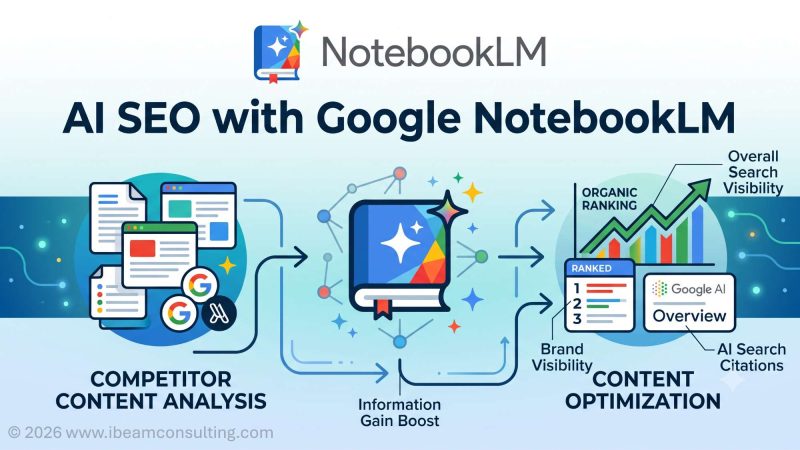
SEO competitor analysis, content optimization, and related SEO tasks all benefit from NotebookLM’s AI capabilities.
This post introduces Google’s NotebookLM as an SEO power player, including top use cases, insights, and a few complementary SEO tools to consider using alongside NotebookLM.
Let’s jump in and take a closer look below!
This post may contain a few referral links to select vendor partners. We may receive compensation for purchases made through these links, at no additional cost to the buyer.
Last updated Jul 8, 2026
Using NotebookLM for AI SEO, GEO, & AEO
The New SEO Goal: Winning the AI Citations Game
For over two decades, the core mission of Search Engine Optimization (SEO) remained virtually unchanged: identify target keywords, optimize meta tags, build backlinks, and secure a spot in the coveted ten blue links. If your link was on page one, you won online visibility and organic website traffic.
But time marches on. And that era has officially drawn to a close.
We are currently living through the most profound shift in information retrieval since the birth of the commercial web.
Traditional search engines are rapidly evolving into synthesis engines. Users are no longer looking for a list of destinations where they might find an answer; they want the answer generated, summarized, and delivered immediately.
In this new paradigm, ranking first is no longer the ultimate prize. The true battleground is attribution share — earning the hyperlinked citation inside the synthesized AI response.
Whether a user is querying a conversational agent on their phone, reading a Google AI Overview on a desktop, or asking a multimodal engine to analyze an image, your content only drives business value if the model chooses your brand as its source.
Enter Google NotebookLM.
While most marketers view NotebookLM as a neat tool for organizing personal documents or generating fun podcast overviews, elite search teams have realized its true potential: it is the single most powerful, free simulator for modern generative retrieval.
NotebookLM is your private sandbox to test, refine, and optimize content for the AI search landscape before your competitors even realize the game has changed.
Ready to learn how? Let’s continue…
What is NotebookLM? (A Quick Intro)
Not “Just Another AI Chatbot”
To understand why NotebookLM is an indispensable asset in a modern SEO toolkit, you must first understand how it differs from generic conversational AI interfaces like ChatGPT, Claude, or standard Google Gemini.
Traditional large language models (LLMs) operate on a “closed-book” methodology during interaction. When you ask ChatGPT a question, it relies on its global training weights — information compiled across trillions of parameters during its training run.
Because these models are optimized to predict the next most probable word rather than retrieve verified facts, they are prone to hallucinations, temporal decay (outdated information), and unreliability.
NotebookLM, powered by Google’s latest multimodal Gemini engines, operates on an entirely different architecture: Retrieval-Augmented Generation (RAG).
When you query NotebookLM, the model is strictly “grounded” in the sources you explicitly upload to your notebook.
It is tightly bound to only generate responses that can be structurally defended by your uploaded material. If the uploaded documents do not contain the answer, the model will cleanly admit it cannot answer, neutralizing the hallucination risk.
This source-grounding approach is paired with Google’s massive context window.
This architecture allows you to upload thousands of pages of text – whole books, comprehensive industry databases, full competitor crawls, and complex spreadsheets – simultaneously.
NotebookLM can instantly compare, cross-reference, and synthesize this massive data pool in seconds.
NotebookLM Studio
Additionally, NotebookLM features NotebookLM Studio.
This dedicated panel takes your grounded sources and allows you to transform raw, technical text into multi-format assets instantly.
With a few quick clicks, you can generate deep, conversational Audio Overviews (highly natural, two-host AI podcasts), structured study guides, interactive briefings, and customized outlines.
It is an end-to-end multi-format content engine grounded strictly in your proprietary data.
Most importantly for SEOs, NotebookLM is built with Explicit Attribution. It does not simply give you a block of text; every claim, summary, and argument it generates is accompanied by an active, clickable citation bubble.
Clicking that bubble takes you directly to the exact paragraph, sentence, or data point in your source documents that provided the answer.
This behavior is not just a user interface feature — it is an exact, private mirror of how Google AI Overviews, Perplexity, and Microsoft Copilot operate.
By analyzing why and how NotebookLM distributes these citations across your uploaded documents, you can decode the mechanical preferences of the world’s most advanced RAG search systems.
Related: See this glossary-style post to learn more modern AI SEO terminology.
NotebookLM for AI SEO & “Information Gain”
The New SEO Triad: SEO, GEO, and AEO
Navigating this search landscape requires breaking free from monolithic definitions of “SEO.” To succeed today, your search program must address three distinct, overlapping disciplines:
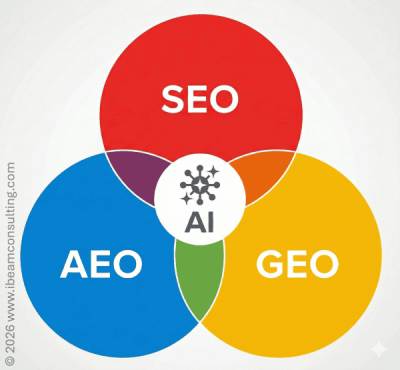
1. Search Engine Optimization (SEO)
This is the foundational, traditional layer. Classic SEO focuses on the structural and technical infrastructure of your web properties. It ensures crawlability, fast page speeds, proper URL structures, schema markup integration, and clean indexing pathways.
Without classic SEO, search engine bots cannot discover, crawl, and render your site. Think of classic SEO as building the highway; without it, no traffic can reach your city.
2. Answer Engine Optimization (AEO)
AEO focuses on crafting modular, direct, highly structured content designed to serve as the immediate, extracted answer for voice search assistants, zero-click featured snippets, and conversational search widgets.
AEO content is direct, unambiguous, and formatted for maximum programmatic extraction. It requires structuring your copy using precise definitions, question-based headings, tables, and bulleted lists.
3. Generative Engine Optimization (GEO)
GEO is the optimization of your content, brand presence, and digital authority so that generative AI models and search platforms synthesize, prioritize, and actively cite your website as an authoritative source when answering complex, conversational queries.
GEO does not look at keyword densities; it looks at semantic alignment, entity relationships, and overall topical trust.
The “Information Gain” Imperative
At the intersection of GEO and AEO lies a critical concept in modern search algorithms: Information Gain.
For years, SEOs could win by looking at the top 10 search results for a keyword or user query, compiling all the subtopics these covered into one massive “skyscraper” guide, and publishing a slightly longer and updated version of what already existed.
Generative search engines have rendered this strategy mostly obsolete.
Because modern retrieval systems must synthesize answers from multiple sources, they penalize redundant, copycat content.
If five different websites all state the exact same definition of a concept, the engine has no incentive to cite all five.
Instead, Google’s Gemini-powered retrieval systems actively search for and reward content that introduces net-new information to the corpus.
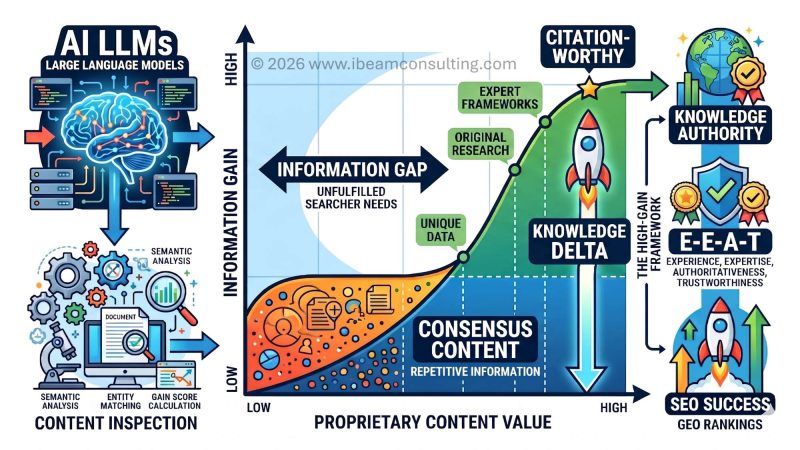
If your content contains zero unique entities, facts, or angles compared to the existing search landscape, a generative engine has no mathematical reason to select your site for its citation network.
To win the citation, your content must inject unique, non-redundant value. This can include:
- Proprietary statistics or first-party data findings
- Hands-on, lived-experience case studies
- Original expert quotes or distinct contrarian arguments
- Highly specific, localized examples that competitors gloss over
NotebookLM as the Ultimate GEO & Information Gain Sandbox
How do you know if your content actually delivers high Information Gain? How can you predict if an AI engine will extract your definitions over a competitor’s?
This is where NotebookLM becomes your ultimate secret weapon.
Because NotebookLM is built on Google’s own RAG architecture and runs on their most advanced multimodal model suite, it behaves exactly like a private, controlled, highly responsive version of Google’s public AI search retrieval systems.
By uploading your proposed content draft alongside the clean text of your top-ranking competitors into a single notebook, you create a perfect “Generative Search Sandbox.”
You can query the notebook with the exact search intents of your target audience and watch, in real-time, who the AI cites.
- Does it cite your competitors for the core definitions, or does it choose your newly optimized content structures?
- Does it ignore your draft entirely because your information density is too thin, or does it pull from your proprietary dataset because it offers a massive Information Gain advantage?
Using NotebookLM as an SEO sandbox allows you to stress-test your content’s structure, factual density, and extractability under strict AI evaluation before you commit a single page to your live CMS.
You are no longer publishing and hoping for the best; you are iterating inside a private RAG engine until you have engineered a document that is mathematically optimized to win AI citations.
Related: Learn more in these posts about SEO and information gain, and the advantages of information gain in B2B SEO.
Use Cases for NotebookLM in AI SEO
10 Great Ways to Leverage NotebookLM for AI SEO
Having established the technical logic of NotebookLM’s RAG system and how it matches the goals of GEO, AEO, and classic SEO, let’s explore the ten most powerful, tactical blueprints you can execute immediately.
1. The Private GEO Citation Sandbox (RAG Simulation & Information Gain Audit)
This is your foundation-level setup. By simulating a live search engine results page (SERP) in a private workspace, you can observe exactly how an AI system assigns credit and authority.
The NotebookLM Playbook:
- Extract the clean text content of the top five organic ranking competitors for your target search term. (To best avoid “boilerplate content pollution”, do not simply add raw source URLs — manually copy-paste the body text or upload a simplified reader PDF).
- Upload your own drafted piece into the exact same notebook, clearly labeled as your own draft content.
- Head to the chat window and prompt the sandbox: “Analyze the uploaded sources and draft a comprehensive, step-by-step guide explaining [target topics]. Every claim, list item, or definition you provide must be explicitly cited back to the uploaded sources.”
- Observe the final generated response. Click on each numbered citation bubble.
The Goal: Identify which competitor sections got quoted and, crucially, when your own draft was cited.
If NotebookLM relies heavily on Competitor A for the core definitions or Competitor B for supportive data, inspect their respective text documents to see how they structured their copy.
Inject your own draft with superior, non-redundant definitions and proprietary statistics to steal those citations on the next sandbox run.
2. Semantic Gap Analysis & “Query Fan-out” Mapping
Topical authority is not just about writing a single long article; it’s about answering the full spectrum of user curiosity around an entity/subject. NotebookLM excels at mapping the distance between user intent and your content’s current state.
The NotebookLM Playbook:
- Scrape community discussions, Reddit threads, Quora answers, and “People Also Ask” questions for your target concept.
- Save this user-generated collection as a document titled User_Questions_And_Pain_Points. Add as a NotebookLM source.
- Upload your content draft as “MyBrand_Draft”.
- In the Chat, prompt NotebookLM: “Act as an analytical search strategist. Cross-reference the real-world user queries in ‘User_Questions_And_Pain_Points’ against the content provided in ‘MyBrand_Draft’. Generate a structured report listing: 1) Core user questions that my draft completely answers, 2) Questions that my draft only partially addresses, and 3) Crucial subtopics, terms, or semantic queries that are entirely missing from my draft. Provide exact recommendations for new sections to add.”
The Goal: Build complete topical coverage. By bridging these semantic gaps prior to publishing, you ensure that search engines crawling your site find answers to the entire AI “query fan-out” tree, elevating your overall search relevance and entity strength.
3. Content Structuring & Formatting for AEO (The Extractability Test)
Answer Engine Optimization (AEO) demands that your information be highly extractable. If an algorithm has to perform complex, multi-sentence processing to synthesize your point, it will default to a content competitor who presented the same fact in an easy-to-digest layout.
The NotebookLM Playbook:
- Take a core informational section of your post and write it in three distinct formatting styles:
- Format A (Narrative): A long, flowing paragraph with detailed, descriptive context.
- Format B (Structured Narrative): Medium paragraph starting with a bolded, concise thesis sentence.
- Format C (AEO Optimized): An explicit heading question, followed by a bolded 1-sentence definition, followed immediately by an unordered list with bolded key terms.
- Upload all three formats to your notebook under descriptive names.
- Prompt the chat: “I need a quick, highly precise summary of [Target Topic] for a voice assistant. Extract the exact answer from the uploaded formats. State which format you extracted the information from, which format required the least amount of word processing or cleaning to make conversational, and why.”
The Goal: Optimize for zero-click visibility. The format that the RAG model pulls with the highest fidelity and the least synthetic modification is your winner. Adopt this formatting framework across your high-impact AEO-focused pieces.
4. Entity Association & Brand Authority Building
Modern search algorithms rely on Knowledge Graphs. These are complex relational databases where real-world concepts (entities) are connected by attributes and relationships.
If an AI engine does not associate your brand name with your core business category, you will not rank for unbranded queries.
The NotebookLM Playbook:
- Upload your primary digital brand assets: your corporate about page, executive bios, core service/product descriptions, company press releases, and any existing brand Schema markup in raw text format.
- Instruct NotebookLM: “You are an AI Search Knowledge Graph Evaluator. Analyze these brand assets. Construct an entity profile of [My Company Name]. What are the primary, secondary, and tertiary entities (industry concepts, specific technologies, geographic regions, key individuals) that our company is most strongly and unambiguously associated with according to these texts? List the exact sentences or paragraphs that establish these connections.”
The Goal: Identify and strengthen your “brand-to-topic” proximity. If the model fails to link your brand directly to your primary target search categories, rewrite your core corporate copy to assert these entity relationships more explicitly, and use the output to construct your JSON-LD organizational schema.
5. “Deep Research” Data Density Audits
Factual density is a massive signal of quality. In an era where AI-generated fluff is cheap, content backed by verified datasets, empirical research, and academic rigor stands out to both human readers and search algorithms.
The NotebookLM Playbook:
- Use NotebookLM’s built-in Deep Research agent or manually upload 3–5 authoritative, highly cited whitepapers, regulatory guidelines, or statistical databases relevant to your topic.
- Upload your current content draft.
- Issue the following prompt: “Perform a rigorous data density audit. Compare my draft against the authoritative research sources uploaded. For each major claim in my draft, evaluate if it is supported by hard data, specific statistics, or official standards. Point out any assertions that are ‘thin’ or rely on generic or vague claims, and suggest exact data points, percentages, or expert citations from the research sources to anchor those claims.”
The Goal: Establish a massive Information Gain advantage. By integrating granular, authoritative data directly into your claims, you make your page the most dense, trustworthy source on the web, signaling high information-richness to AI evaluators.
6. Competitor Strategy Decryption & Logical Outlining
Competitive analysis in SEO is often reduced to looking at keyword counts. To beat a competitor, however, you must understand their logical hierarchy — their structural argument.
The NotebookLM Playbook:
- Take the top-performing article for your target query. Strip out the ads, navigation, and layout widgets.
- Upload this clean document as “Competitor_Structure_Benchmark.”
- Run this prompt: “Analyze the structural blueprint of ‘Competitor_Structure_Benchmark’. Reverse-engineer this document to create a highly detailed, logical hierarchical outline. Detail their structural flow: How do they hook the reader? What is the logical sequence of their arguments? Which H2 and H3 subsections serve as their core pillars, and what semantic entities are they anchoring in those sections? Highlight the single strongest structural component of this article and identify their weakest logical link.”
The Goal: Out-engineer the SERP. Instead of blindly writing more words, you now have a structural map showing exactly where their content is vulnerable.
Use this logical outline as a baseline, then reorganize, deepen, and restructure your own content draft to surpass their blueprint.
7. Historical Content Refresh & “Freshness” Calibration
SEO content decay is a natural part of the search lifecycle. Search engines track temporal relevance; if your top-ranking article from two years ago is still citing outdated data, its citations will slowly be reallocated to fresher pages.
The NotebookLM Playbook:
- Upload your older, decaying article to the notebook.
- Upload the latest industry reports, updated product specifications, or newly released standards.
- Prompt the model: “You are a content freshness auditor. Compare my old post against the newly updated [year] industry materials. Highlight every outdated statistic, defunct industry standard, or obsolete process mentioned in my old post. For each outdated point, write a modern, revised paragraph or bullet point utilizing the exact data from the new sources. Additionally, propose a high-value ‘What’s New in [Year]’ summary box to embed at the top of the post.”
The Goal: Keep search rankings secure. This programmatic refresh takes only minutes per piece but ensures your historical assets remain factually bulletproof and fully updated under search algorithmic review.
8. Multi-Format Repurposing for Cross-Engine Visibility
Generative AI retrieval is multimodal. Google search results routinely display video snippets, image carousels, audio clips, and slide decks alongside synthesized text.
Repurposing your optimized text into complementary media formats expands your overall organic search real estate.
The NotebookLM Playbook:
- Upload your finalized, optimized blog post draft as the single primary source.
- Navigate to the NotebookLM Studio panel.
- Generate the following assets:
- Audio Overview: Let the AI podcast hosts summarize your topic. Use this audio file to embed as an MP3 audio-player at the top of your blog post (critical for dwell time) or publish it on YouTube/Spotify to capture secondary search results.
- Study Guide: Transform your blog post into an interactive study guide. Use this structure to create a downloadable, lead-generating PDF asset on your site.
- FAQ Briefing: Instantly generate an FAQ list. Use this output to write perfect FAQ Schema markup for your page.
The Goal: Capture secondary, rich-media organic results across video, audio, image, and document-search databases.
While the first eight use cases focus on content-level evaluation, semantic gaps, and tactical restructuring, the final two strategies leverage deeper brand systems and advanced code-execution architecture. These allow you to scale your content uniqueness and process analytical data directly within your NotebookLM sandbox.
9. The “Non-Commodity” Brand Voice Guardrail (Preventing Homogenization)
As AI writers become mainstream, the web is suffering from a massive homogenization problem. If everyone uses standard prompts, everyone’s content sounds identical.
Generative engines are beginning to filter out this repetitive “AI voice.” To rank, your content must have distinct, human-sounding brand signatures.
The NotebookLM Playbook:
- Upload your official corporate Brand Style Guide (covering tone, voice pillars, grammatical constraints, and banned words).
- Upload 3–5 of your most distinctive, highly praised “Hero” articles that showcase your unique writing voice at its absolute best.
- Upload your newly drafted, keyword-optimized SEO post.
- Head to the chat window and run this audit prompt: “You are our brand’s Chief Editor. Study our Brand Style Guide and the ‘Hero’ content pieces to understand our exact tone, sentence cadence, vocabulary preference, and rhetorical style. Now, audit our new SEO post. Identify every sentence, transition, or paragraph that reads as generic, dry, or robotic ‘AI-speak’. Provide a revised version for each flag, ensuring the copy retains its SEO keyword anchors while matching our exact brand voice signature.”
The Goal: Strip out or modify the artificial fluff. This ensures your content avoids automated quality filters, resonates deeply with human readers, and builds a memorable brand identity that searchers actively seek out by name.
10. The Interactive SEO Audit & Data Matrix Generator (Programmatic Data Analysis)
Search engine optimization is inherently data-heavy. However, copying and pasting raw keyword metrics, backlink analyses, and click CTRs into a standard chat window often causes context truncation or poor math evaluations.
NotebookLM solves this with its secure, sandboxed code execution.
The NotebookLM Playbook:
- Export raw keyword and competitor performance data as a CSV file from tools like Semrush, Ahrefs, or Google Search Console.
- Upload the CSV directly as a source file in your notebook.
- In the Chat window, ask NotebookLM to run programmatic analyses: “Analyze the uploaded CSV keyword file. Use your secure python sandbox to calculate: 1) The exact keyword overlap between my site and our top three competitors, 2) A list of high-volume keywords (Search Volume > 1,000) where competitors rank in the top 10 but our domain ranks outside the top 30, and 3) A prioritization matrix ranking these gap keywords by Search Volume and Keyword Difficulty. Output the final data as a clean markdown table.”
The Goal: Rapid, programmatic, and mathematically accurate strategic insights.
By executing clean python scripts over your raw datasets, NotebookLM bypasses standard chatbot calculation errors, giving you precise, data-dense, and highly accurate roadmaps for your content planning.
Supporting NotebookLM with Other SEO Tools
Complementary Tools: The Modern AI SEO Stack
To run a highly effective Generative Engine Optimization program, Google NotebookLM cannot exist as an isolated island.
While it can serve admirably as your central “Cognitive Sandbox” and RAG simulator as in the SEO use cases outlined above, NotebookLM requires a supporting cast of technical tools to supply it with clean data, scale its insights, and track its real-world performance.
By wrapping a curated, modern SEO stack around NotebookLM, you transform it from a manual analytical workspace into a more scalable AI SEO engine.
1. Ingestion: Screaming Frog & Advanced Web Scrapers
The RAG architecture of NotebookLM is highly sensitive to text purity. If you feed your notebook a scraped competitor document containing site-wide navigation links, promotional ads, and footer boilerplate, the model’s semantic focus is diluted.
To bypass this, use Screaming Frog SEO Spider or specialized headless scrapers (like ScrapingBee or Apify).
The Workflow:
- Configure Screaming Frog’s Custom Extraction settings using XPath or CSS Path queries. For instance, instructing the crawler to strictly scrape HTML within the blog’s body text container (e.g., //div[contains(@class, ‘entry-content’)] or //article) allows you to vacuum up dozens of competitor articles simultaneously.
- Export the output as clean TXT or Markdown files, completely devoid of layout noise, ready to be bulk-uploaded into NotebookLM.
2. Attribution Tracking: ZipTie.dev, SEOClarity, & Semrush
You cannot optimize what you do not measure. While NotebookLM simulates how an engine compiles citations, you must track your performance on the actual, live SERPs.
Traditional SEO rank trackers only monitor your positions in the standard organic links; they do not track the synthesized boxes.
Enter dedicated generative tracking platforms like ZipTie.dev, SEOClarity, Semrush, and other AI search visibility tools (free and paid).
These tools monitor your target keyword list, detect when a search query triggers a Google AI Overview (AIO) or Perplexity answer, and calculate your “Citation Share of Voice” — analyzing exactly which URLs are cited in the synthesis, how many times they are quoted, and whether your domain is earning attribution.
This live feedback loops directly back into your workflow, highlighting which high-value content assets require a NotebookLM-assisted refresh.
3. Translation: WordLift & Structured Data Generators
Once NotebookLM helps you identify the critical semantic entities and logical associations needed to rank, you must make those connections explicitly readable to search engine crawler bots.
Generative search engines still utilize structured schema data as a foundational lookup database to verify factual claims.
WordLift uses AI to automatically analyze your content drafts, map the internal entities (people, places, products, concepts), and generate complex, connected JSON-LD Schema graphs.
By combining NotebookLM’s structural analysis with machine-readable, schema-mapped entities, you ensure that search engines can easily parse and verify your brand’s relationships in their Knowledge Graphs.
4. Target Discovery: Google Search Console (GSC)
GSC is your ultimate target finder. It exposes the queries where your site is already gaining organic impressions but struggling to secure high click-through rates (typically keywords and queries where you rank in positions 4 through 15 in the traditional “web” SERPs).
The Strategy:
- Filter your GSC data for informational queries with high impression counts but low CTRs. These are your prime candidates for GEO and AEO upgrades.
- Run these pages through the NotebookLM RAG simulation alongside the top competitors, identify the semantic gaps, restructure the layout for extractability, and publish.
You may find that optimizing these pages for citations quickly wins you a spot in the live AI Overview box, bypassing the traditional slow rank-climbing process entirely and boosting your AI brand visibility.
Related: Learn how to find your “long-tail question keywords” in Google Search Console using advanced filtering.
📌 Sidebar Comparison: NotebookLM vs. Traditional SEO Content Editors (Surfer SEO, Frase, Scalenut)
A common point of confusion among modern search marketers is how NotebookLM differs from long-standing, premium SEO content optimization editors like Surfer SEO, Frase, or Scalenut.
While both are used to make content rank higher, they operate on completely different computational philosophies.
Statistical vs. Cognitive Optimization
- Traditional SEO Editors: These tools use statistical models (such as Term Frequency-Inverse Document Frequency or TF-IDF) and NLP algorithms to analyze the top 10 search results for specific target queries. They count word occurrences and provide a quantitative checklist (e.g., “Include the keyword ‘AI-driven operations’ exactly 12 times”). They analyze form, not meaning.
- NotebookLM: Bypasses word-counting entirely. Operating on a generative RAG architecture, it evaluates the cognitive value of your copy. It does not look at whether a keyword appears 14 times; it tests whether the underlying semantic logic, informational completeness, and factual density can withstand rigorous queries. It optimizes for context, logical flow, and informational retrieval.
The Danger of “Copycat” Content
Traditional editors analyze existing top-ranking pages to tell you what to write. If you strictly follow their keyword checklist, you will produce an article that contains the exact same vocabulary, semantic density, and structure as the top 10 competitors you are trying to beat.
This statistical optimization often leads to severe content homogenization. When Google’s algorithms apply an “Information Gain” filter, copycat content is aggressively de-prioritized.
NotebookLM, by contrast, acts as an Information Gain Auditor. It helps you identify precisely what competitors are saying so you can inject proprietary data, contrarian angles, and expert insights that make your piece structurally unique and highly citable.
How to Orchestrate Both Tools for Maximum Impact
These tools should not be viewed as binary alternatives. Instead, combine them into an optimized two-step workflow:
- The NotebookLM Phase (Structural & Cognitive): Use NotebookLM first to reverse-engineer competitor layouts, close semantic gaps, verify information gain, and optimize the document’s structure for high AEO extractability.
- The Traditional Editor Phase (Term-Frequency Polish): Paste your structured, unique draft into Surfer, Frase, or Scalenut. Run a quick term-frequency sweep to ensure you haven’t missed basic industry jargon, keyword variations, or essential content tidbits that traditional search crawler bots expect to see for base-level topical classification.
Getting the Most Out of NotebookLM for SEO
SEO-Related “Pro Tips” for NotebookLM
Deploying Google NotebookLM as an asset in your organic search process is reasonably straightforward, but maximizing its output requires high strategic precision.
When dealing with advanced retrieval-augmented AI models, minor behavioral adjustments to your environment, formatting, and prompting frameworks yield massive differences in evaluation quality.
The following five tactical blueprints represent elite-level configurations developed specifically for modern SEO, GEO, and AEO testing environments.
Tip 1: Command the Persona (The Quality Rater Directive)
By default, NotebookLM’s chat assistant behaves as a helpful, polite secretary. It wants to organize your files and give you agreeable summaries.
In an SEO context, however, compliance is useless. You need a highly critical auditor that mirrors the unforgiving nature of AI search retrieval ranking filters.
To override the default AI persona, utilize the custom instructions or establish an initial system state by pasting a highly detailed framing directive as your very first message.
Here’s an example:
The “Quality Rater” Prompt Blueprint:
“You are acting strictly as an elite Information Retrieval Engineer and Google Quality Rater evaluating search engine optimization (SEO), answer engine optimization (AEO), and generative engine optimization (GEO) signals. Do not try to please me. Do not summarize unless asked.
Your sole function is to assess the uploaded sources with cold, analytical rigor. When I ask questions, evaluate the documents based on Google’s helpful content guidelines, semantic entity association depth, and Information Gain principles. Point out structural fragmentation, circular logic, fluff, and areas where competitors surpass my draft in informational value or technical detail. Begin your analysis now.”
Establishing this specific operational state ensures that NotebookLM stops telling you that your draft is “great” and instead begins exposing the exact logical flaws that would prevent you from winning real-world AI overview (AIO) placements.
Tip 2: The “Source Panel” is Your Real Metric (Tracking Citation Concentration)
When running a sandbox simulation, most marketers make the mistake of evaluating only the conversational text response generated in the chat window. They read the summary, nod, and move on.
In a professional RAG simulation, the chat response is a distraction — the Source Panel is your metric.
When you prompt NotebookLM to synthesize a guide or answer a query based on all uploaded sources, pay obsessive attention to the numbers positioned next to the sentences in the response.
Click on these numbers to open the Source Panel on the left.
- Assess the Distribution: Count the total number of citations generated. If the engine generates 15 citations to answer a high-intent query, how many of those point to your draft versus Competitor A or Competitor B?
- Analyze the Citations Share of Voice (C-SOV): If Competitor A earns 70% of the citations in the synthesis, it indicates that their content structure has a much higher extractability profile or semantic density for that specific query. Your content has a weak C-SOV of 30%.
- Reconstruct the Nodes: Look closely at the exact paragraphs NotebookLM pulled from your competitors. Reverse-engineer their formatting, phrasing, and statistical integration, then weave those stylistic patterns into your own draft. Your goal is to run the query again and watch your C-SOV climb to over 80%.
Tip 3: Avoid the URL Trap (Pasting vs. Planting)
NotebookLM permits you to input raw web URLs as a source type. While this feature is convenient, relying on raw URLs for competitive SEO parsing is highly problematic.
When you input a competitor’s live URL, NotebookLM’s basic web scraper attempts to parse the page’s HTML. This process frequently results in three major points of failure:
- The Boilerplate Noise: It extracts global headers, footer links, cookie consent bars, sidebar “Recommended Reading” links, and ad copy. This extraneous text dilutes the document’s true semantic focus, making the RAG engine perceive it as less cohesive than it actually is.
- The JavaScript Hydration Wall: Modern web pages are often dynamically compiled using JavaScript frameworks (Next.js, React). NotebookLM’s built-in parser cannot execute complex scripts, which frequently results in importing a blank page or a “Please enable JavaScript” fallback message.
- The Firewalled IP Block: High-traffic competitive domains employ security frameworks (Cloudflare, CAPTCHAs, paywalls) that systematically block the automated user-agents utilized by Google’s backend. You run the risk of evaluating a “403 Forbidden” error page without realizing it.
The Safe Sourcing Protocol:
To preserve RAG simulation integrity, bypass the URL input option. Instead, employ two robust methods to “plant” clean data into your sandbox:
- Option A — Copy Clean Markdown: Use browser extensions (such as MarkDown Download) or read-later interfaces to copy the clean, unadorned body text of the competitor page. Paste this text directly into NotebookLM as a clean Copied Text source file, and name it explicitly (e.g., “CompetitorName_TopicName_Clean”).
- Option B — Simplify to PDF: Open the competitor URL in Chrome. Hit Ctrl+P (or Cmd+P on Mac), toggle on “Simplified Layout” or turn off “Headers and Footers”, and select “Save as PDF”. Uploading this clean, structural PDF asset guarantees 100% of the core content is perfectly visible and cleanly parsed by NotebookLM.
Tip 4: Feed the RAG Clean Food (Text Sanitization & Chunking Prep)
The quality of a RAG model’s synthesis is directly determined by the parsing clarity of its ingested data.
AI RAG systems do not read a massive document in one continuous stream; they break the text down into modular blocks called chunks and convert those chunks into mathematical vector representations (embeddings).
If your content drafts are cluttered, or if your competitors’ scrapes contain broken formatting, the boundaries of these chunks will sever critical semantic relationships, leading to poor synthesis and a lack of citations.
The Sanitization Checklist:
- Preserve Header Hierarchies: Ensure your uploaded documents use explicit markdown headings (e.g., # H1, ## H2, ### H3). RAG models rely heavily on heading structures to determine context boundaries when chunking text.
- Strip Interactive Components: Delete cookie disclaimers, affiliate disclosure texts, author bios, social sharing widgets, and calls-to-action (CTAs). These contain generic marketing phrases that interfere with semantic proximity tests.
- Clarify Table Layouts: If your sources include tables, convert them into clean markdown table formats or explicit comma-separated value (CSV) text loops. This formatting allows NotebookLM’s encoder to preserve the relationship between headers and row values.
Tip 5: Structure by Cluster (Establishing Sandbox Boundaries)
Because NotebookLM offers a massive context window, search teams may easily be tempted to build one giant, monolithic notebook containing all their brand’s drafts, competitor profiles, and analytical metrics across every topic they write about.
This is a fundamental error. Do not mix disparate topics in a single notebook.
RAG retrieval relies on a concept called vector space proximity. When you query a notebook, the engine searches for text blocks that are mathematically closest to your query’s intent.
If your notebook contains overlapping, unrelated sources (e.g., a technical guide on “enterprise cloud database integration” mixed with content about “organic garden compost strategies”), the semantic vectors will drift.
The engine will struggle to generate razor-sharp, hyper-focused citation profiles because unrelated content introduces noise into the lookup process.
The “Hub-and-Spoke” Notebook Framework:
Adopt a strict organizational boundary: One Notebook per Topical Cluster.
- Create a dedicated notebook for your “Cloud Hosting” content hub.
- Create a separate notebook for your “Database Management” content hub.
Under this framework, each notebook serves as a dedicated, hyper-specialized, closed-loop sandbox.
It will generate highly accurate, precise, and logically sound citation structures, mimicking exactly how Google’s real-world AI Overviews segment and retrieve answers for specific transactional and informational search verticals.
Like this post? Quickly share it with your social networks here.
Want to make sure you never miss our updates? Click below to add us as a preferred source on Google Search.

AI SEO & NotebookLM — Closing Thoughts
Move Your SEO Forward with Help from NotebookLM
Modern search optimization is no longer a game of simple algorithmic discovery; it is a battle for AI-powered authority.
As search transforms from an index of blue link destinations into a centralized synthesizer of AI-generated answers, your technical metrics must evolve accordingly. Ranking positions on a SERP matter far less than your Attribution Share of Voice (A-SOV).
To win citations, you must shift your content production strategy away from the redundant, statistical baseline-chasing models of traditional on-page editors.
You must aggressively embrace Information Gain as a source of competitive advantage. If your content contribution to the web’s knowledge graph equates to zero net gain, your site is mathematically invisible to modern generative search architectures.
Your goal must be to introduce proprietary datasets, distinctive expert insights, highly structured structural layouts, and genuine non-commodity writing that engines are structurally compelled to cite.
In this landscape, Google NotebookLM represents an unprecedented operational cheat-code.
It is the only free, sandboxed environment constructed on the very same RAG blueprints that dictate Google’s public generative search outputs.
It allows you to simulate and iterate on content architecture in a clean, fully controlled sandbox before a single word is pushed to your live CMS.
The 5-Step Continuous GEO Optimization Workflow
To turn these insights into a permanent, highly scalable operational program, build your editorial and search workflows around this five-step blueprint:
1. Intent Discovery: Use Google Search Console and target query research to identify high-value keywords where your brand sits on the cusp of organic visibility.
2. Strategy Ingestion: Use clean scrapers to harvest the core body content of competitors, upload them to a dedicated notebook, and use custom NotebookLM prompts to reverse-engineer their logical structures.
3. Sandbox Auditing: Conduct rigorous simulation passes to measure your initial content’s Citation Share of Voice. Force NotebookLM to act strictly as a Quality Rater to expose structural and informative deficiencies in your content.
4. Layout Optimization: Reorganize content hierarchies for maximum AEO extractability. Infuse the text with primary expert quotes, original graphics, and localized case studies to establish clear Information Gain signatures.
5. Deployment & Repurposing: Publish your optimized document wrapped in robust entity Schema. Use the NotebookLM Studio panel to instantly compile high-fidelity Audio Overviews (embed the podcast MP3 directly on-page to maximize user dwell times) and structured study guides to convert organic visitors into loyal brand advocates.
The old search playbook may be broken, but the rewards for mastering the new architecture are astronomically higher.
By building a dedicated cognitive sandbox in Google NotebookLM, you can stop guessing how AI models view your brand, and start engineering exactly how they cite it.
Questions or Comments?
I hope this overview of using NotebookLM for AI SEO growth has been helpful! Let’s wrap up the post with a few related questions for you:
- How far along are you today in using AI (in general) in parts of your SEO workflow? Where do you use it the most, and the least?
- Which of the NotebookLM use cases outlined above are the most promising for your specific website and content needs?
- How much do your other SEO tools and platforms leverage AI today? Which tools could act as good complements to NotebookLM in your evolving workflow?
Feel free to add more in the comments below with any thoughts, feedback, or related questions. Thanks also for any social shares on this post!
