
How AI-Powered Search Understands Your Brand & Website
The brave new world of AI-centric SEO demands new thinking, processes, and optimization tactics.
The role and importance of “entities” is one of those areas. Entities and entity relationships are now critical in AI SEO and generative engine optimization (GEO).
This post takes a closer look at AI SEO and entities, including key concepts, tactics, tips, and tools for better website and brand visibility in AI-powered search.
Let’s dive in below for more…
This post contains a few referral links to select vendor partners. We may receive compensation for purchases made through these links, at no additional cost to the buyer.
Last updated Oct 12, 2026
Entity-Based AI SEO & GEO
Introduction: The Evolution Beyond “Strings” to “Things”
If you’ve spent any time tracking organic rankings lately, you already know the sinking feeling: your page holds position two for a high-intent term, yet your actual click-through rate just took a nose dive.
Above your hard-earned listing sits a Google AI Overview, pulling together a synthesized answer from three other websites you’ve barely heard of.
Across town, a prospect isn’t even using Google; they asked Perplexity or ChatGPT to recommend a software vendor, received a bulleted comparison, and made their shortlist without clicking a single traditional ten-blue-links result.
Welcome to search in the age of generative engines.
For nearly two decades, SEO playbooks ran on a straightforward formula: find high-volume search queries, scatter exact-match keywords across title tags and H2 subheadings, build backlinks with target anchor text, and watch the traffic roll in.
But that playbook treats search engines like catalog indexers matching arbitrary text strings.
Google tipped its hand on where things were actually headed all the way back in 2012 when it announced the Knowledge Graph under the banner of moving from “strings to things.” For years, traditional keyword algorithms masked just how deep that semantic shift really went.
Now, with generative search (GEO), retrieval-augmented generation (RAG), and large language models driving discovery, the mask is completely off.
Modern search engines don’t evaluate your website as a loose bag of words. They evaluate it as an ecosystem of verified entities, relationships, and attributes.
If an AI engine cannot clearly identify what your company is, what problems you solve, who leads your organization, and how you relate to the broader industry landscape, you become invisible to the models generating answers.
Winning today’s search game doesn’t mean stuffing keywords for a crawler. It means embedding your brand so deeply into the web’s collective knowledge graph that AI engines cannot answer questions in your niche without mentioning you.
Understanding Entities in Modern SEO
Deconstructing Entities: What They Are & Why AI Search Depends on Them
Before we can optimize for entity-first search, we have to strip away the jargon and get clear on what an entity actually is in computer science and modern search linguistics.
At its core, an entity is a singular, uniquely identifiable concept, thing, person, place, organization, or idea — completely independent of the specific words used to describe it.
Think about it this way:
- “Paris” is an entity (a geographic location, the capital of France). Whether a user searches for “The City of Light,” “la capitale de la France,” or misspells it in Japanese, the underlying entity remains identical.
- “HubSpot” is an entity (a public software corporation founded by Brian Halligan and Dharmesh Shah, headquartered in Cambridge, Massachusetts, providing CRM software).
Keywords vs. Entities: The Fundamental Difference
The distinction between a keyword and an entity is the difference between linguistic packaging and real-world meaning:
- A keyword is a text string. It is inherently ambiguous, tied to language, and fragile. If someone searches for “best enterprise crm”, they’ve typed an arbitrary string of 19 characters.
- An entity is a node in a knowledge graph. It possesses permanent identifiers, established attributes, and explicit relationships to other nodes.
When you treat SEO through a keyword lens, you ask: “How many times should I place ‘enterprise CRM’ on this landing page?”
When you treat SEO through an entity lens, you ask: “How clearly have I established our platform as an entity that possesses the attribute [Category: Enterprise CRM], with verified relationships to [Capabilities: Lead Scoring, Pipeline Automation], serving the entity [Audience: Fortune 500 Companies], and compared directly against competing entities like [Competitors: Salesforce, Microsoft Dynamics]?”
Knowledge Graphs: How Search Engines Connect the Dots
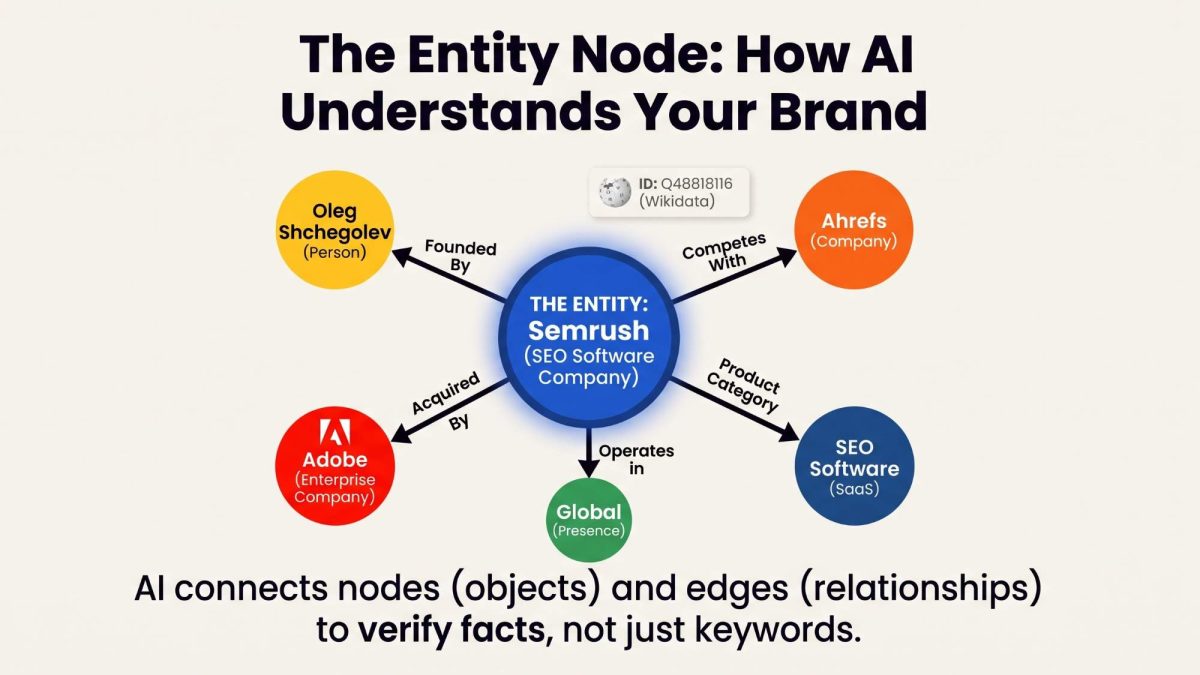
Search engines and AI models organize these connections into Knowledge Graphs, which are essentially massive digital mind maps built from simple, three-part relationship statements:
[Entity A] —> [Relationship] —> [Entity B]
Here is how that looks in everyday business terms:
- [HubSpot] (Company) —> [is headquartered in] —> [Cambridge, Massachusetts] (Location)
- [Dharmesh Shah] (Person) —> [co-founded] —> [HubSpot] (Company)
- [HubSpot CRM] (Product) —> [competes with] —> [Salesforce Sales Cloud] (Product)
- [Your Brand] (Company) —> [provides] —> [Enterprise B2B Payments] (Service)
Instead of viewing your website as an isolated list of keywords, an AI engine reads these relationship lines to build a full picture of who you are, what you sell, and how you fit into your broader market.
Why AI Engines Rely on Entities to Survive
Generative engines and LLMs are notorious for one critical flaw: they are statistical text predictors, which makes them prone to hallucinations.
Left entirely to their own probability weights, models will invent fake case law, fabricate executive names, and attribute quotes to the wrong experts.
To produce reliable, grounded answers, generative engines rely heavily on structured knowledge graphs and verified factual databases. When a user asks an AI engine a complex question, the engine doesn’t just guess what sounds plausible.
It identifies the entities inside the prompt, verifies the relationships between those entities against trusted data sources, and uses those verified facts to generate the final summary.
If your content provides clean, unambiguously structured entity data, you make the AI engine’s job effortless.
You eliminate ambiguity, give it confidence that your claims are factual, and drastically increase the likelihood that your brand becomes the cited source in the final output.
Related: Learn more modern SEO terminology and concepts in my glossary of AI SEO terms.
How AI Search Understands Entities
The Generative Shift: How AI Search Engines Retrieve and Synthesize Information
To win citations in generative engines, you have to look under the hood at how an answer gets created.
In traditional search, the pipeline is linear and familiar: crawler discovers page -> indexer extracts keywords -> ranking algorithm scores authority and relevance -> search engine presents ten blue links.
The search engine simply acts as a curated directory. If you want the answer, you click through to read it.
In generative search – whether through Google AI Overviews, Perplexity, or ChatGPT Search – the engine acts as an executive researcher writing a brief. The pipeline looks fundamentally different:
- Entity Expansion & Intent Deconstruction: When a prospect types a prompt – like “What are the best email marketing platforms for mid-sized e-commerce brands on Shopify?” – the engine doesn’t just scan for that exact phrase. It deconstructs the prompt into distinct entities: [Email Marketing Platform], [E-commerce], [Shopify], and [Mid-Sized Business].
- Multi-Source Retrieval: The engine queries its index using semantic search and knowledge graphs to retrieve a pool of candidate passages that explicitly connect these entities together.
- Factual Grounding & Synthesis: An LLM reads the retrieved passages, discards repetitive fluff, extracts the factual claims, and synthesizes a direct answer with citations pointing to the original sources.
This operational shift introduces two critical dynamics that every SEO must understand: disambiguation and information gain.
The Disambiguation Hurdle: Helping AI Tell You Apart
Words often have multiple meanings depending on context. If a user searches for the word “Mercury,” are they asking about the planet, the chemical element, the vintage car make, or Mercury, the popular fintech banking platform for startups?
Traditional search engines often relied on a user’s recent browsing history or adjacent keywords to guess what they meant. AI engines take this much further by examining the neighborhood of related entities surrounding the term.
If an article mentions “Mercury” alongside “FDIC-insured accounts,” “checking APIs,” and “venture capital funding,” the engine instantly resolves the entity to the fintech company, not the solar system.
For your brand, disambiguation is life or death. If your agency is named “Apex Marketing” or “Beacon Consulting,” you share that name with hundreds of businesses worldwide.
Unless you feed search engines clear signals about your specific domain, headquarters, founders, and industry niche, the AI engine will confuse your brand with someone else – or simply ignore you entirely to avoid publishing inaccurate information.
Information Gain and Entity Salience
Generative engines operate under strict computing budgets. When an LLM evaluates five retrieved articles that all repeat the exact same basic definitions, it has zero reason to cite all five. It will cite one or two authoritative sources and ignore the rest.
This is where information gain comes in. AI models prioritize content that introduces net-new attributes, fresh data points, original perspectives, or distinct entity relationships that aren’t already saturated across the web.
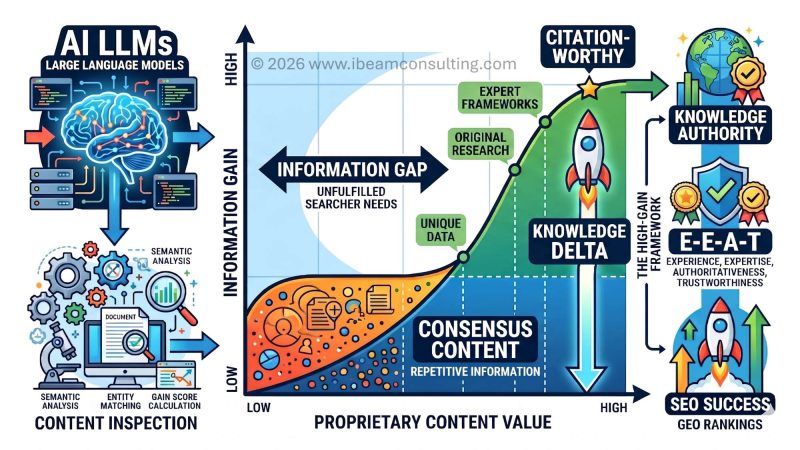
Furthermore, the model evaluates entity salience — a score indicating how central an entity is to the core subject of the piece, rather than just being a passing mention.
If you mention an entity once in paragraph seven, your salience is near zero. If that entity forms the grammatical subject of key headings, is clearly defined early, and maintains consistent relationships throughout your text, the engine identifies your piece as a primary authority on that subject.
Related: Learn more in these posts about SEO and information gain and the information gain advantage for B2B SEO.
Entities and Schema (JSON-LD)
Technical Foundations: On-Page Entity Architecture & Schema
If entities are the currency of AI search, your on-page architecture is how you guarantee your content gets converted without friction. Search engines can infer entity relationships through natural language processing, but relying on inference alone leaves money on the table.
You want to make your entity definitions explicit, unambiguous, and machine-readable.
That starts with structured data, but not the superficial schema most sites deploy.
Structured Data as the Rosetta Stone: Beyond Basic JSON-LD
Most websites stop at basic schema templates: an Article wrapper with a headline, an image URL, and a publication date. To an AI engine, this is like handing someone an envelope without a letter inside.
To anchor your content firmly in the Knowledge Graph, your JSON-LD markup should act as a relational mapping file using advanced Schema.org properties:
about: Declares the primary entity (or entities) that the document is fundamentally focused on. A page about generative search should explicitly declareabout: {"@type": "Thing", "name": "Generative Engine Optimization", "sameAs": "..."}.
mentions: Identifies secondary entities discussed in the piece (e.g., specific software products, underlying algorithms, or key researchers). This tells the engine which topics your content touches without confusing the main topic.
sameAs: The single most powerful disambiguation tag in technical SEO. By linking your entity to canonical web profiles – such as its entry on Wikidata, Wikipedia, or Crunchbase – you eliminate any doubt about who or what you are discussing.
knowsAbout: Applied toOrganizationandPersonschema to explicitly list the specific industries, skills, or subject matter where the author or company possesses verified expertise.
@idURIs (Your Brand’s Digital Passport): Think of an@idURI as a unique digital passport number for your company or key team members (e.g.,https://example.com/#organizationorhttps://example.com/authors/jane-doe#author). Instead of redefining your company from scratch on every single blog post, using a consistent@idallows search engines to instantly tie every new article directly back to your master entity profile.
Here is what a connected, entity-first JSON-LD block looks like in practice. Notice how it explicitly anchors the organization to external databases and declares its primary subject matter:
{
  "@context": "https://schema.org",
  "@graph": [
    {
      "@type": "Organization",
      "@id": "https://example.com/#organization",
      "name": "Acme Analytics",
      "url": "https://example.com",
      "sameAs": [
        "https://www.wikidata.org/wiki/Q12345678",
        "https://www.crunchbase.com/organization/acme-analytics",
        "https://www.linkedin.com/company/acme-analytics"
      ],
      "knowsAbout": [
        "B2B Attribution Modeling",
        "Marketing Mix Modeling",
        "Revenue Operations"
      ]
    },
    {
      "@type": "TechArticle",
      "@id": "https://example.com/blog/multi-touch-attribution/#article",
      "headline": "Modern B2B Attribution in the Age of Generative AI",
      "publisher": { "@id": "https://example.com/#organization" },
      "about": [
        {
          "@type": "Thing",
          "name": "Multi-Touch Attribution",
          "sameAs": "https://en.wikipedia.org/wiki/Attribution_(marketing)"
        }
      ]
    }
  ]
}
When your schema explicitly links your subject to an external authority like Wikidata via sameAs, you aren’t just hoping an LLM understands your context. You are handing it a direct key to the global semantic web.

Natural Semantic Co-occurrence (Speaking the AI’s Conceptual Language)
You don’t just optimize schema; you optimize the natural language itself through conceptual depth. AI engines expect authoritative content to naturally weave together related concepts.
For example, if you write a comprehensive guide on Customer Retention, an AI model expects to see familiar related topics naturally present throughout the piece: churn rate, customer lifetime value (LTV), customer onboarding workflows, Net Promoter Score (NPS), and loyalty incentives.
If an article completely skips these natural companion concepts because the writer was fixated on repeating the exact phrase “customer retention” ten times, the engine recognizes that the content lacks substantive depth.
Writing for entities means covering the whole conceptual ecosystem, not just hammering a single keyword.
Site Architecture as an Entity Relationship Model
Your website’s taxonomy should reflect the real-world relationships of your domain. Instead of arbitrary category folders created for vanity, structure your site like an organized topical map:
- Hub Pages as Parent Entities: High-level concept pages that represent primary industry entities (e.g.,
/email-marketing/).
- Sub-Pages as Child Entities: Deep dives into attributes, sub-disciplines, or applications that cleanly nest underneath the parent entity (e.g.,
/email-marketing/segmentation/or/email-marketing/deliverability/).
- Relational Internal Linking: Use internal link anchor text to define relationships, not just to pass PageRank. When linking from an article about an author to an article about a tool they built, anchor the link on the actual entity name, reinforcing the
[Creator] -> [created] -> [Product]relationship across your domain.
When your on-page copy, technical JSON-LD schema, and internal site structure all reinforce the exact same relationships, you transform your site from a collection of blog posts into an authoritative topical node that AI engines can confidently parse, index, and cite.
Related: Learn more in these posts about AI SEO and structured content, and website schema audits.
Entities and Brand Reinforcement (Off-Site AI SEO)
Off-Page Entity Footprint & The “Digital Consensus”
Optimizing your own website is only half the battle. You can deploy flawless JSON-LD schema declaring your brand as the world’s leading project management software, but an AI engine won’t take your word for it based on your site alone.
Generative engines and LLMs operate on digital consensus. Before an AI engine risks citing your brand in an AI Overview or Copilot answer, it looks across the wider web to verify whether reputable third-party sources corroborate your claims.
The Power of Cross-Web Corroboration
Think of an LLM as a cautious researcher. If only one self-interested source makes a claim, the model treats it as uncertain. But when multiple independent, authoritative platforms repeat the exact same attributes and relationships, the model accepts it as an established fact.
If your website says your company specializes in “HIPAA-compliant telehealth software,” the AI model checks for consensus:
- Does your Crunchbase profile describe you in the same category?
- Do your G2 and Capterra reviews categorize your product under HIPAA healthcare tools?
- Do tech media publications, industry podcasts, and partner directories describe your executive team in relation to telehealth compliance?
When these entity connections align across multiple trusted properties, the search engine assigns a high confidence score to that relationship.
The Primary Off-Site Entity Hubs
To build an unshakeable digital footprint, your brand must claim and actively harmonize its profile across the core repositories that AI models use to train their foundational data:
- Wikidata & Wikipedia: Wikidata is the structured backbone of the semantic web. If your brand or founder has earned the notability required for a Wikidata entry, it provides AI models with a permanent numeric identifier (like
Q12345) that permanently disambiguates your company.
- Google Business Profile: For local and multi-location businesses, GBP is Google’s primary local entity database. Ensuring your category, business name, address, and primary services are consistent is essential for local generative answers.
- Crunchbase, PitchBook, & OpenCorporates: These platforms serve as primary validation hubs for corporate entities, leadership rosters, funding milestones, and operational status.
- LinkedIn & Industry Registries: Company pages and verified executive profiles confirm who your people are and what topics they have authority to speak on.
Winning Commercial Shortlists: Entity Co-Occurrence in Third-Party Roundups
When buyers ask conversational engines for commercial recommendations – such as “What are the top 5 alternatives to HubSpot for mid-market teams?” – the model rarely pulls that recommendation from a vendor’s own homepage.
Instead, the LLM constructs its shortlist by synthesizing third-party comparison guides, software directory lists (G2, Capterra, TrustRadius), and high-ranking editorial review roundups.
To appear on those AI-generated shortlists, your digital PR and partnership teams must focus on comparative entity co-occurrence:
- Audit Model Training Sources: Run prompts for your top competitor alternatives across ChatGPT, Claude, and Perplexity. Note which third-party publishers and review sites are consistently cited in their source pills.
- Target Listicle Inclusion: Proactively reach out to industry publications that maintain top-ranking “best of” roundups in your category. Getting your platform listed alongside established category leaders directly trains generative models that your entity belongs in the same consideration set.
- Cultivate Attribute-Rich Reviews: Encourage software reviewers on third-party directories to mention your specific strengths (e.g., “fastest implementation time,” “best for multi-currency billing”). LLMs synthesize those exact user attributes when qualifying why your product was selected for a specific recommendation.
Unlinked Brand Mentions and Co-Occurrence
In traditional SEO, an unlinked brand mention was considered a missed opportunity — you immediately sent an email asking the editor to turn that plain text into a clickable <a> tag with dofollow PageRank.
In generative search, unlinked brand citations carry immense weight.
When an AI engine processes millions of web articles, it notes every time your company name appears near your target industry terms.
If your brand name regularly co-occurs alongside terms like “supply chain optimization” or “B2B fraud detection” in reputable trade journals, the model’s neural network strengthens the association between your brand and that problem space — even if there isn’t a single hyperlink attached.
Digital PR as Entity Architecture
This reality fundamentally redefines public relations. Modern digital PR isn’t just about building backlinks to drive domain authority; it is about attribute reinforcement.
Every press release, podcast interview, guest editorial, and industry quote should deliberately reinforce your core entity attributes:
- Who you are: Your exact, standardized brand name.
- What you do: Your primary category and specific target market.
- Who leads you: Your verified subject-matter experts.
When your off-site footprint speaks with one clear voice, you build the consensus generative engines need to cite you with confidence.
Related: Learn more about off-site optimization in these posts about AI SEO and backlinks, and using Reddit & Quora for SEO growth.
Tools & Resources for Entity-Based AI SEO
Actionable Playbook: Entity Optimization & The AI Citation Tech Stack
Now let’s translate these principles into a practical, repeatable workflow. Whether you manage an in-house marketing team or lead an agency SEO department, here is the operational playbook for entity optimization and AI visibility tracking.
Step 1: Entity & Topical Mapping (Beyond Traditional Keywords)
Stop starting your content planning with keyword search volume spreadsheets alone. Begin by mapping out the conceptual neighborhood your brand must own:
- Primary Entity: Your core commercial identity (e.g., Automated Accounting Software).
- Secondary Entities: The features, integrations, and compliance standards essential to that topic (e.g., QuickBooks Integration, General Ledger, GAAP Compliance, Expense Reconciliation).
- Tertiary Entities: The pain points, user personas, and real-world workflows your buyers experience (e.g., Month-End Close, Accounts Payable Bottlenecks, CFO Reporting).
The Entity Diagnostic Tool Stack
Before writing a word, use Natural Language Processing (NLP) tools to see how search engines currently read your content and your competitors’ pages:
- Google Cloud Natural Language API: Test your top landing page in Google’s natural language analysis interface. It extracts recognized entities, assigns each an entity category (Organization, Consumer Good, Event), and calculates an Entity Salience score between 0.0 and 1.0. If your primary product scores below 0.10 while generic filler words score higher, your copy is obscuring your core entity.
- Diffbot Knowledge Graph: Test how autonomous web crawlers extract your brand’s facts, key personnel, and product categories into structured data graphs.
- WordLift & InLinks: Content optimization tools specifically designed around entity relationships rather than simple keyword densities. They analyze top-performing content, identify missing conceptual entities, and help generate interconnected schema on the fly.
Step 2: Content Formatting for AI Extraction (Optimizing for RAG)
When an AI engine searches the web to answer a user’s prompt, it breaks web pages into smaller chunks of text (typically 100 to 300 words). If your page hides the core answer inside five paragraphs of introductory fluff, the AI parser will skip right past it.
Format your content so AI engines can effortlessly parse, extract, and ground their answers in your text:
- Lead with Direct Subject-Verb-Object Answers: At the very top of each major subheading, provide an unambiguous direct answer before expanding into commentary. For example: “Accounts payable automation is software that digitizes invoice capture, manages approval workflows, and executes supplier payments without manual data entry.”
- Use Clean Data Tables: AI retrieval models love structured tables for feature comparisons, pricing tiers, and specifications. Tables are compact, high-density entity maps that models can easily convert into bulleted summaries.
- Use Explicit Header Taxonomies: Avoid clever, vague headlines like “The Secret Sauce to Modern Money.” Use clear, descriptive entity headings like “Key Features of Automated Accounts Payable Systems.”
Step 3: Disambiguating Your Brand and Key People
Search engines evaluate who is behind your content to fulfill Google’s Experience, Expertise, Authoritativeness, and Trustworthiness (E-E-A-T) standards. Generative engines want proof that real, qualified humans stand behind the claims.
- Standardize Author Profiles: Create dedicated author bio pages that link to verified external profiles (LinkedIn, Crunchbase, published industry books, or academic research profiles).
- Deploy
PersonSchema: Connect your author bios with structured markup declaring their exactjobTitle,worksFor, andsameAslinks to external social proof.
- Harmonize Brand References: Ensure your company uses identical spelling, legal names, and business addresses across your website footer, privacy policies, terms of service, and external profiles. Eliminate confusing variations like swapping between “Acme Inc.” and “Acme Solutions Ltd.”
Step 4: Tracking AI Citations & Brand Presence Across Search Surfaces
Traditional rank trackers only check where your blue link ranks on page one of Google. In a generative search world, you need tools that track citation share, model mentions, and grounding queries across conversational interfaces.
Here is how modern marketing teams build their AI monitoring stack:
1. Native Search Engine Dashboards (Free & Essential)
- Bing Webmaster Tools (AI Performance Report): Bing provides native reporting specifically for generative search inside Microsoft Copilot. This report reveals your total AI citations, which specific URLs Copilot pulls into answers, and the actual “Grounding Queries” that prompted Copilot to use your site as a factual reference.
- Google Search Console (Generative AI Performance Report): Google provides a dedicated “Generative AI” performance report tucked directly under the Performance > Search results section. This dedicated view isolates impressions your URLs receive across Google’s generative features (such as AI Overviews and AI Mode) from standard web results. Track which URLs are frequently cited in AI Overviews, and cross-reference pages with high generative impressions against traditional organic traffic to evaluate your true share of AI visibility.
2. Accessible Multi-Model Trackers (Agile Marketing Teams)
For mid-sized marketing teams that need quick, comprehensive tracking without six-figure enterprise contracts, dedicated multi-model trackers offer accessible visibility:
- Mangools AI Search Watcher: Mangools monitors your brand across major LLMs and AI engines (ChatGPT, Google AI Overviews, Gemini, Claude, Grok, Mistral, and Llama). Crucially, it features multi-run verification – checking every prompt twice to catch smaller brands that might otherwise blink in and out due to LLM variability – alongside side-by-side competitor benchmarking and brand-tailored prompt discovery. You can complement this with their free AI Search Grader for quick audits.
3. Dedicated Enterprise GEO & LLM Platforms
- Profound: A dedicated platform for tracking how your brand is cited and perceived across generative search platforms, featuring mention position analysis, brand sentiment scoring, and prompt-level competitive intelligence.
- Otterly.ai: A specialized AI search monitoring and GEO suite that tracks brand citations, presence, and answer inclusion across modern generative engines.
- Writesonic GEO: Combines generative search monitoring with content optimization, reporting on AI visibility percentages, competitor gap analysis, and citation frequency across conversational answer engines.
- Enterprise SEO Suites (Semrush & Ahrefs): The leading enterprise toolsets now integrate AI Overview tracking directly into their primary keyword dashboards, highlighting which tracked queries trigger AI summaries and tracking competitive citation cards over time.
4. Knowledge Graph Health Checks
- Google Knowledge Graph Search API: Query Google’s public entity database periodically using your brand’s unique ID (
/m/...or/g/...). Monitor yourresultScore(Google’s confidence metric in your entity) to ensure your optimization efforts are translating into stronger algorithmic certainty.
AI SEO & Entities — Common Mistakes
Pitfalls to Avoid in Entity-Based SEO
Shifting from keyword-focused SEO to entity-first GEO requires changing how you think about optimization. As teams make this transition, a few common mistakes frequently trip them up and hurt their AI visibility:
1. Schema Stuffing and Irrelevant mentions
Just because you can tag every single noun on a page doesn’t mean you should. Some marketers tag dozens of tangentially related entities in their JSON-LD schema (e.g., tagging the city of New York, a random software tool, and a historical date all under mentions on a simple product page).
This dilutes your entity salience.
When an AI engine evaluates your structured data, a massive list of disconnected entities muddies the water about what your page is fundamentally about.
Keep your schema lean: tag only the primary subject under about, and reserve mentions for the three to five key entities that directly support the core argument.
Always validate your code using the official Schema Markup Validator and Google’s Rich Results Test to catch formatting breaks or conflicting declarations.
2. Tolerating Off-Site Brand Discrepancies
AI models rely heavily on digital consensus across the web. If your Crunchbase profile states that your company has 50 employees and is headquartered in Austin, while your LinkedIn profile says you are a 500-person remote company based in Denver, the AI model registers conflicting data.
When an AI engine encounters conflicting attributes across reputable hubs, its confidence score drops. Faced with uncertainty, the model will often omit your brand entirely from synthesized answers rather than risk stating an inaccurate fact.
Audit your brand presence regularly across major registries to ensure names, addresses, leadership, and product categories match word-for-word.
3. Sacrificing Factual Clarity for Fluffy Keyword Copy
Traditional SEO copywriters were trained to hit arbitrary word counts and weave keyword variants into poetic intro paragraphs: “In today’s fast-paced, ever-changing digital landscape, businesses need solutions that empower growth…”
To a Retrieval-Augmented Generation (RAG) system, this kind of copy is pure noise.
When an AI search engine chunks your page into 200-word snippets, it hunts for direct, factual statements that answer the user’s prompt.
If your introductory sections are packed with generic corporate fluff, the extractor will skip your page in favor of a competitor who stated the definition, statistics, and solution clearly in the first two sentences.
Like this post? Quickly share it with your social networks here.
Want to make sure you never miss our updates? Click below to add us as a preferred source on Google Search.

AI SEO & Entities — Closing Thoughts
Conclusion & Entity Optimization Next Steps
The rules of search have changed permanently. While traditional organic rankings and blue links won’t vanish overnight, the highest-intent commercial queries are increasingly answered before a user ever scrolls down the search results page.
In this generative era, search engines no longer treat your website as an isolated document stuffed with keywords. They treat it as an interconnected node within a global knowledge graph.
Winning organic visibility is no longer about tricking an algorithm into ranking a specific URL; it is about establishing your company, your products, and your experts as unmistakable, trusted entities that AI engines rely on to construct truthful answers.
The Quick-Start Entity Optimization Checklist
To put these principles into action today, start with these five high-impact steps:
- Audit Your Brand’s Entity Footprint: Run your core landing pages through the Google Cloud Natural Language API. Verify that your brand and flagship products register as recognized entities with high salience scores (> 0.15) rather than generic common nouns.
- Standardize Off-Site Citations: Harmonize your brand name, leadership team, category descriptions, and company bio across Wikidata (if notable), Crunchbase, LinkedIn, and Google Business Profile.
- Upgrade from Basic Schema to Relational JSON-LD: Move beyond generic blog markup. Incorporate
about,mentions,knowsAbout, and externalsameAslinks connecting your pages directly to authoritative knowledge repositories.
- Format Content for RAG Ingestion: Restructure key subheadings to open with direct, unambiguous Subject-Verb-Object definitions. Replace lengthy narrative descriptions of features or specifications with clear, scannable data tables.
- Set Up Multi-Model AI Citation Tracking: Check your visibility in the Generative AI report under Google Search Console and the AI Performance Report in Bing Webmaster Tools. Layer on agile multi-model tools like Mangools AI Search Watcher to monitor your brand’s share of voice across ChatGPT, Claude, Gemini, and Google AI summaries.
Questions or Comments?
I hope this guide to entity-based SEO & GEO has been helpful! Let’s wrap up this post with a few related questions for you:
- How much “entity-based” thinking is going into your AI SEO and GEO efforts today? Is your current SEO workflow still highly keyword-centric?
- Are you currently tracking your AI brand citations (e.g., “impressions”) in Google Search Console, Bing Webmaster Tools, or 3rd-party tools like Semrush, Mangools, etc.? What entity-related insights are you gaining from these tools?
- How is your site doing with structured data (e.g., JSON-LD) today? How do you implement, manage, and audit this area today?
Feel free to add more in the comments below with any thoughts, feedback, or related questions. Thanks also for any social shares on this post via the buttons below!
