
Last updated Aug 24, 2025
Insights, Tips, and Tools for GEO Audit Success
Now that we’re firmly in the age of AI-powered search, it’s time to evolve our thinking about ‘SEO’ audits for generative search optimization.
While there’s certainly overlap between GEO audit and SEO audit goals, there are also some new considerations for more GEO-focused search.
This post looks at the GEO audit for next-generation search, including insights, tips, and tools for success in this emerging area.
Let’s take a closer look below!
This post may contain a few referral links to select vendor partners. We may receive compensation for purchases made via these links, at no additional cost to buyers.
Introduction — The Dawn of a New Search Era
Boosting Site Visibility in the Age of AI Search
For two decades, the rules of online discovery have been clear: create great content, optimize it for search engines, and aim for the top of the results page (the ‘SERP’). But the ground is shifting beneath our feet.
The world is asking questions differently now. Instead of typing keywords and sifting through a list of blue links, users are turning to AI assistants like ChatGPT, Gemini, Claude, MS Copilot, and Perplexity for direct, conversational answers.

This fundamental change from a ranked list of website content options to a single, synthesized AI response marks the most significant evolution in search since the invention of the search engine itself.
Not surprisingly, this new landscape requires a new approach. If traditional Search Engine Optimization (SEO) was about climbing the rankings, the next evolution is about becoming the source of truth and gaining overall ‘market share’ in AI search visibility.
This is the domain of Generative Engine Optimization (GEO), a crucial new practice focused on ensuring your brand and content are not just seen by AI, but are also understood, trusted, and cited within its answers.
In this post, we’ll dive into this new frontier. We’ll define exactly what a GEO audit is and how it provides a critical health check for your website’s AI readiness. We will compare it to the traditional SEO audits we all know and provide a clear, actionable roadmap for conducting a comprehensive GEO audit on your own site.
Let’s start with an overview of what a ‘GEO Audit’ is all about.
What Exactly is a GEO Audit?
Getting Your Site Ready for Generative AI-Powered Search
Before we can audit for it, we need to define the term itself. Generative Engine Optimization (GEO) is the practice of making your content and brand not just visible, but also understandable, citable, and ultimately recommended by AI-driven search and answer engines.
If SEO helps a user find your website in organic search results, GEO helps an AI understand your expertise and use it to formulate an answer.
With that in mind, a GEO audit is a systematic analysis of your website’s readiness for this new AI-powered ecosystem. It’s a health check that asks different questions than a traditional SEO audit.
Instead of asking, ‘How can we rank higher?’ a GEO audit asks, ‘How can we become the preferred source of the answer?’ It’s a proactive strategy to ensure your brand, products, and expertise are represented accurately and favorably within the AI-generated responses that are quickly becoming the new front page of the internet.
“A GEO audit is a systematic analysis of your website’s readiness for the new AI-powered search ecosystem.”
GEO Audit vs Traditional SEO Audit
Expanding Beyond Existing SEO Audit Processes
It’s crucial to understand that GEO doesn’t replace SEO; it builds upon it. A technically sound, well-structured website — the hallmark of good SEO — is also the foundation for a successful GEO strategy.
In the world of GEO, passing a typical comprehensive SEO audit with only minor outstanding issues is still a very good thing.
However, the focus, goals, and metrics represent a significant paradigm shift. Where SEO prepared your site for an algorithm that ranks links, GEO prepares your site for an AI that synthesizes information.
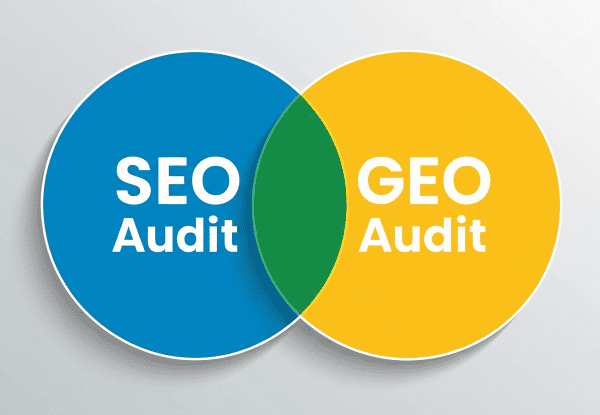
Here’s how GEO and SEO compare from an auditing perspective:
Primary Goal
- SEO: To achieve the highest possible ranking on a Search Engine Results Page (SERP) for target keywords, keyphrases, and queries, and earn clicks from search users.
- GEO: To become a cited, trusted source within a direct, AI-generated answer, often in a ‘zero-click’ environment where some search users do not click through to source content.
Core Metrics
- SEO: Success is measured by keyword rankings, impressions, clicks, click-through rate (CTR), domain authority, and the quantity/quality of backlinks.
- GEO: Success is measured by the AI answer inclusion rate, citation frequency, brand sentiment within AI responses, and the quality of source attribution. Terms and metrics like share of search and search visibility share become even more relevant here.
Content Strategy
- SEO: The focus is on targeting specific keywords, optimizing meta tags, and creating content that satisfies both user intent and search engine crawlers.
- GEO: The emphasis shifts to using conversational language, structuring content to provide direct answers to questions, ensuring absolute factual accuracy, and providing clear, authoritative sourcing for all claims.
Technical Focus
- SEO: Priorities include crawlability, site speed, mobile-friendliness, and clean sitemaps.
- GEO: While the SEO basics are still vital, the focus expands to include advanced structured data (schema), semantic HTML for context, and ensuring content is fully accessible to Large Language Models (LLMs).
Related: Learn more in these posts about AI search visibility and Google SEO and GEO visibility.
The Pillars of a Comprehensive GEO Audit
Key Analysis Factors for GEO-Focused Audits
A GEO audit moves beyond a simple SEO checklist to a holistic analysis of how an AI perceives your entire digital footprint. Here are the six core pillars to investigate.
Content and Semantic Structure
This pillar is about making your content as easy as possible for an AI to read, understand, and quote.
- Citation Readiness: Is your content broken down into clear, concise, and factual statements? AIs look for definitive sentences they can easily extract. Long, winding paragraphs are less ‘citable’ than short, declarative ones.
- Answer Alignment: Does your content directly answer the questions your audience is asking? Audit your pages to see if you are using a clear question-and-answer format (like an FAQ section) and conversational headings that mirror natural language queries.
- Semantic Clarity: This goes beyond keywords to the underlying structure of your HTML. Your audit should confirm you are using heading tags (
<h1>,<h2>, etc.) in a logical hierarchy and employing semantic tags like <article> and <section> to give the AI clear contextual clues about the purpose of each content block.
Authority, Trust, and E-E-A-T
Generative engines are designed to avoid misinformation, so they place immense value on trust signals. E-E-A-T (Experience, Expertise, Authoritativeness, and Trustworthiness) is more important than ever.
- Factual Accuracy: Every claim on your site should be verifiable. Your audit should involve fact-checking your own content. Are statistics current? Are statements backed by evidence?
- Source Attribution: Do you clearly cite your sources for important facts and reference information? Linking out to reputable, authoritative domains (like academic institutions, government reports, or established industry leaders) is a powerful trust signal for an AI.
- Authoritative Signals: Does your website clearly state who is behind the content? An audit should check for clear author bios with credentials, an easy-to-find ‘About Us’ page, and accessible contact information.
Entity Recognition and Brand Consistency
An AI needs to understand who you are as an ‘entity’ — a specific person, place, or organization — and connect the dots across the web.
- Entity Definition: Your audit must check for the use of structured data, specifically Organization and Person schema. This is like giving the AI a digital business card, explicitly defining your name, logo, location, and social profiles.
- Brand Consistency: Are you using your brand, product, and key personnel names consistently everywhere? Inconsistencies can confuse an AI and dilute its understanding of who you are.
- Knowledge Graph Footprint: How does the web’s broader ecosystem see you? Audit your presence and accuracy on crucial data sources like Wikipedia, Wikidata, and high-authority industry directories.
Technical AI Accessibility
If an AI can’t access your content, it can’t cite it. This goes a step beyond traditional technical SEO.
- LLM Readability: Some modern websites rely heavily on client-side JavaScript to render content. Your audit should verify that your core content is accessible in the basic HTML, as some AI crawlers may not render JavaScript effectively, making your content invisible.
- Content Freshness: AI models prioritize current information. An audit should review your processes for updating content and ensure that publication and modification dates are clearly signaled to crawlers.
Multimedia and Multimodal Optimization
Search is no longer just text. AI answers are increasingly multimodal, incorporating images, videos, and audio.
- Asset Accessibility: Your audit must check if your non-text assets are understandable to a machine. Are your images using descriptive alt text and captions? Do your videos and podcasts have accurate transcripts?
- Multimedia Schema: Go beyond alt text by implementing ImageObject, VideoObject, and AudioObject schema. This provides explicit, structured context that helps an AI categorize and feature your multimedia content.
- Voice Search Readiness: Is your content structured for conversational delivery? AIs powering voice assistants (like Siri and Google Assistant) pull from content that is concise and provides direct answers, making this a key part of a multimedia audit.
Community Signals and User-Generated Content (UGC)
AI models learn about the world not just from official websites, but from the organic conversations people have online.
- Forum Footprint: What are people saying about you on Reddit, Quora, and niche industry forums? A GEO audit should include assessing your brand’s presence and sentiment in these key communities. Consistent, positive mentions are a powerful trust signal.
- UGC as a Data Source: Recognize that these platforms are a primary data source for training AI on real-world experience and public opinion. Being part of the conversation is essential for influencing the AI’s understanding of your brand and industry.
Related: Learn more here about using Reddit and Quora social forums for SEO. These points are relevant and useful for GEO as well.
The GEO Auditor’s Toolkit — Mainstream & Emerging Tools
Existing and New Tools Support GEO Auditing Tasks
Conducting a thorough GEO audit requires a mix of manual investigation and specialized software. While the GEO tool landscape is evolving rapidly, the auditor’s toolkit can be broken down into three essential categories.
Checking The Source Itself (Manual Checks)
This is the most crucial and accessible starting point, with no special tools required. Go directly to the generative engines and ask the questions your customers would ask.
- Platforms to Use: Open up ChatGPT, Google Gemini, Perplexity, and others.
- What to Do: Ask a variety of questions about your industry, products, and competitors. Check if your brand is mentioned. If it is, is the information accurate and positive? If it isn’t, who is being cited instead? This manual check provides an invaluable real-world baseline of your current AI visibility.
Dedicated GEO Platforms (The New Wave)
A new category of tools is emerging specifically to automate and scale the manual checking process.
- Examples: Platforms like Semrush’s AI Toolkit, Otterly.ai, AthenaHQ, and Writesonic are pioneers in this space.
- Their Function: These tools are designed to track GEO-specific metrics at scale. They can monitor your brand’s share of voice across thousands of potential queries, analyze the sentiment of how you’re mentioned, and benchmark your visibility against competitors within AI-generated responses.
Traditional SEO Tools (Adapted for GEO)
Many of the tools you may already use for SEO are indispensable for a GEO audit, albeit with a slightly different focus.
- Schema Validators: Tools like Google’s Rich Results Test are critical for auditing the Organization, Person, and multimedia schema that AIs rely on for context.
- Content Optimization Tools: Platforms like Frase, Surfer SEO, or Scalenut are excellent for analyzing your content’s structure. Their focus on answering user questions and covering topics comprehensively aligns perfectly with the goal of creating ‘citable’ content for AI.
- Brand Monitoring Tools: Use these to track both linked and unlinked brand mentions across the web, especially on forums and UGC platforms. These mentions are a key data source for AI models and a strong indicator of your brand’s perceived authority.
Google Search Console (GSC) and Bing Webmaster Tools (BWT)
The core webmaster toolkits for Google and Bing continue to play important roles for both SEO and GEO auditing purposes.
Google Search Console
- Indexing and Crawlability: The URL Inspection Tool and Index Coverage reports are vital. They tell you if your pages are accessible to Google’s crawlers, which are the same crawlers that feed its generative AI models. If a page has a crawl error or a noindex tag, it’s invisible to both traditional search and AI Overviews. This is a fundamental check for Technical AI Accessibility.
- Structured Data Validation: GSC’s enhancement reports (e.g., for FAQs, Products, How-to) directly audit your schema implementation at scale. These reports will flag errors or warnings in the structured data that AIs rely on for context, making this a crucial tool for Entity Recognition and Multimedia Optimization.
- Performance Insights: The Performance report shows you the queries people are using to find you. This is invaluable for understanding user intent and ensuring your content provides direct answers, which is a core tenet of Answer Alignment.
Key Point: For GSC users, as of late August 2025, there is no separate filter or breakout for AI Mode or AI Overviews performance data. It’s included in the overall GSC performance data, but not (yet) visible for separate reporting.
Also Related: For more details on tracking AI search performance in GSC, see these Google articles on AI features and your website, and how to ensure your content performs well in AI search.
Bing Webmaster Tools
- Direct AI Integration: Bing is unique because its webmaster tools are more overtly integrated with its AI, Copilot. Bing has been very clear that strong performance in its traditional search is a prerequisite for being featured in its generative AI responses.
- IndexNow Protocol: Bing is a major proponent of IndexNow, a protocol that instantly notifies search engines when your content is updated. Using this feature, which is often integrated into SEO plugins for website platforms (e.g., WordPress), is a direct way to address Content Freshness.
- Copilot in Webmaster Tools: Bing has integrated its AI assistant, Copilot, directly into the BWT toolkit. You can use it to ask questions about your site’s performance and get AI-driven insights and recommendations, offering a glimpse into how the engine itself interprets your data.
Related: Learn more here about AI SEO and webmaster tools like GSC and BWT.
Want to stay updated on my SEO and GEO-related content? Add your email details below for periodic updates straight from me (David).
Your email info is safe here. We don’t sell, rent, or share your details with outside parties. You can easily unsubscribe at any time.
Like this post? Quickly share it with your social networks here.
The GEO Audit — Closing Thoughts
Future-Proofing Your AI Search Presence
The shift from a search engine that finds to a generative engine that answers is not a distant future — it’s happening right now. Adapting to this new reality is no longer optional for brands and site publishers that want to remain visible and relevant.
The principles of creating clear, authoritative, and well-structured content have always been important, but in the age of AI, they are the very foundation of digital discovery.
Generative Engine Optimization isn’t a fleeting trend or a niche tactic; it is an essential, long-term strategy for building trust and authority in a world where being the source of the answer is more valuable than being the first link.
By conducting a GEO audit, you are not just tweaking your website — you are future-proofing your brand’s ability to be found and heard.
Ready to see where you stand? Take the first step. Open your favorite AI assistant and ask it a question that one of your customers would ask. The answer you get will tell you everything you need to know about why this matters.
Questions or Comments?
I hope this introduction to GEO audit concepts and tools has been helpful! I’ll wrap up with a few related questions for you:
- How are your SEO auditing tasks and processes evolving now to incorporate GEO concepts?
- What site-wide or page-level content changes are you making now to support generative engine optimization?
- How is your SEO toolkit evolving in this new era of AI-powered search? What tools or platforms are providing the most value for you in a GEO context?
Feel free to add more in the comments below with any thoughts, feedback, or related questions. Thanks also for any social shares on this post via the buttons below!
