
Last updated Jul 11, 2025
Understanding the ‘Trifecta’ of Organic Search Results
Search visibility on Google is no longer focused primarily on traditional ranked web links.
Today, SEO-focused web rankings must give way to a blend of traditional and AI-powered search results. SEO plus ‘GEO’, or generative engine optimization.
This post looks further into Google SEO and GEO visibility, comparing web-only ranked results with ‘All + AI Overviews’ and ‘AI Mode.’
Let’s take a closer look below…

This post contains a few referral links to select vendor partners. We may receive compensation for purchases made via these links, at no additional cost to buyers.
Google Search Formats — ‘Web’ vs ‘All + AIO’ vs ‘AI Mode’
Navigating the New Frontier of Google Search Results
The digital landscape is certainly shifting these days. Google, the main gatekeeper of online discovery, is in the midst of a significant evolution, introducing new AI-powered ways for users to find information.
The traditional ‘ten blue links’ of ‘old Google’ are no longer the sole focus of a search engine results page (SERP). Google is actively experimenting with and rolling out AI-powered features that are reshaping how information is presented and consumed.
For businesses, digital marketers, and content creators, understanding these changes is not just advantageous — it’s essential for survival.
This blog post focuses on three primary search experiences now offered by Google: the familiar ‘web’ results, the increasingly common ‘All’ results featuring AI Overviews, and the new, conversational ‘AI Mode.’
We’ll dissect their differences, explore their unique functionalities, and, most importantly, provide actionable strategies to enhance your organic visibility across this evolving trifecta.
Highlighting both SEO and GEO (generative engine optimization) concepts, we’ll break down what you need to know to not just adapt, but to thrive in this new era of search.
Comparing 3 Primary Faces of Google Search
Traditional Listings vs AI-Powered Search Results
To effectively tailor your search optimization efforts, it’s crucial to understand the distinct characteristics of each search result type.
While there are multiple ways to organize and present search results on Google, we’ll focus here on three of the most popular options.
1. The Classic ‘Web’ Results — The Foundation of Search
This is the Google we’ve known for many years. A query returns a list of ranked web pages, often referred to as the ‘ten blue links’ per page of search results. Ranking high here for target keywords and keyphrases is still a major objective for SEO-minded website owners and content creators.
See the example below.
Good to Know: Using this ‘Web’ option on Google presents only the ranked web results, stripping out any ‘SERP features’ that may otherwise be present in the ‘All’ results page.
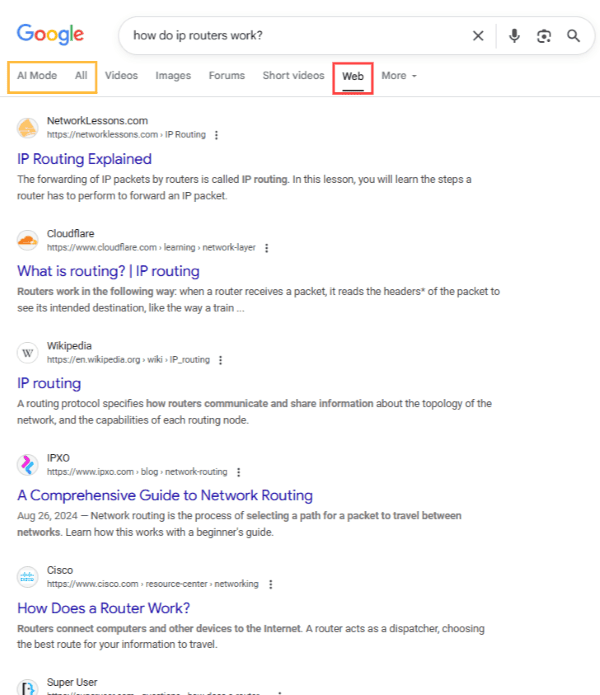
What It Is: A direct, ranked list of links to websites that Google’s algorithm deems most relevant to the search query.
Key Features:
- Organic blue links with title tags and meta descriptions.
- SERP features stripped away — these might otherwise include things like rich snippets, featured snippets, People Also Ask (PAA) boxes, knowledge panels, video or image carousels, top stories, etc.
- As noted above, any applicable SERP features can still appear in the web portion of the ‘All’ results page, below any AI-produced content.
User Interaction: Users scan the list of results, evaluating titles and descriptions to decide which links to click for more in-depth information. The interaction is primarily navigational, leading users to published content.
2. ‘All’ Results with AI Overviews: The Integrated Answer
This is now the default search experience for many queries. It blends the traditional web results (now placed further below) with a new, AI-generated summary at the very top of the page.
The upper AI Overview (AIO) section now includes an ‘AIO SERP Sidebar’ or ‘AI SERP within the SERP’ that contains cited sources used by Google to generate the AIO.
Both the AIO and sidebar are generally expandable via ‘Show more’ and ‘Show all’ buttons.
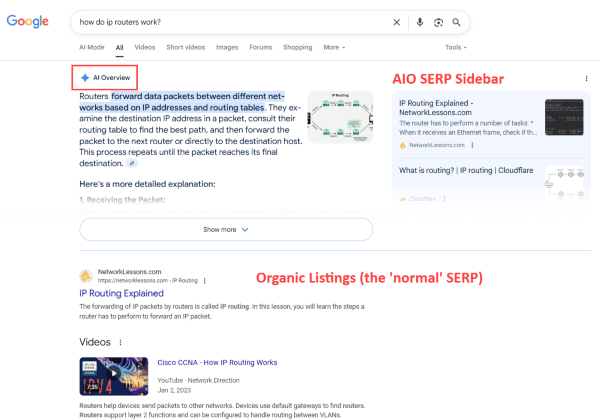
What It Is: A hybrid SERP that prominently features an ‘AI Overview’ at the top, which is a machine-generated answer to the user’s query, synthesized from multiple web sources. The traditional organic listings appear below this overview.
Key Features:
- AI-Generated Summary: A conversational, direct answer to the query.
- Source Citations: The overview includes links to the web pages from which the information was sourced, sometimes presented in a carousel format.
- Follow-up Questions: Suggested next queries to encourage a deeper, more conversational search journey.
- Continued Presence of Traditional SERP Features: All the elements of the normal web results are still present below the AI Overview.
User Interaction: Users are presented with an immediate, summarized answer via the AI Overview. They can get a quick snapshot of information without needing to click through to a website. The focus shifts from navigating a list to consuming a direct answer and then potentially exploring the cited sources for more detail.
3. Google’s ‘AI Mode’: The Conversational Search Engine
This is Google’s most advanced and experimental search interface. It transforms the search experience into a full-fledged conversation with Google’s generative AI models.
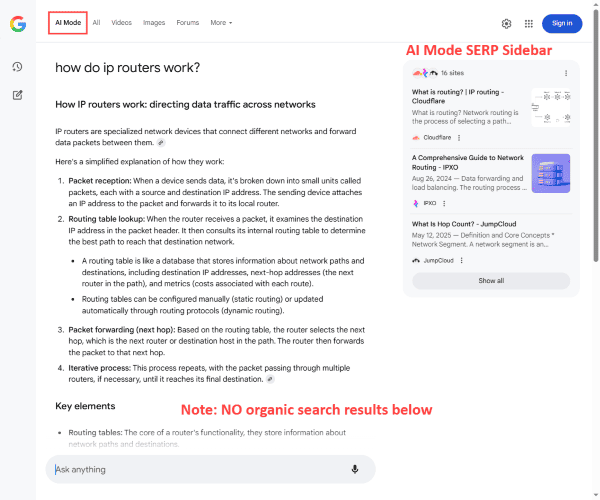
What It Is: A dedicated, opt-in search mode where the entire results page is a conversational interface powered by a Gemini model. It’s designed to handle complex, multi-faceted queries.
Key Features:
- Full AI-Generated Responses: Instead of a brief overview, AI Mode provides a comprehensive, structured response that can include comparisons, summaries, and multi-step answers.
- Query Fan-Out: It breaks down a complex question into subtopics and performs multiple searches simultaneously to construct its answer.
- Sidebar Links: Cited sources are often presented in a sidebar, with a notable overlap with top-ranking organic results but also the inclusion of new, contextually relevant sources.
- Conversational Follow-ups: Users can ask follow-up questions, refine their queries, and have a back-and-forth dialogue with the AI.
- Multimodal Input: Users can input queries via text, voice, and even images.
User Interaction: The user engages in a dynamic conversation with Google’s AI. The initial query is a starting point, with the AI prompting and guiding the user through a deeper exploration of the topic. This is a highly interactive and iterative process.
Summary Table: Web vs All (with AI Overviews) vs AI Mode
| Feature | Web Results | All Results with AI Overviews | AI Mode |
|---|---|---|---|
| Primary Format | Ranked list of blue links | AI-generated summary at the top, followed by traditional ranked links | Full-page conversational AI interface |
| AI Integration | Minimal (powers ranking algorithm and some features) | Prominent AI-generated summary (AI Overview) | The entire experience is a generative AI conversation |
| Source of Information | Individual web pages | Synthesized from multiple web pages | Synthesized from a wide array of web pages and Google’s knowledge graph |
| User Interaction | Navigational: Scan and click | Consumptive & Navigational: Read the overview, then potentially click | Conversational & Iterative: Dialogue with the AI, ask follow-ups |
| Key Features | Intentionally excludes Rich Snippets, Featured Snippets, PAA, Knowledge Panels, other SERP features | AI Overview, source citations, follow-up questions, full web results below the AIO items | Comprehensive AI responses, sidebar links, conversational follow-ups, multimodal input |
| Visibility Goal | Rank in the top 10 (typical SEO goal) | Be a cited source in the AI Overview, rank high in traditional results below (GEO + SEO) | Be a cited source in the AI response, appear in sidebar links (GEO focus) |
Related: See my AI SEO Glossary to learn more key terminology in this area.
Actionable Guidance for Gaining Organic Visibility
Combining SEO and GEO Tactics for Broader Visibility
Now for the most critical part: how do you optimize for each of these search environments? While there is overlap, a nuanced approach will yield the best results.
Gaining Visibility in ‘Web’ Results (The Foundation)
For visibility in this well-established domain of organic search, the principles of traditional SEO remain the bedrock of your strategy.
Master On-Page SEO
- Keyword Research: Continue to target relevant keywords, including long-tail variations.
- Compelling Titles and Meta Descriptions: These are your primary real estate for earning a click from the list of results.
- High-Quality, In-Depth Content: Create comprehensive content that thoroughly addresses the user’s search intent.
Achieve Technical Excellence
- Mobile-First Indexing: Ensure your site is perfectly optimized for mobile devices.
- Page Speed: A fast-loading website is crucial for both user experience and rankings.
- Crawlability and Indexability: Make it easy for Googlebot to find and understand your content.
Build Authority with E-E-A-T and Backlinks
- Demonstrate Experience, Expertise, Authoritativeness, and Trustworthiness (E-E-A-T): This is paramount. Showcase author bios, cite credible sources, and provide evidence of your expertise.
- High-Quality Backlinks: Earn links from reputable websites in your niche to signal your authority.
- Leverage Structured Data (Schema Markup):
- Implement relevant schema (e.g., FAQPage, Product, Review, Article) to be eligible for rich snippets and enhance your visibility in the SERPs.
Gaining Visibility in ‘All’ Results with AI Overviews
To appear as a cited source in an AI Overview, you need to build on your foundational SEO and focus on being a direct, reliable answer.
Focus on Conversational and Question-Based Content
- Answer the Public: Structure your content to directly answer common questions related to your topic. Use headings and subheadings to pose and answer these questions.
- Natural Language: Write in a clear, concise, and natural style that aligns with how people speak and ask questions.
Be a Prime Candidate for Featured Snippets
- There is a strong correlation between being a featured snippet and being a source in an AI Overview. Target ‘how-to,’ ‘what-is,’ and comparison-style queries.
- Provide clear, succinct answers at the beginning of your content.
Related: Learn how to find your ‘question keywords’ in Google Search Console. Then consider how you might be able to rank higher for very important user queries that should be a great fit for your core topics.
Reinforce Your E-E-A-T Signals
- Google’s AI will prioritize information from trustworthy sources. Your E-E-A-T signals are more important than ever.
Prioritize Factual Accuracy and Citable Data
- Include statistics, data points, and clear explanations that the AI can easily extract and synthesize.
- Ensure your content is up-to-date and factually accurate.
Gaining Visibility in ‘AI Mode’
This is the new frontier of Generative Engine Optimization (GEO). It’s about being a valuable part of a larger conversation.
Embrace Comprehensive, Topic-Cluster Content
- Since AI Mode breaks down complex queries, create content that covers a topic from multiple angles. Think ‘ultimate guides’ and comprehensive resource hubs rather than narrow, single-keyword pages.
Structure Content for AI Comprehension
- Clear Hierarchy: Use logical heading structures (H1, H2, H3) to create a clear outline of your content.
- Use Lists, Tables, and Bullet Points: This scannable formatting makes it easy for the AI to extract and present information. Comparison tables are particularly valuable.
Write for Citation
- Craft unique insights, quotable phrases, and clear definitions that the AI would be compelled to cite. Be the source of a novel perspective or a particularly well-phrased explanation.
- Find ways to add ‘information gain’ elements to your content.
Focus on Answering the ‘Why’ and ‘How’
- AI Mode is designed for deeper exploration. Go beyond surface-level answers and provide in-depth explanations, pros and cons, and step-by-step instructions.
Think in Terms of Entities and Concepts
- Optimize for topics and the relationships between them, not just keywords. Ensure your content is well-integrated into the broader knowledge graph of your industry.
Tools for Checking SEO+GEO Visibility
SEO Tools and AI Search Visibility
With the evolution of ‘pure SEO’ to now incorporate GEO as well, the universe of SEO software tools providers must adapt — and quickly.
SEO toolkits with rank-tracking modules or apps should still work fine for tracking traditional web result rankings, including any extra visibility in SERP features such as featured snippets, etc.
Popular existing SEO tools — and new entrants — are already adapting by adding ‘GEO visibility’ capabilities alongside traditional rank tracking.
Traditional SEO Tools with GEO Tracking Expansion
Look for AI search visibility capabilities within popular established SEO toolkits such as:

GEO-Native Search Visibility Tools
Also, see these GEO-focused toolkits for more AI search visibility tracking options:
Related: Learn more about comparing Google Search Console vs Bing Webmaster Tools, especially as they both evolve to support more AI search visibility insights. Also, see more details on these SEO+GEO tools in this post on AI search visibility.
Understanding Visibility Differences
When AI-Based Results Don’t Match Web Rankings
When comparing your search visibility across traditional and newer AI-assisted search results, you may notice that you have good visibility in one area but not others.
This gets right to the heart of the strategic differences between traditional SEO and the emerging field of Generative Engine Optimization. Let’s look at one emerging situation where:
- The content (website page or post) shows strong visibility in Google’s AI Mode and/or the AI SERP sidebar in AI Overview mode. For example, a web page has a high position as a cited resource in the AI-produced portion of the overall SERP.
- But the same URL has weak visibility in the traditional ‘web only’ results.
What can we infer or conclude about this scenario?
If a piece of content shows strong visibility in AI Mode or an AI Overview for a long-tail query but has weaker rankings in the traditional web results, we can infer several key things about it.
It’s likely a sign of hyper-specific relevance and excellent content structure, but a lack of broader page or domain authority.
Here are the most likely conclusions we can draw:
It Contains a ‘Golden Nugget’ of Information: The page likely has an extremely precise, well-explained, and perfectly structured answer to that specific long-tail query. The AI model has identified this specific section, paragraph, or data point as the best and most concise source on the web for that part of the user’s question, even if the page as a whole isn’t considered the top authority on the broader topic.
It’s Optimized for AI Comprehension (Excellent GEO): The content is probably structured in a way that is very easy for a machine to parse and extract. This could include:
- A very clear heading (H2, H3) that closely matches the long-tail query.
- The use of bullet points, numbered lists, or tables that directly address the query.
- A concise, factual, and citable writing style.
It Lacks Traditional Authority Signals (Weaker SEO): While the specific answer is great, the page or the entire domain might be weaker in traditional ranking factors that the classic search algorithm weighs heavily. This could include:
- A lower number of high-quality backlinks compared to the top-ranking pages.
- Lower overall domain authority or brand recognition.
- The page itself might be less comprehensive than the pages that rank higher in the traditional results.
It’s a Niche or User-Generated Source: The content might be from a source like a forum (e.g., Reddit), a Q&A site, or a highly specialized niche blog. Google’s AI models are increasingly good at finding authentic, experience-based answers from these sources, which might not have the SEO power to compete in the traditional top 10 ranked results, but are highly valued for their specific insights.
In summary: You can conclude that the content creator in this case has done an exceptional job of answering a very specific question clearly and directly. They have likely created the best answer, even if it’s not on the best page from a traditional SEO perspective.
The strategic takeaway is that this is a huge opportunity. You’ve already won the ‘relevance’ battle for that query. The next step would be to build traditional SEO authority to that page — through internal linking strategies and earning external backlinks — to try and capture both the AI citation and a higher traditional ranking.
SEO/GEO Visibility Differences — My Observations
When looking at my own content rankings and visibility on Google, I’ve seen lots of variability. Typical examples include:
- Reasonably strong web rankings but low visibility as a cited source in AIO and AI Mode results.
- Exactly the opposite — Weaker web rankings (e.g., positions 10-20), but decent visibility in AI search results. This is also the scenario discussed above.
- Strong visibility in AI Mode but weak in the AI Overview.
- Strong in the AIO but weak in AI Mode.
- Relatively strong and stable rankings in the web-only results, but high variability in the AIO and/or AI Mode results. This seems likely to be due to AI being relatively new within Google search, driving lots of AI SERP instability relative to the much more well-established traditional rankings.
Want to stay updated on my SEO-related content? Add your email details below for periodic updates straight from me (David).
Your email info is safe here. We don’t sell, rent, or share your details with outside parties. You can easily unsubscribe at any time.
Like this post? Quickly share it with your social networks here.
Google SEO & GEO Visibility — Closing Thoughts
The Future of Organic Search Visibility is a Blend
It’s important to recognize that these three search experiences are not mutually exclusive. Strong performance in the traditional web results helps drive visibility in ‘All’ results with AI Overviews and can be a significant factor in AI Mode.
The core tenets of providing valuable, user-centric, and authoritative content remain the common thread.
By understanding the nuances of each interface and tailoring your content and SEO+GEO strategy accordingly, you can position your brand for success not just in the Google of today, but in the increasingly AI-driven Google of tomorrow.
The key is to be a reliable, comprehensive, and clear source of information, no matter how a user chooses to search.
Questions or Comments?
I hope this overview of Google search result formats has been helpful! Let’s wrap up with a few related questions for you:
- How is your site doing currently in terms of overall organic search visibility and traffic?
- In Google Search Console, how are your impressions looking in comparison to average positions and clicks?
- Is your content earning visibility in Google’s AI Overviews (AIO) and/or AI Mode? How does this compare with your traditional web rankings?
Feel free to add more in the comments below with any thoughts, feedback, or related questions. Thanks also for any social shares on this post via the buttons below!
