
“CEE” SEO Toolkits, including the Baltics and Balkans
The universe of SEO software tools available today is broad and deep, for sure!
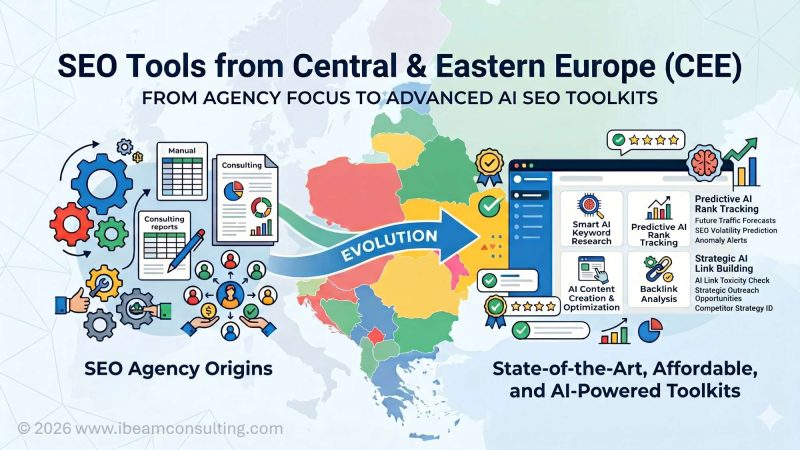
An important subset of powerful yet affordable SEO tools originates from the “CEE” countries of Europe.
This post highlights SEO tools from central and eastern Europe, with background, insights, and top examples that digital marketers everywhere should strongly consider for SEO-driven growth.
Let’s jump in for a closer look!
This post contains a few referral links to select vendor partners. We may receive compensation for purchases made through these links, at no additional cost to the buyer.
Last updated Jun 16, 2026
SEO Tools from Europe — The “CEE” Countries
The Rise of SEO Toolkits from “Non-Western” Europe
When digital marketers discuss the dominant forces in the SEO software industry, the conversation almost always defaults to a familiar, Western-centric narrative.
We talk about the multi-million dollar corporate suites headquartered in Boston or the venture-backed SaaS giants operating out of Silicon Valley and Western Europe.
This geographic bias, however, overlooks a massive, highly consequential reality: Central and Eastern Europe (CEE), including the Baltic states and the Balkans, have quietly transformed into a primary engine room of global SEO innovation and search data infrastructure.
Look under the hood of some of the most widely used SEO workflows today, and you will quickly realize that the global search marketing landscape relies on code written in Wrocław, Odesa, Bratislava, Kyiv, and Tallinn.
Far from being simple “cheaper SEO alternatives” designed to help budget-conscious freelancers cut corners, CEE-born SEO tools have systematically redefined key aspects of the industry.
Whether it is pioneered semantic/NLP content optimization, high-performance desktop web scraping, enterprise-grade programmatic SERP APIs, or beginner-friendly, high-visual-utility keyword suites, this region is no longer chasing global standards — it is setting them.
To understand this phenomenon, we must draw a specific regional map that includes Poland, Ukraine, Slovakia, Czechia, Belarus, Romania, Bulgaria, and other countries in the CEE region.
Within these borders lies an interconnected ecosystem of developers, agency founders, and mathematical analysts who have constructed a parallel market of search tools.
This post explores why this specific geography became such a fertile ground for SEO engineering, how these tools compare to Western legacy suites, and how they stack up against other rising SEO SaaS hubs like India.
SEO in Central & Eastern Europe
The CEE SEO Tech Origin Story: Why This Region?
The rise of Central and Eastern Europe as an SEO software powerhouse is not an accident of geography; it is the direct result of three powerful, converging factors.
1. The STEM and Engineering Heritage
The primary fuel driving this software boom is the region’s legendary technical talent pool. Across Poland, Ukraine, Romania, and neighboring states, educational systems have historically placed an immense, rigorous emphasis on mathematics, computer science, and hard engineering disciplines.
Cities like Wrocław and Warsaw in Poland, Kyiv and Odesa in Ukraine, and Cluj-Mohorâ (Cluj-Napoca) in Romania consistently produce world-class algorithmic engineers.
When applied to the field of search engine optimization – which is, at its core, a game of reverse-engineering complex mathematical ranking systems, parsing vast amounts of unstructured linguistic data, and handling massive database queries – this engineering-first DNA provided a massive advantage.
While Western SaaS often prioritized slick marketing and venture acquisition strategies, CEE teams focused on core algorithmic capabilities: how to build faster crawlers, handle heavier API requests, and parse linguistic semantics more accurately.
2. The Agency-to-SaaS Pipeline
Almost none of the dominant regional players started in a corporate boardroom or a VC pitch meeting. Instead, they were born on the front lines of local digital marketing agencies.
In the late 2000s and 2010s, local SEO agencies in markets like Poland, Ukraine, and Bulgaria faced a double challenge: they needed to deliver world-class SEO campaigns for local and international clients, but the cost of importing Western SEO tools was prohibitively expensive relative to local agency margins.
To solve this, agencies began building proprietary internal tools.
- In Ukraine, the Netpeak Group built internal keyword and crawl utilities that eventually spun out into Serpstat and Netpeak Software.
- In Poland, the founders of Surfer SEO drew directly from their own agency’s pain points in trying to manually calculate on-page keyword frequencies, deciding to automate the process using natural language processing algorithms.
- In Bulgaria, agencies realized that general rank trackers didn’t capture the hyper-local realities of regional search, paving the way for targeted programmatic tools.
Because these software platforms were designed by active practitioners to solve actual agency bottlenecks, they prioritized raw utility, speed, and real-world efficiency over superficial metrics.
Once these internal tools were polished, their founders realized they could sell them globally — disrupting the market with tools built by SEOs, for SEOs.
3. The Culture of Bootstrapping
Unlike their VC-bloated counterparts in Silicon Valley or London, the vast majority of CEE-based SEO SaaS companies built their empires through aggressive bootstrapping and Product-Led Growth (PLG).
Platforms like Slovakia’s Mangools (under parent company itrinity), Romania’s Squirrly SEO, and Estonia’s DataForSEO scaled to millions of dollars in Annual Recurring Revenue (ARR) purely on their own profits, without massive venture capital injections.
This lack of hyper-funding forced a healthy discipline on these companies. They could not afford to burn millions of dollars on aggressive sales teams or flashy billboard ads at major industry conferences.
Instead, every dollar had to be earned through product performance. To survive, regional tools had to have impeccable user interfaces, exceptionally high data limits, and rock-solid reliability that turned users into advocates.
This bootstrapping heritage instilled a culture of efficiency, lean operations, and a relentless focus on shipping features that customers would actually pay for on day one.
Pros & Cons of CEE SEO Toolkits
CEE/Baltic/Balkan SEO Toolkits vs. Today’s Major Global Giants
To assess the utility of CEE SEO tools, we must compare them against the industry’s massive all-in-one software suites (primarily headquartered in the US and Western Europe) that command the largest market share.
When building a professional workflow, choosing these regional alternatives presents clear strategic trade-offs.
The Pros
1. Exceptional UI/UX and Mindful Design
Unlike legacy platforms that can feel cluttered with decades of feature bloat, CEE SEO tools are celebrated for design minimalism.
Platforms like Mangools and Sitechecker have built global cult followings specifically because they reduce cognitive load.
They focus on clean, intuitive data visualization, allowing SEOs to extract insights in seconds rather than digging through endless submenus. This design-led philosophy values simplicity and focus over feature density.
2. Unmatched Value and Generous Data Limits
Because regional vendors operate with lower overhead and a culture of capital efficiency, they can pass these savings directly to their users.
For the price of a entry-level Western subscription (which often throttles keyword tracking limits or limits API access), a digital marketer can secure high-volume data packages from regional CEE SEO vendors.
This includes incredibly generous keyword lookup allowances, crawl limits, and reporting integrations that are priced to match the reality of growing agency budgets.
3. Powering the “Behind-the-Scenes” Data Infrastructure
Perhaps the biggest open secret in search marketing is that the major corporate suites are often just “skins” built on top of database infrastructure engineered in CEE.
Powerhouses like DataForSEO in Estonia provide the raw programmatic API connections that supply millions of rows of SERP, keyword, and backlink data to Western applications.
When you use CEE-based data providers directly, you are bypassing the middleman and plugging your reporting pipelines directly into the source.
4. Rapid, Focused Innovation Cycles
Unhampered by corporate bureaucracy, small and agile CEE engineering teams are incredibly fast at shipping updates.
Whether adapting to real-time changes in Google’s search algorithms, implementing advanced natural language processing (NLP) to model search intent, or building custom crawlers to handle heavy JS-rendered sites, these tools routinely outpace massive global suites in rolling out specialized, targeted features.
The Cons
1. Fewer Enterprise-Grade Integrations
For enterprise organizations, CEE tools can occasionally hit a ceiling. While they provide excellent API endpoints and standard Google Looker Studio connectors, they often lack native, out-of-the-box integrations with enterprise data warehouses (like Snowflake or BigQuery) or complex enterprise CRM ecosystems (like Salesforce).
2. The Brand Awareness Gap
Because these companies rarely raise tens of millions in venture capital, they do not have the massive marketing budgets required to dominate industry trade shows, sponsor major podcasts, or run aggressive global ad campaigns.
As a result, many of these platforms remain “insider secrets.”
Agencies using them must occasionally educate clients on why they are reporting metrics from a platform like Serpstat or Senuto rather than a household Western brand like Moz or Semrush.
3. Fragmented Tech Stacks
Choosing CEE tools often means adopting a “best-of-breed” multi-tool approach.
Instead of paying one premium invoice for a massive all-in-one corporate suite, an agency might choose to combine Mangools for research, Surfer for content creation, and Netpeak Software for heavy desktop crawling.
While this customized SEO stack is often vastly more powerful and affordable, it requires managing multiple subscriptions and distinct user access controls.
Related: Interested in the AI aspects of modern SEO? See my AI SEO Glossary for lots of important concepts and terminology in this growing area, plus a collection of free or freemium AI search visibility tools.
CEE SEO vs. Indian SEO Toolkits
Parallel Evolution: CEE Region vs. India’s SEO SaaS Ecosystem
The rise of SEO tool development outside of traditional Western tech hubs has created two clear centers of gravity: Central & Eastern Europe (CEE) and India.
Both ecosystems have emerged as premier engines of search technology, yet they have evolved along remarkably distinct structural and philosophical lines.
The “Agency-to-SaaS” Commonalities
At their roots, both regions are remarkably similar. Both ecosystems were built by elite software developers and ambitious local marketing agencies.
Facing the high cost of Western tools, agency teams in cities like Wrocław and New Delhi realized they could build superior, custom internal software to manage their clients’ campaigns.
Over time, these internal systems were polished, packaged, and spun out as independent SaaS ventures designed by active practitioners.
Deep Algorithmic Engineering vs. Workflow Orchestration
Despite their shared origins, the two regions possess very different technical orientations:
The CEE Approach
Heavily anchored in mathematical rigor and backend data infrastructure, SEO vendors in this region excel at technical heavy lifting.
They build raw programmatic backbones (DataForSEO), ultra-fast desktop site parsers (Netpeak Software), deep backlink analyzers (cognitiveSEO), and complex NLP semantic models designed to reverse-engineer Google’s language rendering (Surfer SEO).
The Indian Approach
Highly focused on scaling execution, workflow orchestration, and high-velocity output, Indian SEO tool vendors have masterfully seized on the AI-powered content wave, pioneering high-volume content automation engines (such as Scalenut, Writesonic, and Outranking).
They excel at structuring collaborative workspaces that help large marketing teams coordinate, write, and optimize content under one unified roof.
Capital Models: Bootstrapped Efficiency vs. Venture Scale
The funding landscape has shaped how these tools acquire customers and build products:
CEE’s Disciplined Product-Led Growth
Because venture capital has historically been harder to secure in Eastern Europe, regional SaaS companies focused on organic PLG.
Tools like Mangools or Squirrly SEO scaled to millions in revenue purely by designing products so intuitive that they sold themselves.
This bootstrapping heritage breeds highly focused, lean tools that prioritize long-term utility over marketing buzz.
India’s High-Velocity Growth
India’s vibrant venture capital ecosystem has allowed its SEO SaaS companies to raise substantial financing. This capital fuel allows companies to rapidly aggregate features, deploy aggressive global sales teams, and capture market share quickly.
While a CEE tool might master a single niche workflow over several years, an Indian SaaS competitor will rapidly build out an entire multi-tool suite to capture a broader market segment.
Visual Philosophy: Minimalism vs. Consolidation
This cultural divergence extends directly to the user interface:
CEE Minimalist Aesthetics
CEE tools generally lean toward clean, stripped-back interfaces that look and feel like consumer-grade software (often referred to as the “Apple aesthetic” of SEO). The visual design prioritizes empty space, simple charts, and single-task interfaces.
Indian Feature Consolidation
Indian SEO tools lean toward high-density dashboards that bring every imaginable feature into view. They are designed for digital marketers who want a comprehensive, single-screen control center to manage research, outline building, AI writing, optimization, and team collaboration simultaneously.
Related: See this post for more about popular Indian SEO tools, including origins and top vendor options.
CEE SEO Tools — Pricing & Bundling
Pricing, Bundling, and Market Positioning Strategies
The global market positioning of CEE, Baltic, and Balkan SEO vendors is defined by a central, powerful premise: the democratization of search marketing data.
As legacy Western SEO suites face private equity acquisitions and aggressive venture-driven pricing models, they have systematically raised subscription costs, restricted API integrations, and implemented restrictive, per-seat licensing models.
This “enterprise pivot” has created a massive, underserved gap in the SEO tools market. Freelancers, boutique agencies, and mid-market brands are increasingly being priced out of essential tools.
Regional vendors have stepped into this vacuum with highly aggressive, customer-centric commercial models.
Disrupting the “Per-Seat” Crisis
While legacy tools are locking multi-user access behind expensive enterprise tiers, many CEE tools maintain generous, team-friendly user limits.
Platforms like Serpstat and Sitechecker design their standard packages with the understanding that SEO is inherently collaborative.
By offering flat-rate pricing with flexible, multi-user seats, they allow small agencies to add practitioners without watching their operational software overhead skyrocket.
The Rise of the Lean Micro-Suite
The dominant commercial strategy across the CEE region is the “Micro-Suite.” Instead of attempting to be an absolute “all-in-one” behemoth that checks every corporate box, vendors focus on bundling 4 to 5 highly optimized core SEO tools under a single, exceptionally affordable subscription.
Slovakia’s Mangools is the masterclass of this strategy.
Rather than pricing their keyword researcher, SERP tracker, and link checker as individual premium systems, they bundle them into a unified, lightweight package.
This allows a growing digital marketing operation to run professional-grade campaigns at a fraction of the cost of a Western suite, leaving budget available to invest in specialized niche products.
API-First and Programmatic Data Provisioning
For data-heavy organizations, the true positioning masterstroke of the CEE tech scene is its API-first model.
Developers and programmatic SEO specialists have realized that Western visual dashboards charge an astronomical premium just to represent raw data.
Estonia’s DataForSEO and Romania’s GeoRanker bypass the dashboard altogether.
They sell raw SERP, backlink, and local ranking API credits directly to agencies and software developers. Because their overhead is strictly infrastructure-oriented, they are able to offer raw data at programmatic scale.
This allows agencies to build proprietary in-house SEO dashboards and report tools, bypassing subscription markups completely.
Top SEO Toolkits from Central & Eastern Europe
SEO Toolkits by Country or Region
This section highlights many of the top SEO tools from central and eastern Europe, including Baltic and Balkan countries.
Poland: The Powerhouse of On-Page SEO & Visibility
Surfer SEO
The undisputed category king of semantic on-page optimization.
Surfer revolutionized how SEO content is written by using natural language processing (NLP) algorithms to analyze real-time search engine results.
Surfer tells writers exactly what terms, headings, and semantic clusters are required to rank, bridging the gap between copywriters and search algorithms.
Senuto
A dominant search visibility analysis and rank tracking platform that is rapidly expanding across Europe.
Senuto stands out for its exceptional keyword clustering tools and AI-assisted content planning modules, which help marketing teams map out complete topical authority structures in seconds.
Contadu
An advanced content intelligence and strategy planning platform.
Contadu focuses heavily on strategic cluster mapping, competitor analysis, and semantic content writing to ensure that marketing teams are structuring their content around genuine search intent rather than just keywords.
Ukraine: The Masters of Scale and Auditing
SE Ranking
Today a massive, highly successful global brand, SE Ranking maintains strong engineering roots in the CEE region (including Ukraine and Poland).
It provides a robust, beautifully balanced all-in-one SEO platform that serves as a highly scalable, agency-friendly alternative to the oldest corporate suites, featuring advanced rank tracking, backlink monitoring, and AI overview analysis.
Serpstat
Originally built as an internal tool within the Netpeak Group, Serpstat has grown into a highly competitive, massive all-in-one SEO suite.
It offers robust rank tracking, competitor backlink analytics, local SEO, and a highly generous, incredibly cost-effective programmatic API.
Sitechecker
A beautifully designed, cloud-based technical audit and real-time monitoring tool.
Sitechecker stands out for its instant-alert system, which immediately notifies site owners if their pages are de-indexed, if robots.txt is changed, or if critical site health errors occur.
Netpeak Software
The ultimate power tool for technical SEO crawlers.
Comprising Netpeak Spider (a lightning-fast desktop site auditor) and Netpeak Checker (a URL list analyzer), this software is built to scrape massive amounts of technical web data, analyze backlinks, and execute internal PageRank calculations on lists of millions of URLs without hitting cloud limitations.
WebCEO
Deeply rooted in Eastern European software development, WebCEO is a premium white-label SEO suite designed specifically for digital agencies.
It offers 24 distinct, integrated marketing tools and detailed site audits tailored to support agency-client reporting workflows.
Slovakia: The Kings of UX & Accessibility
Mangools
Often called the “Apple of SEO tools” and “budget Ahrefs”, Mangools has built a global cult following by prioritizing minimalist, beautiful, and distraction-free UI design.
Its core tool, KWFinder, is widely considered the most accessible keyword research tool on the market, backed by four other incredibly intuitive tools for SERP analysis, link checking, and rank tracking.
Czechia / Czech Republic: Pragmatic Data & Engineering
Marketing Miner
A pure, bulk data engine designed strictly for professional SEOs.
Marketing Miner excels at executing bulk reports — allowing users to upload thousands of keywords or URLs simultaneously to check search volume, SERP features, current indexing status, and competitor metrics in massive batches.
Collabim
The oldest and most popular SEO tool in the Czech Republic and Slovakia.
Collabim is a highly specialized rank tracking and localized search engine monitoring suite designed to capture regional SERP variations with incredible precision.
Belarus: The Desktop Powerhouse
SEO PowerSuite
Built by LinkAssistant, SEO PowerSuite is the ultimate champion of desktop-based SEO software.
It includes four powerful applications: Rank Tracker, WebSite Auditor, SEO SpyGlass, and LinkAssistant.
Because it runs locally on your machine, it has no cloud storage overhead, allowing SEOs to run unlimited, deep site crawls and track thousands of keywords without paying recurring data-usage fees.
The Baltic States: Infrastructure & Reporting
DataForSEO (Estonia & Ukraine)
The silent programmatic engine that powers the global digital marketing industry.
DataForSEO is an API-first database provider that supplies raw SERP tracking, backlink indexes, Google Shopping lists, and keyword search volume data to hundreds of other prominent SEO software tools and agency reporting systems worldwide.
Brandpush (Estonia)
A specialized digital PR and news distribution platform.
Brandpush is highly popular among SEOs who want to automate authority-building link acquisition, distributing press releases to major news outlets to earn powerful, authoritative contextual backlinks.
Whatagraph (Lithuania)
While not a keyword tracker, Whatagraph is a gorgeous, premier visual marketing and reporting platform designed for digital marketing agencies.
It integrates seamlessly with Google Search Console, rank trackers, and analytics tools, automating the creation of highly polished, client-facing SEO dashboards.
Southeastern Europe: Technical Depth & Automation
cognitiveSEO (Romania)
A highly respected technical suite engineered for deep-dive link profiling and site content analysis.
cognitiveSEO is widely celebrated in the industry for its incredibly advanced backlink auditing tool, which can identify unnatural links, detect Google penalties, and provide a roadmap for complete site recovery.
Squirrly SEO (Romania)
A highly successful, AI-driven, all-in-one SEO plugin designed directly for the WordPress ecosystem.
Squirrly SEO provides real-time, on-page optimization advice as you type, combined with automated keyword planning and daily SEO “roadmaps” built specifically for non-technical bloggers and small business owners.
GeoRanker (Romania)
A highly specialized local rank tracker and SERP API.
GeoRanker uses a massive global network of localized IP proxies to track exactly where a website ranks across 50,000+ cities and zip codes worldwide, making it an essential tool for multi-location businesses and enterprise local SEO programs.
SEO Autopilot (Bulgaria)
A heavy-duty off-page SEO automation platform.
Built strictly for advanced link builders, SEO Autopilot automates the deployment of complex, high-domain authority backlinking and content syndication strategies, providing unmatched crawling and indexation management.
Koalanda (Bulgaria)
A highly specialized niche search tool built strictly for Etsy e-commerce.
Koalanda analyzes Etsy search patterns, mapping out real search volumes, tag performance, and competitor shop sales, allowing Etsy creators to optimize listings with programmatic precision.
SEO Stacks from Central & Eastern Europe
How to Build a “CEE-First” SEO Tech Stack
The true power of the CEE SEO market lies in your ability to mix, match, and orchestrate these platforms into custom, specialized toolsets.
By bypassing the corporate “all-in-one” subscription model, you can assemble a state-of-the-art search setup tailored to your specific operational style at a fraction of the cost.
Below are three blueprint stack configurations engineered for different business objectives:
1. The Budget-Conscious Agency Stack
Designed for boutique agencies and growing freelance practices looking to minimize software overhead while delivering enterprise-level deliverables.
The Workflow:
1. Use Mangools (KWFinder & SERPWatcher) to run highly visual keyword research, track daily position movements, and map competitor search share.
2. Hook Sitechecker.pro up to your clients’ sites to run automated weekly technical health audits, page-change monitoring, and immediate indexation alerts.
3. Plug both pipelines into Whatagraph to build elegant, automated visual reports that deliver clean, executive-level insights straight to your clients.
The Financial Impact:
While a mid-tier legacy corporate suite with similar user limits and agency-reporting features will easily run $500 to $800+ per month, this regional stack delivers superior UX, greater user flexibility, and pristine reporting for roughly $180 to $250 per month.
2. The Programmatic & Developer-First Stack
Engineered for in-house enterprise teams, SaaS product builders, and technical SEO operations managing tens of thousands of pages across multiple global markets.
The Workflow:
1. Leverage DataForSEO APIs to extract bulk keyword search volumes, historical search trend structures, and raw SERP features programmatically.
2. Deploy GeoRanker’s API to pull geo-targeted, hyper-local rankings using regional proxy networks across tens of thousands of ZIP codes.
3. Use Netpeak Spider & Checker locally on your developer machines to run massive, multi-threaded programmatic crawls across complex Javascript-heavy frameworks without incurring cloud API database surcharges.
Map these raw data streams directly into your internal data storage pipelines or a customized Looker Studio setup.
The Financial Impact: This stack bypasses the massive markups charged by Western visualization software. Instead of paying enterprise rates for visual access to search data, you are buying raw programmatic credits directly at the infrastructure level.
3. The Content-First SEO Stack
Optimized for high-velocity affiliate operations, digital publishers, and brand content hubs focused heavily on driving organic traffic via topical authority.
The Workflow:
1. Leverage Serpstat or Senuto to conduct deep competitive gap analysis and research local competitor keywords to construct structural semantic clusters.
2. Import your chosen content briefs into Surfer SEO to write, structure, and optimize content using real-time NLP modeling against top ranking pages.
3. Syndicate high-authority news releases and acquire authoritative backlinks directly through the Brandpush PR engine to rapidly boost domain topical authority.
The Financial Impact: By pairing the generous competitive research limits of Eastern European suites with the advanced linguistic modeling of Surfer, content teams can establish a scalable, high-velocity editorial process that out-optimizes legacy workflows.
Like this post? Quickly share it with your social networks here.
Want to make sure you never miss our updates? Click below to add us as a preferred source on Google Search.

SEO Tools from Central & Eastern Europe — Closing Thoughts
The Future of CEE SEO Tech
As we look toward the horizon of search marketing, the Central & Eastern European regional tech sectors are uniquely positioned to shape the next major era of organic discovery.
The industry is currently undergoing its most volatile structural shift since the advent of mobile search, and CEE engineers are demonstrating that their lean development culture is a massive competitive advantage.
Nimble Adaptation to the AI & LLM Era
The rise of Google’s AI Overviews, ChatGPT search, and alternative LLM search systems has sent shockwaves through the legacy SEO software market.
Established multi-billion dollar suites, bound by rigid data-scraping models and massive database dependencies, have struggled to adapt their tracking tools to capture the highly fluid, personalized nature of generative search.
In contrast, the agile engineering teams of the CEE region have shipped tracking solutions in record time.
- SE Ranking and Senuto were among the very first to roll out comprehensive, real-time rank tracking models specifically mapped to capture Google’s AI Overviews, identifying whether a client’s brand is featured inside synthesized AI answers.
- Mangools has actively begun testing visibility trackers mapped directly to search-capable large language models (LLMs), giving early adopters a distinct edge in optimizing for non-traditional search systems.
- Surfer SEO continues to refine its NLP algorithms to keep pace with Google’s changing semantic retrieval models, moving past basic keyword density calculations toward complete topical domain alignment.
Because regional tech hubs are unencumbered by corporate bureaucracy, they can prototype, test, and ship APIs that parse brand new search layouts weeks – and sometimes months – before Western legacy systems can clear legal and product updates.
The Private Equity and Consolidation Wave
The impressive financial efficiency and organic growth of bootstrapped CEE tools have caught the attention of global tech investment groups. We are starting to see the transition of regional search tech from “indie underdog” status to a highly institutionalized asset class.
The most prominent example of this maturation is the Czech investment firm Pale Fire Capital, which acquired a majority stake in Slovakia’s itrinity (the parent group behind the Mangools suite).
By backing product-centric software with strategic growth capital, these investment engines are helping regional players scale their infrastructure, acquire neighboring regional micro-tools, and deploy global marketing initiatives without sacrificing the product-first focus that made them successful in the first place.
This consolidation wave means that CEE toolsets are becoming increasingly stable, secure, and ready to compete directly with enterprise-level market options.
Closing Thoughts: The Regional Arbitrage Advantage
For the modern digital marketer, business owner, or search practitioner, utilizing SEO tools from the CEE region is not just about choosing an alternative tool — it is about leveraging a powerful form of economic and structural arbitrage.
By integrating regional tools into your regular workflow, you are actively benefiting from:
- Engineering Arbitrage: Tapping into elite mathematical and NLP software architectures engineered by world-class Eastern European computer scientists.
- Financial Arbitrage: Capturing generous data allowances, high-volume crawling limits, and multi-user configurations at a fraction (1/3 to 1/5) of the cost of legacy Western equivalents.
- Operational Arbitrage: Bypassing visual suite markups to extract raw search databases directly from regional infrastructure providers like DataForSEO.
In an era where marketing budgets are closely scrutinized and SEO requires absolute data accuracy, ignoring the software innovations emerging from Poland, Ukraine, Slovakia, and other countries in the CEE region is no longer just a missed opportunity — it is leaving substantial margin and technical capability on the table.
🚀 Ready to Diversify Your SEO Stack? (Choose Your Path)
If you are ready to break free from the constraints of legacy “all-in-one” subscription models, here is how you can pilot CEE search technology in your workflow today:
- The Agency Pilot Plan (Zero Risk): Set up a free trial with Mangools. Run a baseline keyword project through KWFinder to experience their minimalist, distraction-free interface firsthand.
- The Technical Diagnostic Test: Download the free trial of Netpeak Spider or run a quick scan on Sitechecker. Compare their page-speed diagnostics and indexation alerts against your current tools to see if you are missing crawl errors.
- The Developer Data Challenge: Sign up for an sandbox API account with DataForSEO. Run a sample query to see how easy and affordable it is to pull raw SERP and keyword trends directly into your team’s custom internal spreadsheets.
Questions or Comments?
I hope this overview of SEO tools from Europe’s “CEE” region has been informative and helpful! Let’s wrap things up with a few related questions for you:
- For SEO practitioners or website owners, how familiar are you with SEO toolkits from the CEE countries of Europe?
- Do you have any of these toolkits in your core SEO tools stack today?
- Especially for users outside of Europe, how do these SEO options compare with your current suite of SEO tools?
Feel free to add more in the comments below with any thoughts, feedback, or related questions. Thanks also for any social shares on this post via the buttons below!
