
Growing New SEO Skills for the Age of AI Search
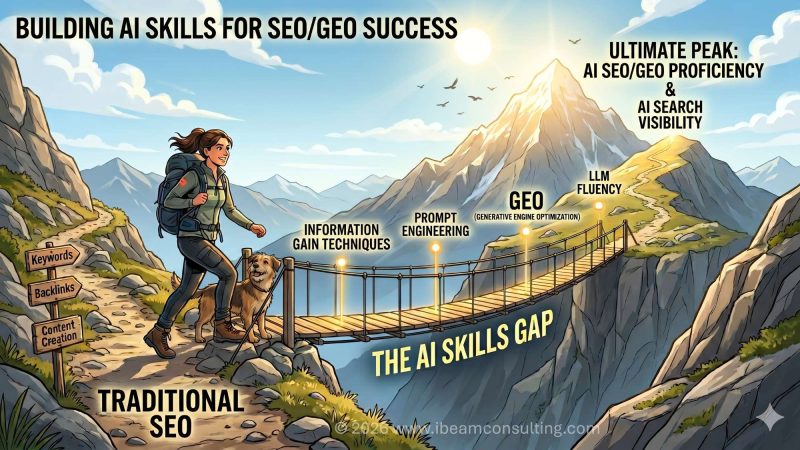
SEO is changing rapidly in the age of AI, and the skills that drove success in organic search yesterday are no longer sufficient for AI-driven SEO today or tomorrow.
New realities demand new skills: AI-centric skills for AI SEO and generative engine optimization (GEO).
This post provides an overview of AI skills needed for modern SEO & GEO, including insights, tips, and educational resources for building the critical skills needed for AI SEO success.
Let’s dive right in and learn more below!
This post may contain a few referral links to select vendor partners. We may receive compensation for purchases made through these links, at no additional cost to the buyer.
Last updated Jun 22, 2026
Building AI Skills for SEO and GEO
Introduction: The Death of the Blue Link (And What Comes Next)
For over two decades, the unspoken contract of the internet was simple. A user typed a query into a search bar, a search engine served up a list of ten blue links, and the user clicked through to find their answer.
That contract has been torn up.
With the explosive rise of AI-driven answer engines – ranging from Perplexity and OpenAI Search to Google’s AI Overviews and Gemini – the search landscape is undergoing its most radical transformation since the invention of PageRank.
Today, search engines are no longer just indexing the web; they are reading it, digesting it, and synthesizing custom, direct answers for users.
This technological leap has created a sharp divergence in the search marketing world, dividing optimization into two distinct, interconnected practices:
- SEO (Search Engine Optimization): The classic discipline of structuring, optimizing, and indexing web pages so they rank highly in traditional search engine results pages (SERPs).
- GEO (Generative Engine Optimization): The emerging discipline of optimizing brand information, digital PR, and content so that Large Language Models (LLMs) find, cite, and recommend your brand within their synthesized generative responses.
Many digital marketers look at this shift with dread, treating AI as a threat to their organic traffic.
But the real threat isn’t AI itself; it’s clinging to obsolete skills.
AI is no longer just a productivity tool to help you research and write copy faster. It is the fundamental, underlying infrastructure of the modern web.
To survive and thrive in this new era, search professionals must undergo a profound mindset shift: we must transition from keyword matching to “information gain” creation, and from completely manual content production to AI-system orchestration.
AI Essentials for the New SEO
Today’s Arsenal: Essential AI-Focused Skills for Success
You do not need to wait for next year, or even the next calendar quarter, to start adjusting your SEO skill set. The shift is already happening, and the marketers winning the visibility war today are practicing a completely different set of core competencies than they were just two years ago.
If you want to maintain and grow your search visibility today, these are the four pillars of the modern search marketer’s toolkit.
1. Engineering “Information Gain” (The New Currency of Visibility)
For years, the “Skyscraper Technique” – finding the top-ranking page for a keyword and writing a longer, slightly more thorough version – was the gold standard of SEO. Today, AI has made this technique completely obsolete.
Because LLMs are trained on billions of pages, they already know the “consensus answer” to almost any common query.
If your content simply repackages that same consensus, an LLM has no reason to cite you, and an AI search engine has no reason to link to you.
The new goal is Information Gain — the measure of how much new, truly unique information a piece of content adds to the existing corpus of knowledge on the web.
To optimize for GEO, you must learn to find the consensus “information gap” (the things AI answers miss or get wrong) and actively inject “high-gain” elements into your content.
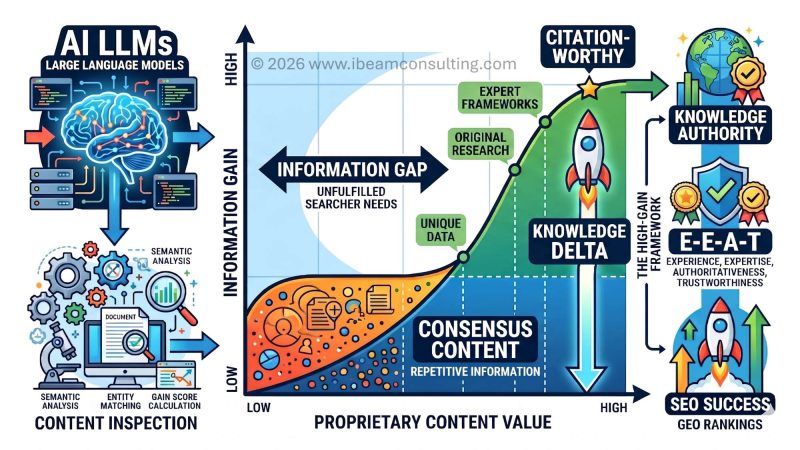
According to pioneering academic research on Generative Engine Optimization, incorporating specific factual, authoritative structures drastically improves your baseline visibility and changes your relative likelihood of being cited by LLMs:
- Cite Credible Sources: Integrating and linking to reliable, third-party authoritative sources and academic datasets can improve your generative visibility by up to 40% (relative improvement).
- Add Precise Statistics: Replacing vague, qualitative descriptions with highly specific numbers and structured metrics can increase your AI citation visibility by up to 37% (relative improvement).
- Integrate Direct Expert Quotes: Injecting unique expert perspectives, direct quotes, and human insights that cannot be synthetically simulated by an LLM boosts brand citations by up to 30% (relative improvement, and up to 41% in certain generative engine configurations).
Related: Learn more in these posts about boosting SEO with information gain and improving B2B SEO with information gain elements.
2. Advanced Prompt Engineering & “Vibe Coding” for Search
Basic copywriting prompts are a commodity. Writing “Write me a 1000-word blog post about digital marketing trends” yields generic, low-quality results that fail search quality guidelines.
Today’s search marketers must master advanced prompt engineering and low-code utility creation.
This means moving past the basic AI chat interface and learning how to:
- Build Custom GPTs & Gems: Developing tailored AI assistants programmed with your brand’s style guide, target audience personas, and technical SEO rules.
- Master System & Few-Shot Prompting: Giving LLMs clear instructions, structural constraints, and high-quality examples of the exact output you expect to ensure highly accurate results.
- Engage in “Vibe Coding”: Using natural language to direct AI tools to build custom scripts, scraping tools, or data parsers without needing a computer science degree. If you can clearly articulate a technical workflow, you can use AI to build a tool that executes it.
3. Technical GEO Strategy & Optimization
Traditional technical SEO focuses on XML sitemaps, crawl budgets, and page speeds. While those still matter, technical GEO requires an understanding of how LLMs retrieve, read, and attribute information.
To optimize your site’s infrastructure for modern AI search, you must understand Retrieval-Augmented Generation (RAG) — the process by which an LLM queries an external data source (like the web or your website) to answer a user’s question.
Technical GEO skills include:
- Formatting for LLM Parsers: Structuring your content with clear, semantic headings, bullet points, and table structures that LLM web crawlers can easily parse and digest.
- Semantic Entity Schema: Using advanced Schema.org markup to explicitly tell AI crawlers what your entity (your brand, product, or author) is, how it relates to other entities, and why it is authoritative.
- Digital PR & Off-Page Citations: LLMs look for validation across the web to ensure their answers are accurate. Securing high-authority mentions on trusted industry websites, forums (like Reddit or Quora), and news platforms builds the external “semantic footprint” that LLMs use to verify your brand’s authority.
4. “AI-Human” Editorial Oversight (E-E-A-T & Quality Assurance)
Google’s search quality evaluator guidelines place massive emphasis on E-E-A-T (Experience, Expertise, Authoritativeness, and Trustworthiness).
Purely AI-generated content often lacks the “human-in-the-loop” elements required to satisfy these standards, frequently resulting in bland prose, outdated information, or outright factual hallucinations.
The modern search marketer must act as a managing editor for AI-generated outputs. Many top organizations use variations of responsible AI frameworks, such as Google’s ACT (Ask, Check, Tell) model:
- Ask (Define the Prompt): Knowing how to prompt the AI to generate the skeleton, draft, or data points for your content.
- Check (Fact-Check & Verify): Rigorously verifying every statistic, date, quote, and claim made by the AI. You must be skilled at catching hallucinations and verifying sources.
- Tell (Inject Human Soul): Rewriting generic AI transitions, injecting your unique brand voice, and layering in real-world personal experience (a critical “E” in E-E-A-T) that no AI model could possibly duplicate.
Evolving Your AI Skills for SEO Success
The 3-Year Horizon: How the AI Skills Profile Will Evolve (2026–2029)
While today’s search landscape demands immediate adjustment, the next three years will completely reshape what it means to be an SEO. The progression of AI from a basic, chat-based assistant to an autonomous, multi-modal systems operator is already underway.
If you want to stay in the top tier of the profession as we head toward 2029, your focus must expand to include these three rapidly emerging areas:
1. The Pivot from Prompting to Agentic Workflows
The era of manual, copy-and-paste prompting is coming to an end. It is simply too slow and fragmented to scale.
Over the next three years, search marketers will transition from writing individual prompts to designing and managing autonomous AI Agents.
Instead of manually prompting an AI to draft an article, cluster keywords, or audit metadata, you will configure multi-agent teams using frameworks like LangChain, CrewAI, or enterprise low-code agent builders.
The Skill Needed: You must become an “agent architect.”
This involves mapping out complex search marketing workflows, establishing specialized agent roles (e.g., an “Audit Agent” that crawls data, a “Scoping Agent” that identifies priorities, and a “Writing Agent” that drafts updates), and setting up governance loops to safely review their automated execution.
2. Multi-Modal Optimization (Beyond the Written Word)
The input of search is no longer limited to text strings. Users are increasingly searching with their cameras, voice assistants, and video uploads.
Accordingly, generative search engines are synthesizing answers that combine audio, dynamically generated video, and custom interactive visuals.
If your optimization strategies only target written text, you are missing a massive percentage of the modern generative ecosystem.
The Skill Needed: SEOs must learn to optimize the raw multi-modal inputs that AI engines consume.
This means structuring schema for rich media, optimizing spoken audio transcripts for conversational patterns, and managing “visual intent” (ensuring your imagery clearly explains complex processes so that visual search models like Google Lens can easily interpret and recommend them).
3. First-Party Brand LLM Tuning & Integration
As enterprises increasingly build and deploy their own internal, custom-facing chatbots, the lines between external search optimization and internal brand discovery are blurring.
If a consumer asks a brand’s proprietary virtual assistant for a product recommendation, that bot must fetch accurate, highly optimized internal brand data.
The Skill Needed: For larger enterprises, search marketers will collaborate with internal data science teams to optimize internal knowledge graphs.
This requires a basic literacy in vector databases, semantic indexing, and knowing how to feed brand-approved product data directly into RAG systems so that corporate internal LLMs represent products correctly.
Education Resources for AI-Powered SEO
Where to Learn: AI & SEO Educational Platforms & Courses
The rapid acceleration of AI has made many traditional search marketing curricula outdated. To build a robust, future-proof skillset, you must look to programs that teach rigorous AI implementation alongside modern search fundamentals.
Here are several premier educational platforms and courses where you can acquire these skills today:
1. Broad AI/ML & Prompt Engineering Foundations
Before you can optimize for AI systems, you must understand how they work. These foundational courses bridge the gap between abstract AI theory and practical workplace execution.
Google AI Professional Certificate
This premier seven-course program is highly recommended for search marketers looking to shift from basic prompt writing to true “AI Fluency.” It provides a highly hands-on, job-oriented curriculum. The most valuable modules for SEOs include:
- AI for Research and Insights: Teaches learners how to use Google’s Deep Research features and NotebookLM to dissect dense industry topics, map “consensus gaps,” and fast-track original analysis.
- AI for Data Analysis: Walks through using Gemini inside Google Sheets to structure, clean, and visualize messy search traffic and ranking data.
- AI for App Building: A capstone course where you learn “vibe coding” — using natural language to build and deploy your own custom, reusable workspace tools (like programmatic metadata generators or audit tools) without writing code.
This Google AI certification course is also available from Coursera here.
DeepLearning.AI (Andrew Ng)
For those wanting to understand the engineering underpinnings of modern AI, Andrew Ng’s short courses are the gold standard. They offer excellent, accessible breakdowns of how LLMs process data, the mechanics of prompt engineering, and how autonomous AI agents function.
2. SEO-Specific AI Applications (Self-Paced Courses & Specializations)
If you already have a solid grasp of AI fundamentals and want to apply them directly to modern technical search, look to these industry-trusted platforms:
Coursera AI SEO Tracks
AI SEO: Mastering Generative Engine Optimization (GEO)
An incredibly targeted course explicitly focusing on SEO’s evolution into AI search. It covers how AI engines understand entities and intent, formatting schemas for AI parsers, and monitoring visibility in Google AI Overviews, Perplexity, and Bing Copilot using emerging GEO tracking metrics.
You can also explore closely related paths like Generative Engine Content Optimization and Generative Engine Optimization Business Applications.
Part of Coursera’s broader SEO and Content Strategy path, this course walks search marketers through mapping keyword clusters, utilizing AI tools safely to draft pages, and refining drafts with human oversight to preserve E-E-A-T.
Check out their specialized courses AI Content Creation and SEO Optimization and Optimize Content with AI for SEO for broader toolsets.
Udemy AI SEO Courses (Tactical, Tool-Based Guides)
Complete AI SEO Course: Beginner’s Guide to SEO with AI
A popular hands-on guide that teaches practical methods for using AI tools to handle high-speed keyword clustering, programmatic title creation, and automated backlink profiling.
AI SEO Mastery w/ OTTO By Search Atlas: A Step By Step Guide
A structured, step-by-step guide showing how to integrate modern AI pixels (like OTTO) to automate technical schema setups, metadata deployment, and semantic adjustments.
AI Search Optimization Masterclass
Created by AI SEO platform vendor Surfer SEO, this is a highly practical course that breaks down structural content optimizations (FAQs, comparison tables) to ensure LLMs quote and reference your pages properly.
3. University Programs & Executive Education
For senior professionals, agency owners, or enterprise managers looking for accredited, highly strategic instruction on how to lead AI-driven search transformations:
University of Virginia (UVA SCPS – Online)
Offers Artificial Intelligence for Marketing, a 5-week practical online program.
Taught by industry practitioners, this program features hands-on projects showing you how to build automated content pipelines (linking ChatGPT/Gemini to Make.com), conduct AI competitor research, and directly optimize your content architecture for AI search visibility (GEO).
Harvard University (Division of Continuing Education)
Offers the executive-level AI Marketing Course: Transforming Strategies with Generative AI. Over a rigorous multi-day format, it covers hyper-personalization, content automation scales, and specifically includes a module on AI in Search: SEO and New AI Tools to guide corporate search strategy.
Northwestern University (Kellogg School of Management – Online)
Offers AI-First Marketing Strategy: Executing Intelligent Systems for Growth. This comprehensive executive program is designed to build “Intelligent Marketing Operating Systems.” Module 5 covers Discovery in AI-Powered Answer Engines, teaching leaders how to capture organic market share when search is mediated by AI platforms.
Wharton Executive Education (University of Pennsylvania)
Offers AI in Marketing: Creating Customer Value in an AI-Driven Enterprise. In addition to brand value structures, this blended program explores the technical nuances of Large Language Model Optimization (LLMO) — which is the academic enterprise equivalent of GEO.
NYU School of Professional Studies (SPS)
Offers a highly creative, online course titled AI for Marketing and Communications: Generative Creativity & Content Innovation. It teaches marketers how to navigate multi-modal platforms, structure brand prompt chains, and target the modern consumer on discovery-based AI search engines.
(You can also view their Advanced AI and Communications Workflows, Automation, and Ethics certificate for programmatic agency pipeline setups).
Industry Bootcamps
For a deep dive into the software engines themselves, explore Search Atlas’s proprietary AI Search & SEO Mastery Course to understand local SEO automation, site structure crawls, and forced citation mechanics.
4. Technical & Code-Adjacent Paths
If you are moving toward a technical, builder-focused SEO track, you will eventually want to interact directly with APIs, data frames, and vector storage.
Kaggle & freeCodeCamp
Both platforms offer outstanding, free, hands-on programming courses. Focus specifically on learning Python, the pandas library (for data analysis), and how to connect to LLM APIs (like OpenAI or Gemini) to automate bulk data processing tasks.
AI SEO Skills & Career Stages
SEO Career Stage Impact: Who Needs What?
The AI revolution in search is not a one-size-fits-all disruption. Your career stage dictates both the severity of the threat you face and the nature of the opportunity available to you.
To future-proof your career, you must play to your specific experience level while aggressively shoring up the exact vulnerabilities AI threatens to expose.
1. Early-Career SEOs (0–3 Years Experience)
The Threat: Historically, early-career search marketers cut their teeth on execution-heavy tasks: basic copywriting, keyword mapping, meta tag generation, and simple link-building outreach.
Because LLMs can now perform these tasks in seconds, the traditional “entry-level SEO” job is shrinking rapidly. Agencies and brands no longer need small armies of junior SEO staffers to write keyword-centric articles.
The Opportunity: While AI has automated execution, it has democratized strategy.
Early-career SEOs have a unique chance to leapfrog traditional career progression by establishing themselves as the high-speed “AI power-users” of their organizations.
Your Action Plan:
- Focus on becoming a masterful editor of AI-generated content, an agile data analyzer, and a rapid prototyper.
- Get certified early (e.g., via the Google AI Professional Certificate or similar programs) to prove your technical AI fluency.
- Learn to use LLMs to automate your own manual work so you can dedicate your energy to studying user search intent, brand strategy, and complex technical setups.
2. Mid-Career SEOs (4–8 Years Experience)
The Threat: Mid-career professionals often find themselves bogged down in operational oversight — managing teams of writers and content producers, reviewing manual site audits, and orchestrating massive content calendars.
These manual, high-friction workflows are exactly what automated, agentic systems are poised to consolidate. If your primary value is “managing the production pipeline,” your role is highly vulnerable.
The Opportunity: The next phase of your career is about moving from an operational manager to a strategic orchestrator.
AI tools are only as good as the systems designed to guide them. Mid-career SEOs are perfectly positioned to design these custom agency or brand workflows, map complex AI solutions to high-level client business goals, and bridge the gap between technical developers and creative writers.
Your Action Plan:
- Transition from manual review to systemic design.
- Learn how to construct agentic teams (using tools like CrewAI or custom LLM frameworks) to run audits and cluster keywords automatically.
- Focus on translating GEO data into clear, business-driven narratives that C-suite stakeholders can actually understand.
3. Late-Career / Executive SEOs (8+ Years Experience)
The Threat: The danger for search directors, CMOs, and veteran consultants is a growing disconnect from the technical reality of how search actually works.
If you are still relying on a 2018 – 2022 playbook built around keyword rankings and desktop CTR tables, you risk making catastrophic budgeting decisions and leading your team down obsolete paths.
The Opportunity: Your veteran experience – your understanding of positioning, brand authority, business economics, and risk management – is more valuable than ever.
AI cannot simulate organizational leadership, ethical risk mitigation, or executive negotiation. Your role is to lead the AI transformation strategy safely, steering the ship through the legal, financial, and cultural waves of AI integration.
Your Action Plan:
- Shift your focus to tech stack budgeting, data privacy, and legal compliance.
- Understand how generative engines scrape and attribute content so you can make informed decisions about your brand’s indexation policies (such as when to block AI crawlers via robots.txt).
- Master the art of positioning your organization as a dominant “entity” in the eyes of LLMs by driving executive-level brand campaigns and high-authority PR.
Technical vs. Non-Technical AI SEO Skills
The DNA Divide: Technical (STEM/Data) vs. Non-Technical (Creative/Editorial) Pathways
One of the most persistent anxieties in the search marketing community is the belief that everyone must become a computer scientist to survive the AI transition.
This is a myth.
While the search ecosystem is becoming highly technical, optimizing for generative engines actually requires a profound symbiosis of two distinct, equally vital skill sets: the Technical Path (The Builders) and the Non-Technical Path (The Storytellers).
1. The Technical SEO Path (The Builders & Systems Thinkers)
Technical SEO is no longer just about optimizing server response times or correcting redirect loops. It is about building and maintaining the structural pipes that feed AI models.
If you have a background in STEM, development, or data science, this is your path.
Your Superpower: The ability to construct scalable, clean data structures that machine-learning algorithms and LLMs can crawl and digest instantly.
Your Key GEO Value:
- RAG & Vector Preparation: You ensure that your brand’s site architecture, nested schema markup, and internal knowledge bases are formatted seamlessly to feed into Retrieval-Augmented Generation (RAG) systems.
- Data Engineering for Search: Instead of looking at basic keyword charts, you write Python scripts and use pandas libraries to query LLM APIs, run automated semantic content audits, and map out crawl anomalies across millions of URLs.
- Agentic System Scale: You write the actual code and API integrations that connect autonomous agent teams to your content and technical monitoring pipelines, creating near-instant response loops for your brand’s digital assets.
2. The Non-Technical SEO Path (The Storytellers, Writers & Strategists)
Many creative search marketers fear they are being replaced by code.
In reality, LLMs are fundamentally language models; they process human semantics, tone, and subjective value.
If your strengths lie in writing, PR, and relationship-building, your skill set is the crucial human variable that AI cannot replicate.
Your Superpower: The ability to build and leverage “Information Gain” — creating the original, authoritative, emotionally resonant human content that AI models actually want to cite.
Your Key GEO Value:
- Expert Integration & E-E-A-T: You lead the “human-in-the-loop” content creation. You interview subject matter experts, orchestrate primary research, and design original, real-world case studies that LLMs cannot synthesize or predict out of thin air.
- “Vibe Coding” Your Own Tools: Because natural language is the new programming language, you don’t need to write Python to build custom solutions. You can use systems like Gemini Gems or custom GPTs to build complex content briefs, editorial styling engines, or metadata optimizers simply by describing your workflow in detail.
- Digital PR & Off-Page Citations: LLMs establish “trust” by verifying your brand’s claims across human-curated, high-authority domains. Your ability to build relationships, earn natural media mentions, and foster active discussions on forums (like Reddit) builds the off-page semantic authority that AI search engines use as critical ranking signals.
3. The Sweet Spot: A Symbiotic Ecosystem
Neither of these first two paths can win the AI search wars alone.
A technical “builder” can design the most advanced, perfectly indexed RAG pipeline in the world, but if the content flowing through those pipes is generic AI-generated fluff, the brand will fail to secure generative citations.
Conversely, a brilliant writer can produce a masterpiece of original research, but if the site lacks structured schema and parseable formatting, AI crawlers may never find it.
The future of search marketing belongs to teams that embrace this symbiosis: the technical “builders” constructing the machine-readable highway, and the creative “storytellers” providing the high-gain fuel that makes the journey worthwhile.
AI Skills for Agency vs. In-House SEO
Structural Considerations: Agency vs. In-House (SMB vs. Enterprise)
The corporate or operational setting in which you practice search marketing dictates how you orchestrate your AI workflows.
An agency SEO director managing fifty accounts has a completely different risk profile, technical baseline, and throughput requirement than a solo in-house marketer at a B2B SMB or an enterprise B2C manager governing millions of landing pages.
1. The Agency Perspective: Scaling Quality and Speed
In an SEO agency, profitability lives and dies on efficiency and client retention. If your team is still spending dozens of hours manually clustering keywords, writing copy options, or formatting monthly PDF reports, your margins are shrinking.
The Core Focus: Standardizing scale without sacrificing quality.
Key Skills to Develop:
- API-Driven Audits: Leveraging LLM APIs to process bulk data (like analyzing intent gaps or translating localized pages at scale) rather than copy-pasting into AI chat windows.
- Programmatic SEO Integration: Merging structured external data (like inventory or location spreadsheets) with localized templates to spin up hyper-targeted, high-quality pages efficiently.
- Unified AI Governance: Designing strict organizational prompts and content templates (such as shared Gemini Gems or custom GPTs) to ensure that junior team members generate output that matches agency quality standards.
2. The In-House SMB: The Agile “One-Person Search Department”
Small-to-medium businesses (SMBs) rarely have the luxury of specialized SEO teams. Often, a single search marketer is responsible for writing content, resolving technical crawl issues, managing paid search, and running digital PR campaigns.
The Core Focus: Doing more with less through high agility and hyper-automation.
Key Skills to Develop:
- Low-Code Integration (Zapier / Make): Building simple “if-this-then-that” sequences. For example, setting up a system where every time a new customer case study is published, an AI agent automatically formats a social thread, generates localized meta descriptions, and updates internal link schema.
- Workspace AI Assistants: Creating custom Gemini Gems trained entirely on your specific SMB style guide, brand voice, and inventory lists to act as your personalized virtual copywriter and editor.
- Nimble Content Pivots: Quickly spotting niche “consensus gaps” in search results and launching targeted, high-gain pages before enterprise competitors (hindered by corporate approvals) can react.
3. The In-House Enterprise: Governance, Security, and Brand Alignment
In an enterprise organization, scale is a given, but speed is often a luxury. One compliance mistake or AI algorithmic hallucination can cost millions of dollars in brand equity, lead to legal action, or trigger Google quality penalties.
The Core Focus: Navigating risk mitigation, protecting proprietary brand data, and establishing clean structural alignment.
Key Skills to Develop:
- Data Security and Privacy Guardrails: Ensuring that your content teams are not feeding sensitive, proprietary company data or customer records into public LLM training pipelines. Enterprise SEOs must work closely with IT to run all workflows through private, secure APIs or local, containerized open-source LLMs.
- Navigating Legal Compliance: Establishing rigorous human-in-the-loop review checks to ensure that AI-generated resources do not violate copyright, run afoul of industry-specific regulations (like medical or financial guidelines), or hallucinate non-existent product capabilities.
- RAG Knowledge Base Structuring: Learning how to map and format massive internal corporate catalogs so they can be smoothly ingested by custom, consumer-facing brand engines.
AI SEO Skills — Related Issues
The “X-Factor”: Hidden Variables to Keep in Mind
Beyond technical roadmaps and career tracks, navigating the future of search requires managing a handful of complex, systemic shifts that are fundamentally rewriting the search contract.
To stay ahead, you must understand how to measure your success when traditional benchmarks become obsolete.
1. The Shifting Metric Paradigm: Measuring the Invisible
For decades, the lifeblood of SEO was simple: Organic CTR, Keyword Rankings, and Organic Session Traffic. If your page ranked #1, you won the traffic.
In a generative engine optimization environment, this model falls apart.
If an AI search engine reads your content, synthesizes a comprehensive response, cites your brand name, and answers the user’s question directly inside the interface, the user may never click through to your website.
This is the current zero-click search reality.
To prove your marketing value now, you must master a completely new class of analytical metrics:
- Brand Share of Voice (SoV) in LLMs: Using AI visibility-tracking tools designed for generative search to monitor how often your brand is recommended, synthesized, or cited by Perplexity, Gemini, and OpenAI Search for queries in your niche.
- Citation Placements and Sentiment: Tracking where your citation appears (e.g., is your link at the very top of the generative summary, or buried in a footnote?) and analyzing the qualitative tone of how the AI describes your product.
- Downstream Referral Quality: Shifting focus from raw traffic volume to high-intent traffic. Zero-click searches will screen out casual, informational browsers, but users who do click through the AI’s direct citations will often be highly qualified, bottom-of-the-funnel leads.
2. The Battle for Crawl Consent: Ethics, Scraping, and robots.txt
As AI companies scramble to train their massive models and power real-time search results, a highly contentious battle has emerged over web crawl consent.
Brands are increasingly forced to ask a difficult question: Should we let AI companies scrape our site for free?
This creates a complicated strategic paradox:
- If you allow crawling: Your high-gain, proprietary data will be ingested by LLMs. They may use it to answer questions directly in search interfaces, potentially diverting traffic from your site, or use it to train models that will eventually compete with you.
- If you block crawling (via robots.txt): If you opt to block user-agents like GPTBot or Google-Extended to protect your data, you risk becoming invisible to those engines. If Perplexity or Gemini cannot read your site, they cannot recommend, cite, or link to your brand in their real-time responses.
Modern search professionals must develop a deep literacy in crawling governance. You must learn how to strategically manage robots.txt files, use semantic paywalls, and negotiate indexation permissions to protect proprietary brand equity while preserving generative search visibility.
Like this post? Quickly share it with your social networks here.
Want to make sure you never miss our updates? Click below to add us as a preferred source on Google Search.

Building AI Skills for SEO — Closing Thoughts
Conclusion: Driving the Transition
The former implicit contract of the web has fundamentally evolved. The familiar world of ten blue links is giving way to an ecosystem of real-time synthesis, digital assistants, and LLM-mediated answers.
This transition represents an evolutionary fork for search professionals. Marketers who limit their skills to basic copywriting, keyword-driven copy, and manual report curation are going to face structural displacement.
Conversely, those who build modern AI-infused SEO skill sets – engineering real Information Gain, architecting Agentic Workflows, understanding technical RAG structures, and leading the strategic bridge between builders and storytellers – are entering the most high-leverage era in the history of search marketing.
The shift from SEO to GEO is not a death sentence for organic traffic; it is a rebirth of what organic authority truly means.
The goal is no longer just ranking on page one. The goal is becoming the definitive, verified factual source that the world’s most powerful AI models rely upon to explain reality.
Your Next Step
Do not let the scale of this transition freeze you into inaction. Focus is your greatest defense against disruption. Pick one immediate project to build momentum:
- Conduct a “Consensus Gap” Audit: Take your highest-performing organic landing page. Query the top LLMs (Gemini, ChatGPT, and Perplexity) about that topic. Find the structural elements, quotes, or statistics their answers miss, and actively edit your page to provide those high-gain details.
- Invest in Structured Learning: Start a dedicated learning program, like the Google AI Professional Certificate, to transition from writing basic text prompts to building functional custom utilities and master raw AI data cleaning.
The future of search belongs to those who build it. Which AI SEO skill will you start building today?
Questions or Comments?
I hope these insights and educational resources for building AI skills for the new world of SEO & GEO have been helpful! Let’s close now with a few related questions for you:
- How are you building and adapting your SEO skills today? How much AI-centric education is involved?
- Which AI skill are you focusing on first this quarter?
- What are your current favorite “go-to” resources for building AI skills specific to SEO and GEO work? Why do they work well for your needs?
- How much is SEO vendor-specific education (Ahrefs, Semrush, others) playing a role here?
Feel free to add more in the comments below with any thoughts, feedback, or related questions. Thanks also for any social shares on this post!
