
Last updated Oct 10, 2025
Reaching Buyers at All Funnel Stages
Marketing and sales funnels have multiple stages that address different user wants and needs.
‘Full-funnel SEO’ leverages this dynamic, and now must incorporate AI generative engine optimization (GEO) considerations as well.
This post highlights the need for full-funnel SEO and GEO — with insights, tips, and tools to help website and blog owners in this important area.
Let’s dive in and take a closer look below.
This post contains a few referral links to select vendor partners. We may receive compensation for purchases made via these links, at no additional cost to buyers.
Understanding Full-Funnel SEO and Generative Engine Optimization
Future-Proofing Your Organic Search Strategy
Remember the days of simple search? You’d type a few keywords into a search bar, hit enter, and get a neat ranked list of ten blue links. But that era has become a relic of the past.
Today, search is a dynamic, conversational experience. We ask complex questions and expect nuanced, summarized answers directly on the results page, powered by sophisticated AI like Google’s AI Overviews (AIO).
The SEO game isn’t just about keywords anymore; it’s about having a real conversation with your audience through the medium of a search engine.
In this rapidly evolving landscape, two critical concepts have emerged for anyone serious about digital marketing strategy: Full-Funnel SEO and Generative Engine Optimization (GEO).
Full-Funnel SEO is a holistic approach that moves beyond just attracting visitors, focusing instead on creating valuable content that guides a user through their entire journey — from initial awareness to the final decision.
At the same time, GEO represents the next frontier: optimizing your content not just to rank in traditional web search results, but to be a trusted, definitive source that AI models use to construct their generative answers.
To succeed and build a lasting presence in the modern digital ecosystem, businesses can no longer treat these as separate ideas. The key is to integrate a comprehensive full-funnel SEO strategy with the forward-thinking principles of GEO, ensuring your brand is visible, authoritative, and helpful — whether a user finds you through a traditional link or as the trusted source in an AI-driven response.
Quick Intro to Full-Funnel SEO
What is ‘Full-Funnel’ Search Engine Optimization?
At its core, full-funnel SEO is the practice of meeting your audience where they are in their search activities. It acknowledges that a user’s path from a vague question to a confident purchase is rarely a straight line.
Instead of just targeting high-volume keywords and hoping for the best, a full-funnel SEO strategy involves creating specific, valuable content tailored to the user’s intent at every stage of their journey.

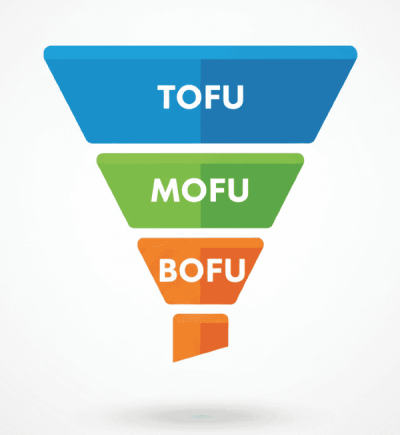
Let’s break down the three main stages:
Top of Funnel (ToFu — Awareness)
This is where the journey begins. The user has a problem or a question, but they aren’t necessarily looking for a product yet. They’re in learning and discovery mode.
- B2C Examples: A user might search for ‘healthy breakfast ideas’ or ‘how to fix a leaky faucet.’ The best content here is educational and helpful, like blog posts (’10 Quick & Healthy Breakfast Recipes’), informative how-to guides, and instructional videos.
- B2B Examples: A manager might be searching for ‘how to improve employee retention.’ They’re looking for information, not a sales pitch. Effective content includes in-depth white papers, comprehensive industry reports, insightful eBooks, and educational webinars.
Middle of Funnel (MoFu — Consideration)
At this stage, the user has defined their problem and is now actively researching and comparing potential solutions. They are weighing their options and looking for the best fit.
- B2C Examples: The search becomes more specific, like ‘best running shoes for flat feet.’ Here, users are looking for expert guidance, making in-depth product reviews, detailed comparison articles (‘Brooks vs Hoka Running Shoes’), and video demonstrations highly effective.
- B2B Examples: A decision-maker might search for ‘HubSpot vs Salesforce’ or ‘best project management software for small teams.’ They need content that helps them evaluate, such as detailed case studies, buyer’s guides, software comparison matrices, and free demo videos.
Bottom of Funnel (BoFu — Conversion)
This is the final step. The user has done their research and is ready to take action — whether that’s making a purchase, signing up, or requesting a quote. Their intent is clearly transactional.
- B2C Examples: Searches are often brand- or product-specific, like ‘buy Nike Air Zoom Pegasus’ or ‘promo code for Chewy.’ The content here needs to be direct and facilitate the conversion: clean product pages, compelling special offer landing pages, and reassuring customer testimonials.
- B2B Examples: A company is ready to engage, searching for ‘get a quote for office cleaning services’ or ‘sign up for Asana business trial.’ Your website must provide clear calls to action through pricing pages, free trial sign-up forms, and easy-to-find consultation booking pages.
By creating content for each of these funnel stages, you build a comprehensive resource that establishes trust and authority, guiding the user from their first question to their final decision.
Fun Fact: While the definitive origin of the funnel terms ToFu, MoFu, and BoFu is a bit murky, the framework is an evolution of the classic multi-stage sales and marketing funnel, which itself is based on the AIDA model (Attention, Interest, Desire, Action) created by advertising pioneer Elias St. Elmo Lewis in the very late 1800s. Inbound marketing platform leader HubSpot helped popularize ToFu-MoFu-BoFu usage through its extensive marketing and education efforts.

Basics of Generative Engine Optimization (GEO)
A Few GEO Essentials
If full-funnel SEO is about creating the right content for the user’s journey, Generative Engine Optimization (GEO) is about ensuring that content is understood and trusted by AI.
GEO is the practice of optimizing your website and content so that generative AI models — like those powering Google’s AI Overviews, Perplexity, and ChatGPT — can find, comprehend, and accurately represent your information in their responses.
The goal fundamentally shifts: it’s no longer just about ranking in a list of web links, but about being cited as a credible source in a definitive, AI-generated answer.
While GEO builds on the principles of traditional SEO, it has its own distinct focus points:
- Conversational Queries: AI is driven by natural language. GEO prioritizes optimizing for long-tail, conversational questions (‘what’s the difference between stocks and bonds as long-term investment options?’) over simple keywords (‘stocks vs bonds’).
- Factual Accuracy and Clarity: AI models are designed to synthesize information and present it as fact. Your content must be meticulously researched, verifiably accurate, and written with extreme clarity. Ambiguity is the enemy of GEO.
- E-E-A-T is Paramount: Google’s signals for Experience, Expertise, Authoritativeness, and Trustworthiness (E-E-A-T) are even more critical for AI. Generative models are trained to rely on sources that demonstrate deep, first-hand knowledge and established authority.
- Structured Data (Schema Markup): Schema provides a clear roadmap for AI, explicitly defining what your content is about. Using schema to label FAQs, how-to guides, author information, and product details helps machines understand the context and relationships within your content, making it easier to parse and use.

Related: See my AI SEO Glossary for terminology covering AI search, GEO, etc. Also, learn more in these posts about conducting GEO audits, improving AI search visibility, and AI SEO rank tracking.
Working Together for Full-Funnel SEO & GEO
The Synergy: How Full-Funnel SEO Powers GEO
Full-funnel SEO and GEO are not separate strategies; they are now two sides of the same coin. A robust full-funnel content plan provides the perfect foundation for GEO.
Think of it this way: to trust a source, an AI model needs to see depth, authority, and comprehensive coverage of a topic. A website that only has bottom-of-funnel product pages is less likely to be seen as a subject matter expert compared to a site with helpful ToFu blog posts, in-depth MoFu comparison guides, and clear BoFu purchasing options.
Here’s how they directly support each other:
Building Authority
A full-funnel approach naturally builds topical authority. By creating a wide range of content that answers questions at every stage, you signal to both users and search engines that you are a comprehensive resource.
This is precisely the kind of authority that AI models are programmed to look for when sourcing information.
Providing Context
The content you create for each funnel stage provides a rich network of internal links and contextual information. Your ToFu content can link to more detailed MoFu guides, which in turn can link to BoFu pages.
This logical structure helps AI models understand the relationships between different concepts on your site, making your information easier to synthesize.
A Practical Example
Imagine you run a health and fitness website. You write a ToFu blog post titled ‘What Is High-Intensity Interval Training (HIIT)? A Beginner’s Guide.’
You optimize this post for GEO by including an FAQ section marked up with schema. A user asks an AI, ‘what are the benefits of HIIT workouts?’ The AI can pull the clear, concise answer directly from your FAQ schema to form part of its response, citing your article as the source.
Because your site also contains MoFu content (‘HIIT vs Steady-State Cardio: Which Is Better?’) and BoFu content (‘Find a HIIT workout plan’), the AI recognizes your domain as a trustworthy authority on the entire topic, making it more likely to use your content for future, related queries.
Actionable Strategies for a Combined SEO & GEO Approach
Integrating Full-Funnel SEO and GEO Principles
Knowing the theory is one thing; putting it into practice is another. Here are four actionable strategies to integrate full-funnel SEO with GEO.
While these practices are very helpful for traditional SEO gains, they become even more important in an AI-influenced GEO world.
Double Down on E-E-A-T
Your content must be trustworthy. For both human readers and AI, this is non-negotiable.
- Show Your Work: Clearly display author names and biographies that highlight their expertise and real-world experience.
- Cite Your Sources: Link out to reputable, authoritative studies, statistics, and sources to back up your claims.
- Be Transparent: Write in a clear, straightforward manner. If your content is sponsored or an opinion piece, label it as such.
Focus More on Topic Clusters, Not Just Keywords
Instead of creating ‘one-off’ articles or blog posts, think in terms of topics. A topic cluster consists of a central ‘pillar page’ covering a broad subject and multiple ‘cluster pages’ that dive deep into specific sub-topics, all linking back to the pillar.
- Pillar Page Example: ‘The Ultimate Guide to High-Intensity Interval Training.’
- Cluster Content Examples: ‘5 Common HIIT Mistakes to Avoid,’ ‘Best Foods to Eat After a HIIT Workout,’ ‘Review: Top 5 HIIT-Friendly Running Shoes.’
- Why it Works: This structure proves to search engines and AI that you have comprehensive knowledge on a subject, establishing you as an authority worthy of citation.
Pro Tip: Optimize your internal linking for maximum SEO and GEO benefits. Consider using tools like AI-powered Link Whisper and LinkBoss to help simplify and automate this process. Learn more here about internal linking analysis and automation tools.

Answer Questions Directly and Concisely
The core of generative AI is answering questions. Structure your content to provide clear, direct answers to common queries.
- Mine Google’s ‘People Also Ask’ in the SERP: Use the ‘People Also Ask’ section of Google search results to find the exact questions your audience is asking.
- Use FAQ Sections: Add a dedicated FAQ section to your articles and use FAQ schema to mark it up. This makes it incredibly easy for an AI to pull your answer.
- Write Simply: Avoid jargon and overly complex sentences. The easier your content is to understand, the easier it is for an AI to parse and use.
Implement Comprehensive Schema Markup
Schema is the vocabulary that search engines and AI use to understand the content and context of your page. Implementing it is no longer optional for GEO.
- Key Schema Types: Focus on Article, Author, FAQPage, HowTo, and VideoObject. Each type gives specific, structured information that helps AI make sense of your content.
- Be Detailed: The more detail you can provide in your schema, the better. For an Article, include the author, publish date, and a clear headline. For an author, link to their social profiles and other publications.
Essential SEO & GEO Tools for Your Toolkit
Free and Paid Tools Help Boost Both SEO and GEO
Putting these strategies into practice is easier with the right tools. Here are a few essentials to help you build and refine your full-funnel SEO and GEO efforts.
Keyword Research and Content Ideation
- Google Keyword Planner: A great free starting point for discovering keywords and monthly search volumes. Primarily used for paid Google Ads campaigns, but also popular for SEO (organic) keyword research.
- Ahrefs and Semrush: Comprehensive paid suites that are the industry standard for competitor analysis, keyword research, rank tracking, and identifying content gaps. For a cheaper desktop toolkit with essentially no data limits, also consider SEO PowerSuite and learn more about popular Ahrefs and Semrush alternatives, including budget-friendly Mangools.
- AnswerThePublic: A fantastic tool for visualizing the questions, prepositions, and comparisons people are searching for around your keywords, perfect for ToFu and GEO content ideas.
On-Page and Technical SEO
- Google Search Console (GSC): An absolutely essential free SEO tool from Google that shows you how your site is performing, what queries it ranks for, and any technical issues it might have. You can also find actual long-tail question keywords for your site using GSC’s performance reporting. As a complement to GSC, consider adding free Bing Webmaster Tools (BWT) to your SEO tools stack.
- Screaming Frog SEO Spider: A powerful desktop crawler that analyzes your website to find broken links, audit redirects, analyze page titles, and discover duplicate content. Also see SEO PowerSuite’s WebSite Auditor application for similar functionality within an overall SEO/GEO suite.
Schema Markup and Testing
- Schema.org: The official home for all schema types. Use it as a reference to understand what’s possible with structured data, and to test structured data for specific pages/URLs.
- Google’s Rich Results Test: A free tool that allows you to test your schema markup to see if it’s implemented correctly and what Google rich results your page is eligible for.
Like this post? Quickly share it with your social networks here.
Want to stay updated on my SEO and GEO-related content? Add your email details below for periodic updates straight from me (David).
Your email info is safe here. We don’t sell, rent, or share your details with outside parties. You can easily unsubscribe at any time.
Full-Funnel SEO & GEO — Closing Thoughts
Conclusion: The Future of AI Search is Conversational
The digital marketing landscape is in a constant state of flux, but the core principle remains the same: provide value to the user. The shift towards a full-funnel SEO model and the rise of GEO are not separate trends, but rather an evolution of this principle.
By creating a comprehensive content ecosystem that serves users at every stage of their journey — and by structuring that content so AI can understand and trust it — you are not just optimizing for today’s search engine; you are building a future-proof digital strategy.
The future of search is conversational, and the brands that succeed will be the ones who are the most helpful, authoritative, and clear partners in that conversation.
Questions or Comments?
I hope this discussion of full-funnel SEO and GEO has been helpful for you!
Let’s close with a few related questions for your consideration:
- For your current website content base, how is it distributed across the 3 layers of the typical SEO funnel — ToFu, MoFu, and BoFu — as described above? Are you too heavy in any one area?
- How are you adapting your content strategy to address the needs of generative engine optimization? Does your existing content need updates now for GEO considerations?
- What SEO and/or GEO tools are helping you drive full-funnel SEO and GEO? Which specific tools (or tool categories) have been most helpful in this effort?
Feel free to add more in the comments below with any thoughts, feedback, or related questions. Thanks also for any social shares on this post!
