
Last updated Nov 21, 2025
From Fully Manual to Max AI
Advances in LLMs and other AI tools bring an important choice: when and how to use AI in content development for SEO and GEO.
The spectrum is wide indeed, from 100% human-made content to fully autonomous AI output.
This post looks at SEO, AI, and the content automation spectrum, with insights, tips, and tools for making smart choices in this area.
Let’s take a closer look…
This post contains a few referral links to select vendor partners. We may receive compensation for purchases made via these links, at no additional cost to buyers.
Introduction — The New SEO Content Reality
AI and the Evolution of SEO Content Strategy
It starts with a familiar sinking feeling. You open your rank tracker software on a Monday morning, coffee in hand, only to see a sea of red arrows pointing down. An SEO competitor — one that you didn’t even know about six months ago — has suddenly leapfrogged you on a dozen high-value keywords.
You click through to their site and find a library of content so vast it would have taken you or your team three years to write.
But get this: they did it in only three weeks.
This is the new reality of SEO. The content treadmill, once a steady jog, has accelerated into an all-out sprint.
With the widespread adoption of Generative AI (GenAI), the barrier to entry for creating content has effectively collapsed. What used to cost hundreds of dollars and several days to produce can now be generated in seconds for pennies.
For many in the digital marketing world, this shift has triggered an identity crisis. We are caught in a polarized, ‘all-or-nothing’ debate that dominates industry newsletters and LinkedIn feeds.
On one side, you have the ‘AI Evangelists,’ claiming that human writers are obsolete dinosaurs and that whoever publishes the most AI-generated slop wins. On the other side, you have the ‘Human Purists,’ warning that AI content is soulless garbage destined for a Google penalty, and that real brands should never touch it.
But here is the truth that gets lost in the noise: Both extremes are wrong.
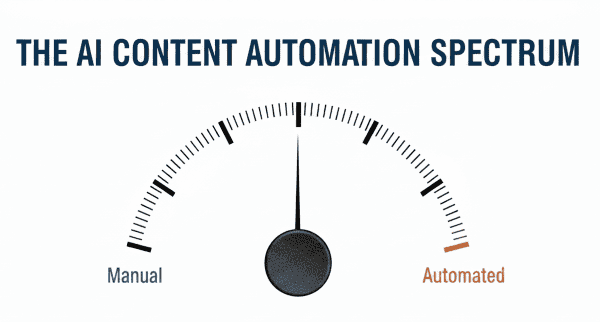
Viewing AI as a Contributor Along a Spectrum
Treating AI as a magic ‘publish’ button is a recipe for mediocrity and eventual de-indexing. But ignoring AI entirely is a recipe for irrelevance. The smartest SEO strategy now isn’t about choosing if you will use AI; it’s about deciding how you will use it.
We need to stop viewing AI as a binary switch and start seeing it for what it really is: a spectrum.
There is a vast difference between using ChatGPT to brainstorm blog topics and using a script to auto-publish 5,000 pages of unedited text. Your content success depends on finding the ‘sweet spot’ on this spectrum — the place where automation meets authenticity, and where efficiency doesn’t come at the cost of quality.
In this post, we’re going to map out the five distinct levels of the AI Content Spectrum. We’ll explore the pros, cons, and tools associated with each stage, from the ‘Human Purist’ to the ‘AI Automaton.’
By the end, you won’t just have an opinion on AI content — you’ll have a framework for building a sustainable strategy that boosts your content workflow and ranking/visibility potential.
The Spectrum of AI Content Automation
Five Levels of Human & AI Content Involvement
To build a winning strategy, you need to understand the playing field. We categorize content production into five distinct levels here, moving from zero automation to total automation using AI.
The key is understanding that you don’t have to live at one level permanently. You can move up and down the spectrum depending on the task, the topic, and the risks involved.
Let’s start at ‘Level 0’ in the ‘pre-AI’ mode.
Level 0: The Human Purist (100% Human-Only)
This is the traditional, artisanal content approach. Here, the content workflow remains untouched by generative AI. While the writer might use standard tools like Google Docs or a keyword research tool, the ideation, drafting, and editing are purely human cognitive processes.
The Use Case: This level is becoming a ‘luxury tier’ in content marketing for SEO. It is essential for high-stakes ‘Your Money or Your Life’ (YMYL) topics — medical advice, legal counsel, or financial planning — where nuance is critical and liability is real.
It is also the only choice for true thought leadership, personal essays, and investigative journalism — where the content value proposition is the unique human perspective.
The Trade-off: You get the highest possible quality and Google ‘E-E-A-T’ (Experience, Expertise, Authoritativeness, and Trustworthiness) signals, but at the highest cost and slowest content production velocity.

Level 1: The AI Assistant (Human-Driven, AI-Assisted)
At this level, the human writer is still firmly in the pilot’s seat, but they have a co-pilot. AI is not used to write the content, but to augment the thinking process. The goal here is to cure ‘blank page syndrome’ and speed up the research phase.
The Workflow: A writer might use Perplexity to quickly gather sources and statistics, or ChatGPT to brainstorm ten different angles for a headline. They might also use SEO-first platforms like Frase, Surfer, or Scalenut to analyze the SERPs and generate detailed content briefs before they write a single word. The actual sentences, however, are typed by human hands.
The Toolset: This is where ‘Answer Engines’ like Perplexity and general AI chatbots like Claude and Gemini shine. It’s also the home of content optimization tools that structure your writing without doing the writing for you.
Aside from the major AI LLMs (ChatGPT, etc.), also consider tools such as:
The Verdict: This is the safest entry point for skeptical brands. It improves efficiency by 20-30% without risking the ‘generic’ feel of AI writing.
Level 2: The AI Draftsman (Human-Edited, AI-Generated)
This is currently the ‘sweet spot’ for many modern content teams. The philosophy here is simple: humans are better at editing than drafting. In this model, AI does the heavy lifting of getting words on the page, and a human Subject Matter Expert (SME) or experienced editor shapes that raw clay into a finished sculpture.

The Workflow: You feed a detailed outline into an LLM (like Claude or ChatGPT) or a specialized writer (like Jasper or Bramework, which is built specifically for bloggers).
Alternatively, you can use the ‘Cruise Mode’ in Scalenut or the AI Writer in Frase to generate a full first draft based on real-time SERP data.
A human editor then spends 45 minutes to an hour fact-checking, removing repetitive phrases, and — crucially — injecting personal anecdotes and brand voice.
Tools to Consider:
The Opal Advantage: This level is where new tools like Google Opal are becoming game-changers. Instead of just prompting a chatbot, you can build a custom ‘agent’ in Opal that follows your specific brand guidelines, tone of voice, and formatting rules every single time, creating a reusable ‘Blog Writer App’ for your team.
The Verdict: This offers a massive velocity boost (often 3x-4x), but it requires a rigorous editing process. If you skip the human edit, you end up with ‘AI slop.’
Level 3: The AI Publisher (Human-Reviewed, AI-First)
Here, the roles flip. The AI is no longer just drafting; it is driving the production. This approach is often used for ‘Programmatic SEO’ — generating hundreds or thousands of pages based on structured data.
The Workflow: Imagine you need to create 500 landing pages for ‘Best [Service] in [City].’ You wouldn’t write these one by one. You would use a script (perhaps via Python and the OpenAI API) or a no-code builder like Google Opal to chain together prompts that generate these pages from a spreadsheet of data.
A human doesn’t edit every sentence; they ‘spot check’ a sample to ensure the system is working, then hit publish.
The Risk: This is a high-risk, high-reward play. It creates massive scale instantly, but the content is often ‘thin.’ If the data is bad, you generate 500 pages of errors. This level is suitable for data-heavy, factual content, but terrible for opinion pieces or thought leadership articles.
Related: See my AI SEO Glossary for many key terms related to AI search, generative engine optimization, and more.
Level 4: The AI Automaton (Fully-Automated)
This is the ‘black hat’ end of the AI SEO content spectrum. Scripts scrape the web, rewrite content using AI, and auto-publish it to WordPress sites without a human ever looking at it.
The Reality: While tempting to those looking for a ‘passive income’ cheat code, this is effectively spam. Google’s spam filters are increasingly trained to detect and neutralize this kind of ‘churn and burn’ content. It contributes nothing new to the web and puts your domain at severe risk of de-indexing.
The Verdict: Don’t do this. It works until it doesn’t, and when it breaks, you lose everything.
The Big Question — Google, E-E-A-T, and ‘Helpful Content’
Leveraging Uniquely Human Value-Add
Whenever the topic of AI content comes up, the elephant in the room is always the same: ‘Will Google penalize me for this?’
The short answer is no. The long answer is it’s complicated.
Google has explicitly updated its guidance to clarify that it focuses on the quality of content, not the method of production. In their own words, ‘automation has long been used to generate helpful content.’
If you use AI to create a calculator, a weather report, or a transcript, that’s helpful. If you use it to spin up 10,000 articles on topics you know nothing about, that’s spam.
The algorithm doesn’t care if a robot wrote the words. It cares if the words are worth reading. And this brings us to the core challenge of AI content, as noted in ‘Level 0’ above: E-E-A-T.
Google’s framework for quality — Experience, Expertise, Authoritativeness, and Trustworthiness — is a critical litmus test for your AI strategy.
The Missing ‘E’: Why Experience is Your Moat
Of all the letters in the acronym, Experience is the one that Generative AI fundamentally cannot satisfy.
- An AI cannot taste the difference between a lighter Merlot wine and a robust Cabernet.
- An AI cannot tell you how the popular new hiking boots felt after mile 10 on a rocky trail.
- An AI cannot describe the frustration of navigating a complex software dashboard.
As things stand today, AI is a prediction engine, not a sentient being. It can simulate descriptions based on training data, but it cannot possess first-hand knowledge. In a search landscape flooded with ‘good enough’ AI summaries, actual human experience is becoming a scarce commodity.
This is why ‘Level 0’ and ‘Level 1’ content strategies often outperform ‘Level 3’ strategies on competitive keywords. If your content lacks personal anecdotes, original photos, or unique case studies, you are vulnerable.
Expertise vs Mimicry
AI is incredible at mimicking expertise. It can pass the Bar Exam and diagnose medical conditions based on symptoms. However, in the context of SEO, AI is a ‘consensus machine.’
It aggregates what is already known. It rarely offers a contrarian opinion, a novel theory, or a breaking discovery. True Expertise often involves challenging the consensus or adding new data to the conversation — something AI struggles to do without human guidance.
The Trust Gap
Finally, there is Trust. One AI-hallucinated ‘fact’ can destroy a reader’s trust forever. If you are operating at Level 3 (The AI Publisher) without rigorous fact-checking, you are playing Russian Roulette with your brand’s reputation.
Google’s ‘Helpful Content’ system is designed to surface content that satisfies a user’s intent. If a user lands on your AI-generated page, spots an obvious error, and bounces back to the search results, that signal tells Google something it needs to know.
The Bottom Line: AI can help you build the structure (Expertise) and polish the presentation (Authoritativeness), but the Experience and Trust must come from you. This is why the ‘Human-in-the-Loop’ isn’t just a workflow preference; it’s a ranking factor.
Related: Learn more in these posts about the pros and cons of AI SEO content and the SEO advantages of long-form content.
Choosing Your ‘Sweet Spot’ on the AI Content Automation Spectrum
Be ‘AI Flexible’ for Diverse Content Needs
The most common mistake many organizations make is trying to apply a single AI policy to every piece of content they produce. Your SEO strategy is likely diverse, ranging from technical documentation to viral opinion pieces.
Your AI strategy, as it pertains to content support, should be equally diverse.
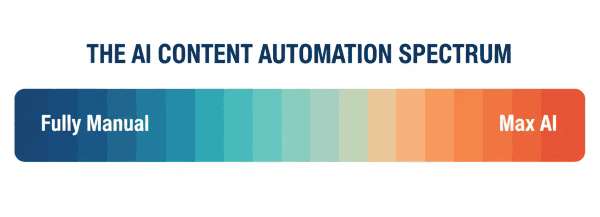
To find your sweet spot, you need to analyze four key variables:
1. Your Goals: Authority vs Traffic
If your primary goal is Brand Authority, lean toward Level 0 (Purist) or Level 1 (Assistant). When you are trying to establish your CEO as a thought leader, the voice needs to be authentically theirs.
However, if your goal is pure Long-Tail Traffic capture for informational queries (e.g., ‘what is an H1 tag’), Level 2 (Draftsman) is perfectly acceptable.
2. Your Resources: The ‘Time vs Money’ Trade-off
Do you have more budget or more time?
- Startups with no budget but lots of hustle: Use Level 2. Let AI write the drafts to save money on freelancers, and spend your sweat equity editing.
- Enterprise brands with large budgets: Use Level 0 or 1. You can afford to pay for premium human talent to differentiate yourself from the AI content noise.
3. The Risk Factor: Brand Safety
How much damage would a factual error cause?
- Low Risk: A list of ’10 Fun Summer Activities.’ If the AI suggests a bad idea, it’s annoying, not catastrophic. Level 2 or 3 works fine here.
- High Risk: A guide on ‘How to File Your Corporate Taxes.’ A single error here could result in legal action. You must stick to Level 0 or 1 with strict human oversight.
4. The Topic: YMYL
As mentioned earlier, ‘Your Money or Your Life’ topics demand the highest level of scrutiny. If you are in health, finance, or law, stay away from fully automated AI content workflows. The potential for harm — and the severity of Google’s smackdown — is too high.
The Hybrid Approach
The smartest companies and content producers don’t pick one level; they build a portfolio.
- They use Level 0 for their weekly newsletter and ‘Founder’s Note.’
- They use Level 2 for their standard educational blog posts.
- They use Level 3 (carefully) to generate meta descriptions and schema markup for their 10,000 product pages.
Want to stay updated on my SEO and GEO-related content? Add your email details below for periodic updates straight from me (David).
Your email info is safe here. We don’t sell, rent, or share your details with outside parties. You can easily unsubscribe at any time.
Like this post? Quickly share it with your social networks here.
SEO & AI Content Automation — Closing Thoughts
Conclusion: AI is a Tool, Not a Strategy
We are in the middle of a gold rush. And like every gold rush in history, there are people selling shovels, people striking it rich, and people getting buried in the collapse.
The ‘AI Automaton’ approach — churning out thousands of pages of unedited AI spam — is a collapse waiting to happen. It works only until the next Google Core Update or a targeted AI spam update.
And then it doesn’t.
At the other end of the spectrum — The ‘Human Purist’ approach — refusing to touch AI on principle — is noble, but it risks leaving you behind as competitors use these tools to work twice as fast as you.
The winning strategy lies in the middle. It lies in recognizing that AI is the most powerful assistant a content team has ever had, but it is a terrible replacement for human judgment.
The future of SEO belongs to the ‘Centaurs’ — humans and AI working together.
So, before you fire your writers or ban ChatGPT from the office, review the content spectrum outlined above. Ask yourself where your content needs to live to be truly helpful.
Use AI to handle the drudgery, the data processing, and the first drafts, so your humans can focus on what they do best: adding true human value and perspective.
Questions or Comments?
That’s a wrap for this post. I hope it is helpful and gives you some good ideas to ponder. Let’s close with a few related questions for you:
- What level(s) of the AI content automation spectrum do you or your team operate on today? Do you see this changing much in the near future?
- Which LLMs or other AI-powered content tools, if any, have been most helpful at your current level of content development?
- How have your SEO rankings or AI search brand visibility changed over the last year? On a related note, how is your organic traffic and referral traffic changing?
Feel free to add more in the comments below with any thoughts, feedback, or related questions. Thanks also for any social shares on this post!
