
Last updated Oct 1, 2024
Using AI Writing Tools for SEO and Content Marketing
Advantages and Disadvantages
Marketers often exclaim that ‘Content is King!’ for SEO, but then find they don’t have the time or other resources to give it the royal treatment it deserves.
So, when a new technology comes along that promises to greatly speed up the production of high-quality SEO content, marketers sit up and take notice.
Artificial Intelligence (AI) and Natural Language Processing (NLP) technologies are powering smart new content writing tools that promise to greatly streamline content development operations while boosting SEO performance.
This post highlights the pros and cons of using AI SEO content and AI writing tools that make it all possible. I also introduce several of the AI writing platforms available.
Let’s dive in and see what it’s all about below.
(BTW, this post is 100% written and edited by a human… yours truly!)

This post contains a few referral links to vendor partners. We may receive compensation for purchases made through these links, at no additional cost to the buyer.
What Is AI SEO Content?
Quickly Creating Quality Content That Ranks High in Search
In a digital marketing context, ‘AI SEO content’ is written content generated with help from AI software tools, created to serve users while also earning high organic search rankings from Google and other search engines.
However, the promise of quickly creating content that satisfies user needs and also delivers great SEO performance comes with several caveats, cautions, and warnings.
I discuss these further below and then introduce several of the popular AI writing tools and assistants available today. You can also jump directly to that section here.
How Do AI Writing Tools Help SEO and Content Marketing?
AI writing assistants help in several key areas, covered further below in more detail.
One of the main benefits is speed. AI writing platforms promise to ‘5x or 10x’ your pace of content production, covering everything from ‘short-form’ content like social media posts, ad copy, and e-commerce product descriptions, to ‘long-form’ SEO content like lengthy blog posts, articles, and even e-books.
For SEO-centric content creators, the tools also promise to leverage AI technologies and machine learning to help you craft the ideal search-optimized content.
They remove much of the manual drudgery of keyword research, competitor analysis, and on-page SEO to help deliver content that’s primed from the start to do well in organic search.
What Is GPT?
AI writing/SEO tools leverage AI technologies such as GPT (e.g., GPT-3, GPT-4, etc.), which stands for ‘Generative Pre-trained Transformer’.
According to Wikipedia, GPT-3 is an ‘autoregressive language model that uses deep learning to produce human-like text. Given an initial text as prompt, it will produce text that continues the prompt.’
See the GPT-3 page on Wikipedia here.
Learn more about OpenAI’s GPT-4 here.
Marketing software vendors have produced generative AI/NLP writing tools and assistants that take advantage of these advances.
For two quick examples, see the videos from AI content platforms Frase and Jasper below.
Frase Introduction Video
Jasper Introduction Video
Now let’s take a closer look at the main advantages and disadvantages of creating AI SEO content with help from AI writers and writing assistants.
AI SEO Content — Pros
AI Tools for SEO Content Promise Many Benefits
AI content platforms and writing assistants can provide a range of important benefits when used correctly.
I emphasize ‘used correctly’ here because it’s easy to get lazy with these tools and assume that they are all ‘one-click’ magic content machines.
With proper human guidance and support, AI writing tools can be very beneficial. Here are some of the most important benefits and advantages.
Helps Drive Business Growth at Lower Overall Cost
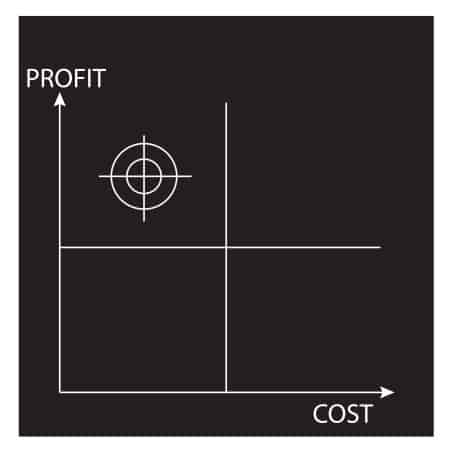
The primary business reason for using AI writing tools is to gain more customers and revenue at a lower overall cost — driving increased profits and growth.
More quality website content drives more and better organic search visibility, which drives more site traffic over time, more customer inquiries, revenue conversions, and business growth.
More good content also provides additional fuel for social media and email promotion, which also drives more website traffic over time, customer engagement, and so on.
AI writing platforms for SEO traffic and other content objectives can greatly increase your productivity and pace of content production.
They can also reduce content costs by replacing outsourced writers and/or producing more content with smaller in-house teams.
Taken together, this means more revenue-producing content at lower overall costs.
Helps Scale Up and Maintain Content Production
Used properly, AI writing tools help content producers create more content at a faster rate.
If you’re a new company, and/or one just starting a content marketing push, you know you may have a big mountain to climb.
You may be facing established competitors that have a huge content and SEO advantage.
Or you may be an established firm with a good content base in place already but are fending off aggressive competitors and upstarts.
Either way, the AI writing tools and assistants available today may help your organization scale up content output or simply maintain a good pace with the help of AI technology.
Supports Resource-Limited Content Teams
For individual writers and small content teams with limited resources (mostly due to people and budget limitations), AI content tools can make a small content team ‘punch above their weight class’.
They can be a force multiplier if used properly and within a repeatable workflow.
Good for Idea Generation and Brainstorming
Since AI tools can easily generate hundreds or thousands of text variations based on tweaking seed inputs, they can act as amazing ideation and brainstorming assistants.
Need a teammate to bounce content ideas off of? Think of an AI assistant as a virtual content team member who can provide new ideas and content angles you may not otherwise consider.
Also, AI writing assistants can use SERP analysis to present SEO content topics, sub-topics, and supporting text for your review and consideration. Further, they can then generate new usable text blocks based on these ideas.
Helps Break Through ‘Writer’s Block’
Even great writers get a case of ‘writer’s block’ now and then. Staring at a blank white screen is not much fun, and getting underway on a fresh piece of content can sometimes feel like trying to turn a giant millstone by hand.
AI-based writing tools do not suffer from this problem, and can quickly help writers come up with a few good opening sentences, headline ideas, etc.
All they need is a seed keyphrase or similar text snippet prompt to prime the AI writer’s pump.
Helps with Text Snippet Generation (titles, subheads, etc.)
AI writing software is good at generating short pieces of text that make sense to human readers.
As a result, they’re useful for auto-generating text snippets like title variations, sub-headers, meta descriptions, intro paragraphs, basic product descriptions, etc.
As mentioned above, they can also write original (i.e., non-plagiarized) text blocks based on SERP competitor topics and content as seed inputs.
Can Produce Usable Drafts of Finished Pieces
Some AI content tools vendors want you to believe that you’re only one or two clicks away from having a polished, ready-to-publish new article or post on just about any topic.
That’s sometimes more like product marketing hype than reality.
However, AI writing assistants with good long-form capabilities can produce usable DRAFT articles that you can then further edit and polish into a publication-worthy piece.
The key is to set your expectations properly about the degree of hands-off automation here.
Think of AI tools as ‘writing assistants’ that still need human input, guidance, corrections, and final editing before the AI-assisted content is ready for public consumption.
Related: Learn more about the advantages of long-form content for SEO.
Incorporates SERP Analysis for Competitor Insights
Many of these tools incorporate Google SERP analysis driven by a seed keyword or keyphrase that you provide.
They provide an automated analysis of top search results (e.g., Google SERP pages 1-3) to help understand what’s currently ranking for your target keyword, competitive content structure, related words and phrases, etc.
You can then select bits and pieces of SEO competitor results to build your own unique content outline or brief, then generate AI text copy based on these inputs and seed ideas.
Related: Learn more here about SEO competitive analysis and supporting tools.
Helps Build Out Topic Clusters and Internal Linking
SEO professionals believe that having topic clusters centered on key topics is good for SEO.
Also, good content groups or clusters set the stage for having a strong internal linking structure, which is good for people as well as search engines — and therefore good for SEO.
These topic clusters and internal link structures require multiple pieces of related content, all built upon a core theme or main topic.
And that’s where AI writing tools (and AI-driven idea generation) can come in handy. They can help you formulate a smart content/topic cluster strategy. In some cases, they will help with internal linking suggestions as well.
AI SEO Content — Cons
Avoid the Potential Pitfalls of AI Content Tools
While AI writing tools hold much promise for SEO content development and optimization, they also present several challenges to their users.
They have some weaknesses to be aware of. Let’s take a look at some of them below.
May Produce Lower-Quality, Cookie-Cutter Content
One of the main complaints about current AI-generated text copy, at least auto-generated long-form content, is that it’s not very good or usable ‘right out of the box’.
For example, AI tools aren’t yet very good at building ‘thought leadership’ pieces or opinion pieces based on original thinking.
They’re also not ideal for covering fast-moving topics or news items based on fresh information.
They’re built and trained on digesting millions or even billions of pages of existing text, but this doesn’t mean they can produce highly innovative or brilliant new content all by themselves.
Also, the AI SEO tools that incorporate competitive SERP analysis may just produce something that looks like what’s already in the SERP for a target keyphrase or user query.
That means the potential for more ‘cookie-cutter’ content in search results — and that’s not very helpful for humans seeking high ‘information gain’ or value-add from original high-quality web content.
Can Hurt Company Brand and Reputation
If left unchecked, AI-driven content can produce text that is factually incorrect or even offensive to some readers.
Now imagine scaling this negative effect to the tune of dozens, hundreds, or even thousands of new AI-written content pieces carrying your company’s brand.
That’s not a good look, is it?
This is yet another reason why AI-assisted content needs careful human review, corrections, and related hand-holding before final content goes live.
May Negatively Impact Author E-E-A-T
Google has introduced the concept of E-E-A-T, which stands for Experience, Expertise, Authoritativeness, and Trustworthiness, as a guide for improving content and website quality.
Learn more about Google’s E-E-A-T concepts here.
E-E-A-T is also discussed in Google’s Search Quality Evaluator Guidelines document (PDF). Google uses E-E-A-T concepts and other content quality factors to help guide its team of human search quality raters.
If your AI-written content weakens any of the four E-E-A-T pillars, your website and content authors may suffer in the eyes of Google (and possibly other search engines as well.)
Related: See my post on an SEO case study with possible E-E-A-T implications.
May Look Obviously Machine-Generated to Google and Users
Google has stated that automatically-generated content (AGC) that seems to exist primarily to influence search rankings (vs being helpful to humans) may be subject to penalties or down-ranking in search.
See Google’s discussion of spammy auto-generated content here.
Google wants us to focus on creating ‘helpful content’ for people first and foremost, and may not ultimately care if the content source is AI-driven.
However, slamming out lots of lower-quality AI content that is obviously ‘SEO driven’ and of limited user value is an invitation to getting downgraded by Google over time.
Some AI content platform vendors are responding proactively to Google’s push for more human-centric, helpful content.
Content Writing Agencies May Misuse AI Tools
This point is for companies and organizations that outsource content development to marketing agencies, solo writers, or specialty content development agencies.
With the rise of AI-driven content platforms and tools, be sure to understand how your outsourced writing services use AI tools today or plan to in the near future.
For many of the cost and scalability reasons discussed above, it’s certain that writing agencies will be keen to leverage AI tools to help them produce more content at lower cost.
As a buyer of these services, you’ll need to really understand how they incorporate these AI tools, which ones they use, how they manage the quality and originality of final deliverables to you, etc.
At their best, content agencies using AI tools will deliver great content at a good pace, with the right quality level for your budget.
At their worst, outsourced writers will lowball you on content cost and feed you low-quality, minimally-edited AI-generated content that hurts your brand, diminishes E-E-A-T, and may even hurt your overall SEO performance.
Popular AI Writing Tools
Many Options for Creating Short-Form and Long-Form AI Content
The arrival of LLM-based AI text generation helped to speed the evolution and adoption of many AI writing platforms.
As you’ll see below, these AI writing tools and assistants can cover dozens of use cases, from auto-generated text snippets to complete blog posts of 1500+ words.
Some also include ‘AI art’ or image generation features, such as text-to-image AI photo generators.
Some uses are very SEO-focused (such as search-optimized blog articles), while some of the short-form use cases have limited or no SEO goals (e.g., text copy for paid ads, email replies, etc.).
Overall, content writing is a primary focus of many AI-powered tools, though there are several other applications for AI in SEO tools as well.
AI Writers and Content Platforms — Core and Optional Features
There’s a lot of feature overlap in most of the AI content platforms on the market today.
Various proprietary AI features, user interfaces and guided workflows, content templates, and pricing approaches help to differentiate vendors from each other.
Of the 12+ AI writing vendors I’ve included below, here are many of the common core features, plus a few options.
Note that not all vendors introduced further below provide 100% of the features/benefits mentioned in this list.
Typical AI Writing Platform Features and Options
- Leverages GPT-based AI language models; some add proprietary AI capabilities
- Short-form and long-form content; some AI writing tools focus more on long-form
- Short-form: social media posts, titles and subheaders, etc.
- Long-form: full blog posts and articles, e-books, etc.
- Content briefs and outlines for writers to follow
- Customizable templates for many different writing situations
- Ecommerce product descriptions (just one of many use cases)
- Team collaboration features
- Facebook Group for peer-oriented user support
- Built-in editors with real-time content analysis and suggestions
- Word counters, content graders, readability graders (reading grade level), etc.
- Wizards and guides help with start-to-finish content production
- Generates 100% unique copy; passes common plagiarism checks
- Tone-of-voice settings for different writing situations
- Paraphrasing, text rewriters, and content extenders
- Analysis and optimization of existing content
- SERP competitor analysis (top 10-30) for SEO-focused content insights
- Keyword and term analysis, search intent insights, etc.
- Multi-language support (native writing and/or translation from English)
- Integrations with WordPress, Google Docs, MS Word, other SEO tools, etc.
- Google Search Console integration for existing content SEO analysis
- Free browser extensions (typically for Chrome)
- Free AI writing tools for short-form content to help users get more comfortable with the platform
- Some have ‘free-forever’ monthly plans with low usage limits
- AI API access options
Good to Know: WordPress users can also consider several WordPress SEO plugins with AI features.
With all of that in mind, here are 12+ of the AI writing platform vendors and tools worth looking into. Given the significant feature overlap of many of these tools (see above list), I don’t repeat these for each vendor.
Article Forge — Automated Long-Form AI Content
Leveraging some of the same AI methods that Google uses to rank content, Article Forge claims to be the ‘first fully-automatic AI article writer’.

They specialize in creating unique, on-topic, and accurate long-form content, including articles of 1500+ words that are helpful to people while also offering great SEO/ranking potential.
Pricing starts at $13/month when billed annually.
See Article Forge’s latest plans and pricing here.
Clearscope — Highly Relevant SEO Content from AI
Focused on content quality and topical relevance, Clearscope helps automate and integrate the worlds of content writing and SEO.
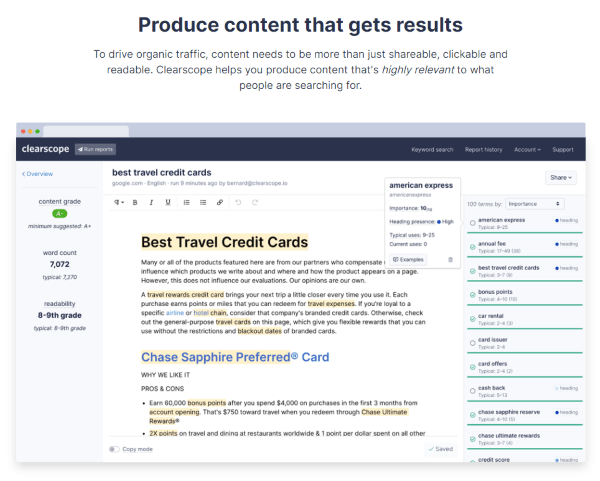
Clearscope pricing starts at $170/month.
See Clearscope’s plans and pricing details here.
Copy.ai — Flexible AI Content with Numerous Templates
With numerous content templates and strong language support, Copy.ai has tools for a wide range of written marketing deliverables.
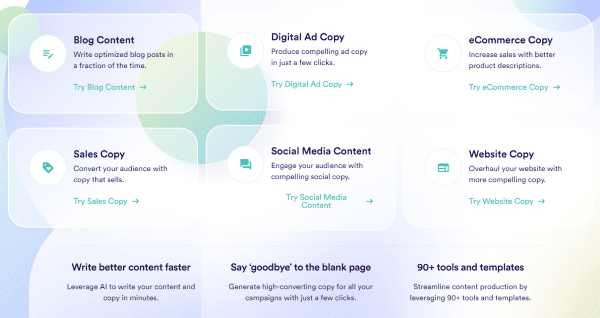
Copy.ai offers a ‘free-forever’ limited plan plus paid plans starting under $40/mo based on the number of AI words generated per month.
They also offer a good variety of free AI tools for specific short-form content use cases.
See Copy.ai’s full pricing details here.
Copysmith — AI Content for Enterprises and Ecommerce
Focused on AI content generation for enterprises and e-commerce sites, Copysmith handles everything from search-optimized product descriptions to bulk content, blog articles, social content, and more.

Copysmith pricing starts at under $16/month on annual plans, then scales upward to pro and enterprise plans.
See Copysmith’s plans and pricing details here.
Frase — Complete SEO Content Workflow with AI
Frase combines thorough SERP analysis, AI technology, and flexible content templates to simplify the SEO content workflow from start to finish.
(I use and recommend Frase for its efficient content tools, including AI writing assistance when you need it.)

Frase pricing starts as low as about $13/month when paid annually.
View Frase’s latest plans and pricing here.
Frase also often offers extra incentives for first-time subscribers — see one example in the banner below.

Jasper — Broad AI Marketing Content Support Plus AI Art
With both short-form and long-form AI content modes, Jasper is a flexible AI content platform that also supports 25+ languages.
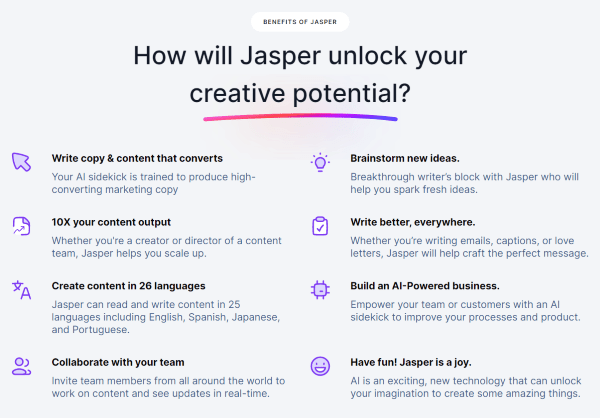
Jasper also now provides an AI art/image capability called Jasper Art for AI-based art and image creation.
For extra SEO capabilities, they also offer an integration option with Surfer SEO.
Jasper’s pricing starts at under $25 per month for short-form AI content needs. Higher tiers unlock features for long-form content users (like blog posts and other full-length content).
See Jasper’s pricing and features lineup here.
Kafkai — AI Content with Broad Topic Niche Coverage
Focused on writing needs for specific business sectors, Kafkai has trained its AI to understand 40+ topical niches. They also have a powerful general-purpose AI writer.

Interestingly, Kafkai also allows user feedback on article quality directly in the user interface. This helps to further train and refine their AI models.
Kafkai pricing starts at $29/month.
See Kafkai’s complete pricing details here.
MarketMuse — Data-Driven AI SEO Content Workflow
Focused on data-driven AI content planning and optimization, MarketMuse speeds you from topic research through publication with time-saving AI tools and automations.
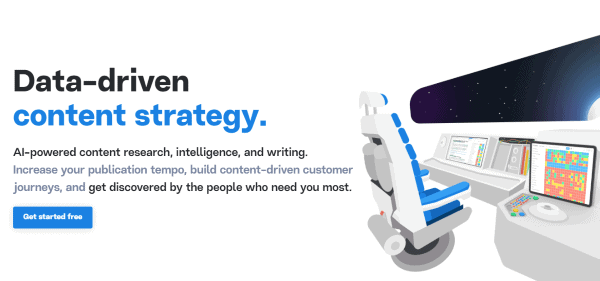
MarketMuse includes a very basic free plan with no time limit, then multiple paid plans above that.
See the MarketMuse pricing and feature details here.
Rytr — Affordable and Flexible AI Writing Assistant
Supporting 40+ use cases, 30+ languages, and 20+ tones of voice, Rytr is a flexible and value-priced AI writing assistant platform. It also supports AI image generation.

Rytr offers a free basic plan with paid upgrades starting at only $9 per month.
View Rytr’s plans and pricing details here.
Scalenut — AI Content Platform for SEO and More
Scalenut is an AI content platform for everything from short-form social media content to long-form content like blog articles.
Their SEO competitor analysis includes up to 30 entries in the SERP. They also have tools to help build smart topic clusters.

Scalenut also offers access to a ‘talent network’ of professional writers who can further offload your workload using the Scalenut platform.
Scalenut plans start as low as $12/month.
See Scalenut’s latest plans and pricing details here.
Semrush — SEO Powerhouse with Content Optimization
Unlike the other vendors I’ve included in this roundup, Semrush is an all-in-one SEO and digital marketing platform powerhouse that needs no introduction for many readers of this post.
Semrush handles just about every SEO task imaginable, including tools for content optimization. They compete most directly with other major SEO platforms like Ahrefs and Moz. They also compete with the more value-priced, affordable SEO tools.

While Semrush is not yet a full-blown AI writing platform like other vendors in this post, they are adding selected AI writing capabilities, like the AI Rephraser tool within their SEO Writing Assistant.
For further AI-driven keyword research and topic cluster support, Semrush also offers integration with Scalenut (also introduced above).
See Semrush’s detailed plans and pricing here.
Surfer SEO — Leveraging AI for SEO Growth Workflow
Using AI in a slightly different way vs the pure AI text generation tools, Surfer SEO provides AI-driven step-by-step SEO workflows and recommendations focused on content, keywords, and internal links.

Surfer supports content planning and writing, content scoring, and optimization tasks for new and existing content.
For further SEO insights (e.g., backlink analysis and link-building opportunities), Surfer has a Semrush integration option.
They can also connect to Jasper for integrated AI writing support.
Surfer SEO offers a free plan, then paid plans starting at $49 per month.
See Surfer’s latest pricing plan details here.
Writesonic — AI Content for Everyone
With over 80 AI-powered writing tools, Writesonic can help produce everything from 1500+ word blog articles to e-commerce product descriptions and social media ad copy.
It can also write in AIDA (Attention-Interest-Desire-Action) and PAS (Pain-Agitate-Solutions) styles to help create compelling sales copy.

Writesonic offers a ‘free forever’ limited plan, plus paid plans starting at just $10 per month. They include the ability to select short-form or long-form tiers plus desired ‘content quality’ options, which impact monthly AI word count limits.
AI Content for SEO and Other Uses — Closing Thoughts
AI Writing Tools and Assistants — Do the Pros Outweigh the Cons?
For marketing and sales copywriters of all types, there’s an AI-assisted writing tool for just about everyone and every writing situation.
Some of these content needs are very SEO-focused, while others are more about the speed and efficiency of creating snappy short-form content, with less need for SEO considerations (e.g., social media ads or text snippets).
Weighing the pros and cons of using AI writers and assistants is important, of course. Many people are choosing to use AI writing tools while keeping a close human eye on the output and correcting/editing as necessary.
This is certainly a dynamic area for content marketers and SEO practitioners. The advantages and disadvantages of using AI writing tools will change over time as the tools mature and become mainstream even for late adopters.
At this stage of development, leveraging AI for both content generation and SEO improvements seems like a winning approach that can save loads of time while improving content performance as well.
Questions or Comments?
I hope these insights into using AI content platforms for SEO and other purposes have been helpful to you. I’ll close with a few questions:
- What do you think about the AI writing pros and cons discussed above?
- Are you using AI writing platforms or assistants in your content or SEO workflows today? Why or why not?
- Are there other AI writing tools you like that I should include in the roundup above?
Feel free to add more in the comments below with any thoughts, feedback, or related questions. Thanks also for any social shares on this post via the buttons below!

The cost comparison would be stronger if it included editing time per publishable article, not just the subscription or word allowance. A short trial using the same brief could track factual corrections and missing examples, which would make the agency-quality risk you describe easier to spot.
Hi Caleb — Thanks for stopping by and adding your thoughts. Those are great observations and suggestions. I especially like the idea of testing different AI content tools with the exact same content brief and evaluating the output from each. That would also help assess some of the total cost factors — the human time needed to fact-check, verify, and polish the final deliverable.
Great overview of AI’s role in SEO content. It’s refreshing to see an honest take on the pros and cons—especially the reminder that human editing is still crucial for quality. Thanks for sharing these insights!
You’re very welcome. Thanks for your visit and feedback!
The AI SEO Content Writer in Undetectable.ai makes it easy to generate content that aligns with search engine requirements.
Hi Darius, thanks for your visit and comment. Very good to know that about Undetectable.ai!