
Last updated Jan 17, 2025
Beat Your SEO Competition with These Key Activities and Tasks
SEO is a demanding but rewarding digital marketing activity when done correctly, and analyzing your SEO competitors is an important part of the game.
The activities outlined below will help you cover the most important aspects of SEO competitive analysis.
Do these things well and you’ll be on the right path to better SEO performance, higher rankings, and more website traffic from Google and other search engines.
Let’s take a closer look now at an SEO competitor analysis checklist and its components, plus related tips and resources.

This post contains a few referral links to select vendor partners. We may receive compensation for purchases made via these links, at no additional cost to buyers.
SEO Competitive Analysis Tasks
SEO Competitor Analysis — Primary Activities
Understanding your competitive environment in SEO is important for several reasons, including:
- Identifying specific industry competitors who may be easier to beat with SEO-targeted content, and which ones may be very tough to dislodge from top positions in Google or other search engines.
- Knowing which topics and keywords (user search queries) are likely to be difficult for SEO ranking purposes (understanding organic SEO keyword difficulty).
- Learning what types of content the search engines prefer to rank for your target keywords and topics.
- Discovering opportunities, methods, and competitive gaps that you can leverage to your advantage. This includes competitive content and keyword gaps.
Good SEO competitive analysis work can also help build an ‘underdog SEO advantage’ vs larger competitors. For example, when doing SEO for smaller B2B companies in industry segments where SEO is an underutilized strategy for driving website traffic.
With that intro, here’s a summary table of 10 areas for conducting SEO competitor analysis. It’s a basic checklist of SEO-related tasks and why they’re important.
See the discussion areas below the table for more descriptions and context.
Related: See this post covering the competitor analysis tools available in SEO PowerSuite. This is the SEO toolkit I use the most for rank-tracking, website audits, and more.
SEO Competitor Analysis Checklist: Summary Table
| SEO Competitor Analysis Tasks | Why Important |
|---|---|
| Find Relevant SEO Competitors | Identify specific competitors to focus on for SEO, related to your core topics and keywords (target search queries) |
| Analyze Competitors’ Ranking Keywords | Understand competitive keyword focus and potential keyword gaps |
| SEO Competitor Qualitative Review | Assess the general quality of competing websites from an SEO perspective |
| Technical SEO Competitor Site Audits | Learn your competitors’ technical SEO strengths and weaknesses (site level) |
| Page-Level SEO Competitor Audits | Find page-level competitor strengths and weaknesses (for their high-ranking content) |
| Competitor Backlink Analysis | Understand competitor backlink profiles, strengths and weaknesses (site level and page level); find new link-building opportunities |
| Find Most Popular Competitive Content | Discover which competitor content pieces earn backlinks and social engagement |
| Check for Competitor PPC Activity | Gain new ideas for keyword targets, SEO titles and meta description copy |
| Automate SEO Competitor Tracking | Speed up competitor tracking tasks to gain actionable insights faster |
| Repeat SEO Analyses as Needed | Refresh SEO competitor insights on a regular schedule |

Find Your Relevant SEO Competitors
The first activity in SEO competition analysis is to understand who actually occupies the first page of search results for your most valuable search queries and topics.
The search engine of choice is usually standard Google on desktop or mobile, but could also be YouTube, Bing, etc.
Note: In this post, I’ll use the terms ‘search queries’, ‘keywords’, ‘keyphrases’, etc., as essentially equivalent terms. ‘Query’ is the terminology used in Google Search Console, but ‘keyword’ and its close variants are often used to mean the same thing.
Importantly, as noted below, your SEO competitors and your actual commercial competitors may not be the same thing.
Identify Your SEO Competition
Determining who your core competitors are for SEO purposes involves:
- Manually inspecting the SERP (e.g., Google Page 1) for your top search queries to see who currently wins the top 10-20 positions for your target search engine. Are you in there somewhere already? If so, great!
- Understanding the difference between ‘SEO competitor’ and actual commercial competitor, if you have a business website. Your top SEO competitors may be things like Wikipedia, industry publications, trade association websites, directories, etc. These may all currently outrank you on Google for certain good target keywords, but they’re not actually competing with you for product or service revenue. Still, you want to outrank your indirect ‘search competitors’ when you can for better SEO visibility and more click-throughs to your website.
- Using good SEO tools that fit your budget to automate the discovery of your top SEO competition. For example, you can use SEO software tools to find topic and keyword-based competitors, find other domains that compete directly or indirectly with your website content, and assess the strength of competing domains and their specific pages or posts.
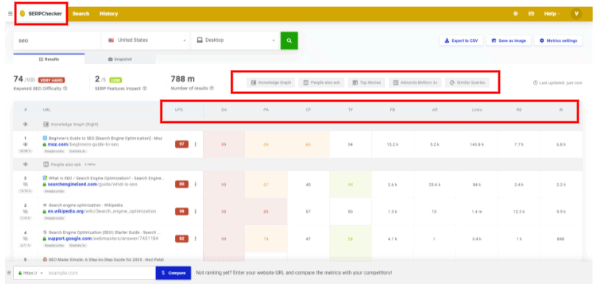
- Consider using specialized SERP analysis tools that automate this part of SEO competitor analysis. SEO PowerSuite’s Rank Tracker application includes an interesting SERP analysis module. SEO content optimization platform Frase also provides a helpful visual SERP analysis. The Mangools SERPChecker module is also popular.

Pro Tip: Many of the popular SEO content optimization software tools available today also do a great job of competitive SERP analysis. They typically also include AI writing assistants, SEO content brief tools, etc.
Analyze Competitors’ Ranking Keywords
With a collection of specific competitors now in mind, you can leverage SEO software to extract their ranking keywords. Many good SEO tools offer this capability since they have massive databases of keywords and the domains and pages that rank for them already.
Keyword Gap Analysis
This is also a great time to look for competitive keyword gaps.
In many cases, you’ll find that your SEO competitors rank well for target keywords and you do not. If these search queries are potentially valuable for you, consider updating existing content to include them, or creating entirely new content that is focused specifically on them.
On the flip side, you may find that you rank well for good keywords where your competition is lagging behind. This is great, of course, but may not last forever. Keep an eye open for competitors who are catching up, and even entirely new SEO competitors that were previously not on your radar screen.
Want to stay updated on my SEO-related content? Add your email details below for periodic updates straight from me (David).
Your email info is safe here. We don’t sell, rent, or share your details with outside parties. You can easily unsubscribe at any time.
Qualitative Competitor Website Analysis
To complement the full-site competitive SEO audit and target page(s) SEO audits, it’s also important to do your own manual, visual walk-through of your competitors’ sites and ranking pages.
Keep these points in mind during your review:
- How does the competitor’s website look overall? Is it modern and professional looking? Does it look ‘best in class’ for your industry and niche?
- Similarly, how does their ranking content look? These are the pages and posts that currently rank better than you do for your target keywords. Do you see anything in their content (e.g., better images or visuals) that you should also incorporate into your own?
- How do their URLs look? Does it appear that they have good SEO in mind when structuring page and post URLs?
- Do you see a good SEO Title tag pop out when you hover over their little icon (favicon) at the top of your browser tab?
- Do they have strong call-to-action (CTA) elements on their ranking pages? Do they encourage their readers to stay on-site and/or take other positive actions that build better user engagement?
Other Site-Wide Things to Review
Another thing I like to do is review the HTML source code for competitor sites to look for these things:
- Does your competitor have Google Analytics and Google Search Console installed and validated? You can often easily find this just by looking at the HTML source for the home page.
- Does your competitor have an SEO plugin installed, such as Yoast, All in One SEO, or RankMath for WordPress sites? If so, that’s a good indicator that SEO matters to them, assuming they are actively using it.
Competitor Technical SEO Audits (Full or Partial Site)
Running a complete technical SEO audit on a few of your top competitors’ websites will give you a much more complete picture of their competitive strengths and weaknesses.
You’ll quickly see if they have significant SEO weaknesses, such as:
- Missing Title tags or meta descriptions on pages and posts
- Page Not Found (404) errors
- Broken links (internal and external links)
- Overly-large images (a page speed issue)
- Missing image ‘alt text’ elements
- ‘Mobile friendly’ problems (mobile user experience or UX issues)
- Core Web Vitals problems (speed and other metrics)
All of the good SEO software suites have full-site auditing tools. SEO PowerSuite’s WebSite Auditor is very good in this area and now includes features for checking Core Web Vitals per Google’s latest guidelines. It can also do a partial site analysis for you, crawling a subset of pages per your settings.
Screaming Frog is another very popular freemium SEO crawler tool.
Related: See this post for more details about several of the top paid / premium SEO audit tools available.
Competitor Page Audits
The full-site SEO audit gives you a big-picture view of a competitor’s website.
For your specific keyword targets, however, you should also run page-level SEO audits on your top-ranking competitors to look for more specific strengths and weaknesses.
This kind of audit analyzes a specific competitive page or post, and flags any technical or other ‘on-page SEO’ issues found.
Both types of competitive SEO audits can identify competitor weaknesses that you’ll want to be sure to avoid on your site. Run the same tools on your site periodically to make sure you’re in better shape in these areas.
Competitor Backlink Analysis
With this task, we’re investigating the backlink profiles of key competitors’ websites, or even just individual ranking pages and posts.
The point is to understand how strong your SEO competition is in terms of the quantity and quality of the external links pointing back to their content (hence the term ‘backlinks’ here).
Many SEO competitor analysis tools will perform this function; some better than others. Ahrefs Site Explorer is very popular for this capability. Other good Ahrefs alternatives can also perform backlink analysis.
For example, SEO PowerSuite offers a completely free backlink checker. It’s part of their SEO SpyGlass tool kit.

Note: Backlink analysis is an area of SEO competitor analysis that free tools like Google Search Console can’t touch. Why? Because GSC only tells you about backlinks to sites that you verifiably own and/or manage. GSC, for good reason, will not provide any details at all about your competitors’ websites or external backlinks.
Related: Learn more here about using Google Search Console versus paid SEO tools. The post goes into much more detail about the similarities and differences. Also, see this post discussing how and why SEO tools and platforms integrate with Google Search Console to improve SEO analysis.
Find Most Popular Competitive Content
You can think of this area of SEO competitive analysis as consisting of two parts:
- Examining your competition’s backlink profile (see above) to discover which pages and posts have earned the most backlinks from referring domains.
- Using social media analytics to discover which competitive content is garnering the most social engagement, such as shares, likes, retweets, etc.
Some SEO software platforms can tell you not only about referring domains and backlinks but also about social content popularity as well.
Many people also use special tools like BuzzSumo’s Competitor Intelligence for this task. Other social monitoring tools like Awario and Mention can also help you monitor activity for your target competitive topics and keywords.
Check for Competitor PPC Activity
While visually examining the search engine results pages (e.g., Google SERP page 1), be sure to note the PPC ads above and/or below the organic results.
You’ll likely see PPC text ads from some of the same companies that show up in the organic results, as well as from other competitors who want to pay for visibility on that results page.
These ads compete for attention and clicks, and so may reduce the organic click-through rates (CTR) for the organic content on the page.
However, the presence of PPC activity for a search query or keyword is also evidence of commercial value for that keyword. People are willing to pay money for visibility with this specific search, so that’s good to know for organic content creators as well.
Borrow PPC Copywriting Ideas
Another reason to pay attention to the PPC ads is to borrow and adapt some of the good copywriting that goes into those ads. You may see something clever in the PPC ad copy that you can incorporate into your SEO Title tag, meta description, article headlines (h1 tags) and sub-headlines (h2-h4 tags), etc.
These efforts can help boost your organic listing CTR and reader engagement with your content after the click.
Leverage Competitive SEO Tracking Automation
In many SEO software toolkits, you can set up target competitors (or competitive page URLs) and automate the tracking of your competition. This is a key time-saving benefit of using SEO competitive analysis tools.
For example, you can:
- Track the ranking fluctuations of top competitors for your most important keywords. It’s much easier to let a software tool do this for you, rather than manually inspecting the SERPs over time and trying to keep track of relative movements in SEO competitor rankings.
- Track the backlink profiles of target SEO competitors, looking for overall backlink growth, specific backlinks gained and lost, etc.
Be sure to check your preferred software tool(s) to see what they can do for you in the area of automated SEO competitor tracking.
Many of these affordable SEO software tools have useful automation features, task scheduling, etc.
Repeat SEO Competitive Analysis Steps Periodically
SEO is always dynamic, so you’ll want to decide on a proper schedule for repeating and updating the areas discussed above.
For example, you may want to do competitive rank tracking on a weekly or bi-weekly basis, but only do competitive backlink profile checks and keyword gap analysis every month or quarter. And then full-site competitor audits every six months or so.
There’s no one right answer, so just decide on a good pacing that fits your specific needs and available resources.
And of course, as mentioned above, be sure to leverage SEO task automation where it makes sense for you.
Like this post? Quickly share it with your social networks here.
SEO Competitor Analysis Checklist — Closing Thoughts
The checklist and brief discussion above is intended as an introduction to SEO competitor analysis, but it’s just a starting point.
Many of the SEO tools vendors have significant blog content, training videos, and webinars that cover these aspects in greater detail. Be sure to look for them and take in what you need to get stronger as an SEO competitor in your industry and target niches.
Questions or Comments?
Here are some parting questions for you to consider:
- How do you currently perform SEO competitive analysis?
- How does your process differ from the SEO competitor analysis checklist outlined above?
- What do you see as the main pros and cons of your approach?
- What SEO software tools have been a big help to you? And which ones have turned out to be less helpful and not worth the money and time invested?
Feel free to add your thoughts in the comments area below. Thanks also for any social shares on this post!