
Last updated Sep 23, 2024
How AI Tools Help with Long-Form Content and SEO
Writing and Ranking Blog Posts and Articles
For many website and blog owners, generating a steady stream of high-quality written content can be quite a challenge. This is especially true for what’s called ‘long-form’ content, such as longer blog posts and articles.
Then getting your new content to rank high on Google and other search engines is yet another hill to climb.
Fortunately, new capabilities and tools based on artificial intelligence (AI) and related technologies are available now to help in both areas.
This post highlights AI tools for long-form SEO content — including how AI writing assistants and SEO content optimizers can help craft and optimize long-form content that both readers and search engines will love.
I also share my thoughts after using one of these tools to help produce this post.
Let’s dive in and see what it’s all about below!

This post contains a few referral links to select vendor partners. We may receive compensation for purchases made through these links, at no additional cost to the buyer.
Introduction — Using an AI SEO Content Tool for This Post
Focusing on Long-Form AI Content Use Cases
While researching many of the AI writing assistants available today, I quickly realized that some of the AI writing platforms are much more focused on helping generate good ‘long-form’ content types, such as longer blog posts and articles.
So, that’s my focus for this post. It’s also the type of content I work on the most.
Another goal in writing this post is to use an AI writing assistant and SEO content optimizer — Frase in this case — for at least some of the text content.
I’m also leveraging Frase to:
- Build a content brief and outline before building out the body of the article
- Optimize and score the post for SEO, based on Frase’s AI-assisted SERP analysis
Some of the content below is Frase’s AI-generated content, with my tweaks and final edits. I’ll point out some of these text blocks below as well.
Note: If you’re familiar with this topic and want to see some applicable tools, you can jump ahead to a selection of long-form AI content tools here.
What is Long-Form SEO Content?
Long-form content, also known as ‘deep’ content, has been a buzzword in the search marketing industry for quite some time. But what exactly does it mean and how can you use it to your advantage?
Generally speaking, long-form content is written content that is longer than around 1500-2000 words or so.
Different definitions may suggest different word-count breakpoints for long-form pieces, but 1500-2000 words is a good minimum length. Some long-form content easily pushes into multiple thousands of words.
So, long-form content includes things like longer and ‘meatier’ blog posts or articles, essays, white papers, detailed case studies, e-books, and other written deliverables that have decent depth and substance to them.
Compare this with short-form copy such as social media posts and ad copy, headlines, outlines, brief product descriptions, and other formats that tend to be shorter — typically under 500 words.
Related: Learn more here about the many SEO advantages of long-form content. Also, learn more about how SEO tools use AI more broadly. This includes keyword research and other SEO tasks that aren’t writing-specific.
Should You Use AI to Write Blog Posts?
[Note: the next three paragraphs came from Frase’s ‘Write About This’ feature from SERP-discovered text.]
Artificial intelligence (AI) is increasingly being used to assist humans with tasks such as translating languages, writing news stories, and even generating web content. But while we’re still far away from having robots do our jobs, there are already ways to leverage AI technology to help us produce better content faster.
With natural language text generation technologies like GPT-3 and higher, you can use AI to generate blog posts, although it requires a lot of manual work. For example, you’ll need to proofread, check facts, and edit it yourself to fit your brand voice — otherwise, it won’t sound authentic.
In the future, a good portion of the articles published online will be assisted by AI and machine learning in some form. Many publishers are beginning to realize that producing quality content takes too much time and effort. So they’re turning to AI to automate certain parts of the process, including creating headlines, summarizing long pieces of text, and generating images and videos.
Hey, that AI-generated text is not bad! So I’m leaving it in with just a few edits. — David
The AI-written text above at least goes part of the way toward answering the question: ‘Should you use AI to write blog posts?’
My short answer is ‘yes’, assuming you know how to use the AI writing assistants and their SEO tools properly. And you’re aware of the general pros and cons of using AI tools for SEO content. See more on these points below.
The AI writing tool software vendors are also, in general, pretty good at user education and setting the right expectations about what their tools can and can not do.
Will the AI-Generated Content Be Unique?
AI writing tools typically have built-in plagiarism checkers to help ensure unique content. Or they may have optional integrations with tools like Copyscape for checking plagiarism risk.
Also, the GPT-based AI (GPT-3 and higher) strives to generate completely unique text, rather than lightly spinning content it already knows.
Tools like Frase also now include automated ‘originality checkers’ to help ensure that your written article stands apart from top competing pieces (SEO competitors in the Google SERP.)
Learn more about Frase’s ‘originality checker’ and ‘information gain’ features here.
These are in part a response to Google’s Helpful Content Update — an important Google algorithm change in 2022 that seeks to reward content that is truly helpful to real people, vs content that is purely SEO-driven.
How to Use AI Writers for Long-Form Blog Content
Proper User Input and Guidance Are Keys to Success
Specific to long-form writing, such as a 1500+ word blog post, AI content and SEO optimization tools can help with the following:
- Researching current SEO competitors in the SERP (e.g., Google results pages 1-3)
- Generating topic and sub-topic ideas, including h1-h5 header analysis from competitors
- Quickly building an outline for the entire piece
- Quickly generating ‘content briefs’ for in-house or outsourced writers, content agencies, etc.
- Writing an intro paragraph (or several variants for selection and editing)
- Rephrasing or extending existing text copy
- Building AI-generated transitions between sections
- Generating complete ‘full drafts’ based on user inputs and guidance
- Checking for plagiarism and readability
- Building internal website links and external backlinks
- Providing ‘content scoring’ for SEO optimization, keyword and topic coverage, etc.
- Optimizing older/existing content with AI-driven insights
Specific to AI-generated output of longer lengths, it’s really important to provide good direction and context to the AI writer. Without enough human guidance, AI writers can easily stray off-target and even produce nonsensical or offensive content.
When you’re paying for certain AI word limits or character allowances per month, you don’t want to waste your budget on ‘garbage’ AI output that you’ll never use.
This is one of the potential negatives of using AI writing platforms.
Related: See this post for more discussion of the advantages and disadvantages of using AI writing tools for SEO content.
How Does AI Help with SERP Analysis and SEO?
Long-Form AI Writing Tools Integrate SERP Analysis for SEO
Most AI writers and writing assistants use the latest LLM models from OpenAI for AI-based text prediction. Some add proprietary AI technologies to further improve upon the LLM’s output.
For long-form content creators with SEO as a primary concern, many AI content platforms also include things like SERP competition analysis and content scoring.
The tools quickly reveal what’s currently ranking for a target keyphrase and incorporate these findings into specific content recommendations, including outline structures and topic sub-headers.
Some of this is really just ‘SERP scraping’ activity — providing ranking content URLs, word counts, header structures, competitor text snippets, related questions, numbers of links and images in posts, etc.
Vendors may also apply their own AI or ML-based capabilities in some of these areas.
Therefore, when looking at vendor claims about their AI/ML smarts, there are of course the different LLMs for text generation, but there may be other AI tech involved in SEO analysis and optimization as well.
Some of this technology is more ‘under the hood’ within the platform and therefore not as obvious as the AI-generated text or images.
Using AI Writers After Google’s Helpful Content Update
[These two short sections also have some Frase-generated AI text in them.]
Google’s 2022 Helpful Content Update to its search algorithm has been a boon for authentic content creators. But it also means that the quality of your content is now more important than ever before.
The Google algorithm update has made it clear that high-quality content is what will get you ranked higher in search results. This is because Google wants to reward sites with good content over those who are just trying to game the ranking systems.
So, if you want to rank well on Google, you need to make a concerted effort to produce ‘helpful content’ above all else. You can safely use AI writing assistants in this creative process, as long as the results are truly helpful to human readers and not just designed for SEO purposes.
Does Google Penalize AI Writing?
Google can penalize AI writing, but only when it is used as an automated tool to replace human writers. This means that if you use a program like Grammarly or another similar service, you will not be penalized by Google for using the service.
How Does Frase Work for Long-Form AI Content?
Using Frase as One Example of AI SEO Writing Platforms
Frase Features for Long-Form Posts and Articles
Practical Tips for Using AI Writers with Long-Form Content
Guidelines for Creating Better Long-Form AI Content
Based on my experience so far using AI writing and SEO content optimization tools, plus my ongoing research in this area, these are some of my top tips for leveraging AI writing tools for better long-form content.
DO:
- Keep realistic expectations about productivity and efficiency gains from AI. Be a bit wary of vendor claims about ’10x-ing your writing speed and output’, especially for more complex long-form content.
- Think of AI writing tools as ‘assistants with good growth potential’ vs. magical one-click generators of beautiful long-form writing.
- Use the AI tools for content/topic brainstorming, outlining, content briefs, starter text, text expansion, rephrasing, first full drafts, etc. You may find that several of the blog-focused AI content templates work well for your articles.
- Use AI writers to help break through periods of writer’s block and get past the ‘blank page’ stage.
- Use AI writing assistants to research topics and come up with new angles and sub-topics that you may have missed on your own.
- Be prepared to spend considerable time editing/correcting longer blocks of AI-generated text.
- Carefully review and correct any AI-generated factual information/errors and watch out for nonsensical or potentially offensive text snippets.
- Use AI SEO content tools for competitive content research (e.g., SERP analysis), SEO optimization suggestions, and scoring your content.
- Leverage their SEO capabilities for keyword and topic research, building keyword groups and topic clusters, finding internal linking opportunities, etc.
- Use AI writing and SEO assistants to import, analyze, and improve older existing long-form content from your blog or website.
- Use free SEO tools like Google Search Console to track the search performance of your AI-assisted blog posts and other long-form web content.
- Try your AI writing tools on other use cases (e.g., short-form content), aside from long-form content needs. These can expand your ROI from AI writing tools.
DO NOT:
- Expect any AI writer to perfectly match your personal writing style, tone, brand voice, etc.
- Expect AI to be great at generating ground-breaking thought leadership pieces, covering hot new topics and trends, etc.
- Automatically assume that your new AI-assisted SEO content will quickly rise to a Google ‘top 3’ ranking for your target user query (keyword/keyphrase). If it does happen — GREAT and congrats! — that’s a big SEO win. But you will likely need to be patient and potentially improve the piece further in later weeks and months, to see big positive movement in the Google SERPs.
Popular Long-Form AI Writing Tools
Look for AI Features Specific to Long-Form Writing
There are at least several dozen AI content writing tools available today, with many overlapping feature sets.
For users with mostly long-form content needs, it makes sense to try to zero in on the AI writing platforms that demonstrate special features and value-add for generating long-form content.
If your AI writing tool has dozens of use-case templates but only a few long-form features, and/or if ‘long-form content’ seems like an afterthought or a bolt-on capability, it may be time to look for better options.
In general, producing long-form AI content is a very important subset of the overall AI SEO tools feature capabilities available today.
Common Features of Long-Form AI Writers
AI content platforms with stronger long-form value propositions often have several common features that set them apart from short-form AI writing tools or the do-it-all AI writers.
These long-form content features include:
- Vendor product messaging that has long-form content creation as a core value proposition and primary use case
- Ability to produce longer articles and blog posts without having to manually piece together the full article from small chunks of AI text
- AI character and word-count limits that are generous enough for long-form needs (see vendor pricing plans and AI character/word allowances per month)
- Use of multiple language models to allow for more sophisticated text generation
- AI templates and building blocks specific to writing blog posts and articles
- Built-in plagiarism checkers and originality scoring
- Word counters and reading level scoring (readability graders)
- Built-in SERP analysis, SEO suggestions, and optimization scoring based on target keyword(s) or keyphrases
- Built-in editing workspaces suitable for long-form writing and formatting
- AI-assisted content briefs for use with internal or outsourced writers
- CMS integrations (e.g., WordPress plugins) to simplify the writing and optimization workflow
Even with all of these long-form-centric features in hand, you’ll still need to edit the AI output to incorporate your own ‘brand voice’ and style, check and correct any factual errors, add your own unique angles and original thoughts, etc.
Cross-Section of Long-Form AI/SEO Writing Tools
Here are ~ 12 vendors and tools designed to help produce or support long-form AI content, including SEO optimization needs.
This is a good sampling or cross-section look at this subset of AI writing tools. They go beyond the base features of AI tools like Google Gemini, ChatGPT, Microsoft Copilot, etc., especially when you utilize their full SEO capabilities.
Article Forge — Automated Long-Form AI Content
Leveraging some of the same AI methods that Google uses to rank content, Article Forge claims to be the ‘first fully-automatic AI article writer’, including long articles and blog posts as a core use case.

They specialize in creating unique, on-topic, and accurate long-form content, including articles of 1500+ words that are helpful to people while also offering great SEO/ranking potential.
Pricing starts at $13/month when billed annually.
See Article Forge’s latest plans and pricing here.
Bramework — AI Writing Assistant for Blog Posts
Focused primarily on speeding the creation of blog post content, Bramework uses GPT and proprietary NLP algorithms to help generate high-quality, search-optimized blog articles at a much faster pace.
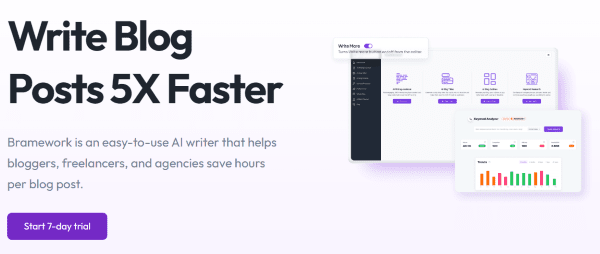
To their credit, Bramework also does a good job of describing the types of AI writing where they are NOT a good fit.
Bramework offers a free trial, followed by paid plans starting as low as $17/month on an annual plan.
See Bramework’s latest pricing and plan details here.
Clearscope — Relevant Long-Form AI Content
Focused on content quality and topical relevance, Clearscope helps automate and integrate the worlds of content writing and SEO.
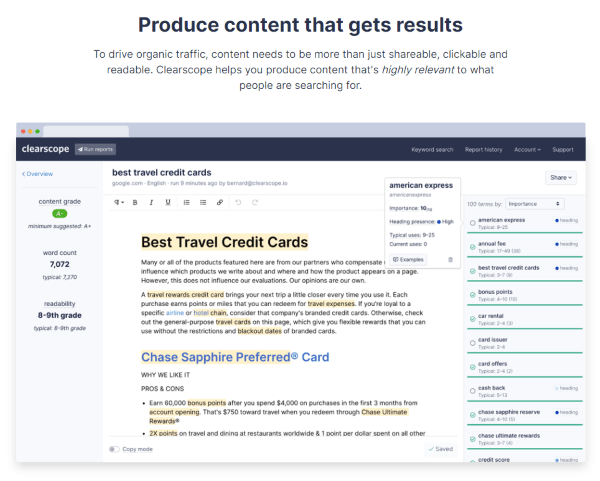
Clearscope pricing starts at $170/month.
See Clearscope’s plans and pricing details here.
Frase — AI-Assisted Long-Form SEO Content Workflow
Frase combines thorough SERP analysis, proprietary AI technology, and flexible long-form content templates to simplify the SEO content workflow from start to finish.

Frase pricing starts as low as around $13/month when paid annually. They also often have good promotions for getting started, such as the promo offer in the banner below.

Wordplay — Long-Form AI & SEO Content Specialist
Focusing specifically on search-optimized long-form AI content, Wordplay is a great example of an AI writing platform that doesn’t try to be everything for every writer or marketer.
Instead, Wordplay is a long-form AI SEO content specialist. It takes your starter inputs and context to automatically flesh out AI-written articles that can be as long as 2000+ words.

Wordplay offers a free 7-day trial, then paid plans starting at ~ $21 per month when billed yearly.
For users primarily interested in leveraging AI writing tools for longer content, Wordplay is definitely a good short-list option to consider.
See Wordplay’s complete pricing and features breakdown here.
Jasper — Popular AI Writer with Long-Form Options
With both short-form and long-form AI content modes, Jasper is a flexible AI content platform that also supports 25+ languages.
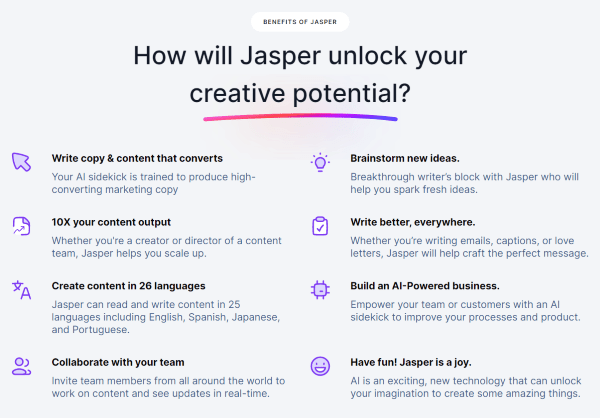
Jasper also now provides an AI art/image capability called Jasper Art for AI-based art and image creation.
For extra SEO analysis and optimization capabilities, they also offer an integration option with Surfer SEO (see more on Surfer below).
Jasper’s pricing starts at under $25 per month for short-form AI content needs. Higher tiers unlock ‘Boss Mode’ features for long-form content users.
See Jasper’s pricing and features lineup here.
Kafkai — AI Articles Tailored to Specific Topic Niches
Focused on writing needs for specific business sectors, Kafkai has trained its AI to understand 40+ topical niches. They also have a powerful general-purpose AI writer.

Interestingly, Kafkai also allows user feedback on article quality directly in the user interface. This helps to further train and refine their AI models.
Kafkai pricing starts at $29/month.
See Kafkai’s complete pricing details here.
Rytr — Long-Form AI Content and Much More
Supporting 40+ use cases, 30+ languages, and 20+ tones of voice, Rytr is a flexible and value-priced AI writing assistant platform. It also supports AI image generation.

Rytr offers a free basic plan with paid upgrades starting at only $9 per month.
View Rytr’s plans and pricing details here.
Scalenut — SEO Hub Helps Optimize Long-Form Content
Scalenut is an AI content platform for everything from short-form social media content to long-form content like blog articles.
Their SEO competitor analysis includes up to 30 entries in the SERP. They also have tools to help build smart topic clusters that group and interlink related pieces of long-form content. This helps build the ‘topical authority’ of your website.

Scalenut also offers access to a ‘talent network’ of professional writers who can further offload your workload using the Scalenut platform.
Scalenut plans start as low as $12/month.
See Scalenut’s latest plans and pricing details here.
Semrush — Search Optimization for Long-Form Content
Unlike the other vendors I’ve included here, Semrush is a powerful all-in-one SEO and digital marketing platform that many readers of this post will recognize.
Semrush handles just about every SEO task imaginable, including tools for content optimization. They compete most directly with other major SEO platforms like Ahrefs and Moz. They also compete with the more value-priced, affordable SEO tools.

While Semrush is not yet a full-blown AI writing platform like other vendors in this post, they are adding selected AI writing capabilities, like the AI Rephraser tool within their SEO Writing Assistant.
For further AI-driven keyword research and topic cluster support, Semrush also offers integration with Scalenut (also introduced above).
See Semrush’s detailed plans and pricing here.
Surfer SEO — SEO Guidance for Long-Form Content
Using AI in a slightly different way vs the pure AI text generation tools, Surfer SEO provides AI-driven step-by-step SEO workflows and recommendations focused on content, keywords, and internal links.

Surfer supports content planning and writing, content scoring, and optimization tasks for new and existing content.
For further SEO insights (e.g., backlink analysis and link-building opportunities), Surfer has a Semrush integration option.
They can also connect to Jasper for integrated AI writing support.
Surfer SEO offers a free plan, then paid plans starting at $49 per month.
AI Tools for Long-Form SEO Content — Closing Thoughts
Great Potential When Used Correctly
My original goal for this post was to use the AI writing features in my base Frase subscription to build out the majority of the post text.
However, I realized that I was quickly using up my monthly cap (20,000) for AI-generated characters, so I switched back to my usual manual writing mode using the built-in Frase content editor and search optimizer assistant.
I did use Frase’s AI writing tools to generate some text ideas with the ‘Write about this’ feature in the SERP competitor analysis area (right sidebar of the Frase editor interface), and in the ‘expand’ option for selected text.
The latter (‘expand’ tool) is a good way to get unstuck when you have a paragraph or two but need some related ideas to flesh it out further.
Here’s more about what I liked and didn’t like while writing this post with help from Frase. Some of these items tie back to earlier points in this post.
Things I Liked and Found Very Useful
- Frase’s automated Content Brief builder is nice. Based on my target keyword, it gave me lots of ideas mined from the top 20 competitors in the Google SERP, plus summaries of target word count, numbers of headers, links, images, etc.
- Ability to include multiple target keywords in the SERP analysis
- The SERP metrics visualizer provides a quick overview of top SEO competition
- Frase’s content editing interface is clean and easy to use. The real-time content scoring is also handy.
- The ‘Unoriginal Findings Versus Competitors’ analysis
- The ‘Write about this’ feature for creating unique AI text based on other reference text in the SERP Overview sidebar, and also for text blocks I highlighted for some AI-generated expansion.
- Flexible options for inserting AI templates and transitions, rewrite and expand tools, etc. These look interesting, though I really need to test them further in long-form situations.
- The Frase WordPress plugin is helpful for SEO optimization guidance right inside the WordPress editing space.
Things I Didn’t Like So Much
- The AI ‘Write about this’ tool, when based on a short headline or subhead only, did not produce much usable text. I got much better results when I first manually added a few lines of text to give the AI the push it needed in the right direction. To be fair, this is exactly what Frase’s training videos recommend.
- The monthly character limit on my base Frase plan (20,000 AI characters) means I’ll need to be careful about where and how I use the AI writer part of Frase when building long-form articles. Of course, I can always upgrade to boost monthly AI usage limits.
All in all, I continue to use Frase and recommend it to anyone interested in these AI-enhanced SEO content writing tools.
They often have decent promotions for first-time subscribers. See the banner below to check out Frase and get started.

Questions or Comments?
I hope these insights into using AI writing tools for long-form SEO content have been useful to you.
Are you using AI writing platforms or assistants in your content or SEO workflows today? Why or why not?
Have you found a long-form AI writer that works great for your needs?
Feel free to add more in the comments below with any thoughts, feedback, or related questions. Thanks also for any social shares on this post via the buttons below!

The AI SEO Content Writer from Undetectable.ai is perfect for creating content that’s both search-friendly and easy to read.
Just give the undetectable AI a try for re-phrasing and detecting plagiarism.
Good to know about this solution, thanks!