
Last updated May 17, 2025
Does SEO Take Long to Work?
A Brief Case Study with Search Console Data Provides Helpful Insights
Questions regarding how fast SEO works, or time to SEO success, are common.
People may have a sense that ‘SEO is hard’ or ‘SEO is expensive’, so they want to know when it will all pay off, or at least start to produce a visible positive ROI.
The examples below show actual website SEO performance data for how new content starts producing clicks, and therefore more website traffic and potential for valuable goal conversions.
Read on to gain more real-world insights into how fast SEO works.

SEO Success Usually Takes Time
Think of SEO as a Business Investment More Than a ‘Quick Fix’
A common question regarding SEO is this: ‘How long does SEO take to work?’ It’s a completely fair question for business-minded people to ask since there are real costs involved in executing an SEO plan.
And, there are real budget trade-off decisions to make regarding competing programs and marketing channels, such as PPC ads, social media, live or virtual events, inbound vs outbound channels, etc.
A common answer to this question is that it can take several months to see SEO results, with many variables impacting the success timeframe.
The typical time delay factors, along with the sustained effort required for SEO success, contribute to common perceptions about why SEO is hard. It’s also smart to be skeptical about SEO performance guarantees provided by some SEO service providers.
Regarding using SEO as a primary marketing tactic and channel, also keep the following areas in mind when pondering how quickly SEO works and if it’s a good traffic acquisition channel for you.
SEO as an Offensive Marketing Weapon
SEO can be a highly effective way to attack competitors, especially in industry segments or niches that attract a lot of online search activity.
In these cases, effective SEO can help displace your direct competitors from the top of Google search, resulting in more organic traffic for your website, and less for theirs.
You can win ‘search market share’ over time, which can lead to revenue market share gains vs your top competitors as well.
Related: See this post on how to better understand your SEO competition.
SEO as a Defensive Marketing Wall
On the other hand, SEO efforts that have built a reliable organic traffic stream can continue producing high-quality traffic for months and years after the content is indexed and ranked by search engines.
As we know, this is not the case for paid marketing channels such as PPC ads, display ads, paid social campaigns, sponsored events, etc.
As soon as you stop funding these, the traffic dies down very quickly.

So, website traffic driven by prior SEO and content efforts can act as a ‘defensive wall’ that keeps some traffic flow alive even in times of tighter budgets for other marketing activities.
As one prominent example, when marketing budgets took a hit during the COVID-19 pandemic-driven business slowdown, the SEO value of existing and new content during that period became even more visible and important.
Even if SEO takes time to show progress and build momentum, smart SEO practitioners also know that it’s possible to achieve relatively quick SEO wins with the right mix of tactics. SEO can produce a faster payoff in some situations.
Related: Learn more about using SEO on offense and defense, plus more on SEO priority vs other marketing tactics.
SEO Performance Examples from a Live Website
The rest of this post looks at some actual performance data from Google Search Console, focusing on the early stages of new content existence and timing until actual Google organic click-throughs occur.
SEO Success Timing — Three Examples from Google Search Console (GSC)
Using GSC to Analyze Content SEO Performance
The Google Search Console examples highlighted below show different patterns for impressions, ranking positions, and clicks (most importantly!) for three distinct pieces of website content from the same website.
A couple of things worth noting for these content examples:
- Each piece was produced with specific keywords / keyphrases in mind. The on-page SEO was fairly thorough and intentional.
- No proactive link-building was done for any of these pieces.
Two SEO Performance Metrics — TTFC and TTSC
In the Google Search Console examples below, we’ll look at two time-based metrics related to early SEO performance and traction.
Note that these are not ‘official’ Google or GSC performance metrics. I just sort of made them up as a way to look at early SEO success milestones for new website content.
Time to First Click (TTFC)
Mostly as a point of interest, TTFC shows us when we earn the very first click-through on a piece of content after it’s launched and made visible to search engines (Google in this case).
TTFC is an SEO content milestone of sorts, though by itself is not hugely important.
Time to Sustained Clicks (TTSC)
Much more interesting is TTSC, or the time it takes a piece of content to start earning organic clicks on a regular (sustained) basis.
The volume of clicks is not so important for TTSC. It just helps to measure the time gap between publishing a piece of content and later seeing it gain traction with reasonably regular click activity.
After TTSC, click activity for the content under review should be fairly steady, even if it’s not quite every day. In the best cases, click growth (magnitude) increases steadily after TTSC, with few or no daily gaps.
Note that TTSC can be much greater than TTFC. The calendar time gap between these metrics can be days, weeks, or even months.
Let’s look at a few examples below.
Note: In all of the Google Search Console graphs below, the purple line indicates total impressions, the orange line is average ranking position, and the blue line indicates user click activity.
This is the typical color coding used in GSC’s performance reports.
SEO Performance Data — Content Example #1
In this example, the first user click on Google’s organic search engine results page (the ‘SERP’) comes very quickly after content launch.
However, the TTSC point is not reached until several months later. Daily click activity is fairly regular (‘sustained’) after this point.

The gap between TTFC and TTSC is sort of a no-man’s land of click activity. We may see a few sporadic clicks here and there, but it’s pretty spotty until the TTSC marker. We see this in the example below, as well.
SEO Performance Data — Content Example #2
Here’s an example where the newly published content just sort of bumped along with low Google search impressions for a couple of months before hitting even the first click-through at TTFC.
TTSC then comes about three months after TTFC, and after a two-stage ramp-up in impressions.
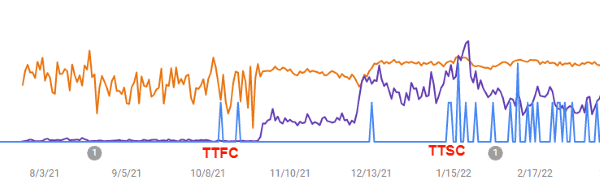
Note also how the average ranking position (orange line) smooths out significantly as impressions ramp up. This is partly a function of Google having more user queries to work with and more impressions overall for averaging purposes.
It also seems likely that Google just gets better at generating the ‘correct’ ranking as queries and impressions gain momentum, and Google digests and understands the content better after repeated crawler visits from Googlebot (desktop and mobile).
SEO Performance Data — Content Example #3
In the example below, TTFC comes several weeks after the content is first published. TTSC is a bit harder to accurately place here.
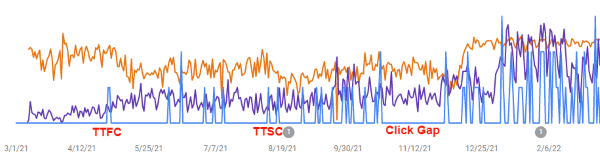
The cause of the ‘click gap’ in the November 2021 timeframe is not immediately obvious, but there’s a new phase of visibility growth and click momentum in late 2021 into early 2022.
Google ‘Sandbox’ and ‘Honeymoon’ Effects?
There are many common ‘SEO myths’ out in circulation, that’s for sure.
Two of them, related to Google search performance timing for new content (or brand new websites), are known as the ‘Sandbox’ and ‘Honeymoon’ effects.
However, Google’s own experts have repeatedly debunked these myths over many years, or at least explained why the perceptions might persist.
See this article from Search Engine Journal on how Google’s John Mueller describes the Sandbox and Honeymoon ranking effects.
Also, see this article that debunks 26 common SEO myths.
My own thinking is that it’s perfectly acceptable and understandable for Google or any search engine to run newly discovered content through some ‘early testing’.
That would help explain early spikes in impressions and a few isolated early clicks.
It also makes sense for Google to spend time collecting new signals, measuring content quality attributes vs competitive content, etc., before surfacing the new content more broadly via greater search impressions and higher rankings over time.
Both of these would help explain a quick TTFC but a delayed TTSC, per the charts above.
Remember to Check for Search Intent Match
Once a piece of new content has reached the TTSC point — a sustained stretch of search click activity — be sure to also check the ‘Queries’ tab of the GSC Performance Report, specific to the page or post (exact URL) in question.
Ask yourself these questions:
- Do the search queries match well with the intended topic focus and target audience? Check the queries driving the most clicks and/or most impressions.
- Do the best-ranking queries make sense for this piece of content?
- Are there any ‘surprise queries’ or ‘unintended queries’ that are driving major impressions or clicks? If so, you may have an opportunity to refine the content to lead Google away from any poorly suited queries.
- Are there specific well-targeted queries driving lots of impressions and ‘almost good’ average ranking positions (e.g., positions 11-30)? These are great candidates for emphasizing a bit better in your next updates to this piece of content. Or they may give you some great ideas for a new related piece.

Other Related SEO Performance Considerations
Earning organic clicks from Google (and other search engines) is just the front end of an overall ‘website visitor conversion’ process.
Your landing page or post needs to be compelling enough to keep the search user engaged long enough to get what they came for.
If a page-level bounce rate is unusually high for organic traffic, you may have a mismatch between the user search intent and the purpose of the content. Check your GSC query data (also mentioned above) to check for clues in that area.
If your click volume is decent but your conversion metrics are poor, then you have an SEO conversion rate optimization (CRO) challenge.
Maximize the Value of Your Organic Search Traffic
You’ve worked hard to earn your organic search visitors. Wouldn’t it be nice to know more about who these visitors are?
Website analytics tools like Google Analytics are helpful at a high level, but for B2B websites you may also want to learn more about B2B website visitor tracking software tools. Better visitor insights can help your B2B revenue team identify and pursue more sales leads, and even help support account-based marketing (ABM) programs.
For consumer-oriented websites, some martech tools now also support B2C website visitor ID and tracking. This is all part of identifying anonymous website visitors and leveraging those insights.
These more specialized web analytics tools can help you understand the actual companies, organizations, (and sometimes actual people) visiting your site from Google and other traffic sources.
Want to stay updated on my SEO-related content? Add your email details below for periodic updates straight from me (David).
Your email info is safe here. We don’t sell, rent, or share your details with outside parties. You can easily unsubscribe at any time.
Like this post? Quickly share it with your social networks here.
How Fast Does SEO Work — Closing Thoughts
The ‘It Depends’ Answer is Usually Correct in SEO
Hopefully, the examples provided above help to explain why SEO professionals and agencies are typically (and correctly) cautious about promising anything close to instant gratification in terms of SEO success.
As the content examples show, you may see a first organic click or two rather quickly after launching new content, but the sustained click activity may take weeks or months to emerge.
Of course, the popularity of the topic and your ‘SEO competition’ will play big roles as well.
Related: See this post about SEO keyword search volume estimations and these posts about SEO competitor analysis and understanding organic SEO search difficulty. Major SEO software tool providers also tend to cover these topics well.
The answer to ‘How long does SEO take to work?’ will also vary for different websites and goals.
For example, a ‘local SEO’ project for a small retailer in a specific town or city is quite different from a midsized e-commerce site that has to compete with Amazon and big-brand websites.
And, a B2B website in a highly specialized industrial or technical niche is yet another SEO challenge that may have different success timeframes.
In general, however, I’d say think about ‘months and quarters’ in terms of SEO success timeframes and milestones.
In some cases, it’s also fair to think in terms of a few years, measuring year-over-year SEO success and progress in addition to the interim milestones and metrics.
Questions or Comments?
I hope this discussion of how long SEO takes to work in the context of actual SEO performance data has been helpful.
Feel free to add your own insights in the comments below with any thoughts, feedback, or related questions. Thanks also for any social shares on this post!