
Last updated Nov 1, 2025
Content Chunking and the New SEO
Digital marketers know that the worlds of organic search and SEO have changed dramatically.
New tactics and terms are front and center now — including the concept of ‘content chunking’ in the context of AI-powered search.
This post covers AI SEO and content chunking, including key aspects, tactics, and a few tools that can help build better content to meet the demands of AI SEO and GEO.
Let’s take a closer look below…
This post contains a few referral links to select vendor partners. We may receive compensation for purchases made via these links, at no additional cost to buyers.
The New Search Landscape — AI SEO & GEO
Organic Search Has Changed Dramatically
Take a look at a typical search results page today. Notice anything different? That familiar list of ten blue links is quickly being replaced by something new — a direct, conversational answer, often written in complete paragraphs and presented at the very top of the page.
This is the new face of search, powered by generative AI.
This shift isn’t just a design update; it’s a fundamental change in how information is found, consumed, and credited. For marketers, content creators, and SEO professionals, this new landscape requires a new playbook. The old rules of simply ‘ranking’ for a keyword or long-tail keyphrase are evolving.
Welcome to the era of AI SEO and generative engine optimization!
To navigate this change, we need to understand a new set of terms:
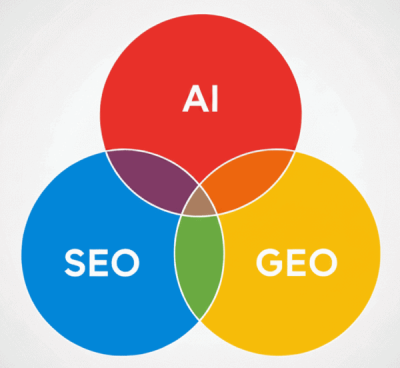
- AI SEO: Think of this as the next evolution of traditional SEO. The focus is no longer just on keywords and backlinks but on optimizing your content to be understood, trusted, and, most importantly, cited by generative AI models like Google’s AI Overviews, ChatGPT, Perplexity, and Claude.
- GEO (Generative Engine Optimization): If AI SEO is the ‘what,’ GEO is the ‘how.’ It is the set of practices and frameworks for structuring your content so that AI models select it as a high-quality source for their generated answers.
- Content Chunking: This is arguably the most important, foundational tactic in the entire GEO playbook. It is the strategic process of breaking down your large pieces of content (like ‘ultimate guides’) into smaller, highly-focused, semantically related, and independently understandable sections, or ‘chunks.’
To win in this new era of AI-driven search, we must fundamentally shift our mindset. We have to move beyond optimizing pages and start optimizing answers.
Content chunking is the most critical tactic for making your content discoverable, citable, and valuable to both the AI engines and the human users they serve.
What is Content Chunking?
And Why Content Chunking Matters Now in SEO & GEO
If you’ve been in digital content marketing for a while, you might hear ‘content chunking’ and think it just means using short paragraphs and bullet points for readability.
That’s part of it, but today, content chunking signifies a much deeper strategic SEO shift.
Think about the old model of SEO. We created massive, 5,000-word ‘ultimate guides’ designed to be the single, authoritative destination for a broad topic. We optimized that entire page to rank for a primary keyword or search query, and Google’s index was largely page-level.
The new model is radically different. Generative AI doesn’t just ‘read’ or ‘rank’ your page; it deconstructs it. It breaks that 5,000-word article down into its core ideas, or ‘chunks,’ and analyzes each one for its specific meaning and utility.
This matters because Large Language Models (LLMs) operate on a principle called passage-based retrieval. When a user asks a highly specific question, the AI doesn’t look for the ‘best page’ on the topic. It hunts through its index to find the single best chunk of text from across the entire web that most precisely answers that query.
This is why the core rule of modern content strategy is ‘One Idea = One Chunk.’ The goal is to create sections (often around 150-300 words) that fully answer one specific question or cover one distinct sub-topic. This makes the chunk ‘quotable’ and useful to the AI in complete isolation from the rest of the page.
By strategically pre-chunking your content, you are essentially doing the AI’s work for it. You’re part of a practice called Answer Engine Optimization (AEO), serving up a platter of perfect, bite-sized, citable answers that the AI can confidently retrieve and present to its users.
Content chunking is the most critical tactic for making your content discoverable, citable, and valuable to both the AI engines and the human users they serve.
Related: See my glossary of AI SEO & GEO terminology for key terms in this topic area.
From SEO ‘Best Practice’ to GEO ‘Necessity’
A Good SEO Practice Takes On New Importance
As you read this, you might be thinking, ‘This just sounds like good SEO.’ And you’re 100% correct.
Using clear headings, writing scannable content, creating lists, and optimizing for Google’s coveted ‘Featured Snippets’ at the top of the organic SERP have been best practices for years.
We did this to improve user experience and to help crawlers understand our content. But the purpose behind these actions has fundamentally changed.
- The Traditional SEO Goal: The goal was to win the click. We used good structure (headings, lists) to help our page rank higher in the ten blue links. We optimized for a Featured Snippet to get to ‘Position 0.’ In both cases, success was measured by a human clicking a link to find their answer on our site.
- The New AI SEO/GEO Goal: The new goal is to be the source. We now use good structure (chunking) to help the AI engine find the answer. Success is being the citation for the AI’s direct answer, whether the user clicks through or not.
This shift transforms our old SEO tactics into new necessities:
- Headings (H2s/H3s): These are no longer just simple ‘section themes.’ In a GEO-optimized article, every heading should function as a specific user query. An H2 heading like ‘What is the Best Time to Visit Italy?’ isn’t just a topic break; it’s a retrieval anchor for an AI to grab the exact chunk of text that follows.
- Featured Snippets: We used to fight for the one Featured Snippet box at the top of the page. Now, every single section of your article should be written as its own potential snippet.
- Long-Form Content: A 5,000-word ‘ultimate guide’ is no longer a single, monolithic ‘authoritative destination.’ It must now function as an ‘authoritative, indexable database‘ of dozens of individual answers.
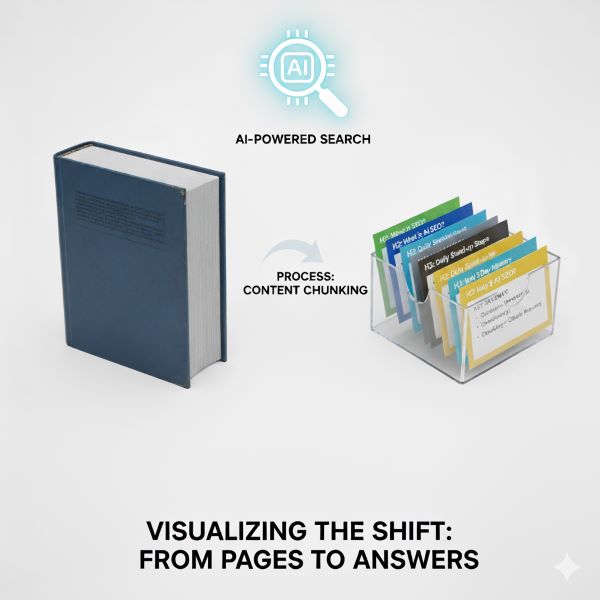
Visual Metaphor: Think of content chunking as transforming a monolithic textbook (the old way) into a perfectly organized library of flashcards (the new way). The goal is to optimize for individual, instantly-retrievable answers.
Content Chunking vs Other GEO Tactics
What’s Most Important for Boosting GEO?
Content chunking is a critical piece of the Generative Engine Optimization puzzle, but it doesn’t work in a vacuum. It’s important to understand where it fits within your broader AI SEO strategy.
GEO is a holistic effort that also includes:
- E-E-A-T (Experience, Expertise, Authoritativeness, Trust): This is arguably the single most important signal for AI. Generative models are being trained to identify and prioritize content that is reliable, written by credible experts, and backed by real-world experience.
- Schema Markup (Structured Data): Using FAQPage, Article, Author, and Organization schema is like handing the AI a ‘cheat sheet’ for your content. It provides a clear, machine-readable summary of what the page is about, who wrote it, and why it’s trustworthy.
- Topical Authority: This is about demonstrating deep and wide knowledge on a subject. Creating comprehensive topic clusters (like a ‘hub-and-spoke’ model) proves to AI that you are a true authority, not just a surface-level content mill.
- Original Data & Research: Providing unique statistics, proprietary insights, or new case studies makes your content a primary source. AI models, which are designed to synthesize information, will prioritize citing a primary source over a ‘me-too’ article.

So, where does chunking fit in?
Content chunking is the foundational delivery system for all of these other tactics.
Think of it this way: If your E-E-A-T, topical authority, and original data are your high-quality ingredients, content chunking is the recipe and the plate that makes them consumable. An AI can’t ‘consume’ or ‘serve’ (cite) your brilliant expertise if it’s buried in an unstructured 8,000-word wall of text.
Here is how chunking works with these other tactics:
- It makes your E-E-A-T visible at a passage level. An AI can identify a specific chunk as being written by an expert, even if the whole page covers many topics.
- It provides the Topical Authority model (the ‘hub-and-spoke’) with a clear, crawlable, and semantically organized structure.
- It isolates your unique data and direct answers, making them easy for an AI to find, verify, and grab for a citation.
The bottom line: While E-E-A-T determines if an AI trusts your content, content chunking determines if it can find and use that trusted content efficiently. You absolutely need both to win, but without a smart chunking strategy, your most valuable expertise will remain buried.
The ‘GEO’ Double-Meanings — Generative & Geographic
‘GEO’ Takes on New Meaning Now
To make things just a little more confusing, the acronym ‘GEO’ has recently taken on two critical meanings in the world of search:
1. Generative Engine Optimization: The practice of optimizing your content to be found and cited by AI-powered search engines, as we’ve been discussing.
2. Geographic (Local) SEO: The long-standing practice of optimizing your content to appear for location-based user queries (e.g., ‘best pizza near me’).
Here’s the good news: these two concepts are not in conflict. In fact, mastering Generative Engine Optimization is quickly becoming the key to winning at Geographic optimization.
AI-powered search thrives on delivering hyper-personalized, relevant results. This is especially true for local intent. Users no longer just see a generic national ‘Services’ page. Instead, the AI can parse that page, find the one ‘chunk’ that matters to the user’s specific location, and present it as a direct answer.
Let’s see it in action. Imagine a national residential roofing company with a massive ‘Roofing 101’ blog.
- A user in Miami, Florida searches: “What do I do after hurricane roof damage?”
- The AI’s action: It scans the roofing company’s blog and finds a specific chunk of text under the heading, “A Homeowner’s Guide to Post-Hurricane Roof Assessment in Florida.” It completely ignores other irrelevant chunks on the same page about “ice dam removal in Minnesota” or “wildfire-proofing in California.”
- The Result: The AI serves this specific, locally-relevant chunk to the user.
Without content chunking, that helpful advice for Florida homeowners would be buried. By structuring its content into distinct, query-focused sections, the national roofing company can suddenly compete at a local level, making its content hyper-relevant to a user at their precise moment of need.
Content Chunking in Practice
Content Chunking Examples — B2B & B2C
This is all great in theory, but what does content chunking actually look like in practice? The easiest way to understand its power is to see the ‘before’ and ‘after’ of a content asset.
Scenario 1: B2B SaaS Company (Project Management Software)
The Monolith (Old Way): The company has a single, 4,000-word blog post titled ‘The Ultimate Guide to Agile Project Management.’ It’s a massive, authoritative article that covers everything: the definition, the history, different methodologies (Scrum, Kanban), how to run meetings, and what software to use.
The entire piece ranks well for its main keyword, but its utility for specific, long-tail queries is limited.
The Chunked Hub (New Way): The company’s SEO team decides to deconstruct this ‘monolith’ into a ‘hub-and-spoke’ model.
- The Hub: They create a new pillar page titled ‘The Agile Project Management Hub.’ This page serves as a visual table of contents, introducing the core concepts of Agile and linking out to all the new, focused ‘spoke’ articles.
- Spoke Page (Chunk) 1: ‘What is Agile Methodology vs Waterfall?’ This new post is a 400-word, hyper-focused article that directly answers this common definitional query.
- Spoke Page (Chunk) 2: ‘How to Run an Effective Daily Stand-up Meeting.’ This is a scannable, list-based article detailing the 5 steps for a perfect stand-up.
- Spoke Page (Chunk) 3: ‘Top 5 Features Your Kanban Board Software Must Have.’ This chunk is a feature-benefit-driven article that an AI can now use for ‘best of’ or comparison queries.
The AI SEO/GEO Benefit: The results are transformative. When a user asks an AI, ‘How do I run a daily stand-up meeting?’ the AI can now retrieve and cite the perfect, self-contained answer from Spoke Page 2.
When another user asks, ‘What are the benefits of kanban boards?’ the AI can pull a snippet from Spoke Page 3. The company now has dozens of ‘nets’ in the water, each perfectly sized to catch a specific query.
Scenario 2: B2C E-commerce (Travel Company)
The Monolith (Old Way): A travel company has a 5,000-word behemoth of a post: ‘The Complete Travel Guide to Italy.’ It’s beautiful, but it’s dense. Tucked away on page 7 is a small section about restaurants in Florence.
The Chunked Hub (New Way): They recognize this single post is trying to do too many jobs. They decide to break it apart.
- The Hub: ‘Italy Travel Planning Guide: Your Complete Resource’ becomes the new pillar page, linking to all the specific guides.
- Spoke Page (Chunk) 1: ‘The Best Time of Year to Visit Italy: A Month-by-Month Guide’ answers a common, high-level informational query.
- Spoke Page (Chunk) 2: ‘A 3-Day Itinerary for Your First Trip to Rome’ provides a specific, actionable, step-by-step plan that a user can follow.
- Spoke Page (Chunk) 3: ‘The 10 Best Restaurants in Florence’s Oltrarno Neighborhood.’ This hyper-local article is pulled from that small section and expanded into its own authoritative post.
The AI SEO/GEO Benefit: The travel company’s organic reach gains new momentum. A user asking their phone, ‘What’s a 3-day itinerary for Rome?’ can be served Spoke Page 2 as a direct, AI-generated answer.
Another user visiting Florence asking, ‘best restaurants in Oltrarno’ gets the hyper-local Spoke Page 3. They are capturing users at every stage of the funnel, from broad dreaming (Chunk 1) to specific planning (Chunk 2) and on-the-ground action (Chunk 3).
Related: Learn more in these posts about conducting a ‘GEO audit’, Google SEO & GEO visibility, and boosting AI search visibility.
Getting Started with Content Chunking
Key Tactics & Tools for Building Content Chunks
Understanding the ‘why’ of content chunking is the first step. The ‘how’ comes down to two key strategies and a new landscape of tools built to support them.
The Tool Landscape — Adapting and Emerging Platforms
You don’t necessarily need a whole new AI SEO software stack to start. Many of the tools you already use are adapting, while new, AI-native tools are emerging to perfect the process.
Leveraging Existing Platforms (The ‘Classic’ SEO Tools)
- Content Optimization Tools (e.g., Frase, Surfer, Clearscope): These platforms are evolving beyond simple keyword density. They now analyze the top-ranking content and recommend a comprehensive structure based on the H2 and H3 subheadings that answer common user queries. By prompting you to cover these topics, they are effectively forcing you to create a well-chunked, topically complete article.
- Schema Markup Generators (e.g., Rank Math, Yoast SEO, Merkle’s schema markup generator): Technical SEO platforms and plugins are essential for ‘packaging’ your chunks. By using FAQPage and HowTo schema, you can mark up your Q&A sections and step-by-step guides, providing a machine-readable ‘package’ that an AI can easily parse and present as a direct, citable answer.
- Topic Cluster Tools (e.g., Ahrefs, Semrush): These tools are perfect for planning the ‘Hub-and-Spoke’ model. They help you identify content gaps and visualize your topic clusters, making it easy to see which ‘spokes’ (chunks) you need to build out to establish full topical authority.
Emerging AI-Native Tools (The ‘New Guard’)
- LLM-Driven Auditing Tools (e.g., Jasper, Writesonic): A new category of AI-powered content suites is emerging. These tools can analyze your 5,000-word ‘monolith’ article, automatically identify the ideal chunk boundaries, suggest new query-based headings for each section, and even auto-generate the ‘Key Takeaway’ summaries, making the optimization process dramatically faster.
Strategy 1 — The ‘Hub-and-Spoke’ Model (New Pages)
This strategy, detailed in the B2B and B2C examples, is ideal for building deep topical authority and capturing a wide range of specific, long-tail keywords.
Audit Your ‘Monoliths’: Start by identifying your longest, most comprehensive ‘ultimate guides.’ These are your low-hanging fruit.
Identify the ‘Hidden’ Chunks: Read through the post and find every distinct sub-topic or specific question that is answered within it. Each H2 or H3 sub-headline is a potential candidate for its own page.
Break and Build:
- Break: Carefully copy and paste these sections into their own, new, highly-focused blog posts. Expand on them, adding more detail now that they have room to breathe.
- Build: Create a ‘Pillar Page’ (or ‘Hub’) that serves as the new table of contents. This page should briefly introduce the main topic and link out to all the new, smaller ‘spoke’ articles. This creates a strong, internally-linked structure that AI crawlers love.
Related: Learn more in these posts about AI-assisted internal linking tools, internal linking visualization, and internal link anchor text optimization.
Strategy 2 — The ‘Optimized Monolith’ (On-Page Chunking)
This is a powerful and often faster alternative to building out lots of brand-new sub-topic pages or posts. Instead of creating dozens of new pages, you meticulously restructure one long-form post to concentrate all its authority (like backlinks and ‘SEO juice’) onto a single URL.
- Start with a TOC: Implement a clear, clickable Table of Contents (TOC) at the very top of the post. Use anchor links (e.g., <a href=”#section2″>) that allow a user — or an AI — to jump directly to the relevant section. This is a direct, machine-readable map of your content.
- Use Query-Based Headings: This is non-negotiable. Every single H2 and H3 in your post should be rewritten to function like a specific user query. Change ‘Our Features’ to ‘What Are the Key Features of [Product].’ Change ‘Meeting Ideas’ to ‘How to Run an Effective Daily Stand-up.’
- Add Sub-Section Summaries: This is an advanced GEO tactic. Directly under each query-based heading, add a ‘Key Takeaway’ box or a bolded, 1-2 sentence summary that directly answers the question in that heading. This gives the AI a perfect, pre-packaged snippet to cite.
The benefit of this ‘Optimized Monolith’ approach is that it is often faster to implement and consolidates all your SEO authority into one ‘ultimate guide,’ which can help it rank for both the broad ‘head’ term (short keyword) and all the specific ‘long-tail’ queries and keyphrases you’ve chunked within it.
Want to stay updated on my SEO and GEO-related content? Add your email details below for periodic updates straight from me (David).
Your email info is safe here. We don’t sell, rent, or share your details with outside parties. You can easily unsubscribe at any time.
Like this post? Quickly share it with your social networks here.
AI SEO & Content Chunking — Closing Thoughts
Learn to Think Like an AI While Writing for Humans
The shift to an AI-first search landscape asks us to be better, clearer, and more organized communicators. At its heart, content chunking isn’t about making your content ‘dumber’ or shorter; it’s about making your expertise more precise, accessible, and discoverable for everyone.
Content chunking is the logical evolution of good SEO structure into a fundamental requirement for visibility in a world of generative AI answers.
This is where modern SEO is heading. The future is not just about building a blog of long articles — it’s about building a comprehensive knowledge base of citable, trustworthy answers.
So, here is your call to action: Stop just writing pages. Start building answers. Go back to your site’s content library, find one ‘monolithic’ post this week, and ask the question: Is it time to ‘Break and Build’ into a hub-and-spoke model, or can you create an ‘Optimized Monolith’ by sharpening its structure?
Either way, the work of chunking starts now.
Questions or Comments?
I hope this overview of ‘content chunking’ for better AI-focused SEO and GEO has been helpful! Let’s close now with a few related questions for you:
- For your current website or blog, how well is your content base positioned for a more ‘chunked’ approach for AI SEO purposes?
- Will you leave your existing ‘SEO content’ assets as-is, or update them specifically with content chunking principles in mind?
- Which SEO or GEO tools, if any, will you leverage to help with content chunking? Do your current tools help enough, or will you need more AI-native SEO/GEO tools?
Feel free to add more in the comments below with any thoughts, feedback, or related questions. Thanks also for any social shares on this post!
