
Last updated Nov 8, 2025
Tactics & Tools for Boosting SEO and AI GEO Content Performance
SEO — and now generative engine optimization (GEO) — require great content for sustained success.
So, measuring and analyzing content performance is a key part of both SEO and AI-focused GEO.
This post looks at SEO and content analytics, offering insights and a few tools to help drive your success.
Ready to learn more? Let’s go!

This post contains a few referral links to select vendor partners. We may receive compensation for purchases made via these links, at no additional cost to buyers.
Introduction — The Need for SEO Content Analysis
Moving Beyond the ‘Publish and Pray’ Approach to Content
In the early days of content marketing, success often felt like a lottery. You’d write a blog post or article, hit ‘Publish,’ and then hold your breath, hoping it would magically appear on Google’s first page within a reasonable time period.
We’ve all been there: a fantastic piece of content generates zero search traffic, while a quickly written post somehow becomes an organic traffic engine.
This era of content guesswork is long over.
Today, content creation is just the first step. The real success comes from the continuous, rigorous process of measurement, diagnosis, and adjustment — known as SEO Content Analytics.
This practice is what separates a thriving content program from a struggling one. It transforms content from a creative expense into a measurable revenue driver.
In this post, we’ll demystify the world of SEO content analytics. We’ll cover what it is (and what it isn’t), its core pillars, and its critical new role in the age of Generative Engine Optimization (GEO).
Finally, we’ll explore the essential traditional and AI-focused tools you need to get the job done.
What is SEO Content Analytics?
The ‘What’ and ‘Why’ of Content Analytics
Many digital marketers mistake ‘content analytics’ for just ‘keyword rank-tracking.’ While knowing your rankings is important, it’s a tiny piece of a much larger puzzle.
True SEO content analytics is the practice of connecting your content’s search visibility to tangible business outcomes. It’s a diagnostic process that helps you understand performance on a holistic level. It’s designed to answer the critical questions that keyword ranking reports can’t:
- Who is finding our content? (Audience demographics and location)
- How are they interacting with it? (Dwell time, bounce rate, pages per session, on-page events)
- Which keywords, topics, and pages drive valuable traffic? (Conversions, leads, sign-ups, other call-to-action (CTA) events)
- Why is some content succeeding while other content fails? (User intent mismatch, poor page experience, competitor strength)
The Core Purpose: Moving from Data to Decisions
The goal of analytics isn’t to create impressive-looking SEO dashboards — it’s to get actionable insights that lead to smarter decisions. This process is all about:
- Identifying High-Performers: Finding your ‘home run’ articles so you can understand what made them successful and replicate that success.
- Finding Low-Performers: Pinpointing content that is underperforming. This allows you to make a strategic decision to update and optimize it, or remove (prune) it to improve your site’s overall quality.
- Understanding User Intent: Discovering if the people finding your content are getting the answers they actually want.
- Proving ROI: Finally, you can draw a direct line from the resources you spend on content creation to the revenue it generates, proving its value to yourself, your team, and website/business stakeholders.
Clarification: Content Analytics vs a Content Audit
It’s easy to confuse the ongoing process of content analytics with the periodic project of a content audit. Here’s the simple breakdown:
The SEO Content Audit (A ‘Snapshot’)
A content audit is a project you do periodically — say, once a quarter or once a year. Its goal is to create a complete inventory of all your content to answer the question, ‘What do we have?’
You’ll go page by page and, using data, make a hard decision for each one: keep, update, or delete and redirect.
SEO Content Analytics (The ‘Ongoing Process’)
Content analytics is the continuous, real-time monitoring of your content’s performance. It’s the daily and weekly work of watching trends to answer the question, ‘How is our content performing right now and why?’
This is what gives you the insights for day-to-day improvements, strategy pivots, and new content ideas.
How They Work Together
You can’t have a good content audit without good content analytics. Analytics is the engine that provides the data, and the audit is the project that uses that data to make broader strategic content decisions.

Related: Learn more key terms and concepts in my AI SEO & GEO Glossary.
The Core Pillars of Content Analytics
Five Key Pillars for SEO Content Analysis
To do content analytics effectively, you can’t just look at one metric. A complete analysis involves monitoring five key areas that, together, give you a full picture of your content’s health and performance.
Pillar 1: Audience & Intent Analysis
This pillar is about understanding the human on the other side of the screen. It answers two questions: ‘Who are they?’ and ‘What do they really want?’
Audience Analysis: This involves looking at visitor demographics (like age, location, and device) to build a clear picture of who your content is reaching.
Search Intent: This is the ‘why’ behind their search. You must decode their intent to know if your content is a good match. Intent is typically broken into four types:
- Informational: The user wants an answer (e.g., ‘how to make good pizza’).
- Navigational: The user wants to find a specific site (e.g., ‘LinkedIn login’).
- Commercial: The user is investigating options (e.g., ‘best running shoes’).
- Transactional: The user wants to buy (e.g., ‘buy Nike Pegasus 41’).
If your page is built for transactional intent but only ranks for informational queries, analytics will show high traffic but very low conversions — a clear sign of an intent mismatch.
Pillar 2: Performance & KPI Tracking
This is the quantitative heart of content analytics. It’s where you track the Key Performance Indicators (KPIs) that tell you if you’re winning or losing. We can group these into four main buckets:
Traffic Metrics: These tell you about volume and reach.
- Organic Traffic: How many people are visiting your site from search engines.
- Impressions: How many times your content appeared in search results.
- New vs Returning Users: Are you attracting a new audience or just serving the same one?
Ranking Metrics: These show your visibility in search results.
- Keyword Rankings: Where your page ranks for a specific query.
- SERP Visibility: Are you just a blue link, or are you appearing in featured snippets, ‘People Also Ask’ boxes, and image or video carousels?
Engagement Metrics: These tell you what users do after they click.
- Click-Through Rate (CTR): The percentage of people who saw your page in search (Impressions) and actually clicked it.
- Dwell Time: How long a user stays on your page before returning to the search results.
- Bounce Rate: The percentage of visitors who leave your site after viewing only one page. (A high bounce rate may be a red flag for poor content or a bad user experience.)
Business Metrics: This is the ‘so what?’ — the metrics that prove ROI.
- Conversion Rate: The percentage of users who completed a desired action (e.g., filled out a form, made a purchase, signed up for a newsletter).
- Goal Completions: The total number of times that action was taken.
- Revenue: The total dollar value generated by your organic content traffic.
Related: Learn more in this post about SEO vanity metrics and how to avoid focusing on them.
Pillar 3: On-Page & Content Auditing
This pillar focuses on the quality and structure of the content itself. Analytics tools can help you audit these elements at scale.
- Content Elements: Are your titles, meta descriptions, and headers (H1s, H2s) optimized, compelling, and aligned with your target keywords?
- Content Quality (E-E-A-T): Does your content demonstrate Expertise, Experience, Authoritativeness, and Trustworthiness? Analytics can’t measure this directly, but poor engagement metrics can be a strong indicator of low E-E-A-T.
- Linking: Do you have a strong internal linking structure that guides users and search engines to related content? Do you have high-quality backlinks pointing to this content from 3rd-party domains?

Pillar 4: Technical Health Analysis
Your content can be brilliant, but if search engines can’t find, crawl, or understand it, it doesn’t exist.
- Crawlability & Indexability: Are search engines able to access your content? (Analytics can flag crawl errors, improper robots.txt directives, or sitemap issues).
- Page Experience: How fast is your page? Is it mobile-friendly? Your Core Web Vitals (LCP, INP, CLS) are key content metrics now, as a slow page will lead to high bounce rates.
- Structured Data (Schema): Are you using schema markup to tell search engines what your content is (e.g., a ‘HowTo,’ a ‘Recipe,’ or a ‘Product’)? This helps you win rich snippets and builds context.
Related: Learn more here about good SEO site auditing tools and how to use Google Search Console for website audits. See this post about tools for measuring Core Web Vitals as well.
Pillar 5: Competitive & Gap Analysis
Finally, content analytics isn’t just about looking at your own site; it’s about seeing how you stack up against the competition.
- Content Gaps: This is the process of finding high-value, relevant topics that your competitors are ranking for, but you aren’t. This is a goldmine for new content ideas.
- SERP Analysis: This involves analyzing the top-ranking pages for your target keyword to understand why they are winning. What topics do they cover? What is their page structure? How many backlinks do they have? This data-driven approach removes the guesswork from content creation.
Related: Learn more in these posts about SEO content gap analysis and competitive SERP analysis. Also, see this post on SEO competitive analysis.
Essential Tools for Content Analytics
Existing and Newer Tools for SEO/GEO Content Analysis
Understanding the five pillars outlined above is the first step. Having the right tools to gather and interpret the data is the next. Your content analytics ‘stack’ doesn’t need to be complicated, but it does need to cover all your bases.
We can separate these tools into two main categories.
Traditional SEO Powerhouses: The ‘Must-Haves’
These are the non-negotiable platforms that provide the foundational data for all your analysis.
Google Search Console (GSC)
This is the source of truth for your Google organic performance. It’s Google’s direct data feed to you, showing exactly how your site appears in search results.
Best for: Measuring Impressions, Clicks, Click-Through Rate (CTR), and average keyword positions. It’s also where you’ll find technical health data, like Core Web Vitals and indexing errors (Pillar 4).
Google Analytics 4 (GA4)
This is the source of truth for on-site user behavior. It tells you what users do after they land on your site.
Best for: Measuring organic traffic, bounce rates, engagement, and on-page events like clicks, file downloads, video plays, etc. Its true power lies in tracking conversions and goal completions, allowing you to connect content directly to business value (Pillar 2).
(Looking for some non-GA website analytics options? See this post about Google Analytics alternatives for WordPress sites.)
All-in-One SEO Suites (e.g., Ahrefs, Semrush, Moz)
These are your competitive intelligence and auditing platforms. They fill in the gaps that Google’s free tools don’t, primarily by showing you what your competitors are doing.
Best for: Competitive & Gap Analysis (Pillar 5), backlink auditing (Pillar 3), and tracking a wide range of keywords over time.
Related: Learn more in these posts about all-in-one SEO platforms, free SEO tools from Ahrefs, Semrush, etc., and good alternatives to Ahrefs, including budget-friendly platforms like Mangools and SEO PowerSuite.
Next-Gen Tools: The AI-Powered Advantage
This new class of tools uses AI to move beyond simple keyword-level rank-tracking and analyze content quality at a much deeper, semantic level.
Content Intelligence Platforms (e.g., Frase, Clearscope, Surfer, MarketMuse)
These tools answer the question, ‘Is this content good?’ They analyze the top-ranking pages for your target keyword to identify all the key subtopics, common questions, and important ‘entities’ (people, places, things) you must include to be considered comprehensive.
Best for: Auditing content depth and quality (Pillar 3) and ensuring your article is semantically richer than the competition (Pillar 5).
Generative Engine Optimization Tools
This is an emerging and critical AI-focused category. These tools are specifically designed to analyze how your content is being used (or not used) in AI-generated answers like Google’s AI Overviews.
Best for: Tracking ‘citation’ count (is your site being cited by AI search as a source?), analyzing the tone and structure of AI answers, and identifying new opportunities to become a trusted source for generative models.
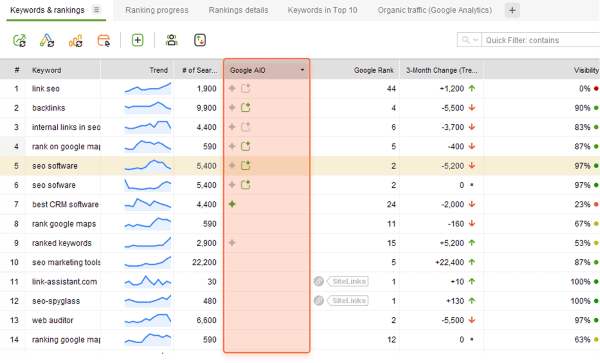
Good to Know: Traditional SEO tracking platforms are evolving to include analytics for Google AI Overviews and AI search visibility more generally. For one example, see the AIO Rank and AIO Mentions metrics now available in SEO PowerSuite’s RankTracker application.
Specialized and Workflow Platforms
Beyond the big suites, a new generation of tools offers specialized capabilities or all-in-one workflows tailored to specific needs. These platforms often focus on connecting data from different pillars into a single, actionable view.
Two good examples are SEO Stack and Rank Logic:
This platform acts as a supercharged ‘Google Search Console replacement.’ It removes GSC’s 16-month data limit and 1,000-row export cap, allowing you to analyze long-term trends.
Its power for content analytics comes from its AI Content Auditor, which layers on top of your GSC data to analyze E-E-A-T, topic gaps, and user intent, directly connecting your performance data (Pillar 2) to your on-page quality (Pillar 3).
This tool is a WordPress plugin that excels at answering the most important question in content analytics: ‘Did my content update work?’ It visualizes your GSC and GA4 data within WordPress, but its key feature is content-related ‘events’ tracking.
It automatically logs when you update a post, change a title, or add links, and then overlays those events on your ranking graphs. This provides a direct, visual correlation between a specific action and its performance outcome.
Analyzing Your SEO Content Data
Gain Actionable Insights from Content Analytics
Data is useless until you translate it into action. The entire point of content analytics is to find optimization opportunities. Here are four common scenarios you’ll find in your data and the specific actions you should take to fix them.
Insight 1: High Impressions, Low Clicks (Fix the Listing)
The Scenario: You’re in Google Search Console (GSC) and you see a page with thousands of impressions but a 0.2% Click-Through Rate (CTR).
The Diagnosis: This means people see your page somewhere in the search results, but they aren’t compelled to click it. Your content is visible, but your ‘storefront’ (your search snippet) is unappealing relative to the other content options.
The Action: Optimize Your Title Tag and Meta Description.
- Title Tag: Is it boring? Does it match the user’s search intent? Make it more compelling. Ask a question (‘Tired of Slow SEO?’) or promise a specific outcome (’10 Tips to Fix SEO…’).
- Meta Description: Does it accurately summarize the page and provide a strong call to action? Treat it like ad copy. Tell the user why your page is the best answer to their query.
Insight 2: High Traffic, High Bounce Rate (Fix the Page)
The Scenario: You’re in Google Analytics 4 (GA4) and see a long-form blog post getting tons of traffic, but the bounce rate is 90% and the average engagement time is only 10 seconds.
The Diagnosis: Your title and meta description worked (they clicked!), but the page itself failed them. This is a classic ‘bait-and-switch’ problem, often caused by:
- Intent Mismatch: The content on the page doesn’t actually answer the question your title promised.
- Poor Page Experience: The page is ugly, hard to read, full of ads or pop-ups, or painfully slow to load on a mobile device.
The Action: Check Intent and Page Speed.
- Check Intent: Re-read your content. Does it immediately address the search query? If not, rewrite your introduction to deliver the answer upfront. This may also help you with AI search visibility (e.g., via ‘content chunking’).
- Check Page Experience: Run the URL through speed analysis tools like Google’s PageSpeed Insights (PSI) or GTmetrix. If your Core Web Vitals are poor, all the traffic in the world won’t matter. Fix image sizes, remove render-blocking scripts, and improve your mobile layout.
Insight 3: Ranking on Page 2 for a High-Value Term (Fix the Depth)
The Scenario: You’ve been stuck at position #12 for months for a ‘money keyword’ that you know would drive conversions.
The Diagnosis: You are ‘in the conversation’ but not seen as the definitive authority. You’ve met the basic requirements, but your content isn’t comprehensive or trustworthy enough to beat the top 10.
The Action: Increase Depth and Authority.
- Run a Content Gap Analysis: Use a Content Intelligence tool (like Frase, Surfer, or Clearscope) to analyze the top 10 ranking pages. What subtopics, questions, and entities do they cover that you’ve missed? Update your article to be more comprehensive.
- Boost E-E-A-T: Add author bios, cite your sources, include original data or case studies, and get more high-authority internal and external links pointing to the page.
Insight 4: Obvious Content Gaps (Create the Content)
The Scenario: You run a competitive analysis in Ahrefs or Semrush and find your main competitor is ranking for 50 high-value keywords that you don’t even have content for.
The Diagnosis: You are missing an entire cluster of topics that your audience is searching for. You have an opportunity to capture net-new traffic.
The Action: Prioritize and Create New Content.
- Don’t just build a wish-list of content — prioritize it. Start with the keywords that have the best combination of high search volume, high conversion intent, and ‘winnable’ competition. This is how you build a data-driven content calendar instead of just guessing what to write next.
Content Analytics & Generative Engine Optimization
The Future of Content Analytics is GEO-Centric
If content analytics is the current practice in traditional SEO, then adapting for Generative Engine Optimization is its immediate future. The game is no longer just about ranking high in Google’s standard web results; it’s about becoming the trusted source for AI-driven answers.
What is GEO? It is the practice of optimizing your content to be found, understood, and used by generative AI models. This means creating content that is not only discoverable by crawlers but is also structured to be the perfect, citable answer for models like Google’s AI Overviews, ChatGPT, Perplexity, or Claude.
In this new landscape, our analytics focus has to shift to a new set of metrics and strategies.
New Metrics for a New Era
- Factual Completeness: Is your content a comprehensive, one-stop answer for a user query? AI models are designed to synthesize information, and they favor sources that provide complete, accurate data.
- Conciseness & ‘Snippet Readiness’: Can your content be easily distilled into a 2-3 sentence summary, a bulleted list, or a ‘how-to’ step? AI models look for clearly structured information that can be repackaged as an answer.
- Citation & Sourcing Signals: Are you being cited as a source in AI Overviews? This is the new ‘ranking.’ SEO platforms and newer GEO tools are emerging to track this, but it will soon be a critical KPI for all content.
- Authority & Sourcing: Your E-E-A-T (Experience, Expertise, Authoritativeness, Trust) signals are more important than ever. AI models are being trained to prioritize sources that are demonstrably authoritative, so linking to and from other trusted sites is crucial.
Related: Learn more here about the importance of ‘content chunking’ for AI-focused generative engine optimization.
The New Strategy: Be the Most Citable Answer
Your goal is to make it easy for an AI model to choose your content. This means shifting your strategy from ‘keyword stuffing’ to ‘concept stuffing.’
- Structure is Everything: Use clear, semantic HTML. Use your H2s and H3s to ask and answer questions directly. Use bulleted lists and numbered steps.
- Be Factual and Unambiguous: Clearly state facts, figures, and definitions. The AI is looking for clarity, not just clever prose.
- Build Authority Clusters: Don’t just write one article. Write 10 related articles that link to each other, establishing your site as a topical expert that the AI can trust for an entire subject area, not just a single query. Learn more about internal linking strategies and AI-powered tools for better internal linking.
Want to stay updated on my SEO and GEO-related content? Add your email details below for periodic updates straight from me (David).
Your email info is safe here. We don’t sell, rent, or share your details with outside parties. You can easily unsubscribe at any time.
Like this post? Quickly share it with your social networks here.
SEO and Content Analytics — Closing Thoughts
Conclusion — Your Website Content’s Future is Data-Driven
For decades now, content creation has been treated as a linear process: research, write, publish, repeat. The ‘publish and pray’ model is inefficient, expensive, and ultimately, a gamble.
Putting more focus and energy into SEO content analytics fundamentally changes this. It transforms the linear process into a continuous loop, where the data from your published content becomes the direct feedback that fuels your next optimization.
It’s the engine that turns basic content creation into smarter content optimization.
If you’re still relying on guesswork and gut feelings, your content is destined to be outperformed by teams that are guided by data and adapting faster to AI-centric search. The future of content success doesn’t belong to those who just create the most content; it belongs to those who measure, understand, and adapt quickly.
Stop guessing. Start measuring.
With that in mind, here’s your first step: Log into your Google Search Console, find one important page with high impressions and low clicks, and ask yourself: ‘How can I make this title and description better today?’ And ‘What are the easiest improvements I can make to the piece this week?’
Questions or Comments?
I hope this overview of SEO/GEO content analytics has been helpful! Here are a few closing questions for you to consider:
- What is your content analytics process today in the context of SEO or GEO? Is it closer to non-existent, or fairly mature and repeatable?
- How does content analysis overlap with your periodic SEO content audit work? How are they connected?
- Which SEO tools have been most beneficial to your content analytics work? How is AI impacting your content analytics toolkit?
Feel free to add more in the comments below with any thoughts, feedback, or related questions. Thanks also for any social shares on this post!
