
Putting the Spotlight on the Dark Funnel of SEO
Before the era of AI-powered search, “SEO traffic” was easier to track and analyze — from source through conversion.
With the right analytics tools in place, the SEO funnel part of digital marketing was more transparent overall.
Now, it seems a LOT more opaque. Hence the extension of “dark funnel” concepts to the worlds of AI SEO, GEO, etc.
This post looks closer at the “SEO Dark Funnel”, with insights, tips, and tools for peering into it to help boost SEO-driven growth.
Let’s grab our SEO flashlights and take a closer look below!
This post contains a few referral links to select vendor partners. We may receive compensation for purchases made through these links, at no additional cost to the buyer.
Last updated May 31, 2026
Introduction to the SEO Dark Funnel
Into the Darkness: The Disappearing Organic Click
Picture a scenario that is currently keeping marketing leaders awake at night. You log into Google Analytics on a Monday morning and see a terrifying sight: your informational blog traffic – historically the lifeblood of your top-of-funnel organic search presence – has plummeted by 35% quarter-over-quarter.
Panic sets in. You prepare to draft an urgent Slack message to your SEO team. But before you hit send, you check your pipeline dashboard.
Yet strangely, your sales team is having a record month. High-intent demo requests are surging, and branded searches for your company name have spiked.
Even more perplexing, when you look at the source attribution for these new qualified leads, the vast majority are categorized as “Direct” or “Branded Organic Search.”
What is happening here is not an anomaly; it is the new normal.
We are witnessing the rapid collapse of traditional top-of-funnel SEO. For decades, search engine optimization was a predictable game of capturing “blue link clicks” from users searching for educational keywords.
Today, that playbook is fracturing under the weight of “zero-click” search engines, conversational AI answers, and algorithmic summaries.
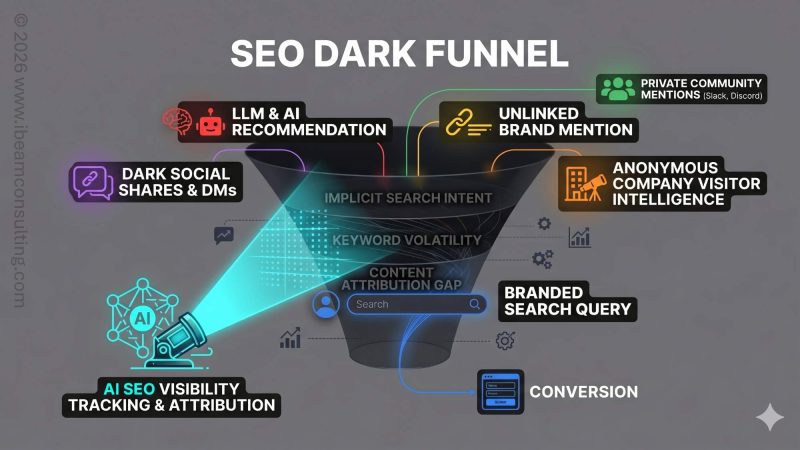
This invisible landscape of search is what we call the SEO Dark Funnel (or Dark SEO Funnel).
Originally coined by B2B marketing advisor Gaetano DiNardi in an early 2026 Search Engine Land piece, the term describes the highly fragmented, AI-mediated search space where brand discovery and consideration happen completely outside the view of traditional tracking scripts and analytics platforms.
In this era of Generative Engine Optimization (GEO) and conversational search, organic session volume is no longer the ultimate trophy. Success lies in understanding, optimizing for, and measuring the invisible, untracked touchpoints of the SEO Dark Funnel.
If you continue to evaluate your SEO success solely by traditional clicks and impressions, you are measuring a ghost channel. It is time to shine a light on where modern discovery actually happens.
Origins of the SEO Dark Funnel
The Roots of the Concept: B2B Marketing & The Broader “Dark Funnel”
To understand how the Dark Funnel swallowed organic search, let’s first trace its origins. The concept of “invisible” marketing channels did not begin with AI; it grew out of the unique complexities of B2B buying behavior.
From “Dark Social” to the “Dark Funnel”
The lineage of invisible digital behavior goes back to 2012, when Alexis Madrigal, then a senior editor at The Atlantic, coined the term “Dark Social.”
Madrigal pointed out that a massive percentage of web traffic sharing occurred outside of trackable social networks. When a user copies a link and pastes it into Slack, WhatsApp, iMessage, or an email, web analytics software is stripped of its referrer data.
When the recipient clicks that link, the visit is classified in standard website analytics simply as “Direct.” In other words, there is no visible referrer source for website traffic attribution purposes.
As B2B purchasing evolved, this untracked sharing expanded far beyond private messages. The enterprise software discovery process moved into podcasts, private masterminds, gated webinars, and third-party industry groups.
To describe this entire untracked buyer journey, the B2B account-based marketing (ABM) platform 6sense coined the term “Dark Funnel.”
They defined it as the “ghostly data-realm” of anonymous digital buyer behavior — such as visiting third-party review sites, reading blogs anonymously, and exploring solutions long before identifying themselves.
The term was later popularized and turned into a core strategic movement by demand generation leaders like Chris Walker.
Walker argued that traditional B2B marketing was broken because software attribution models forced marketers to optimize only for trackable, low-quality actions (like gating a whitepaper to capture an email) while ignoring the high-intent, untracked brand-building channels (like building community or launching a highly shared podcast) where buyers actually made their decisions.
Related: Learn more in this post about the “B2B dark funnel” and anonymous website visitor tracking.
The B2B Buying Reality
This shift is backed by rigorous data. Gartner and CXL research regularly demonstrates that modern B2B buyers spend over 80% of their purchasing journey navigating third-party, un-trackable, or peer-led channels before they ever make direct contact with a vendor’s sales team.
Buyers actively avoid traditional gated funnels. They prefer un-trackable environments because they are:
- High-Trust: They rely on peer-led, unbiased verification rather than polished corporate marketing collateral.
- Ad-Free and Frictionless: They prefer to browse information in communities or on independent platforms where they won’t immediately be hounded by outbound sales reps.
- Private: Buyers value their anonymity until they are ready to purchase.
Historically, SEO was considered the ultimate “bright” or “illuminated” funnel because every keyword search and click-through was neatly recorded in Google Search Console and Google Analytics.
However, as search engines have evolved into answer engines and conversational AI platforms, this final bastion of predictable digital attribution has officially gone dark.
AI, LLMs, and SEO Dark Funnel Impact
The New Layer: How It Applies to “AI SEO” and “GEO” Today
If B2B marketing leaders spent the early 2020s adjusting to the untracked nature of podcasts and Slack channels, the mid-2020s have introduced a far more disruptive force: AI Large Language Models (LLMs).
The rise of conversational search engines like ChatGPT, Claude, Gemini, and Perplexity has added an entirely new algorithmic layer to the Dark Funnel.
How LLMs Darken the Funnel
In a traditional search model, a buyer looking for a solution would search Google for “enterprise CRM platforms,” review the top four organic results, click onto your blog post, download a comparative PDF, and enter your marketing automation system.
You had a neat, trackable, multi-touch digital breadcrumb trail.
In an AI-mediated search world, that entire sequence may be compressed into a single “conversation” that never touches your website.
Today’s buyer opens their conversational AI of choice and inputs a highly specific, context-rich query, such as:
“I run a B2B enterprise startup with a 9-month sales cycle and custom contract requirements. We find Salesforce too bloated. What are the best three lightweight CRM alternatives that support deep custom fields and complex pipeline gating, and what are their pros and cons?”
Within seconds, the LLM generates a comprehensive response. It recommends three distinct brands, synthesizes their feature sets, notes their pricing structures, and highlights exactly why they fit the user’s criteria.
The buyer has just successfully completed their informational, comparison, and evaluation stages. They are highly educated and ready to act. Yet, from the perspective of those three recommended brands, absolutely zero website traffic has occurred.
No links were clicked, no cookies were set, and no analytics scripts were triggered. The interaction was entirely hosted inside a closed LLM interface.
Google’s AI Overviews: The Transitional Gatekeeper
It is a mistake to think this phenomenon is isolated to third-party tools like ChatGPT or Perplexity. The SEO Dark Funnel has set up camp directly on Google’s own territory via AI Overviews (AIO).
With AIO, Google synthesizes answers to complex queries directly at the top of the search engine results page (SERP). Even if a buyer uses Google instead of an LLM, they are served a comprehensive, AI-generated summary that answers their question without requiring a single click.
The authoritative links are tucked away in small, footnoted citation cards. This means the transitional gatekeeper of search is actively training users not to click. The Dark Funnel is no longer an alternative ecosystem — it is actively cannibalizing Google’s blue links from the inside out.
The Invisible “Ingestion-Recommendation-Verification” Loop
This new paradigm operates in a continuous, three-stage cycle that bypasses traditional marketing analytics entirely:
- Ingestion: Behind the scenes, LLMs crawl the web, scrape industry blogs, ingest review platforms, and parse peer sentiment across public forums. This continuous scraping is entirely invisible to your Google Analytics dashboard.
- Recommendation: A buyer queries the LLM. The AI pulls from its synthesized database to recommend your brand, citing specific advantages. Because the user is interacting with an AI interface, they get their answer immediately, resulting in a “zero-click” event for you.
- Verification: Bypassing top-of-funnel keywords entirely, the highly motivated buyer opens a standard browser, types your brand name directly into Google (or goes straight to your URL), and visits your pricing or demo page to validate what the AI suggested.
The Attribution Trap
When this user eventually requests a demo, your analytics software registers the conversion’s origin as “Direct” or “Branded Organic Search.”
This is the ultimate attribution trap. The modern SEO work – optimizing your brand entity, building structured data, and earning authority so that the LLM recommended you in the first place – is rendered completely invisible.
The underlying catalyst of your pipeline goes uncredited, while “Direct” takes the crown.
SEO Dark Funnel Tactics
Designing for the Shadows: Optimizing for GEO and LLM Citations
How do you optimize for a search environment that doesn’t rely on keywords or direct clicks? The answer lies in Generative Engine Optimization (GEO) — the practice of making your brand’s digital footprint highly readable, authoritative, and attractive to artificial intelligence models.
To win in the shadows of the SEO Dark Funnel, you must transition from capturing search engines to capturing the sources that feed them.
Shift from Keywords to Entities
Traditional SEO was built on text string-based matching — incorporating high-volume keywords like “best marketing software” into your metadata and headers.
However, AI engines do not rely on simple text strings; they rely on entities.
An entity is a clearly defined concept, person, place, or brand that exists within an AI’s semantic knowledge graph. Instead of asking, “Does this page contain the keyword?” an LLM asks, “Is this brand entity strongly associated with high-quality CRM solutions for startups?”
To optimize your entity, you must consistently publish authoritative, factual content that establishes clear relationships.
You are no longer just writing website or blog articles; you are building an undeniable web of associations that proves your brand is the definitive answer to specific user problems.
The Death of Regurgitation: Optimizing for “Information Gain”
Traditional SEO rewarded the “skyscraper” technique — taking the top ten Google results, blending them together, and writing a slightly longer, highly polished version of the same information.
In the Dark Funnel, this strategy is dead.
AI engines are trained to ignore generic, regurgitated copy. Instead, they prioritize Information Gain — a concept rooted deeply in Google’s own patent filings.
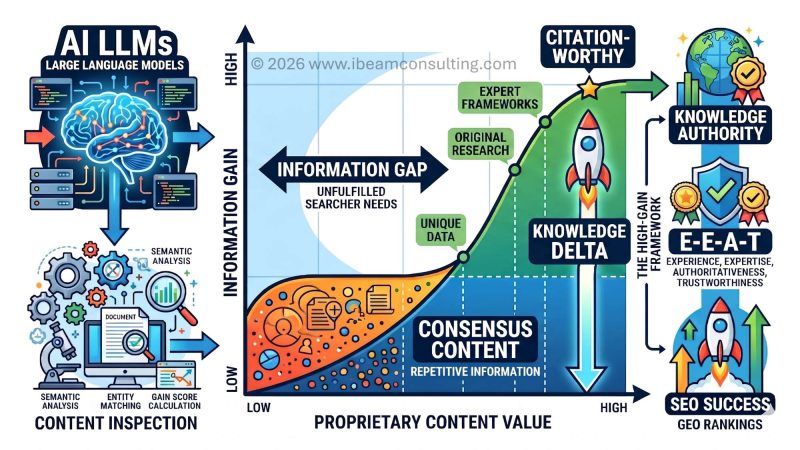
To be cited and recommended by an LLM, your content must offer unique, non-commodity value: proprietary data, original research, customer case studies, or deeply authoritative, contrarian opinions that cannot be found anywhere else on the web.
If your site merely summarizes what is already on the web, AI engines will ingest your summary but cite your competitors who provided the original source data.
Related: Learn more in these posts about SEO and information gain and the information gain advantages for B2B SEO.
Winning the “Relevant Digital Neighborhoods”
LLMs do not generate recommendations out of thin air. They base their neural network weightings on trustworthy, highly cited digital neighborhoods. To ensure your brand is recommended inside the Dark Funnel, you must dominate these key environments:
Peer Consensus Platforms
AI models heavily prioritize human consensus to avoid dry, corporate marketing copy. Platforms like Reddit and Quora, as well as industry-specific Slack and Discord channels, are heavily crawled.
If real users are actively recommending your software in Reddit’s /r/sales or /r/marketingops subreddits, the LLMs will ingest that sentiment and echo it in their conversational recommendations.
Related: Learn more in these posts about popular SEO tools on Reddit, SEO marketing tips for Reddit and Quora, top SEO Q&A on Reddit, and using Reddit and Quora for B2B lead generation.
The Power of Direct AI Data Partnerships
Why are platforms like Reddit and Quora suddenly the crown jewels of organic search? It is because of multi-million dollar Direct AI Data Partnerships.
Companies like OpenAI, Google, and Apple have signed direct licensing agreements to secure real-time access to these platforms’ data pipelines.
This means that if an industry expert recommends your tool on Reddit today, that sentiment is almost immediately ingested into the training sets of active LLMs, directly influencing chatbot recommendations tomorrow.
These platforms are no longer just forums; they are the active, high-priority training nodes of the modern search ecosystem.
Structured Review Ecosystems
Review aggregators like G2, Capterra, and Trustpilot are golden repositories of structured, categorized data.
LLMs utilize these sites to quickly compare feature matrices, user sentiment, and pricing. If you lack a high volume of positive, detail-rich reviews on these platforms, AI engines will pass over your brand entity in favor of competitors who do.
Premium Third-Party Editors
High-authority publications, industry-specific newsletters, and independent “top 10” lists are frequently cited as source citations by conversational engines like Perplexity.
Earning organic mentions on these domains is a force multiplier; it proves your authority to both human readers and AI crawlers simultaneously.
Technical GEO Best Practices
While semantic authority is king, technical formatting ensures that AI scrapers can parse and digest your brand’s core capabilities effortlessly:
Implement Semantic Structured Data
Use advanced Schema.org markup (JSON-LD) to explicitly define your organization, its products, key features, and target audience. This translates your website into a structured format that LLMs can map directly into their knowledge bases.
Design with Clear, Scannable Hierarchies
Use logical heading structures (H2s and H3s) and tables. LLMs excel at processing tabular data. If you have a comparison page, use a clean, well-formatted HTML table comparing your features to competitors.
Use Authoritative, Jargon-Free Declarations
Avoid flowery, ambiguous marketing copy. Instead of writing, “We synergize enterprise ecosystems to maximize paradigm shifts,” write, “Our software is a SOC-2 compliant document management platform built specifically for healthcare providers.”
Clear, declarative statements make it incredibly easy for an AI to categorize your brand entity correctly.
Illuminating the SEO Dark Funnel
Tools, Metrics, and Approaches for SEO Dark Funnel Insights
If the buyer’s journey has moved into the shadows, running your department by staring at standard Google Analytics 4 (GA4) traffic charts is a recipe for strategic failure.
When raw blog traffic drops while conversion rates climb, it is a sign that your dark funnel GTM (Go-to-Market) strategy is actually working — you are weeding out unqualified traffic and attracting high-intent buyers who discover and qualify you off-site and make direct visits later.
To prove and optimize this impact, you must replace depreciated metrics with tools and methodologies designed to de-anonymize search behavior and map out invisible pathways.
Method 1: B2B Website Visitor Tracking (De-anonymizing Intent)
Before a B2B buyer ever fills out a “Request a Demo” form, they will visit your website. Usually, they browse anonymously, looking at your pricing, documentation, or integration pages.
Because they discovered you via an off-site LLM or peer community, traditional attribution classifies them as anonymous “Direct” traffic.
By implementing B2B website visitor tracking software, you can run reverse IP and DNS (“IP-to-Company”) lookups to identify the specific companies visiting those high-intent pages.
How it helps: If your conversational AI presence and dark funnel mentions are working, you should see a measurable increase in target accounts (your Ideal Customer Profile, or ICP) browsing your bottom-of-funnel pages, even if they don’t immediately convert on day one.
It proves your invisible SEO program is driving high-value enterprise interest.
Key Vendor Tools:
- Leadfeeder and Albacross: Excellent for identifying European and global company traffic and feeding that intent data directly into CRMs.
- Visual Visitor: A highly capable sales intelligence engine specializing in identifying anonymous corporate web traffic, providing depth in contact details, and integrating closely with sales follow-up and email marketing campaigns.
- Leadinfo (now with Visitor Queue): A European-focused B2B de-anonymization tool that has merged its strengths with Canada-based Visitor Queue, enabling real-time corporate IP tracking, detailed firmographic data enrichment, and custom lead scoring matrices. (Learn more about Leadinfo’s acquisition of Visitor Queue.)
- Clearbit Reveal (now part of HubSpot Breeze Intelligence): Seamlessly integrates with GA4 and the broader HubSpot ecosystem to deanonymize traffic and enrich anonymous visitor data by industry, employee count, and company name.
- Koala and Warmly: Modern, highly visual platforms that combine deanonymization with real-time chat prompts and automated Slack notifications when high-value accounts land on critical pages.
An EU-Native B2B Lead Generation Platform
Leadfeeder is a ‘revenue engine’ for B2B sales and marketing teams, especially those with European / EU account targets.
It’s an AI-assisted platform for B2B lead generation and revenue growth.
Pros:
Boosts revenue and sales/marketing efficiency
Integrates multiple sales intelligence tools and data for B2B revenue teams
Provides strong GDPR/regulatory compliance for EU markets
Offers new AI-powered capabilities
Supports affordable Account-Based Marketing (ABM) programs
Offers a free ‘Lite’ option with basic capabilities
Cons:
May be pricey for smaller B2B’s with limited account targets
Lacks some features of enterprise-scale ABM platforms
Method 2: LLM Share of Voice & GEO Tracking
To measure how visible your brand is inside conversational AI engines, you cannot use traditional keyword-based rank trackers. You need specialized software built to parse and evaluate generated responses.
How it helps: These tools act as “AI Rank Trackers.” They systematically query models like Claude, GPT-4, and Gemini with hundreds of variations of buyer queries, cataloging when your brand is recommended, what sources the AI cites as proof, and the sentiment of the output.
Key Vendor Tools:
- BrightEdge (Copilot & Generative Parser): Helps track your brand’s presence in Google’s AI Overviews and other conversational engines, identifying exactly which content directories are being used to synthesize answers.
- Authoritas: Offers robust tools designed to analyze conversational engine share of voice, helping you map out which terms generate your entity’s citations.
- WordLift: A technical AI SEO platform that focuses on optimizing and automating your internal structured data graph, making it incredibly easy for LLM crawlers to ingest your site’s information.
Pro Tip: Learn more in this post about free AI search visibility trackers. Many tools offer basic free AI visibility tracking and then more robust paid plans.
Method 3: Self-Reported Attribution
The simplest and most powerful tool for illuminating the dark funnel is one you can build in five minutes: an open-text form field for website visitor feedback.
Instead of a rigid dropdown menu containing canned answers like “Search Engine” or “Social Media,” ask a blank, mandatory question: “How did you hear about us?”
How it helps: Software attribution tools are structurally incapable of tracking a recommendation inside a private Slack community or a personalized prompt on ChatGPT.
Human beings, however, remember exactly how they found you. When a software lead is marked as “Direct” in your CRM, but the user typed “My peer on the Exit Five Slack community recommended you” or “I asked Claude for CRM suggestions and your brand was number one,” you have successfully illuminated your dark channel value.
Key Tools: Standard marketing automation and form builders (HubSpot, Typeform, or Jotform) paired with qualitative categorization strategies to group raw user inputs into meaningful reports.
Method 4: Branded Search Volume & BOFU Resilience
Finally, keep a close eye on two macro-KPIs that act as direct proxies for Dark SEO success:
- Branded Search Queries: Monitor Google Search Console for spikes in people typing your exact brand name or brand + product variants into Google. This is the direct result of the “Verification” step in the loop.
- Bottom-of-Funnel (BOFU) Page Traffic: While top-of-funnel blog posts may lose traffic to quick AI answers, your product feature, pricing, and case study pages should remain highly resilient. Focus on protecting and optimizing these high-intent pages above all else.
Like this post? Quickly share it with your social networks here.
The Dark Funnel of SEO — Closing Thoughts
Conclusion: Winning in the Era of Invisible Attribution
The modern SEO landscape is undeniably growing darker. The traditional, trackable loop of keyword-to-click-to-lead is fading.
However, this does not mean that organic search is dying — it is simply undergoing its most profound evolution since the inception of the search engine.
We are transitional players in a shift from a game of capturing clicks to a game of dominating authority.
In the era of the SEO Dark Funnel, your ultimate goal is not to hoard anonymous web traffic; it is to make your brand entity so authoritative, so trusted, and so highly cited that AI engines cannot compile a recommendation without including you.
When your SEO program focuses on building real authority – via structured data, industry peer reviews, authoritative third-party coverage, and robust community word-of-mouth – you build an engine that operates seamlessly in the shadows.
Traditional software attribution might struggle to track it, but your revenue pipeline will inevitably feel its power.
Actionable Next Steps to Start Illuminating Your Dark SEO Funnel Today
If you want to stop guessing and start dominating the SEO Dark Funnel, here is your immediate playbook:
1. Conduct an LLM Audit of Your Brand
Open ChatGPT, Claude, and Perplexity today. Act as your ideal target customer and input 10 highly specific buying queries related to your niche.
Note whether your brand is recommended. If it is, what sources did the AI cite? If it isn’t, which of your competitors are winning those citation slots and why?
2. Install a Website Visitor De-Anonymization Script
Add a tool like Leadfeeder, Koala, or Clearbit Reveal to your web stack this week. Filter your views specifically for your target industry and ICP criteria. Monitor who is visiting your pricing and product pages anonymously to see if your off-site GTM brand-building is driving high-value intent.
3. Deploy Self-Reported Attribution
Replace your outdated “How did you hear about us?” dropdown fields with a blank, open-text field. Give it thirty days, and read the raw, qualitative answers. You will likely find a wealth of dark funnel and AI-driven touchpoints that your digital software had completely miscategorized.
4. Transition Your KPIs
Present a new reporting framework to your executive team. Stop focusing solely on informational blog traffic trends, and start reporting on Branded Search Spikes, Target Account Web Visits (ICP), and qualitative attribution patterns.
Shift the focus from quantity of clicks to quality of pipeline.
Questions or Comments?
I hope this peek inside the dark funnel of SEO has been helpful and informative! Let’s close this post with a few related questions for you:
- Have you noticed your overall marketing/sales funnel “going a bit dark” and becoming harder to measure in recent months? If so, what are the main root causes?
- Are you experiencing any of the SEO Dark Funnel issues highlighted in this post? What are your fastest and best tactics for illuminating the darkness here?
- Which of your current or planned martech tools can help you further illuminate the dark funnel of SEO?
Feel free to add more in the comments below with any thoughts, feedback, or related questions. Thanks also for any social shares on this post!
