
Last updated Jul 17, 2025
How SEO Tools Are Adapting to AI
It seems like every martech software product needs to ‘have AI in it’ these days. And SEO tools, generally speaking, are no exception.
AI technologies can greatly enhance SEO platforms, while in some areas also providing direct competition to traditional SEO tools.
This post looks at AI and SEO toolkit evolution, with a special focus on typical ‘all-in-one’ SEO platforms and a related SWOT analysis.
Let’s take a closer look below…

Special welcome to those landing here from AI-powered search results, including Google’s AI Overviews and AI Mode, ChatGPT, Perplexity, etc. Small independent publishers (like me and this site) really appreciate your visits!
This post may contain a few referral links to select vendor partners. We may receive compensation for purchases made via these links, at no additional cost to buyers.
SEO Tools — Navigating the AI Revolution
AI & The Future of the All-in-One SEO Toolkit
Looking at the SEO software space over the last several years, I’ve witnessed many changes and shifts in strategy. But nothing has been as seismic for SEO as the recent advancements in artificial intelligence (AI).
The rise of powerful, accessible AI, including free chatbots and generative models, is not just another trend — it’s a fundamental reshaping of how we approach search engine optimization and a catalyst for a new discipline: Generative Engine Optimization (GEO).
For software vendors providing all-in-one SEO platforms, this new reality presents both exciting opportunities and significant challenges. It’s a moment that demands introspection and a clear-eyed assessment of where they are and where they’re going.
This post highlights the likely impacts of AI on the core pillars of the SEO tools industry, offers a ‘SWOT’ analysis of SEO platforms in this environment, and provides an overview of what the future might hold for your trusted SEO toolkit.
AI Impact on Core SEO Functions
Traditional SEO Functions Must Adapt to AI
Every major component of a traditional SEO platform is being reimagined in the age of AI. This includes keyword and topic research, content development and optimization, technical audits, and ‘off-page’ SEO classics like building backlinks.
Here’s a summary look at how AI is influencing these areas.
Keyword Research — From Search Volume to Semantic Understanding
For years, keyword research for SEO has been a numbers game: search volume, keyword difficulty, and even cost-per-click (CPC for PPC ads) as a related indicator of competitive interest.
While these common keyword metrics remain relevant, AI is pushing us toward a more nuanced, intent-focused approach.
The Shift to Topics and Entities
AI-powered search engines are moving beyond simple keyword matching to a deeper understanding of topics and entities. This means SEO toolkits must evolve to help users build topical authority and optimize for a web of related concepts, not just a list of keywords and keyphrases.
Predictive Keyword Analysis
We can now leverage AI to forecast keyword trends, identify emerging topics, and even predict the potential ROI of a given content strategy. This moves keyword research from a reactive process to a more proactive and forward-looking discipline.
Conversational and Long-Tail Queries
With the rise of voice search and AI chatbots, users are interacting with search engines in more natural, conversational ways. SEO platforms need to be adept at uncovering these longer, more specific queries and helping users create content that directly answers them.
Content Creation & Optimization — The AI-Assisted Wordsmith
Generative AI has democratized content creation, but it has also raised the bar for quality and originality. The role of an SEO platform is no longer just to check for keyword usage and ‘on-page’ optimizations, but to serve as a sophisticated content strategy and optimization partner.
From Generation to Refinement
While AI can generate entire articles, its real value lies in assisting and augmenting human expertise. SEO and GEO tools will increasingly focus on generating detailed content briefs, providing real-time optimization suggestions, and identifying content gaps based on a comprehensive analysis of the search landscape.
Quick Tip: See AI-powered Frase and Surfer for more in this area.
Ensuring E-E-A-T
In a world of AI-generated content, Google’s emphasis on Experience, Expertise, Authoritativeness, and Trustworthiness (E-E-A-T) is more critical than ever. Future SEO and GEO platforms will need to incorporate features that help users infuse their content with unique insights, expert opinions, and verifiable facts.
Content Repurposing and Personalization
AI can be a powerful engine for repurposing existing content for different channels and personalizing it for various audience segments. This allows marketers to get more mileage out of their ‘SEO content’ investments and deliver more relevant experiences to their users.
Technical SEO — AI as the Ultimate Site Auditor
Technical SEO has always been a complex and often tedious discipline. AI is poised to automate much of this complexity, freeing up SEOs to focus on higher-level strategy.
Proactive Issue Detection
Instead of waiting for a scheduled crawl to uncover technical issues, AI can continuously monitor a site and predict potential problems before they impact performance. This includes everything from identifying slow page speeds to flagging potential crawlability issues.
Automated Schema Markup
Generating accurate and comprehensive schema markup can be a challenge. AI can automate this process, ensuring that search engines have a clear understanding of a site’s content and structure.
Log File Analysis at Scale
Analyzing server log files can provide invaluable insights into how search engine bots are interacting with a site. AI can process and interpret these massive datasets, uncovering patterns and opportunities that would be impossible for a human to spot.
Link Building — Intelligent and Personalized Outreach
Link building (for backlink profile growth) remains a cornerstone of SEO for many, but the days of mass, generic outreach are over. AI is enabling a more targeted, personalized, and effective approach.
Smarter Backlink Prospecting
AI can analyze the web to identify the most relevant and authoritative link-building opportunities for a given site or piece of content. This goes beyond simple domain authority to a deeper understanding of contextual relevance and audience overlap.
Personalized Outreach at Scale
AI can help craft personalized outreach emails that are tailored to the specific interests and work of each backlink prospect. This dramatically increases the chances of a positive response and helps build genuine relationships.
Link Quality and Risk Assessment
Not all links are created equal. AI can analyze a site’s backlink profile to identify toxic or low-quality links that could be harming its performance. It can also assess the potential value and risk of a new link-building opportunity.
Related: Learn more about backlinks vs internal links, plus tips for ‘backlink-free’ SEO, where ranking without backlinks is possible.
The Next Frontier — From SEO to GEO
Say Hello to Generative Engine Optimization
The individual impacts on core SEO functions are all leading to a more profound strategic shift: the emergence of Generative Engine Optimization (GEO).
While traditional SEO focuses on ranking a URL in a list of blue links to earn a click, GEO focuses on making your content so authoritative, clear, and well-structured that it gets selected, synthesized, and cited within an AI-generated answer.
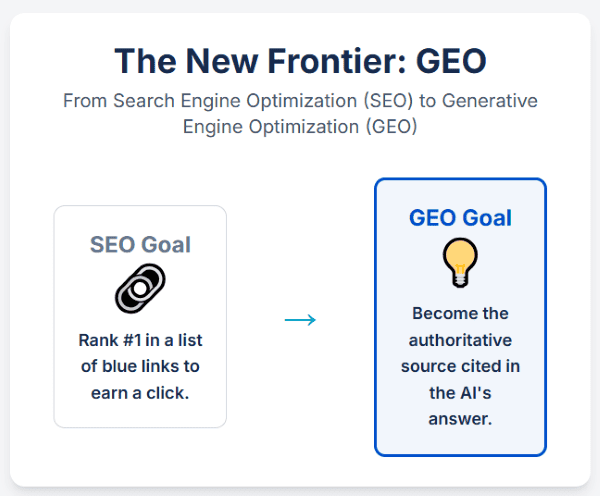
The goal of GEO is not to rank #1, but to become the answer. This requires a new set of tactics:
- Optimizing for Extraction: Content must be structured with clear headings, lists, tables, and direct answers to specific questions, making it easy for an AI model to parse and extract key information.
- Building Verifiable Authority: Citing sources, including statistics, and featuring expert quotes are no longer just best practices — they are essential signals that an AI can use to verify the trustworthiness of your content.
- Information Synthesis: GEO is about ensuring your brand’s information and data points are consistently represented across the web, making it more likely that an AI will see your brand as a reliable source on a given topic.

The End of Keyword Rank Tracking as We Know It?
This shift from SEO to GEO has a direct and disruptive impact on one of the most foundational features of any complete SEO platform: rank tracking.
When the search result is a dynamic, personalized, conversational answer instead of a static, numbered list, what does ‘rank’ even mean? The traditional metric of a single numerical position for a keyword or keyphrase becomes obsolete.
The future of ‘rank tracking’ in a GEO world will involve measuring:
- Citation Frequency: How often is your domain or brand mentioned as a source within AI Overviews for your target topics?
- Answer Ownership: What percentage of an AI-generated answer is based on information from your content?
- Share of Voice: For a given query, what is your brand’s visibility within the AI response compared to competitors?
- Visibility in AI Features: Are you appearing in carousels, featured images, or other elements within the generative experience?
For SEO tool providers, this is a monumental challenge and opportunity. They must re-engineer SERP crawlers and analysis tools to not just check page or post positions in a list, but to parse and analyze the content of AI-generated responses to provide these new, more meaningful metrics.
Related: Learn more, including helpful related tools, in these posts about AI search visibility and Google AI SEO & GEO visibility. Also, see my AI SEO Glossary for key terminology in this overall area.
SWOT Analysis — AI’s Impact on the All-in-One SEO Platform
AI and New Dynamics for SEO/GEO Toolkits
To summarize the transformative potential of AI on SEO toolkits, a clear and simple framework is helpful. Let’s try an old friend — the classic SWOT analysis.
The SWOT analysis below summarizes the strengths, weaknesses, opportunities, and threats facing many SEO toolkits in the age of AI — including popular all-in-one SEO platforms.
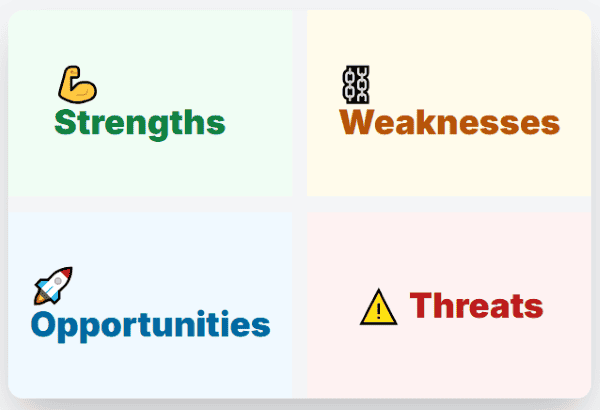
This SWOT analysis is for a typical (generic) all-in-one SEO toolkit viewed in the context of AI.
Strengths
- Proprietary Datasets: Many well-established SEO platform vendors have decades of historical data on keywords, rankings, backlinks, and site crawls. These proprietary SEO databases provide a ‘defensible moat’ that general AI models lack.
- Enhanced Data Analysis: AI can process and interpret these datasets, along with any new data, to provide deeper and more actionable insights than ever before.
- Increased Efficiency and Automation: Repetitive and time-consuming tasks can be automated, freeing up SEOs (and now GEOs!) to focus on high-impact strategic work.
- Improved Predictive Capabilities: AI can forecast trends, predict outcomes, and help search marketers make more proactive and informed decisions.
- Improved Personalization: SEO strategies and user experiences can be better tailored to specific audiences and users.
Weaknesses
- Dependence on Data Quality: The output of any AI system is only as good as the data it’s trained on. Inaccurate or biased data can lead to flawed SEO or GEO recommendations.
- Lack of Human Intuition and Creativity: While AI can analyze and generate, it still lacks the genuine creativity, intuition, and subject matter expertise of a human professional.
- Potential for Over-Automation: Relying too heavily on AI-powered automation can lead to a ‘set it and forget it’ mentality, which can be detrimental in the dynamic and ever-changing world of SEO and GEO. One example is the area of AI-assisted automated internal linking, which is a big time saver but can easily be overdone if not configured properly.
- Cost and Complexity of Implementation: Developing and integrating sophisticated AI features can be expensive and technically challenging, especially for smaller or less well-resourced SEO tools providers.
Opportunities
- Comprehensive SEO & GEO Coverage: Evolving platforms can handle the expanded scope of both traditional SEO and emerging GEO duties.
- New Product and Feature Development: The rise of AI opens up a wealth of opportunities for new tools and features that were previously unimaginable (e.g., GEO tracking as the logical successor to traditional rank tracking).
- Deeper Integration with the Marketing Stack: AI can help SEO platforms integrate more seamlessly with other marketing tools, creating a more unified and data-driven marketing ecosystem.
- Democratization of Advanced SEO: AI can make advanced SEO techniques and strategies more accessible to a broader audience of marketers and business owners.
- Focus on Strategic Consultation: As AI automates the more tactical aspects of SEO, there is a growing opportunity for platforms to provide higher-level strategic guidance and consultation.
Threats
- Disruption from General-Purpose AI Chatbots: Free or low-cost AI tools and LLMs are becoming ‘good enough’ to replace specific, high-frequency functions within paid SEO platforms, including:
- Basic keyword ideation and topic brainstorming
- First-draft content and copy generation (outlines & drafts, meta descriptions, etc.)
- Simple schema markup generation
- Basic on-page content critiques
- The ‘Black Box’ Problem: The inner workings of some AI models can be opaque, making it difficult to understand how they arrive at their recommendations. This lack of transparency can be a concern for some users.
- Rapid Pace of Technological Change: The AI landscape is evolving at a breakneck pace. SEO platforms must be able to adapt quickly to stay relevant and avoid their proprietary data advantages being eroded by more advanced AI models.
- Ethical Considerations and Misuse: The potential for AI to be used for black-hat SEO tactics, such as generating spammy content at scale or manipulating search results, is a significant concern for the entire SEO and GEO ecosystem.
AI Threats to SEO Platforms — A Closer Look
Focusing on the ‘threats’ topic a bit further, the SEO platform features most at risk are those that rely on tasks that large language models are inherently good at, such as text generation, brainstorming, and summarization, especially when a massive, proprietary SEO dataset isn’t required.
Here are the areas of a typical SEO toolkit most vulnerable to being replaced by general-purpose AI chatbots.
Initial Content Ideation and Keyword Brainstorming
This is the most vulnerable area. Asking a chatbot to ‘give me 50 long-tail keyword ideas about sustainable gardening’ or ‘create a content cluster around the topic of “cold brew coffee”, using a hub and spoke structure’ is a task they excel at.
While AI chatbots lack the precise search volume and difficulty metrics of a dedicated SEO tool, for pure ideation, they are incredibly fast and effective.
First-Draft Content Creation
SEO tools that offer AI writers for generating blog post outlines, meta descriptions, or social media posts are facing direct competition. A user can easily paste a topic into a chatbot and ask for a well-structured outline or a compelling meta title and description, often for free.
Even full-text drafts, ready for human editing and fact-checking, are easy tasks for general-purpose AI assistants like ChatGPT, Google Gemini, Microsoft Copilot, and others.
On-Page Content Optimization (Basic Level)
While a dedicated SEO content tool provides a more data-driven score based on competitor analysis (e.g., SERP competitor analysis), a user can paste their text into a chatbot and ask it to ‘act as an SEO editor and suggest improvements.’
The chatbot can then easily identify opportunities for adding keywords, improving headings, and enhancing readability.
Simple Schema Markup Generation
A user no longer needs a dedicated generator for common schema types. They can simply ask a chatbot, ‘Create FAQ schema for these three questions and answers,’ and it will produce the necessary JSON-LD code instantly.
Where Proprietary Paid SEO Platforms Still Win
The core defense for all-in-one SEO platforms lies in their proprietary, large-scale, and historical data. Features that rely on this data are much safer:
- Technical Site Auditing: AI chatbots cannot crawl your entire website to find broken links, redirect chains, or hreflang issues.
- Rank Tracking: AI chatbots cannot systematically track your ranking changes for thousands of keywords over time across different locations, devices, and target search engines.
- In-depth Backlink Analysis: General-purpose AI tools do not have a proprietary index of trillions of backlinks to analyze competitor profiles or find new backlink opportunities.
- Large-Scale Keyword Research: While good for ideation, AI chatbots lack the precise search volume, keyword difficulty, and CPC data across billions of keywords that dedicated SEO/SEM tools provide.
Related: Learn more here about how AI LLMs can directly support SEO work, including ChatGPT, Google Gemini, and Perplexity AI. In some areas, these popular freemium AI tools compete directly with established SEO tools.
SEO Platforms Adapting to AI
Examples of Popular SEO Toolkits and AI Adaptation
With the explosion of AI-driven technologies all around us, and facing the issues highlighted in the SWOT analysis above, makers of SEO tools have not been sitting still.
Based on current feature sets and public-facing strategies, here’s an assessment of the all-in-one platforms that are adapting most effectively to the AI-driven shifts discussed above.
This is a highly dynamic space, but a few platforms stand out for their proactive and strategic approaches.
Semrush
A top competitor in the ‘all-in-one’ SEO/SEM software platform space, Semrush has arguably been the most aggressive in integrating AI across its entire toolkit. It’s not just a single feature; it’s a multi-pronged strategy.
Semrush has moved beyond simple content generation. They’ve launched the Semrush Copilot, an AI assistant that provides personalized recommendations by analyzing data from all their other tools.
They are also actively studying and providing data on AI Overviews and have even started tracking brand visibility within ChatGPT. This shows they are thinking holistically about how AI changes the entire SEO workflow, from research to measurement.
Ahrefs
While perhaps quieter initially, Ahrefs has made a very significant and targeted move to address the core challenge of Generative Engine Optimization (GEO).
Their new Brand Radar tool is a direct answer to the question, ‘How do we measure success when traditional rankings matter less?’ By focusing on tracking brand mentions and citations within Google’s AI Overviews, ChatGPT, and Perplexity, they are building the exact kind of ‘GEO tracking’ functionality that will be essential in the future.
This is a forward-thinking move that looks past content creation to the new reality of SEO/GEO performance measurement.
Moz
Based on their public announcements and product updates, Moz is taking a characteristically thoughtful and integrated approach. They aren’t necessarily launching a single, standalone ‘AI brand’ like some competitors, but are weaving AI capabilities into the core of Moz Pro and leading with education.
Focus on ‘Augmented Intelligence’: Moz’s stated goal is to use AI to enhance the SEO professional, not replace them. Their new features, like Search Intent analysis in Keyword Explorer and Domain Search Themes in the Domain Overview, are designed to save time and provide deeper insights.
Instead of just giving you keywords, they’re using AI to help you understand the why behind a search and how Google perceives your entire domain thematically. This aligns perfectly with the shift from keywords to topics and entities.
Leading with Education and Data: The Moz Blog and their famous Whiteboard Friday series have been all over the topic of GEO and AI Overviews. They are actively researching and publishing data on how frequently AI Overviews appear, which industries are most affected, and what types of sites are being cited.
This positions Moz as a trusted guide for their community during this transition, which is a smart move that builds loyalty.
Enterprise-Grade Tracking (STAT): For their enterprise clients, Moz’s STAT tool is their answer to the GEO measurement problem. They have integrated the ability to track and filter keywords based on whether they trigger an AI Overview. This allows enterprise-level users to identify where their biggest opportunities and threats are in this new landscape, which is a crucial first step in developing a GEO strategy.
In short, Moz’s approach seems less about flashy AI content generation and more about providing the deeper analytical tools and the education required to navigate the shift to GEO. While others might be focused on building AI-powered assistants, Moz is doubling down on providing the intelligence and data for smart humans to make better decisions.
Surfer (SurferSEO)
Although it started as more of a specialized content optimization tool, Surfer deserves a top spot because it was built from the ground up on AI principles that the all-in-one platforms are now adopting.
Surfer’s entire methodology is based on analyzing SERPs to provide data-driven recommendations for content structure, topics to cover, and keyword usage. Their AI writer is guided by this deep analysis, making it inherently more ‘GEO-focused’ than a generic AI writer.
They’ve also added features like ‘Custom Knowledge’ to help infuse content with unique facts (for SEO ‘information gain’ advantages), directly addressing E-E-A-T and authority in an AI world.
Writesonic
This platform is a notable example of an AI-native writing tool that is rapidly and explicitly evolving into a GEO platform.
Writesonic has fully embraced the Generative Engine Optimization concept in its marketing and feature development. It focuses on creating content specifically structured to be understood and cited by AI engines.
By integrating with data sources and focusing on competitor analysis for AI visibility, it’s tackling the new challenges head-on from the perspective of an AI-first company.
In summary, Semrush is leading on breadth of integration, Ahrefs and Moz are leading on the critical new problem of measurement (GEO tracking) and education, and tools like SurferSEO and Writesonic demonstrate the power of an AI-native approach.
These are just a few examples based on popular SEO toolkits. Other dynamics to watch for include:
- Completely new AI-first and AI-only tools that embrace GEO from the start. Some of these will be ‘point product’ solutions that tackle very specific aspects of GEO and the evolution of SEO to GEO.
- More traditional SEO tools or platforms that can’t make the SEO-to-GEO transition — for lack of development skills, funding, vision, or other factors — and either pivot or exit the SEO tools market altogether.
Related: Learn more in this post about AI SEO Tools Stacks, which incorporate AI features in all key areas of SEO.
Want to stay updated on my SEO and GEO-related content? Add your email details below for periodic updates straight from me (David).
Your email info is safe here. We don’t sell, rent, or share your details with outside parties. You can easily unsubscribe at any time.
Like this post? Quickly share it with your social networks here.
AI & SEO Software Platforms — Closing Thoughts
The Path Forward — A Collaborative Future
The integration of AI into SEO is not a zero-sum game. It’s not about replacing human expertise with artificial intelligence, but about augmenting it.
The future of the all-in-one SEO platform lies in its ability to become an indispensable partner to the modern marketer — a tool that not only provides data and insights but also facilitates a more strategic, creative, and effective approach to both SEO and GEO.
As software vendors continue to navigate this new landscape, their focus will be on building a platform that empowers users to leverage the power of AI while staying true to the core principles of great marketing — understanding your audience, creating value, and building authentic connections.
The road ahead is exciting for SEO & GEO toolkit makers — and a very busy and competitive one at that!
Questions or Comments?
Thanks for spending some time with this post. I hope it has been helpful and informative!
Here are a few closing questions for you:
- How has your website SEO strategy evolved during the early emergence of AI chatbots, assistants, and other AI-powered tools?
- How has your SEO tools stack changed during this time? Have your preferred tools adapted well to incorporate AI features?
- Which AI-assisted SEO tools or features have been most helpful and impactful for you? And which have been the least valuable?
- Have regular AI chatbots (ChatGPT, Gemini, Claude, MS Copilot, etc.) displaced any of your former favorite SEO tools? In which functional areas?
Feel free to add more in the comments below with any thoughts, feedback, or related questions. Thanks also for any social shares on this post!
