
Last updated Aug 18, 2024
Grow Your Base of Ranking Keywords Over Time
Getting your important content pages and posts to rank high for your target keywords is of course a primary goal in SEO.
But this is just the beginning. As your content matures, it will likely start to rank for even more keywords over time.
This post looks at SEO and ranking for more keywords, with insights, tips, and a few tools that can help accelerate this process.
Let’s take a closer look below…

This post contains a few referral links to vendor partners. We may receive compensation for purchases made via these links, at no additional cost to buyers.
SEO Keyword Spectrum and Potential
What Is Your Keyword Ranking Potential in Organic Search?
When you’re writing website or blog content with SEO performance in mind, you probably have one or a few target keywords in mind for each piece of content.
In this SEO context, ‘keywords’ means the actual search queries that users enter into search engines like Google, Bing, etc.
You want search engines to rank your content high for these queries, driving visibility and organic search traffic for your site or blog.
What’s interesting here is that your initial set of target keywords/queries is truly just the starting point for your content, as well as your website or blog overall.
In most cases, you’ll find that you can rank reasonably well for many related queries over time. Even better, there are ways to accelerate this for faster SEO performance gains and website traffic growth from organic search.
Let’s see how this works, starting with rank-tracking for a relatively small set of target baseline keywords.
SEO and Target Keyword Rank-Tracking
Tracking Your Most Important Keywords
A top priority in keyword rank-tracking for SEO performance evaluation is establishing a baseline of keywords (search queries) to track over time.
These are the ‘starter keywords’ that you think are top priorities for tracking. They may come from:
- Initial keyword research and prioritization
- Understanding your main content topics and sub-topics
- Your understanding of customer needs and how they describe them in words
- Understanding your products and services and the problems they address
- Keywords ‘borrowed’ from PPC campaigns you may be running
This initial set of target keywords may be fairly small — perhaps 10-20, a few dozen, a hundred, etc. In general, this starter list should be relatively small and focused on your core topics, including highly relevant ‘long-tail’ keywords that are very specific but have lower search volumes.
If you’re using an SEO rank-tracking tool or platform, these are the first keywords you’ll enter into the rank-tracking module. They are your baseline keywords for SEO performance tracking.

Related: Learn more here about basic SEO keyword research methods.
SEO Keyword Expansion — Growing the Base
Expanding Beyond Your Primary Tracked Keywords
Over time, you’ll discover that your baseline set of target SEO keywords is just the beginning.
Using tools like Google Search Console (GSC) and others (see below), you’ll uncover a world of actual user queries that can go far beyond what you thought were great starter keywords.
Some of these new keywords/queries can be very insightful and helpful. Especially those that show significant content impressions and are close to ranking well but need a little help and attention to drive better SEO visibility for your content.
Other queries discovered in GSC may not be super helpful but are still interesting to see. You may see user typos, misspellings, and even queries in other languages that drive impressions for your site.
Premium (paid) rank-tracking tools also help uncover new ranking keywords based on their proprietary keyword databases, which can be quite massive and global in scope.
SEO Keyword Growth and Content Impact
There’s a positive correlation between the amount of content on your website and the number of keywords for which it can rank well over time.
Consider this: A ‘thin’ website with only a few short pages has very limited potential for ranking keywords beyond a small core set. This may be fine for so-called ‘brochure-style’ websites or when SEO is not a main marketing priority, but it’s a problem for many websites that could truly benefit from more organic search traffic.
On the flip side, a website or blog with a large and growing content base can naturally rank for more keywords, even when SEO keyword expansion is not a major thrust for the site owner.
For example, website content that is primarily intended for social media or PPC campaigns can still drive SEO gains, even if these benefits aren’t entirely intentional.
Google and the Time Factor of Keyword Growth
It’s important to understand that progress doesn’t happen overnight in the world of SEO. Your newly published content will take a while to earn visibility and clicks from Google, Bing, and other search engines.
This can mean weeks and months of gradual SEO performance gains, depending on things like keyword difficulty, search competition, and the quality of your content and related SEO work.
The good news is that once your content has a foothold with Google and starts to rank higher for certain keywords/queries, it can also begin ranking for more and more keywords over time.
So, time is definitely an important factor when trying to grow your base of ranking keywords.
Related: Learn more here about how long SEO takes to work, based on my actual content and performance data.
Rank Tracking — Tracked vs Untracked Keywords
When tracking your SEO keyword growth over time in various software tools, it’s important to understand the related concepts of tracked vs untracked keywords.
For example, in the screenshot below from SEO PowerSuite’s Rank Tracker application, I have both ‘tracked’ and ‘untracked’ keywords showing in this search for overall ranking keywords.
The distinction is simple:
- Tracked Keywords — The keywords that you (or your SEO team) have selected to be actively tracked in your SEO rank-tracking tool of choice.
- Untracked Keywords — Keywords for which your website already ranks (top 50, 100, etc.), but you aren’t actively tracking in your SEO project. Your SEO software knows you rank for these keywords/queries (per the vendor’s keyword database), but you aren’t tracking them for some reason.

SEO Keyword Expansion Tactics
For any given content page on your site, the untracked ranking keywords offer insights into how your content ranks for related terms that may interest you.
You may decide to strengthen existing content for specific attractive keywords/queries, or perhaps develop and publish something entirely new that more squarely targets a specific high-value query.
GSC Opportunity Keywords
A related tactic is to leverage what I call ‘GSC Opportunity Keywords’. These are queries in Google Search Console that show high or growing impressions for important pages but with currently weaker average ranking positions. Perhaps in the 30-50 range, which equates roughly to Google pages 3-5 in a normal SERP.
Look here for opportunities to work some of these keywords/queries and terms into your existing content. Or you may decide to develop completely new content that more directly addresses these queries.
Topic Clusters and Internal Linking
Another way to drive keyword growth is to cover topics and sub-topics completely with groups of related content.
These groups of related content are often called ‘topic clusters’. They provide additional fuel for natural keyword expansion since they tend to introduce new related terms and keyword variations that search engines will incorporate into their visibility and ranking algorithms.
SEO topic clusters also provide natural targets for better internal linking, which includes both inbound and outbound internal links to and from each piece of content.
Related: Learn more here about keyword groups and topic clusters and internal linking strategies. Also, understand the differences between internal links and backlinks.
Tracking Your Total SEO Keyword Universe
SEO Tools for Keyword Rank-Tracking
There are many SEO tools and platforms available for SEO keyword rank-tracking and further exploration.
Some are free but most are paid/premium software tools that require at least some monthly or annual investment.
Here’s a look at a few free and paid options.
Google Search Console — Free Keyword Insights
Google Search Console (GSC) is a free webmaster toolkit from Google. It provides many useful metrics and insights related to Google SEO, including your content’s keyword (query) performance data over time.

In GSC terminology, SEO keywords are called ‘queries’, since they reflect the actual search queries entered by Google users around the world.
GSC’s queries will most likely include your baseline target keywords, as long as people use those exact terms when searching.
GSC performance data will usually also include a large number of other queries that go far beyond your starter set of target keywords. It’s helpful to pay attention to these and look for useful actionable insights to help refine and expand your SEO efforts.
Bing Webmaster Tools — More Free SEO and Keyword Data
Another free webmaster toolkit, Bing Webmaster Tools (BWT) can serve as a complement to Google’s GSC tools.
Bing Webmaster Tools includes keyword research and related features that can help you expand your site’s visibility for more keywords.

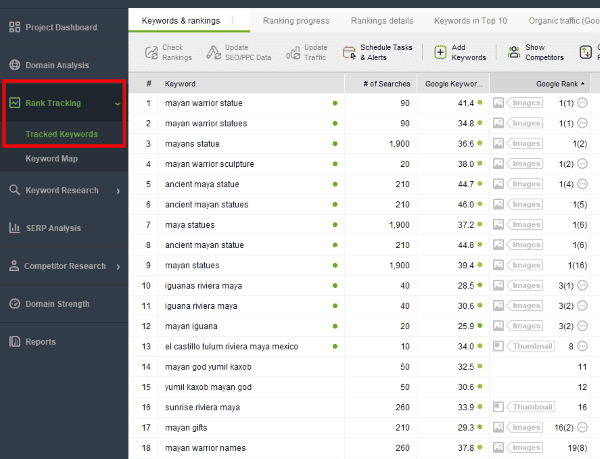
SEO PowerSuite Rank Tracker — Keyword Data & More
SEO PowerSuite is a desktop SEO toolkit that I use for rank-tracking and many more SEO essentials on multiple websites I own and/or manage.

The Rank Tracker application within SEO PowerSuite provides comprehensive keyword rank-tracking, multiple keyword research tools, domain analysis, SEO competitor analysis, SERP analysis, and more.
In other words, it’s much more than just a simple rank-tracking tool, despite its name.
The screenshot below provides a quick glimpse at example keyword data within SEO PowerSuite’s Rank Tracker.
Ahrefs Webmaster Tools — Free Basic SEO Insights
Ahrefs Webmaster Tools is another option for gaining free (but limited) insights into your SEO keyword performance, domain health, etc.
It’s a good way to get started using Ahrefs for free, before committing to one of their paid plans.

Other SEO Rank-Tracking Tools — Freemium and Paid
Beyond the completely free toolkits like Google Search Console and Bing Webmaster Tools, most good rank-tracking software requires a paid subscription.
For several options in this category, see my other posts embedded below. Most SEO software toolkits offer a free trial period or a feature-limited free plan for getting started.
SEO and Ranking for More Keywords — Closing Thoughts
Growing Your Base of Ranking Keywords
As discussed above, an important element of SEO growth is the expansion of ranking keywords for your website or blog.
Some of this happens naturally over time, as search engines understand your content more completely and decide (algorithmically) to show and rank your content for a larger number of search queries.
You can also influence and accelerate this process by updating older content with new related terms and keywords, adding new content with new focus keywords, and building content clusters, with good interlinking, based on related topics and sub-topics.
Even the anchor text you use for internal links can help search engines understand and rank your content for more keywords.
Over time, you should see that individual pages, as well as your overall site, rank for many more keywords and queries than you first selected as your baseline target keyword set.
All in support of a primary SEO goal: more high-value traffic for your site via organic search sources.
Questions or Comments?
I hope this discussion of establishing and then growing your universe of ranking keywords has been helpful! I’ll leave you with a few related questions to ponder:
- If you do SEO for your website or blog, how many keywords are you actively tracking today? How does this number compare with when you first started rank-tracking?
- What insights have you gained by using tools like Google Search Console or paid SEO rank-tracking tools?
- Do you modify existing content or create entirely new pieces based on rank-tracking or other SEO performance insights? What SEO impact do you see from these efforts?
Feel free to add more in the comments below with any thoughts, feedback, or related questions. Thanks also for any social shares on this post via the buttons below!
