
Last updated May 5, 2025
Fix Your ‘Short Content’ SEO Issues with These Tips and Tools
One SEO problem that many websites have is too much short or ‘thin’ content.
This presents several SEO challenges. However, you can address many of these by expanding and improving existing short content.
This post looks at ways to improve short/thin content for SEO performance gains, including practical tips and a few helpful tools.
Let’s take a closer look below…

This post contains a few referral links to select vendor partners. We may receive compensation for purchases made via these links, at no additional cost to buyers.
Short-Form vs Long-Form Content
Quick Definitions
For the purposes of this post, I’ll assume the following working definitions of different content lengths:
Short-Form Content — These are content pieces or types that are less than 500 words in length. (See more on this below.)
Long-Form Content — Content that is at least roughly 1500-2000 words in length. Longer blog posts and website articles are typical examples here.
Medium-Form Content — Pages and posts that are in the middle zone, approximately 500-1500 words in length.
There’s no single accepted definition of these content length breakpoints, but these are decent approximate values that should work in most cases.
SEO Challenges of Short or Thin Content
Shorter Content Usually Has Less SEO Value
By its very nature, short content on a website offers fewer opportunities for driving SEO gains.
The limited word count is a primary culprit here. With fewer words and paragraphs to work with, short-form content just doesn’t have as many SEO opportunities as long-form content. This is one of the reasons why long-form content is great for SEO.
Legitimate Short-Form Content vs ‘Thin’ Content
While this post is about turning short content into long-form SEO content, it’s important to also recognize that true short-form content is perfectly fine and necessary in many instances.
Examples of short-form content that should remain short include:
- On-page SEO elements like title tags and meta descriptions
- Image ‘alt text’ (for assistive screen readers, etc.)
- Image captions
- Headers and sub-headlines
- Brief product/service descriptors
- Brief informational pages (contact info, etc.)
- Concise landing pages with call-to-action (CTA) text
- Social media content (tweets, FB posts, etc.)
These common short-form content types can and should be SEO-optimized to some extent — usually by including a few relevant target keywords where possible and without ‘keyword stuffing’ to a harmful degree.
These purposeful short-form elements are in contrast to purely thin or weak short content that can be expanded for greater SEO benefits.
Note: A short or thin blog post or page of 300 words also qualifies as short-form content, at least by my word-count definition above.
The ‘Brochure-Style Website’ Issue
Many websites serve primarily as online ‘marketing brochures’ for their company or organization. They are focused on brand image, basic positioning messages and value propositions, and brief product/service offer descriptions.
This is all fine, but many marketing brochure-style websites have SEO problems due to an emphasis on short content and little to no actual long-form content.
Many sites like this have SEO problems ranking for non-brand keywords and queries. In some B2B industry segments, this is an opportunity area for B2B SEO improvements and for gaining ground against weaker B2B SEO competitors.
How to Upgrade Short Content Into Long-Form
Tips for Turning Shorter Content into Long-Form SEO Content
If you have many weak or thin/short pages and posts on your site, you’re missing out on potential SEO wins — more organic traffic and conversion opportunities for your site and business or organization.
Here are some proven ways to take your shorter pages and posts/articles into true long-form SEO content territory.
Expand on Existing Points
- Add more details: Provide additional information, examples, or case studies to support your main points.
- Explore different angles: Consider different perspectives or approaches to the topic.
- Offer in-depth explanations: Explain complex concepts or ideas in greater detail.
Expand Product/Service Listings
- Add helpful details: For product or service-based businesses, add more depth and detail to brief product/service listings. Flesh out example product use cases, describe services in greater depth, etc.
Conduct Additional Research
- Gather more data: Look for statistics, studies, or expert opinions to strengthen your arguments. Include references and link out to helpful credible resources.
- Explore related topics: Identify subtopics or related areas that can be incorporated into your post.
- Interview experts: Seek insights from professionals in the field.
Create Subsections
- Break down your content: Divide your post or article into smaller, more digestible sections with clear headings.
- Improve readability: This makes your content easier to skim and understand.
- Organize your thoughts: Subsections help you structure your ideas logically.
Add Visual Elements
- Use images, infographics, or videos: Visuals can break up the text and make your content more engaging.
- Enhance understanding: They can help illustrate complex concepts or data.
- Improve SEO: Images with relevant alt text can improve your search engine rankings.
Related: Learn more here about how to optimize images for SEO.
Consider a Q&A Format or a FAQ Section
- Answer common questions: Address frequently asked questions related to your topic.
- Engage your audience: A Q&A format can encourage reader interaction and further engagement.
Pro Tip: Adding a concise FAQ subsection can help readers while naturally boosting word count and relevant keyword usage.
Write a Comprehensive Conclusion
- Summarize key points: Recap the main arguments or findings of your post.
- Offer final thoughts: Share your concluding thoughts or recommendations.
- Encourage further action: Prompt readers to take a specific action, such as subscribing to your newsletter or visiting another page on your website.
Add Internal Links
- Quality long-form content provides rich opportunities for adding internal links to other pages and posts on your site. This is helpful for users and search engine crawlers, and great for SEO as well. There are many good internal linking tools available to make this process easier, faster, and better (see below for more on this.)
Go for ‘Medium-Form’ Lengths When Needed
- You may not need to stretch shorter content all the way to long-form lengths. Medium-form content is fine in many cases. You’ll get some of the SEO benefits of long-form pieces with less effort.
Add or Improve On-Page SEO Optimizations
- Don’t forget to optimize the short-form elements (new or existing) on your expanded content. Section headers and sub-headlines, image alt text and captions, etc.
- Include variants of target keywords and keyphrases for variety and readability.
Monitor SEO Progress in Google Search Console, Etc.
- With your content expansions now published, keep an eye on Google Search Console (GSC) for ranking changes, click-through activity, etc. Also, monitor your 3rd-party keyword rank-tracking tools for changes over time.
By following these tips, you can transform shorter content into longer, more informative and engaging pieces that are likely to rank higher in search engine results and provide greater value to your audience.
Tools for Upgrading Shorter Content for SEO Gains
Solutions for Long-Form Content Creation and Optimization
There are many tools and methods available now for expanding shorter content into long-form territory.
Many now use generative AI capabilities to help craft new content based on existing text. It’s relatively easy and quick to add hundreds of words to a short blog post that needs an SEO boost.
But you still need to edit the output for consistency, accuracy, voice and style, and overall fit with your goals for the expanded piece.

Here are some examples of tools you can use for content expansion and optimization.
General AI Writing Assistants (ChatGPT, Gemini, etc.)
Any of today’s popular AI writing tools can be used to help flesh out shorter content pieces.
Popular free and premium tools in this area include:
- ChatGPT (from OpenAI)
- Google Gemini
- Microsoft Copilot
- Claude.ai (from Anthropic)
- PropensityAI (Europe-focused for data protection)
With good focused prompting, general LLM-based AI writing tools can help expand short or thin content into more helpful pieces.
Now let’s look at a few tools below that help with content expansion and/or SEO optimization for long-form content. Solutions in this category can help in several ways, including:
- AI content expanders — Using generative AI features to expand on existing text. These can quickly expand on existing paragraphs, add related topics and angles, etc.
- Other content suggestions — Other improvement suggestions based on SERP analysis, related keywords, etc.
- Dynamic SEO content scoring — Numeric optimization scoring based on your target keywords and SERP competition (content in current top search results). Scoring can change in real-time as you write, add suggested missing keywords and variants, etc.
Frase — AI and SEO Content in One Platform
Frase is an example of SEO-focused content development that combines SEO analytics and competitive insights with AI-driven writing features to help you go from ‘blank page’ to finished SEO-optimized long-form content.
Frase also helps expand and optimize existing content.

As an SEO content tool, Frase analyzes SERP competition (your SEO competitors) to make keyword usage recommendations while also providing real-time content scoring as you make progress on your new or expanded piece.
Get the latest Frase product and pricing details here.
Bramework — AI for Blogging Productivity & More
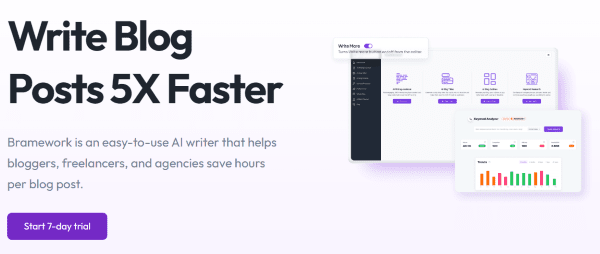
Like Frase above, Bramework is another platform with SEO-optimized long-form content production as its core focus.
Bramework helps bloggers, freelance writers, and marketing agencies develop more quality content at a much faster pace.
Get Bramework product and pricing info here.
Link Whisper — Automated Internal Linking
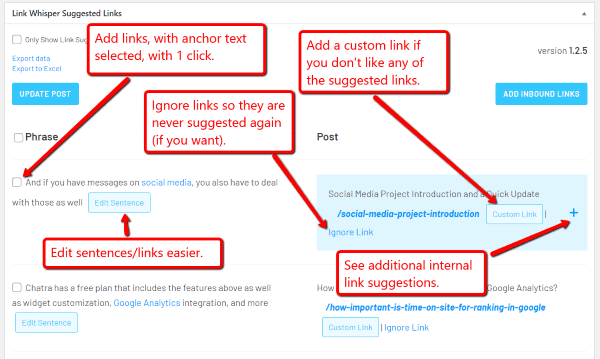
Having more long-form content on your site brings a wealth of new internal linking options that benefit SEO as well as site users.
Here’s a tool I use to help with internal linking on my websites. It now has AI-driven internal linking capabilities as well.

See Link Whisper’s latest features and pricing details here.
Other Long-Form SEO Content Tools
There are many tools and platforms available for creating and optimizing long-form content. See these posts for more on long-form AI content tools and several tools for SEO content optimization.

Want to stay updated on my SEO-related content? Add your email details below for periodic updates straight from me (David).
Your email info is safe here. We don’t sell, rent, or share your details with outside parties. You can easily unsubscribe at any time.
Like this post? Quickly share it with your social networks here.
Fixing Short-Form SEO Content Issues — Closing Thoughts
Improving and Expanding Shorter Content is Easier Now
With a smart approach, and perhaps a helpful SEO content tool at hand, it’s easier than ever now to convert shorter content into more SEO-friendly long-form content.
The tips above offer several practical ideas for expanding content. Today’s AI writing assistants and content optimizers (either free or premium) can help further if needed.
Of course, not all short content needs to be improved or expanded. Intentional short-form content elements serve specific purposes and are short for good reasons.
However, other short content is ripe for improvement and conversion to long-form content with better SEO potential. Short and thin blog posts, articles, and product/service pages are good examples.
Next time you’re reviewing your website or blog’s content, try picking a few pages or posts that can stand some improvement in this area.
Then, after expanding and optimizing shorter content, monitor its SEO performance on Google Search Console and see what impacts you can detect.
Questions or Comments?
I hope these tips for upgrading your short content into SEO-friendly long-form pieces have been helpful. Here are a few closing questions to consider:
- Looking at your website’s content base today (pages and posts), what percent would you say qualifies as short or thin content?
- From an SEO standpoint, how do your current long-form pages/posts perform compared to shorter content?
- Have you expanded short content into long-form word counts specifically for SEO gains? What methods and supporting SEO tools worked best for you? Any more tips or great tools to add to my list above?
Feel free to add more in the comments below with any thoughts, feedback, or related questions. Thanks also for any social shares on this post!
