
Last updated May 24, 2024
Long-Term Value of High-Ranking Content
SEO practitioners understand that getting into high-ranking positions in organic search results (the ‘SERPs’) is only part of the battle.
Staying there is another matter. However, sometimes high SEO rankings become ‘sticky’ — so you stay in top positions for a long time.
This post is about persistent high rankings in SEO, with a few tips about maintaining those high rankings over time.
Let’s take a closer look below…
This post contains a few referral links to vendor partners. We may receive compensation for purchases made via these links, at no additional cost to buyers.
SEO and ‘Sticky’ High Organic Rankings
Some High Organic Rankings Stay High Over Time
When crafting SEO-focused content for your website or blog, you’re naturally optimistic that it has a decent chance of ranking high on Google, Bing, or other target search engines.
As we know in SEO-land, it may take a while for search engines to fully understand and appreciate your new content and decide where it should rank for various user search queries. This is also related to the common question of how fast SEO works.
But if you’re good at SEO and maybe a bit lucky, you will find that some of your content moves up steadily in organic search rankings and ultimately produces steady click-through traffic to your site.
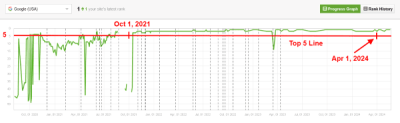
In the best case, your most important content moves into a Google #1 position (or at least a top 5 average position) and stays there indefinitely for your primary target keywords or queries.
In an SEO context, ‘indefinitely’ may translate to weeks, months, or even years in top-ranking positions.
That is part of the potential magic of SEO. See the example below.

Value of Persistent High Search Rankings
SEO and ROI Considerations Over Time
When your ‘SEO content’ eventually earns high rankings for target keywords/queries, it may be a short-lived success or a persistent win. Let’s look at it in the context of what I’ll call here the ‘SEO ROI Lifecycle’.
SEO platform provider Semrush captures the basic idea of ‘long game’ SEO in this graphic.

The SEO ROI Lifecycle
Quick ROI Definition and Example
ROI = [(Revenue – Cost)/Cost] * 100%
Subtract cost from revenue, then divide that number by cost. Multiply by 100% to convert to a percentage figure.
For example, [($1000 – $200)/$200] = $800/$200 = 4, times 100% = 400% ROI.
(Note that the ROI numerator is negative until revenue exceeds cost. There’s a basic ‘breakeven’ concept built into this simple ROI equation.)
With that simple ROI formula in hand, here’s a brief qualitative breakdown of SEO ROI for content that eventually reaches high-ranking positions and stays there over a sustained timeframe.
Phase 1: SEO ROI = Negative
This is the ‘building/investment’ stage of SEO content and the early post-launch timeframe.
SEO ROI here is negative because it’s all cost and no ‘return’ (revenue or other value metric) during this time. You’re spending time and/or resources to build the content and then launch it into the internet, not knowing for sure yet how it will perform.
Phase 2: SEO ROI Heads Toward Positive Territory
At this stage, the initial content work is complete and it is live on the internet. Search engines have crawled and indexed it. You start to see initial impressions on Google (don’t forget to check your Google Search Console performance report!).
Eventually, you start to see organic search user click-throughs to your new content. When these turn into ‘conversions’ for you, your SEO ROI starts moving in a positive direction. When your business value metric (e.g., SEO-driven revenue) exceeds the associated costs, your SEO ROI goes from negative to positive.
This initial ‘ROI > 0’ milestone may be a tiny positive ROI at first, but at least it’s moving in the right direction now and has cleared a breakeven point (SEO revenue or value > SEO costs).
Phase 3: SEO ROI Goes High or Even ‘Infinite’
If your content earns a high-ranking position and stays there indefinitely, producing a steady stream of organic clicks and visits to your site (and more conversions to business value), the ROI >> 0 metric should get high enough to hit your overall ROI target for doing SEO in the first place.
Infinite SEO ROI — If you reach a point where you’re no longer updating or maintaining a piece of content (zero incremental cost), but it’s still producing positive clicks, website traffic, and business conversions, then you can argue you’ve reached ‘infinite ROI’ just for that zero-cost stage of the SEO content lifecycle.
In ROI math terms, based on using incremental numbers only, you have a positive numerator and a zero in the denominator — hence an ‘infinity’ result.
Of course, your overall SEO ROI will be some positive number, hopefully very high, but not infinity.
Getting to ‘Free’ SEO Traffic
There’s a common myth in digital marketing that ‘SEO traffic is free traffic’, or something along those lines.
This is definitely NOT true overall. There are real costs associated with using SEO as a marketing channel and tactic. From labor and talent to what can be fairly expensive SEO software platforms.
However, within the context of the Phase 3 ‘infinite ROI’ scenario outlined above, it is common to get positive value from SEO content (and prior SEO efforts) at zero incremental cost.
This is the only time when the ‘SEO generates free website traffic’ argument makes any sense, and it needs a big asterisk next to that claim.
Reality Check: You know this already, but… not all of your target keywords and content pages will rank high or stay high. Especially if you’re in a competitive topic space or industry niche. That’s why good keyword research is important and understanding your SEO competition is also key.
How to Maintain High-Ranking SEO Content
Tips for Keeping Your High-Ranking Content in First Place
Earning persistently high search rankings for your top target keywords is a wonderful thing — especially if you don’t need to do much to stay in those top-ranking positions.
However, getting that ‘free SEO traffic’ for a while, even a sustained period, doesn’t guarantee that it will last forever.
Here are some things you can do to help keep your SEO content on top of the world.
Refresh and Improve Older Important Content
Even top-performing SEO content needs updating from time to time, to keep it current and relevant for your target audience.
Improving and updating older content also helps keep your SEO competitors at bay, especially if some of them are letting their content fade over time.
Failure to do this can lead to the next topic — ‘SEO content decay’.

Watch for Content Decay
Your current high-ranking content will most likely not stay in a leading position on Google or other search engines forever. Search algorithm changes and the competitive dynamics of search visibility will see to that.
So, it’s important to monitor search rankings and click-through activity for your most important content and look for signs of SEO content decay.

Monitor Top Keywords for New Competitors
In many cases, the top search results for a given keyword/query will stay largely the same, with the same SEO competitors and URLs showing up in roughly the same positions over time.
However, sometimes a completely new piece of competitive content will appear in the top SERPs. Perhaps from one of your existing known business competitors. Or maybe from a completely new competitor that has tackled the same SEO topic(s) as you.
Manual inspection of search results pages for your top target keywords is one way to check for this problem. But it’s very time-consuming and repetitive.
Automated rank-tracking software and SERP analysis tools are better ways to monitor for SEO competitor incursions.

Build Topic Clusters and Internal Links
Being intentional about building SEO topic clusters and keyword groupings is a good strategy in general. It can help build your authority and coverage for target topics and can also help support existing content that already ranks well.
A related benefit of building topic clusters is the opportunity to build more and better internal links between related pieces (posts, articles, or pages).
Your internal linking strategy can include ‘peer-to-peer’ internal links between pieces of similar importance, and ‘hub-and-spoke’ structures where a cornerstone anchor piece (the ‘hub’ content) receives more incoming internal links from several supporting pieces (creating the ‘spokes’).

Build External Backlinks
Many SEO experts and practitioners spend time and resources on ‘backlink building’, trying to gain incoming external links from 3rd-party domains.
The SEO goal here is to build perceived authority and recognition for your website based on a growing high-quality ‘backlink profile’, thereby boosting your ranking potential.
However, Google’s in-house search experts have repeatedly stated that backlinks (as a ranking factor) have less importance now vs earlier days of search and SEO.
I don’t have ‘Google insider’ insight into this area, but I can say with certainty that it’s possible to rank high on Google with almost zero backlinks. And against non-trivial SEO competition as well.
Related: Learn more here to understand the key differences between internal links and backlinks. Also, gain these insights into why organic search rankings change over time.
SEO and Persistent High Rankings — Closing Thoughts
Earn High Ranking Positions on Google — Then Stay There
Winning top-ranking positions on Google, Bing, or other search engines for valuable search queries — then staying there indefinitely while growing website traffic and conversions — is a top SEO goal.
Fortunately, high rankings in organic search results often tend to be ‘sticky’ in a good way. Once your content is strong enough to win top rankings, it becomes harder for weaker competitors to dislodge it.
This is the time to harvest the fruits of your good SEO work. Optimize further for conversions, monetize content, and work on other website areas that generate business value from your incoming organic site visits.
Questions or Comments?
I hope this brief look at the persistence or ‘stickiness’ of high rankings in SEO has been helpful!
Here are a few related questions for you:
- How has your top-ranking content and associated keywords performed in organic search so far this year? When did it gain a high ranking and for how long?
- What proactive steps do you take to keep your high-ranking content in top positions? Do you have an ‘SEO formula’ or methodology for this that works reliably?
- What SEO tools, if any, do you use to monitor your keyword and content rankings
Feel free to add more in the comments below with any thoughts, feedback, or related questions. Thanks also for any social shares on this post via the buttons below!
