
Last updated Aug 8, 2023
Top Things to Do After Publishing New Content
Hitting ‘publish’ on a brand new piece of content for your website or blog is always a great feeling. It’s the end of a journey from concept to completion.
But it’s not really the end, is it? It’s an important content milestone, for sure, but it’s actually just the beginning of what comes next.
Especially if you want to drive organic search visitor traffic from your online content.
This post provides several tips and tactics about top things to do after publishing new SEO content.
Let’s take a look below…

This post contains a few referral links to vendor partners. We may receive compensation for purchases made via these links, at no additional cost to buyers.
SEO Content and Top Activities After Publishing
Post-Publishing Tips for Your SEO Content Workflow
When publishing content on a regular basis, it’s very tempting to finish one piece, hit ‘publish’ in your content management system (CMS, such as WordPress, etc.), and then immediately move on to the next page, post, or article on your content plan.
However, after publishing new website content, such as a blog post or article, there are several important things to do for SEO purposes to ensure that the content gets the visibility it deserves and performs well in search engine results.
Take the time to do these and you’ll be glad you did. Of course, you can do these tasks in parallel with planning, researching, drafting, and completing other new content as well.
Most of these tips have SEO content performance top of mind. But there are other benefits and promotional angles below as well.
I’ve also broken these down into approximate post-publishing timeframes.
Note: The list and discussion below assume that you’ve already done good SEO work before the initial publication of the content. For example, I assume you’ve done your keyword research, have good on-page SEO elements in place, etc.
Also, note that these tips and recommendations apply to most business and organization types. You can use these in small business SEO, B2B-focused SEO, and even large enterprise SEO content scenarios.
SEO Content Tasks — Immediately After Publishing
There are several important things to do essentially right after publishing new content. This means the ‘day of’ publishing or maybe 1-2 days later.
Check the Live Page or Post for Major Unexpected Flaws
Sure, you previewed your draft page or post before going live with it, right? And it probably all looked great.
But still, immediately after publishing your new content, check the live page or post in a few browsers (desktop and mobile) to make sure it’s coming across visually as you intended.
This is the time to find and fix any unexpected major problems with rendering, format, layout, etc. Fix any major issues before the rest of the world (and Google) finds them.
Check for Initial Crawling and Indexing by Google, Bing, etc.
Depending on how quickly and frequently major search engines crawl your site, you may find that Google (for example) discovers and crawls your new content very quickly — perhaps within a few minutes or an hour of the new content going live.
Within a day or two of publishing new SEO content, use Google Search Console (GSC) to find your crawling and indexing status on Google Search.
Specifically, put your new content URL into GSC’s ‘Url Inspection’ tool to get the latest status.

Build Internal Links to the New Content
This is one that I’ve started doing much earlier and more proactively than before.
It’s an ‘SEO secret’ that isn’t obvious to many content producers who aren’t really plugged into SEO tactics.
The basic idea is easy: simply identify some existing content that is complementary to your new page or post, then update those older pages/posts to add new internal links pointing to the new content.
Easy peasy, right?
But one challenge here is that as a site grows larger, it becomes harder to track all incoming and outgoing internal links, find new internal linking opportunities, add the actual links and anchor text variations to multiple existing pages, etc.
That’s where good internal linking tools can really help.

I use Yoast SEO and Link Whisper plugins for WordPress to help with my own internal linking needs.
Pro Tip: Leverage the concept of ‘topic clusters’ or ‘content clusters’ to make it much easier and more natural to build internal links between related content.
Promote the New Content Internally
This tip is especially good for B2B firms with in-house, direct sales teams.
Be sure to let your sales organization know about the new content so they can help get it in front of their customers and prospects. This gives salespeople more good reasons to proactively engage with their prospects and probe for new needs and interests.
This can be especially useful for account-based marketing (ABM) strategies. It’s also helpful for more traditional B2B marketing/sales approaches as well.
If your company uses B2B website visitor tracking tools, you should even be able to detect some of these prospects coming to your website and engaging with new and/or existing content.
Promote the Content on Social Media, Email, Etc.
If social media is part of your digital marketing mix, then definitely get the word out there about your new content.
Use your audience-specific knowledge to pick the right social channels for promotion.
The same goes for email marketing. Consider repurposing parts of the new content for email newsletters or other formats. Sharing it with your email subscribers can lead to more engagement and traffic.
Of course, the more tightly you can map specific content topics and types to specific email sub-audiences (segments), the better your response will be (open rates, click-throughs, website engagement metrics, etc.)
One or Two Weeks After Publishing New Content
In the context of SEO performance monitoring, remember that it can take a while for search engines to start to show your content at all in organic search activity.
These are the very early initial ‘search impressions’ that you’ll be expecting to see for your new content URL.
Check for Initial Google Search Visibility
Within a week or two of publishing a new content piece, go into Google Search Console to see the early activity for your new URL.
Here’s an example that shows both early stage and later activity on Google.
The purple line is impressions, orange is average position, and blue is clicks.
TTFC = ‘Time to First Click’. TTSC = ‘Time to Sustained Clicks’.
This comes from a post I wrote earlier about how long SEO takes to work.
In this particular case, Google impressions remained low for a couple of months after initial content publication. Then the first clicks appeared, impressions gained some momentum, and the ranking positions improved and became more steady.
Sustained click activity then followed.
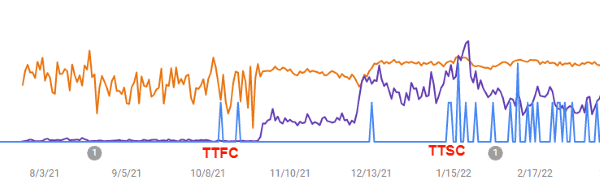
The graphic above from GSC is just one possible example of early-stage search performance.
In the first couple of weeks after publication, you should mostly just verify that impressions are happening — evidence that Google is learning when and where to show your new content in search.
If you also see some early click activity, meaning your ‘TTFC’ is short for the new piece of content, then that is even better!
Start Building Backlinks
If backlink-building from external websites to your content is part of your SEO playbook, you can really start that at any point after the new content URL goes live.
Most of the good SEO software suites and all-in-one SEO toolkits have modules that support backlink building (external link-building).
They can help you identify good target sites/domains for link-building outreach, and some can even help automate and manage link-building outreach campaigns.
If you don’t have time or resources for a concerted link-building effort, don’t panic. It is also possible to rank high in organic search without backlinks.
Reach Out to Influencers
If your new content is particularly valuable or share-worthy, reach out to influencers or others in your industry who might find it interesting.
If they link to or share your content, this can boost its visibility, potentially earn valuable new backlinks, and drive even more visitors from social and referral sources.
Consider Guest Posting or Cross-Promotion
If the content is relevant to other websites or blogs, consider reaching out to see if they would be interested in featuring it as a guest post or for cross-promotion.
You may be able to drive more visibility, new backlinks, and brand/author recognition along with more referral traffic from new audiences this way.
Monitor and Engage With Comments (including social media activity)
If your website allows comments, monitor and respond to them. Engaging with readers can help build a sense of community and encourage return visits.
If your social promotion drives content engagement and reactions, be proactive about responding via those channels as well.
New SEO Content Tasks — One Month After Publishing
Approximately one month after first hitting ‘publish’ on your new piece, circle back and take a look at these areas.
Check SEO Performance in GSC
By this point, your new content should be indexed by Google, Bing, and other major search engines.
This is a good time to take another look at webmaster tools (such as GSC) to understand how your content is performing in search. Look for these things:
- Are search impressions for the new URL growing at this stage?
- Are you seeing any click-through activity in the first month?
- Have your impressions in Google search ‘flat-lined’, indicating a possible Google content de-indexing problem? (Keep an eye on this one in later months as well.)
Check Actual User Queries in GSC
At the one-month point, assuming your new content is earning impressions on Google, Bing, etc., you can use webmaster tools like GSC to see what actual user search queries are driving impressions and clicks.
As you review this area, ask yourself these questions:
- Do the search queries make sense for the target content/URL?
- Do they match the ‘search intent’ you were aiming for with your content?
- Are there any ‘surprise good queries’ that you didn’t anticipate?
This is a good time to take a good look at actual search query data to see what you can learn from it.
If you spot a few good, very relevant queries in GSC that are driving lots of impressions at weaker ranking positions, try to work these into your content naturally with some light edits/updates at this stage.
Check for Landing Page Activity in Website Analytics (Google Analytics, etc.)
Use your website analytics tool (e.g., Google Analytics 4 or one of the many alternatives to Google Analytics) to check for your new content appearing as a landing page for organic search.
This should show you all organic search sources, not just Google. Look for activity from Bing, DuckDuckGo, Baidu, Yandex, and other non-Google search sources.
Website analytics tools will also help you understand what your organic search visitors are doing after they land on your new content.
Look for site engagement activity and metrics, on-page events such as downloads, video plays, etc., that indicate deeper engagement with your overall website.
While you’re in your web analytics tool, also see if your new ‘SEO content’ is also serving as a landing page for other promotional efforts — for example, any social media or email promotions that you may have also done for the new content.
These are all good reasons to leverage more general-purpose website analytics tools (like GA) in addition to the very search-centric tools like Google Search Console and Bing Webmaster Tools.
Check Specific Queries in Your Keyword Rank Tracking Tools
If you’re into SEO fairly seriously, you probably have a keyword rank-tracking tool in place.
At the one-month mark after publishing new content, you may find that it’s breaking into the top 25, 50, or 100 search positions (the ‘SERP’) for your target keywords, search engines and geographies.
Now is a good time to check that in your SEO keyword rank-tracking tool of choice.
If you need to, add new target keywords that apply to your new content before running fresh ranking checks. Bring these in from your keyword research methods or tools to make sure your rank-tracking checks are up to date.
There are many good SEO rank-tracking tools available. I use SEO PowerSuite’s Rank Tracker (see below), which also includes comprehensive keyword research with its keyword rank-tracking capabilities.
Many people like Mangools SERPWatcher and the whole Mangools SEO toolkit for its affordability and user-friendly design. It’s one of the affordable alternatives to Ahrefs and other more costly SEO software suites.

New SEO Content Tasks — Six Months After Publishing
Approximately 6 months after publishing new content, it’s time to take a fresh look at SEO performance and potentially make more substantial updates to the content itself.
Recheck Your One-Month Post-Publishing Tasks
Verify how your now 6-month-old content is doing in terms of SEO performance metrics in Google Search Console.
- Is it steadily gaining impressions and ranking strength (average positions) in GSC?
- Are you seeing increasing click-through activity? For which queries, specifically?
- Has Google picked up on your internal link-building to and from your new page? (See GSC’s Links report)
- Does Google show any external backlinks coming into the new content? (See GSC’s Links report)
Also, look at website analytics again for landing page activity from search and other sources. Look for other pageview activity as well, for when your new content isn’t the first/landing page for visitor sessions.
Finally in this area, run fresh rank-tracking checks with your favorite keyword tracking tool(s) to check for positive content momentum there.
Refresh and Update the Content As Needed (and for more keyword coverage)
At the 6-month post-publishing mark, your content should have a decent track record in terms of actual user queries that drive search impressions.
Take a close look at this area of Google Search Console. Do you see any queries that are driving high impressions but still have relatively weak average ranking positions?
If so, consider this the perfect time and opportunity to go back and work these queries into your content, perhaps in a more substantial way than just simple keyword additions here and there.
SEO Content Expansion
Maybe it’s time to add a new sub-section or sharpen the focus of some existing text copy. You want to add more value for readers while also sending signals to Google that your content has become more relevant for those user search queries.
Also, consider adding more helpful images if your original content was a bit weak in that area. Use image filenames, alt text, and captions that all work together to support existing or expanded target keywords.
Learn more about image optimization for SEO here. Also, see these tips for WordPress image SEO.
Remember: Updating your content periodically not only helps your users. It also shows Google and other search engines that your content is fresh and up-to-date. Updating content can result in relatively quick SEO performance gains.
Run a Page-Level SEO Audit
In the world of SEO, search results and SERPs can change for your target topics while you’re not looking.
That’s why doing a page-level SEO audit of your content can help you maintain good rankings or improve on weaker positions.
Some good website auditing tools will also let you run page-level audits that will compare your content against SERP competitors for your selected target keyword.
You’ll get page-specific optimization scores and suggestions for improvement, all in the context of your SEO competition in the SERP.
Example tools in this area include SEO PowerSuite’s WebSite Auditor program.

Content optimization tools like Frase and Surfer SEO can also provide page-level SEO analysis and provide insights and recommendations for improvement.


New SEO Content Tasks — Hitting The One-Year Mark
Congratulations! Your ‘new’ content piece is now one year old!
While you’re breaking out the birthday cake and party hats for your year-old content, also do another 6-month review.
Full SEO Content Audits
At this point, your ‘yearling’ content has graduated to a reasonable level of maturity and can join the ranks of your older content.
This means that you’ll want to start including it in normal ‘full-site SEO content audit’ activities to evaluate its success, failure, and any need for change in direction.
In most cases, you’ll want to keep the individual content piece alive and continue to update it periodically to keep it relevant and helpful for your target audience.
You can also work on conversion rate optimization (CRO) for specific website goals, better content monetization, etc.
In some cases, for SEO purposes you may conclude that Google just doesn’t ‘like’ a specific page or post. Using Google Search Console, you’ll see very few impressions for it, poor average ranking positions, and few if any clicks from users.
Then you have a decision to make: keep, kill, or substantially change and improve the content.
Keep in mind that your content may have other value aside from growing SEO traffic, even if driving search traffic was a primary objective when you first developed and published it.
Working Your Content Machine
SEO Content Performance Monitoring and Ongoing Optimization
If you’re publishing new content on a regular basis, you’ll have many pieces in play at different points along the timeline discussed above.
Some will be in their first days and weeks of existence as live content on your site.
Others will be a few months or more beyond their initial publication dates.
And many pieces will be 1+ years old (or even very much older), hopefully with periodic updates to keep them fresh and relevant for your target audience.

For SEO performance gains, you have to understand and work the content life cycle, keeping up on SEO performance monitoring and ongoing content optimization tasks.
By following the steps outlined above, you can increase the chances of your new website content performing well in search engine rankings, attracting more traffic, and contributing positively to your overall SEO efforts.
SEO and New Content Tasks — Final Thoughts
New SEO Content Publishing Should Be a Process, Not An Event
From ‘Day Zero’ of publishing new content to the one-year mark and beyond, driving SEO performance and traffic from new website or blog content involves a range of tactics.
Understanding and engaging the activities described above will help you get the most benefit from your new content.
The good news is that many of your less SEO-savvy competitors will not do these things. They either won’t know enough to tackle these post-publishing tasks or they will be too busy and resource-strained to pay enough attention to them.
In any case, if you treat SEO content publishing as an ongoing process with milestones, rather than a ‘publish-and-done’ event for each new piece, you’ll have a good shot at earning higher rankings and content visibility, and stronger traffic growth from organic search channels.
Questions or Comments?
I hope these ideas about good post-publishing activities for new SEO content have been helpful!
What do you do after publishing new website content?
Is SEO performance a priority for your website or blog content?
Do you have a system or workflow in place for SEO content publishing and post-publishing tasks?
Feel free to add more in the comments below with any thoughts, feedback, or related questions. Thanks also for any social shares on this post via the buttons below!
